What are recommended initial email sending volumes for email deliverability?

Matthew Whittaker
Co-founder & CTO, Suped
Published 10 Jul 2025
Updated 14 May 2026
10 min read
Summarize with
The recommended initial email sending volume is 10-20 emails per major mailbox provider on day one when the sending domain, subdomain, or dedicated IP has no meaningful history. For Gmail, I start at the low end of that number. If the list is permission-based, recently engaged, and authenticated cleanly, 50 Gmail messages on day one can work, but I pace it at 5-10 per hour instead of sending the whole batch at once.
That answer sounds conservative because it is. The first send is not about revenue volume. It is about letting mailbox providers see a small, normal pattern with low complaints, low bounces, real engagement, and clean authentication. If those signals hold, the ramp can move faster. If they do not, a larger first send makes the recovery longer.
The caveat is that not every sender starts from zero. A brand-new domain, a new subdomain under an established domain, a migrated sending domain, and a new dedicated IP all deserve different starting points. I use the same principle for each one: start with the smallest volume that can produce measurable delivery signals, then increase only when the data is stable.
The direct starting volumes
|
|
|
|
|---|---|---|---|
New domain | 10-20 per provider | 1-5 per hour | No sender history |
New IP | 25-100 total | Spread by provider | IP reputation gap |
Warm domain migration | 500-5,000 total | Match old cadence | Authentication drift |
Low-volume sender | Normal volume | Keep it steady | Sudden spikes |
Cold marketing list | Do not send | Clean first | Complaints |
Use these as starting points, then adjust by engagement, complaints, bounces, and mailbox provider response.
I separate volume by mailbox provider, not just by total daily volume. Sending 1,000 messages total is not one reputation event. It is a set of separate events at Gmail, Microsoft, Yahoo, corporate filters, and regional providers. A safe first day can still fail if most of the volume lands at Gmail in the first hour.
For a brand-new domain, I prefer 10-20 total messages to Gmail on day one, 10-20 to Microsoft, and the same cautious number for Yahoo. If the sender has a real relationship with recipients and strong engagement history under the same brand, I will consider 50 to Gmail on day one, but only when it is throttled across the day.
Day-one sending volume bands
The safest starting point depends on how much reputation the domain or IP already has.
Cold start
10-20 per provider
New domain, new subdomain, or no visible sending history.
Cautious permissioned start
Up to 50 at Gmail
Engaged recipients, clean DNS, and strong consent signals.
Warm migration
500-5,000 total
Same sending domain, same audience, new vendor or infrastructure.
Unsafe cold launch
5,000+ cold
Large first send without reputation, consent proof, or pacing.
A warm migration is the main exception. If the same domain has been sending predictable volume and the recipient mix stays similar, starting at 500-5,000 messages in the first day can be reasonable. I still split it by provider and compare the new cadence with historical volume. For a deeper look at IP volume limits, see dedicated IP volumes.
Why low day-one volume matters
Mailbox providers do not give a new sender full trust because SPF, DKIM, and DMARC pass. Authentication proves the mail came through authorized infrastructure. Reputation comes from behavior over time: volume consistency, complaint rate, bounce rate, spam placement, recipient engagement, and whether the sender keeps using the same identity.
This is why a sender can pass authentication and still land in spam. If a domain has no history and sends thousands of messages at once, filters treat that as a high-uncertainty event. If the same domain sends a small number to recently engaged recipients and gets replies, clicks, low bounces, and low complaints, the next increase has a cleaner base.
A safer first send
- Engaged recipients: Start with people who opened, clicked, purchased, logged in, or replied recently.
- Provider pacing: Limit Gmail, Microsoft, and Yahoo separately instead of using one daily cap.
- Clean identity: Use the same From domain, DKIM domain, and bounce domain throughout the ramp.
A risky first send
- Cold audience: Starting with old, rented, scraped, or unvalidated addresses raises complaints fast.
- One big batch: Sending all day-one mail in one hour removes the chance to catch early problems.
- Mixed setup: Changing domains, tracking links, templates, or vendors during warm-up clouds the signal.
The small start also makes troubleshooting cheaper. If the first 20 Gmail messages show spam placement, a missing DKIM signature, or a blocklist (blacklist) hit, the sender can pause before the issue affects thousands of recipients. Suped's product is useful here because its DMARC, SPF, DKIM, blocklist, and deliverability views show the source and the fix path in one place.
This matters most for new domains. If the domain itself is new, filters have little behavioral history to trust. The same issue explains why new domains go to spam even when the technical setup looks correct.
A practical warm-up schedule
I do not use one fixed warm-up schedule for every sender. I use a starting schedule, then let the data decide whether to increase, hold, or reduce. The key is to avoid a launch pattern that looks nothing like normal business demand.
Example first-week ramp for a cold start
This example assumes clean authentication, engaged recipients, and no complaint or bounce spikes.
Daily total per major provider
The chart is an example, not a rule. If Gmail shows deferrals, spam placement, or weak engagement, I hold Gmail steady while other providers keep moving. If Microsoft performs cleanly but Gmail does not, I do not punish the whole program. I treat each provider as its own ramp.
- Day one: Send 10-20 per major provider, or up to 50 at Gmail when the audience is highly engaged and pacing is hourly.
- Days two-four: Double only when delivery, complaints, bounces, and authentication stay clean.
- Days five-seven: Move toward a few hundred per provider if the early audience reacts normally.
- Week two: Increase by 50-100 percent on clean providers, but hold any provider showing throttling or spam placement.
Hourly pacing matters as much as daily volume. A day-one Gmail cap of 50 is a different risk when sent as 5-10 per hour than when sent as 50 at 9:00 a.m. The slower pattern gives filters, postmasters, and your own monitoring time to show whether the send is being accepted.
Do not copy another sender's ramp blindly
Two senders can use the same volume schedule and get different results because list quality, brand recognition, domain age, complaint history, and mailbox mix differ. Treat warm-up templates as guardrails, not permission to ignore your own data.
- Hold increases: If complaints rise, spam placement appears, or soft bounces increase at one provider.
- Reduce volume: If the same provider shows repeated deferrals or rejects across multiple sends.
- Resume slowly: After the cause is fixed, restart near the last clean volume, not the failed target.
For Gmail-heavy lists, the hourly cap deserves its own plan. I use 5-10 per hour on the first day for a cold start, then raise the hourly cap only after inbox placement and engagement look normal. More detail on this provider-specific pacing is covered in Gmail warm-up limits.
What to verify before increasing volume
Volume increases are earned. Before I raise the cap, I want the sending identity, DNS records, and first-send metrics to be boring. Boring is good here: no surprise sources, no SPF lookup failures, no unsigned mail, no unexplained bounce spikes, and no blocklist or blacklist listings.
Minimum authentication records to checkdns
example.com TXT "v=spf1 include:_spf.example-esp.com -all"
_dmarc.example.com TXT "v=DMARC1; p=none; rua=mailto:d@example.com"
selector1._domainkey TXT "v=DKIM1; k=rsa; p=MIIB..."
Those examples are intentionally minimal. They are not a complete policy recommendation for every sender. The point is that a warm-up plan should not begin until the mail authenticates consistently and reporting is available. A single bad include, missing DKIM signature, or misrouted source can make a careful volume plan look like a reputation problem.
A quick domain review before the first send prevents a lot of bad reads. Run a domain health check to confirm DMARC, SPF, and DKIM are visible and valid. Then send a real message through the email tester before you send to recipients.
Email tester
Send a real email to this address. Suped opens the report when the test is ready.
?/43tests passed
Preparing test address...
I also check whether the sending domain, return-path domain, tracking domain, and DKIM domain are the ones I expect. If a vendor migration introduces new domains without reporting, early delivery data gets noisy. Suped's DMARC monitoring helps by showing which sources are sending for the domain and whether authenticated mail matches the expected identity.
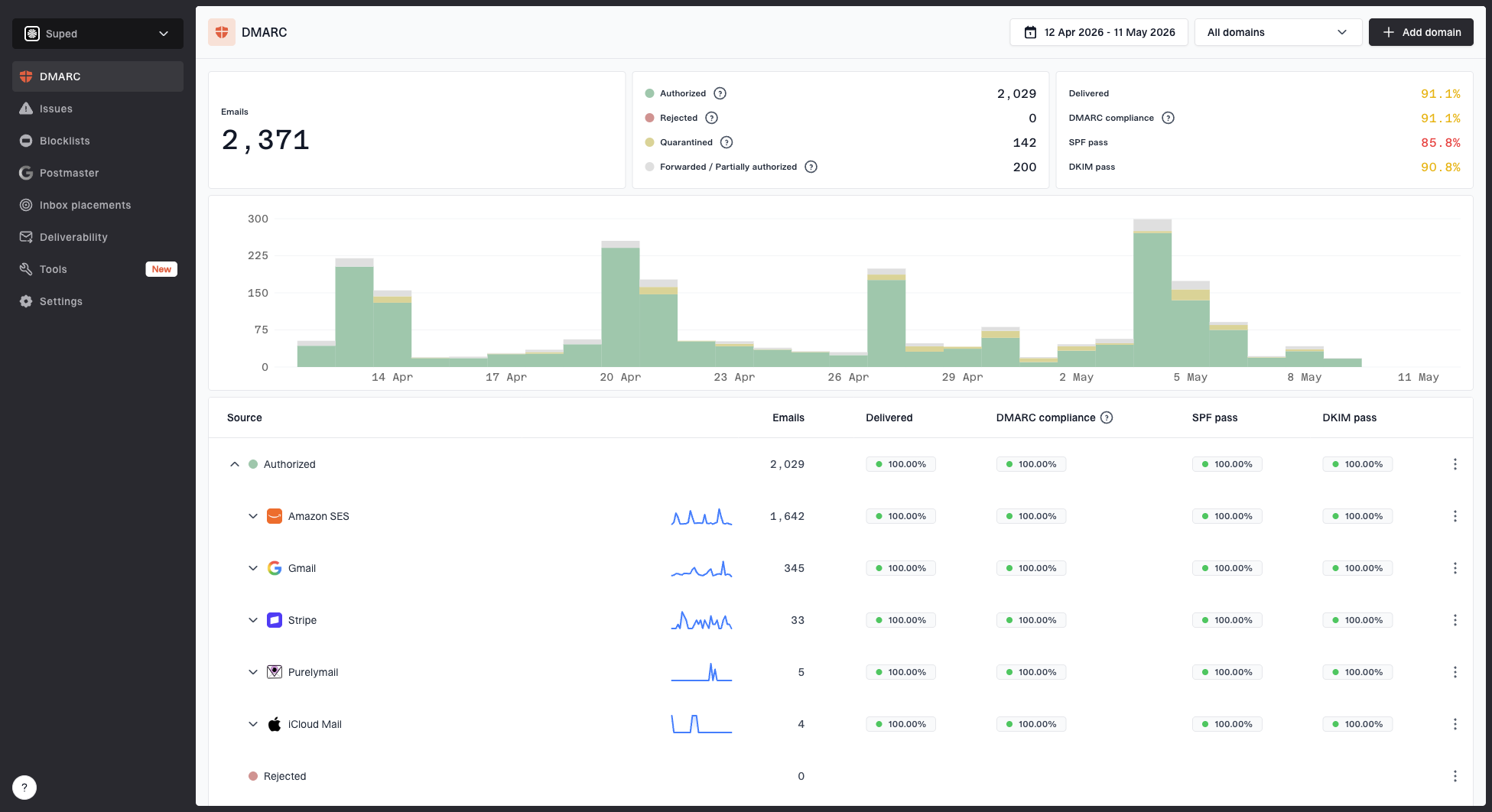
Suped DMARC dashboard showing email volume, authentication health, and source breakdown
The useful part is not the chart by itself. It is the ability to connect a volume change with a source, authentication result, and provider response. That is where Suped's product fits the workflow: it brings DMARC monitoring, SPF and DKIM checks, issue detection, alerts, and blocklist monitoring together so the next volume decision is based on evidence instead of guesswork.
How to read early results
Open rate alone is too weak for warm-up decisions. It is useful as one signal, but privacy protections and image caching make it less precise. I care more about complaint rate, hard bounces, soft bounces, deferrals, spam placement, replies, clicks, unsubscribes, and whether any mailbox provider starts treating mail differently after a volume increase.
|
|
|
|---|---|---|
Complaints | Near zero | Keep ramping |
Hard bounces | Very low | Clean list |
Soft bounces | Stable | Watch provider |
Replies | Real replies | Increase slowly |
Spam placement | None seen | Hold or raise |
Blocklist | Clear | Keep checking |
Early warm-up signals and what to do with them.
When a signal changes, I look for the last clean point. If Gmail was fine at 75 per day and started deferring at 125, I do not jump to 200 because the schedule says so. I hold or reduce Gmail, check the audience and authentication, then retest with a smaller increase.
Volume consistency matters after warm-up too. Sudden spikes after a quiet period can create the same kind of filtering problems as a bad launch. If your program has seasonal or campaign-driven changes, plan those increases separately instead of treating them like normal daily volume.
A simple rule for increases
Raise volume only when the previous send produced the result you wanted. That means accepted mail, expected authentication, low complaints, clean bounces, and no provider-specific warning signs.
- Green light: Increase by 50-100 percent when delivery and engagement are clean.
- Yellow light: Hold steady when results are mixed or one provider behaves worse than the rest.
- Red light: Reduce or pause when complaints, bounces, blocks, or spam placement appear.
When Suped fits into the workflow
The hard part of warm-up is not writing a schedule. The hard part is knowing whether the schedule is still safe after real messages start moving. Suped's product is built for that operational layer: it monitors DMARC policy, authenticating sources, SPF and DKIM status, blocklist and blacklist signals, and practical issue steps.
For a small sender, that means fewer manual DNS checks and faster visibility when a new source appears. For an MSP or agency, the multi-tenant dashboard makes it easier to see which client domains are ready to ramp and which ones need a fix before volume increases.
Manual warm-up monitoring
- Many screens: DNS, ESP logs, bounce logs, and mailbox tests need separate review.
- Slow fixes: A bad source or failed DKIM signature can hide until volume has already moved.
- Weak history: It is harder to connect today's volume with last week's authentication results.
Suped warm-up monitoring
- Unified view: DMARC, SPF, DKIM, sources, alerts, and blocklist checks sit together.
- Clear actions: Automated issue detection gives steps to fix before the next increase.
- Scale controls: Hosted DMARC, hosted SPF, SPF flattening, and MSP views reduce DNS friction.
Suped is strongest when the sender needs both monitoring and action. The platform can show whether authenticated volume is coming from expected systems, alert when failures cross a threshold, and keep blocklist monitoring close to the same operational workflow. That is more practical than treating warm-up as a spreadsheet-only exercise.
The most useful setup is simple: start with DMARC monitoring, confirm the expected senders, then add blocklist monitoring before the ramp reaches meaningful volume.
Views from the trenches
Best practices
Start Gmail at 10 to 20 messages on day one when the domain has no clear history.
Hold each mailbox provider to its own ramp, because Gmail and Microsoft score separately.
Increase only after complaint, bounce, spam placement, and authentication results stay stable.
Common pitfalls
Treating a vendor migration like a fresh domain wastes good reputation signals already earned.
Jumping to thousands on day one makes filtering look like a volume spike, not normal demand.
Judging the ramp by opens alone hides spam placement, clipping, throttling, and soft bounces.
Expert tips
Spread early Gmail sends across the day, with 5 to 10 per hour until replies and clicks land.
Use your most engaged recipients first, then expand to colder segments after several clean days.
Pause increases after any blacklist or blocklist hit until the cause is fixed and cleared.
Expert from Email Geeks says very low day-one Gmail volume has been common guidance for years, especially when the domain or IP has no history.
2024-02-11 - Email Geeks
Marketer from Email Geeks says 10 to 20 messages is hard to sell internally because senders want revenue faster, but it gives filters cleaner early signals.
2024-03-08 - Email Geeks
The practical answer
For a brand-new sender, the practical answer is 10-20 emails per major mailbox provider on day one. For Gmail, keep it close to 10 unless the audience is highly engaged and the send is paced across the day. A day-one Gmail cap of 50 is reasonable only when the sender has clean authentication, strong consent, and a plan to monitor every signal after the first send.
For a migrated warm domain, the first-day number can be much higher, often 500-5,000 total, because the domain already has history. Even then, I would match the old cadence, segment by provider, and avoid changing too many identity elements at once.
The safest volume is the one your last clean send justifies. Start small, use the most engaged audience first, increase only when the previous step is clean, and watch provider-specific results instead of total volume alone.