How to avoid Gmail rate limits when sending essential communications to a large, infrequently mailed audience?

Published 23 Jun 2025
Updated 3 Aug 2026
12 min read
Summarize with
Updated on 3 Aug 2026: We updated the guidance with current Gmail requirements and queue-based ramp decisions.
Break the send into controlled waves across several days. That is the safest direct answer when you need to reach a large audience that you rarely mail. Start with people who recently logged in, purchased, contacted support, requested this type of notice, or clicked your mail. Increase Gmail-facing volume only while deferrals stay low.
The Gmail error 421-4.7.28 is a temporary deferral, not a permanent rejection. Gmail uses variants of this response for unusual volume or unsolicited mail associated with an IP address, IP netblock, DKIM domain, SPF domain, URL domain, or repeated Message-ID. Read the complete SMTP response to identify the affected source. If you are already seeing 421 deferrals, slow down, keep retry behavior polite, and avoid changing sender identity mid-send.
- Emergency path: send the required notice, accept some deferral risk, and rely on queue retries instead of forcing throughput.
- Safer path: ramp over days, starting with recipients Gmail already sees interacting with your mail or account.
- Long-term path: keep a real cadence for opted-in recipients, but do not create low-value mail just to preserve volume.
- Fallback path: use in-app notices, account banners, postal mail, or support workflows for notices that cannot wait for email delivery.
Know which Gmail limit you are hitting
A Gmail account sending cap and a Gmail recipient-side rate limit are different controls. An account cap stops a Gmail or Google Workspace mailbox from submitting more outbound mail. A recipient-side limit occurs when Gmail's receiving servers defer traffic from your sending infrastructure. Splitting a campaign into batches helps with traffic shape, but it does not raise an account's daily sending ceiling.
|
|
|
|---|---|---|
Account sending cap | Gmail or Google Workspace mailbox refuses new outbound mail | Wait for the quota to reset and use a sending method sized for the audience. |
Recipient-side deferral | Gmail returns a 4xx SMTP response to the sending platform | Slow new Gmail traffic and let the retry queue back off. |
Permanent rejection | Gmail returns a 5xx SMTP response | Do not keep retrying that message; fix the stated cause first. |
Google says a personal Gmail account can stop sending after more than 500 messages in a day or more than 500 recipients in one message, with access generally returning within 1 to 24 hours. Google Workspace limits depend on the account and sending method. A large essential send normally belongs on infrastructure intended for bulk delivery, with its own queue and retry controls.
What triggers Gmail's inbound rate limits
Gmail does not publish one fixed safe number for every sender because the limit depends on trust signals. A sender with steady Gmail volume, useful mail, a clean complaint history, and consistent authentication can handle a larger increase than a sender that has been quiet for months. Treat Gmail rate limits as a reputation and pattern problem first, then a raw volume problem second.
The wording of the SMTP response matters. When Gmail names the DKIM domain, it is pointing to the d= domain in the DKIM signature. Other 4.7.28 variants can name the IP address, IP netblock, SPF domain, URL domain, or duplicate Message-ID pattern. If normal mail uses one authenticated source and the essential send suddenly uses another, Gmail sees a new traffic pattern. The source named in the actual response needs attention.
Common Gmail deferraltext
421-4.7.28 Gmail has detected an unusual rate of mail
originating from your DKIM domain.
Do not solve this with a sender switch
Moving the send to a new domain, new DKIM identity, newly dedicated IP, or untested URL domain right before the notice usually increases uncertainty. Gmail needs a pattern to evaluate. A sudden new source with a large dormant audience has the wrong pattern.
- Keep identity stable: use the same visible From domain and DKIM domain you want Gmail to recognize.
- Separate streams carefully: do not mix marketing blasts with truly required account notices on the same queue rules.
- Respect temporary failures: retry 4xx responses with increasing delays instead of immediate repeated delivery attempts.
The practical send plan
For a large, infrequently mailed audience, do not start with an even split of the whole file. An even split treats your best recipients and your coldest recipients the same. Gmail does not. Start with recent logins, purchases, support requests, explicit subscription activity, and clicks. Treat opens as secondary evidence because automated image loading can inflate them. Let weaker segments follow only after the mail system stays stable.
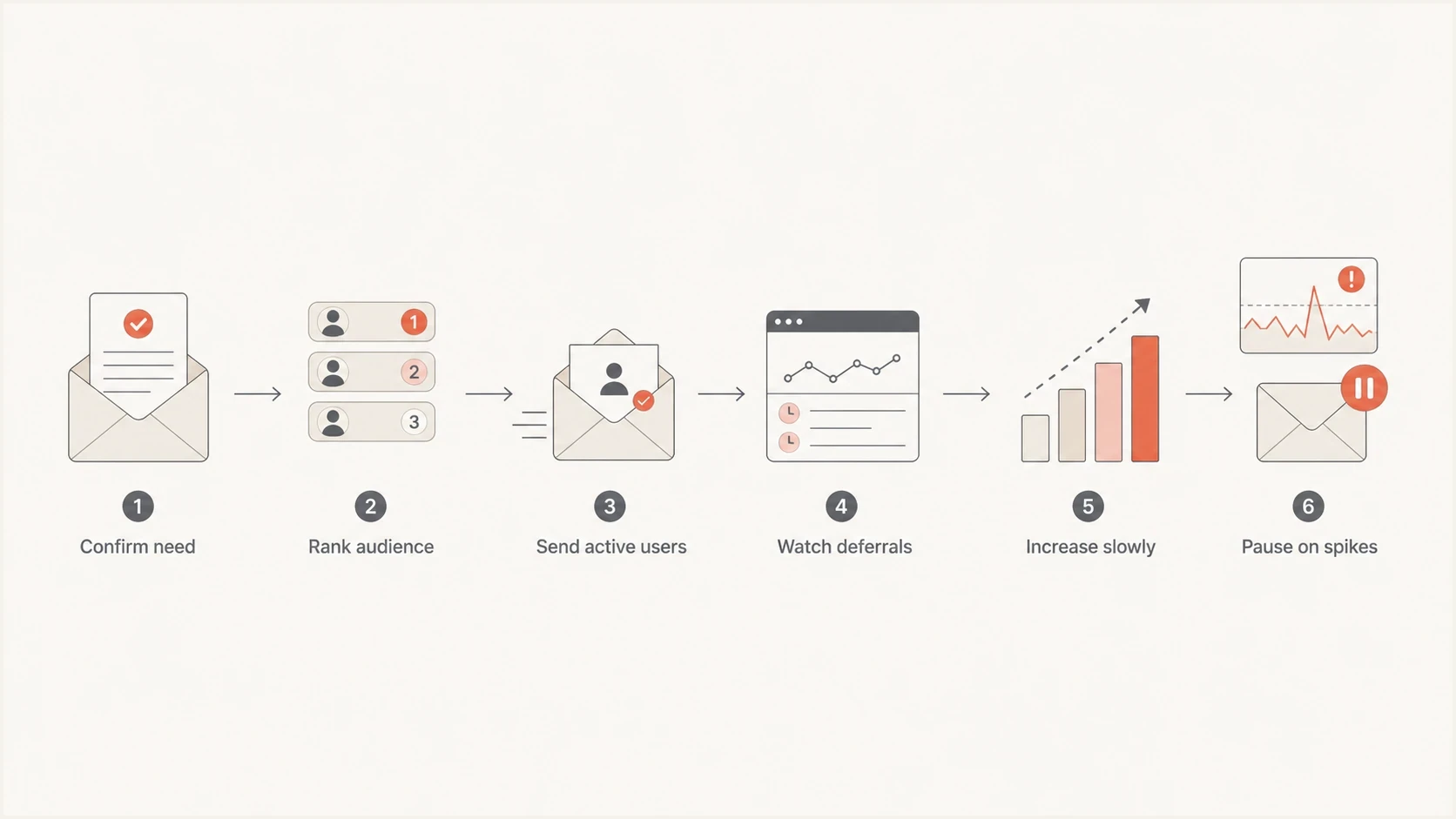
Six-step Gmail send ramp based on audience quality and deferral pressure.
- Confirm necessity: decide whether email is required, or whether an account banner, app notice, or support workflow can carry the notice.
- Rank by relationship: send first to recent site users, active customers, recent clickers, and people who asked for this type of update.
- Start near normal: begin the Gmail portion near the recent normal Gmail volume for that authenticated source.
- Watch the queue: track 421 deferrals, retry age, spam complaints, bounces, and unsubscribes after each wave.
- Increase only on stability: raise the next wave when deferred mail clears and complaint signals stay low.
- Stop on pressure: pause or cut the next wave when Gmail deferrals rise faster than the queue can drain.
A common pattern is a first day close to normal, a second day that grows if the first day clears, and later waves that carry the colder audience. The exact number depends on your baseline. If your recent Gmail volume is twenty thousand per day, opening with five hundred thousand is a different risk than opening with forty thousand.
Rate limits need queue control
The send plan is only half the work. The MTA or ESP queue has to respond correctly when Gmail says slow down. A 421 response tells the sending system to try later. Frequent aggressive retries can turn a manageable deferral into sustained queue pressure.
For planned volume spikes, set queue rules before launch. The goal is to finish delivery without creating a pattern Gmail associates with compromised or unwanted mail. Use the recent Gmail-facing baseline and your provider's documented controls rather than copying a universal messages-per-minute value.
Queue policy templateyaml
gmail:
  concurrency: <start near recent baseline>
  rate: <set for Gmail-facing history>
  retry_on:
    - 421
    - 451
  backoff:
    first_retry: <provider default>
    increase_delay: true
    max_retry_age: <notice deadline>
  pause_new_waves_when:
    deferrals_rise: true
Signals for the next wave
Use Gmail-facing history and live queue behavior for the same authenticated source.
Baseline stable
Continue
Deferrals remain low and deferred mail clears.
Deferrals rising
Hold
Do not add another wave yet.
Queue aging
Slow
Reduce new Gmail-facing volume.
Permanent errors
Fix first
Resolve the stated cause before resuming.
Meet Gmail's sender requirements before ramping
Before ramping, verify that the domain identity and mail path are consistent. Suped's domain health check can check SPF, DKIM, DMARC, and forward and reverse DNS for obvious gaps. Verify TLS on the actual SMTP path as a separate transport check. Passing these checks does not guarantee that Gmail accepts a spike, but it removes avoidable compliance failures.
For mail sent to personal Gmail accounts, Gmail requires every sender to use SPF or DKIM, valid forward and reverse DNS, TLS, RFC 5322 message formatting, and a user-reported spam rate below 0.3%. A domain that sends more than 5,000 messages in a day to personal Gmail accounts must use both SPF and DKIM, publish DMARC with at least p=none, and make the visible From domain match the organizational domain authenticated by SPF or DKIM under DMARC rules. Marketing and subscribed messages also need RFC 8058 one-click unsubscribe plus a visible body link. Purely transactional messages are excluded from the one-click requirement. Gmail recommends keeping its user-reported spam rate below 0.1% and avoiding 0.3% or higher.
|
|
|
|---|---|---|
DKIM | Stable d= domain and passing signatures | Gmail can associate mail with the authenticated domain. |
SPF | Authorized sending IP for the envelope domain | The sending path passes SPF authentication. |
DMARC | Visible From domain matches an authenticated organizational domain | The message passes DMARC and aggregate reports expose failures. |
DNS | Valid forward and reverse records | Gmail requires consistent host and IP identification. |
TLS | Encrypted SMTP connection | Gmail requires TLS for mail sent to personal accounts. |
Complaints | Below 0.1% target and never 0.3% or higher | High user-reported spam rates reduce delivery and mitigation options. |
Content | Clear purpose without unrelated promotion | Recipients can recognize why they received the notice. |
Suped's product combines DMARC monitoring, hosted SPF, hosted DMARC, hosted MTA-STS, and blocklist monitoring in one workflow before and during the ramp. Use Suped to confirm expected sending sources and catch changes in authentication failures. Configure alerts for blocklist or blacklist status. Gmail-specific 421 data still has to come from your delivery logs.
Suped DMARC dashboard showing email volume, authentication health, and source breakdown
What to confirm before launch
- Authentication passes: SPF and DKIM pass for the active sender, and the visible domain passes DMARC.
- No surprise senders: DMARC reports show only the expected ESPs and mail systems.
- Complaint rate controlled: Gmail's user-reported spam rate stays below 0.1% and never reaches 0.3%.
- Fast alerts: the team gets notified when failure rates, unknown sources, or blocklist and blacklist signals change.
- Owned DNS flow: hosted SPF or carefully maintained SPF flattening keeps authorized senders current without exceeding lookup limits.
Audience strategy for infrequent lists
The hardest part is not the Gmail throttle. It is the question of why the audience is infrequently mailed. If people have not heard from you in a year, Gmail has less evidence that they want the message. The recipient also has less context. That combination creates complaints, ignores, deletions, and spam-folder placement.
Sending because it is required
When the notice is legally required, security-sensitive, tied to account access, or operationally necessary, send it with a controlled ramp and documented retry policy. Keep the copy plain and specific.
- Use clear context: explain the account, product, or relationship that makes the notice relevant.
- Avoid extra offers: keep marketing content out of required communications.
- Keep records: log send time, queue status, deferrals, and final delivery results.
Keeping volume warm
A monthly cadence helps only when recipients explicitly expect and value that cadence. Sending filler mail to hold a baseline usually trains people to ignore you.
- Ask for cadence: let people choose required notices, product updates, digest mail, or other subscribed messages.
- Suppress inactivity: exclude people with no recent relationship unless the notice truly requires email.
- Use account surfaces: show terms updates and policy notices after login when email is not the only path.
A planned monthly send to the whole audience can help Gmail learn a pattern, but only when the audience wants it. If the message exists only to keep volume warm, it creates the complaint and disengagement signals that make the next essential send harder.
Check the message before the ramp
Before launching the first wave, send the exact production message to a real mailbox and inspect the result. Suped's Email tester checks authentication, headers, content warnings, and mailbox placement signals before the audience sees it.
This step catches preventable problems: broken DKIM after a template change, a From domain mismatch, a tracking domain with stale DNS, or content that looks like an account takeover notice without enough account context. Fix those before Gmail has to judge the campaign at scale.
Email tester
Send a real email to this address. Suped shows a results button when the test is ready.
?/43tests passed
After the test passes, use the same headers, DKIM identity, link domains, and envelope path for the real send. Last-minute changes create new variables when you need stable signals.
When to send at once anyway
There are cases where waiting several days is worse than getting some Gmail deferrals. Court-ordered notices, account security notifications, service shutdowns, and billing access changes can have a real deadline. In those cases, still segment the send, but do not assume every recipient gets the message immediately.
A fast-send operating rule
If the notice has a hard deadline, send the most active Gmail recipients first, keep retrying deferred mail within the message's useful lifetime, and publish the same notice inside logged-in account surfaces.
- Document the reason: record why the deadline overrides the normal ramp.
- Protect the queue: keep retries slow and stop sending new cold waves when deferrals spike.
- Use other channels: show the notice on login, support pages, billing pages, or status pages.
One isolated Gmail rate limit does not automatically ruin sender reputation. Repeatedly forcing cold volume through the same identity after Gmail pushes back is the pattern to avoid. Treat each deferral burst as feedback and adjust the next wave.
Views from the trenches
Best practices
Ramp Gmail-facing volume by audience quality first, with active recipients leading each wave.
Keep a steady baseline only when recipients gave clear permission for that regular cadence.
Treat 421 deferrals as a queue signal, then slow retries instead of pushing harder that day.
Use the same DKIM identity for planned large sends so Gmail sees a consistent source.
Common pitfalls
Sending a large stale segment at once makes the traffic look unfamiliar to Gmail fast.
Creating low-value monthly mail only to preserve volume trains people to ignore you.
Switching ESPs before the notice can reset the sending identity Gmail evaluates for trust.
Ignoring authentication results hides which sending source Gmail is throttling today.
Expert tips
Test one wave, read deferrals and complaints, then decide the next wave size for Gmail.
Use app banners for account notices when email is not the only required channel for users.
Prioritize recent logins, purchases, and clicks before the long-dormant Gmail audience.
Track DKIM-domain volume separately when more than one ESP sends for the brand domain.
Marketer from Email Geeks says large rare sends should be split into increments, and the first increments should stay close to normal Gmail-facing volume.
2024-10-22 - Email Geeks
Expert from Email Geeks says Gmail is not reacting only to raw volume, because sudden mail to unfamiliar recipients can look like a compromised sender pattern.
2024-10-22 - Email Geeks
A better default for the next essential send
The best default is to avoid surprise. Keep the sending identity stable and keep recipients familiar with the type of mail they receive. Build a ramp plan before the essential notice exists. If the large audience is worth keeping, it deserves a cadence and preference model that keeps the relationship current.
When the notice is urgent, send in controlled waves, respect Gmail's temporary failures, and keep other account channels active. The reliable pattern is a sending program that looks consistent and wanted, with correct authentication when the moment matters.




