How to manage large email sending volume spikes for optimal deliverability?

Published 1 Aug 2025
Updated 5 Aug 2026
11 min read
Summarize with
Updated on 5 Aug 2026: We updated this guide with current bulk-sender checks, provider-level stop conditions, and a plan for protecting transactional mail during volume spikes.
The safest way to manage a large email sending volume spike is to avoid treating it as a single blast. Treat it as a controlled reputation change: baseline the normal volume, split the audience by engagement and mailbox provider, start with the most active recipients, spread delivery over days or weeks, and slow down the moment deferrals, complaints, bounces, or inbox placement get worse.
Real send counts matter more than percentages. A jump from 20k to 40k messages is usually easier to absorb than a jump from 300k to 2M, even though both can be described as a large increase. A 300k to 2M campaign should not be pushed through one 24-hour window unless the domain, IPs, audience, and mailbox provider history already prove they can handle it.
Separate business pressure from delivery reality. Marketing often wants a named send date, but mailbox providers care about recipient response and sender consistency. The workable compromise is a planned send window: keep the campaign date, but deliver in controlled waves that let Gmail, Yahoo, Microsoft, Comcast, and other mailbox providers collect feedback before the next wave lands.
Start with the exact volume problem
Before choosing a ramp, write down the absolute numbers. Percent increases hide too much. A 10% lift on 500 recipients is noise. A 10% lift on 10M recipients is a very different operational event. Separate the total list size from the number that will hit each mailbox provider, because a campaign that looks manageable overall can still overload one provider.
- Use the last 30 to 60 days of delivered volume by domain, IP, campaign type, and mailbox provider.
- Separate recent clickers, recent purchasers, authenticated account users, supporting open activity, and inactive contacts.
- Calculate planned volume for Gmail, Yahoo, AOL, Microsoft, Comcast, corporate domains, and smaller providers.
- Name who can pause the campaign when delivery signals degrade, before the send begins.
|
|
|
|---|---|---|
20k to 40k | Low | Watch metrics |
300k to 2M | High | Ramp by waves |
5M to 10M | Severe | Plan weeks ahead |
Rarely mailed list | Unknown | Requalify first |
Use absolute send counts first, then add percentage context.
Do not call the whole list engaged
A large list can be permission-based and still create deliverability trouble. Consent is one part of the decision. Recent history with these exact recipients at this scale, followed by healthy feedback, is the other part. If that history does not exist, do not treat the whole list as warm.
Put the best recipients first. That means recent clickers, purchasers, and authenticated account users before recipients ranked only by opens, and all of those groups before old records. Opens can support the ranking, but privacy-related image prefetching makes them too noisy to lead segmentation. If the early waves perform cleanly, the campaign earns the next wave. If they produce throttling or complaint pressure, hold back the less active recipients.
One-day blast
- Mailbox providers receive too much new behavior before they can score it cleanly.
- The team reacts after the damage is visible in delayed delivery or spam placement.
- Inactive subscribers receive mail before the active audience proves demand.
Controlled ramp
- Each wave gives providers time to measure recipient actions, complaints, and deferrals.
- The team pauses the next wave while the sender still has room to adjust.
- The most active recipients build early evidence before colder records enter.
This is where a related planning habit helps: staggering sends is a calendar tactic that also buys time for data to come back before the riskier audience segments go out.
Build a ramp around provider feedback
A useful ramp has two controls: a volume schedule and stop conditions. The schedule tells the sending platform what to send. The stop conditions tell the business when the plan changes. Without stop conditions, a ramp becomes a slower blast.
Example ramp for a 300k to 2M campaign
A sample weekly delivery curve, expressed as total messages in thousands.
planned volume
For a 300k to 2M jump, plan in weekly or multi-day waves rather than hours. If the list has recently received mail and the first waves look healthy, the increase can move faster. If the list has not been mailed regularly, use a multi-week plan. For sensitive providers or older audience segments, stretch it longer. A new domain or dedicated IP needs its own warm-up plan and should not be introduced during the spike.
Example send planCSV
wave,total_send,audience,provider_rule,decision
0,300000,normal baseline,normal routing,measure baseline
1,450000,clickers and buyers,split by provider,continue if stable
2,650000,recent active users,cap Yahoo and AOL,continue if stable
3,900000,active non-clickers,cap Microsoft,continue if stable
4,1200000,older engaged,slow if deferrals rise,continue if stable
5,1600000,remaining qualified,hold risky providers,continue if stable
6,2000000,final qualified pool,only if metrics hold,complete campaign
The provider rule is important. Do not increase every provider at the same rate. If Yahoo or AOL starts deferring, slow that lane while Gmail or corporate domains continue at their planned speed. If Microsoft starts pushing mail to junk, hold Microsoft volume and keep the rest of the campaign separate.
Stop conditions matter
A ramp should pause when mailbox feedback says the sender is moving too fast. Delivery after retries still counts as a warning when the provider is already throttling the stream.
- Slow down when temporary failures increase above the normal provider baseline.
- Keep Gmail user-reported spam below 0.1%, never let it reach 0.3% or higher, and hold any provider lane when complaint pressure rises.
- Treat spam folder movement as a signal to reduce volume and improve segmentation.
- Suppress hard bounces immediately and investigate any sudden provider-specific pattern.
Protect transactional mail and sending infrastructure
A planned marketing spike should not share an uncontrolled queue with password resets, receipts, or security notifications. Separate marketing and transactional streams with distinct subdomains, sending pools, queue limits, and rate controls when the infrastructure supports it. This protects time-sensitive mail and makes reputation problems easier to isolate.
- Confirm account quotas, provider throughput limits, and campaign capacity before launch.
- Check reverse DNS, TLS, SPF, DKIM, and DMARC identifier matching on every IP and domain in the route.
- Warm any new domain or dedicated IP separately instead of combining a provider migration with the volume spike.
- Set queue-age limits and retry behavior so prolonged deferrals do not produce a delayed second spike.
- Reserve enough capacity to keep transactional mail on its normal cadence.
Shared IP pools and dedicated IPs create different risks. On a shared pool, other senders can affect reputation and available capacity. With dedicated IPs, the sender owns warm-up and volume consistency. Neither setup removes the need for provider-level pacing and live feedback.
Check authentication and reputation before sending
A volume spike is the wrong time to discover weak authentication, broken DMARC identifier matching, missing DKIM coverage, or an IP or domain reputation problem. Before approving a large send, check domain health, review DMARC pass rates, verify SPF and DKIM, and look for blocklist or blacklist exposure across the sending domain and IPs.
For marketing and subscribed mail, confirm that one-click unsubscribe headers work and that requests are honored within 48 hours. Gmail treats a sender as bulk when the same primary domain sends close to 5,000 messages to personal Gmail accounts in 24 hours, and that classification does not expire. A spike can cross the threshold for the first time, so check bulk-sender requirements before launch.
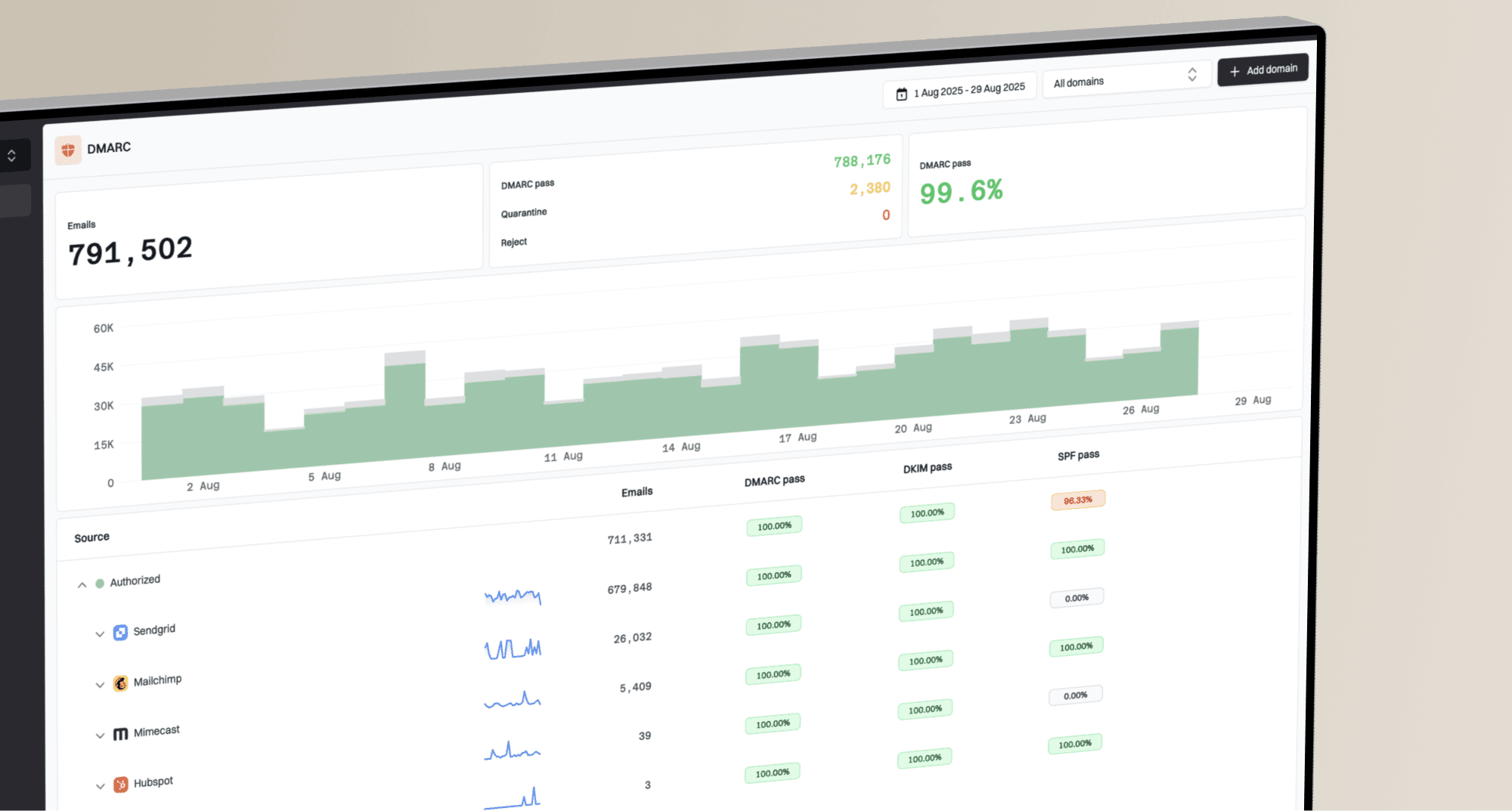
Suped's product supports this workflow with DMARC monitoring, SPF and DKIM visibility, hosted DMARC, hosted SPF, SPF flattening, hosted MTA-STS, blocklist monitoring, real-time alerts, and issue detection in one place. During a spike, the team can trace what changed, identify the responsible source, and set the next remediation step.
Suped DMARC dashboard showing email volume, authentication health, and source breakdown
For a quick pre-send pass, check the domain health checker before the first wave, then use Suped to monitor authentication and reputation during the send. The pre-send check does not replace live feedback, but it removes avoidable DNS and authentication errors before scale magnifies them.
?
What's your domain score?
Deep-scan SPF, DKIM & DMARC records for email deliverability and security issues.
Test the actual message before the ramp
Volume is only one part of the risk. The message itself can make the spike worse. A campaign with heavy image weight, aggressive link patterns, URL shorteners, stale templates, or broken authentication headers creates more pressure on a sender that is already changing behavior.
Before sending the first production wave, send the final creative through an email tester and inspect the authentication results, content warnings, rendered preview, and message headers. The goal is to catch obvious issues before the campaign reaches a provider at high volume, not to chase a perfect score.
Email tester
Send a real email to this address. Suped shows a results button when the test is ready.
?/43tests passed
Make sure the operations team has a clear way to read provider errors. Rate limits are not all failures. Some are temporary signals that the sender should slow down. Others point to reputation, authentication, or policy problems. The ramp plan should tell the team which errors trigger a pause and which trigger suppression or remediation.
Use a feedback loop during the send
During the send, review metrics by provider as well as in aggregate. Aggregate dashboards hide the problem when one provider is rejecting or deferring mail while the rest of the campaign looks normal. Provider-level views also help the business accept a partial slowdown instead of stopping everything.
Signal levels during a spike
Use your own baseline, then compare each wave against normal provider behavior.
Stable
At baseline
Bounce, deferral, complaint, and placement signals match the baseline.
Caution
Above normal
One provider shows a clear increase in deferrals or spam placement.
Stop
Breakout
Complaints, hard bounces, or provider blocks increase sharply.
Review
Unknown
The data is incomplete or delayed, so the next wave waits.
The practical rhythm is simple: send a wave, wait for enough feedback, compare against baseline, and then choose continue, slow, hold, or suppress. Do not let calendar pressure remove the feedback step. When the data is late, the next wave waits.

Provider-level feedback loop for an email volume ramp.
A 300k to 2M volume spike plan
For a sender that normally sends about 300k and now needs to reach about 2M, do not start with a universal percentage. Build an initial multi-day or multi-week plan, then shorten or stretch it based on the earliest provider feedback.
- Remove unverified, purchased, role-based, bounced, and recently complaining addresses.
- Build waves by recent clicks, purchases, authenticated account activity, supporting open data, and last mailed date.
- Set separate send caps for Gmail, Yahoo, AOL, Microsoft, and smaller mailbox groups.
- Start above the normal baseline, but not at the target volume, then increase only when stable.
- Keep old or rarely mailed contacts out until earlier segments prove clean performance.
- Review bounces, deferrals, complaints, placement tests, DMARC data, and blacklist or blocklist status after every wave.
No fixed script works for every sender
A fixed rule such as increasing by 10% each week is too blunt for modern mailbox filtering. Business model, audience recency, historical volume, provider mix, IP reputation, domain reputation, and message content all change the answer. The durable rule is to increase only as fast as healthy feedback allows.
Views from the trenches
Best practices
Build the ramp from real send counts, not percentages, because scale changes risk fast.
Segment by mailbox provider so Gmail, Yahoo, Microsoft, and others can be slowed separately.
Start with active recipients and keep older or colder segments out until metrics stay stable.
Common pitfalls
Treating rarely mailed subscribers as engaged hides the real risk before a spike starts.
Sending a 300k to 2M jump inside one day invites deferrals and provider throttling.
Ignoring shared infrastructure reputation can make a clean campaign inherit old problems.
Expert tips
Hold a daily stop decision with bounce, deferral, complaint, and placement data on screen.
Keep the monthly send date, but spread delivery across days instead of one send window.
Use authentication and blocklist data to catch domain issues before volume gets raised.
Expert from Email Geeks says real send counts matter more than percentages because a small sender and a very large sender absorb volume changes differently.
2025-04-07 - Email Geeks
Marketer from Email Geeks says a 300k to 2M jump should be spread across a week or more so mailbox providers can gather feedback.
2025-04-08 - Email Geeks
Large volume spike checklist
The safest deliverability plan for a large volume spike is a controlled ramp with authority to pause. Start with real numbers, send to active recipients first, split by mailbox provider, and protect transactional capacity. Watch deferrals, complaints, bounces, spam placement, authentication, and blocklist or blacklist signals. Increase only while the data stays healthy.
Suped's product gives teams one place to monitor DMARC, SPF, DKIM, blocklist or blacklist status, domain health, and issue remediation during normal operations and high-volume sends. The campaign plan still needs human judgment, but shared monitoring keeps authentication and reputation signals available while a large send is underway.