How to train help desk staff on DMARC alerts

Published 6 Aug 2026
Updated 6 Aug 2026
9 min read
Summarize with
We train help desk staff on DMARC alerts by giving them a fixed severity model, a short evidence checklist, clear ownership boundaries, and rehearsed escalation paths. Tier 1 should confirm the affected client and sending source, measure the failure pattern, collect evidence, and route the ticket. They should not edit DNS, authorize an unknown sender, or change enforcement policy without approval.
For an MSP, the goal is consistent service delivery across many client domains. Every alert should produce the same minimum record: domain, source, volume change, SPF result, DKIM result, DMARC alignment result, business impact, and next owner. That structure reduces guesswork and lets senior engineers spend time on remediation instead of reconstructing the first response.
Define what a DMARC alert means
A DMARC alert is a signal that a monitored condition crossed a rule. It is not proof of an attack and it is not automatically a DNS problem. Common triggers include a sudden rise in failed alignment, a new sending source, a drop in authenticated volume, a policy change, or legitimate mail that started failing after a provider or domain configuration changed.
Staff need enough authentication knowledge to interpret the signal. SPF checks whether the connecting IP is authorized for the envelope sender. DKIM checks a cryptographic signature and signing domain. DMARC passes when at least one of those mechanisms passes and its domain aligns with the visible From domain. A raw SPF pass for an unrelated domain does not make the message DMARC-compliant.
The first training rule
Treat the alert as a prompt to investigate. Do not tell a client that spoofing has been confirmed until the source, identifiers, alignment results, and message context support that conclusion.
Give staff a severity model
Severity should combine authentication evidence with business impact. A large failure count can be low risk when it comes from obvious, rejected abuse. A smaller failure count can be urgent when a client's payroll platform has stopped sending. Train staff to classify the event before they investigate deeply, then revise the class when new evidence appears.
|
|
|
|
|---|---|---|---|
Critical | Legitimate mail blocked | Page on-call | Mail engineer |
High | New source, high volume | Validate and escalate | Security queue |
Medium | Known source degrading | Open remediation task | Service owner |
Low | Rejected abuse only | Document and monitor | Tier 1 |
Example MSP triage classes. Set response targets in the client agreement.
The client contract should define response and communication targets for each class. The runbook should also name the person who can authorize DNS changes and the person who can confirm whether a sending service is legitimate. Without those names, even a technically correct alert can sit unresolved between the MSP and client.
Teach one repeatable triage workflow
A useful workflow fits on one screen and applies to every client. We make the help desk answer six questions in order. Who is affected? What changed? Is the source known? Which authentication mechanism failed? Is legitimate delivery impaired? Who owns the next action?
The alert, ticket, and client inventory should use the same domain and source names. Staff should avoid copying a provider name based only on an IP lookup because shared infrastructure and forwarding can mislead them. The source becomes verified only when DMARC data, provider documentation, client confirmation, and a known change record support the identification.
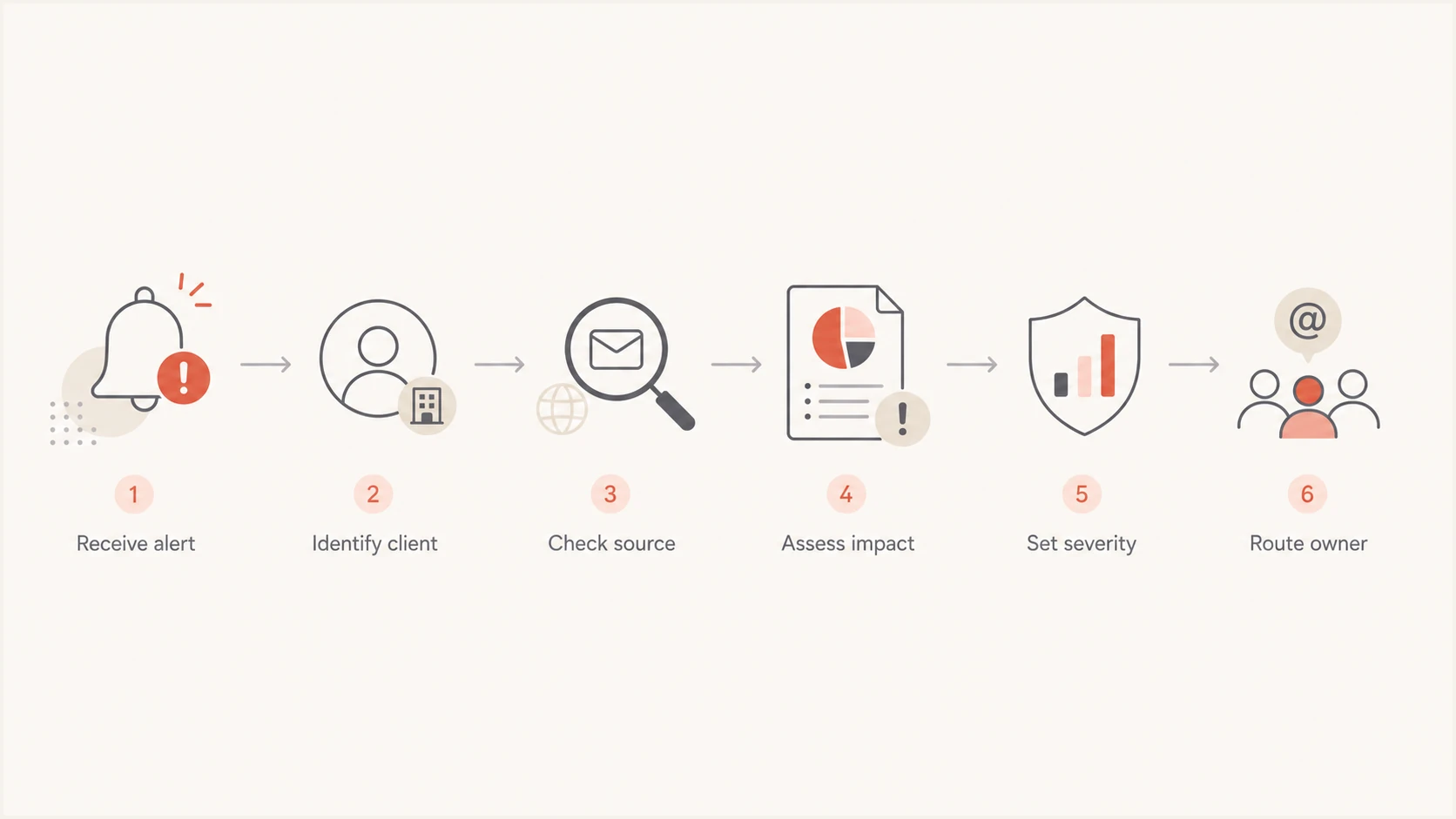
Six-step MSP workflow for triaging a DMARC alert
The detailed MSP triage process should live beside the ticket template. Keep the first-response checklist short enough that a new analyst can finish it while the evidence is fresh. Deeper source attribution belongs with the mail or security engineer after the ticket has the minimum fields.
- Confirm scope. Record the client, affected domain, alert time, and observed interval.
- Compare baseline. Check normal volume, pass rate, source mix, and recent approved changes.
- Inspect alignment. Capture SPF, DKIM, and DMARC outcomes plus the domains used by each check.
- Verify source. Match it to the client inventory or request confirmation from the service owner.
- Assess impact. Determine whether legitimate mail is delayed, quarantined, rejected, or unaffected.
- Route safely. Assign severity, preserve evidence, notify the right contact, and set the next update.
Train staff to read the evidence
Start with alignment, not the policy value. A policy of none can still produce useful failure evidence, while a policy of reject can still allow legitimate mail when DMARC passes. Staff should read the header From domain, envelope sender domain, DKIM signing domain, source IP, disposition, and message count as separate fields.
A DMARC record tells receivers what to do with failing mail and where to send reports. Tier 1 should recognize the main tags but should not edit them. Use a controlled lab domain to show how policy changes affect disposition without risking client production mail.
Training DMARC recorddns
v=DMARC1; p=quarantine; rua=mailto:dmarc@example.com; pct=25
In this example, receivers are asked to quarantine failing mail for 25 percent of applicable messages, and aggregate reports go to the listed mailbox. Staff should know that receiver behavior can vary and that the percentage tag is a rollout control, not a measure of confidence. They can validate syntax with the DMARC checker, but any production change still needs the client's change process.
DMARC checker
Look up a domain's DMARC record and catch policy issues.
?/7tests passed
Forwarding deserves its own exercise. SPF often fails after forwarding because the connecting IP changes, while an intact aligned DKIM signature can preserve DMARC pass. Mailing lists can modify content and break DKIM. Staff should record this pattern and escalate it, not add a forwarder's IP to the client's SPF record without understanding which domain the forwarder uses.
Teach analysts to compare a failure spike with recent changes before treating it as abuse. A vendor migration, selector rotation, expired configuration, or new regional sending pool can create a sudden change. The operational response to a DMARC failure spike should preserve legitimate delivery while the owning team fixes authentication.
Separate source incidents from policy incidents
Most alerts fit one of two operational paths. A source incident concerns mail generated by a sender, such as a billing platform with broken DKIM. A policy incident concerns the domain's authentication configuration or rollout control, such as an unauthorized DMARC record change. The evidence and approver differ, so the ticket must state which path staff selected.
If the path remains unclear, staff should preserve the current policy and escalate. Relaxing enforcement can expose the client's domain to more impersonation, while tightening it can block legitimate traffic. A help desk target based only on closing tickets creates the wrong incentive for both cases.
Source incident
- Evidence. One sender or IP changed.
- Owner. Client service owner or vendor.
- Action. Repair SPF or DKIM alignment.
- Control. Retest actual mail.
Policy incident
- Evidence. Record or enforcement changed.
- Owner. DNS or mail security owner.
- Action. Validate intent and restore control.
- Control. Use approved change records.
This distinction also improves reporting. Source incidents show which client services need remediation. Policy incidents show where access control and change management need attention. Track them separately so recurring sender defects do not hide unauthorized DNS changes.
Standardize tickets and client updates
The ticket template should force evidence into structured fields. Free-form notes are useful for context, but they make cross-client review slow. Require the analyst to identify the client domain, source status, failure interval, affected volume, baseline comparison, delivery impact, severity, current owner, next update time, and relevant change record.
Client messages should separate facts from decisions. State what the monitoring data shows, whether legitimate delivery is affected, what the MSP has done, what confirmation is needed, and when the next update will arrive. Avoid claiming that an IP belongs to a vendor until it has been verified. Avoid copying raw XML into a client email when a short source summary will do.
Client update template
We detected a rise in DMARC failures for [domain] beginning at [time]. The traffic appears associated with [source or unverified source]. [Delivery impact] has been confirmed. We have [action taken] and need [client confirmation or owner action]. The next update is due at [time].
The broader MSP DMARC runbook should contain approved templates, contact matrices, maintenance windows, and rollback authority. Review the template after any escalation where the receiving engineer had to ask Tier 1 for missing evidence.
Run drills and measure decision quality
Use a lab domain and anonymized historical cases for training. One drill can show a new legitimate sender with no aligned authentication. Another can show rejected spoofing with no business impact. Further drills should cover forwarding, a broken DKIM signature after content modification, an unexpected policy change, and a real service outage.
Score the analyst on evidence quality and safe decisions, not only speed. The useful measures are correct severity, complete required fields, correct source status, appropriate escalation, time to client update, and unauthorized changes avoided. Review misses in a short calibration session and update the runbook when several analysts make the same error.
Training readiness bands
Example assessment bands based on correct decisions in scenario drills.
Ready
90-100%
Can handle Tier 1 alerts with normal quality review.
Supervised
75-89%
Can triage alerts with engineer review before client contact.
Retrain
Below 75%
Needs targeted practice before handling production alerts.
These bands are internal training controls, not industry benchmarks. Adjust them to match the help desk's authority and the risk in the client base. Reassess staff after major runbook changes and sample closed tickets each month for false conclusions, missing evidence, and unsafe recommendations.
Use Suped to support the operating model
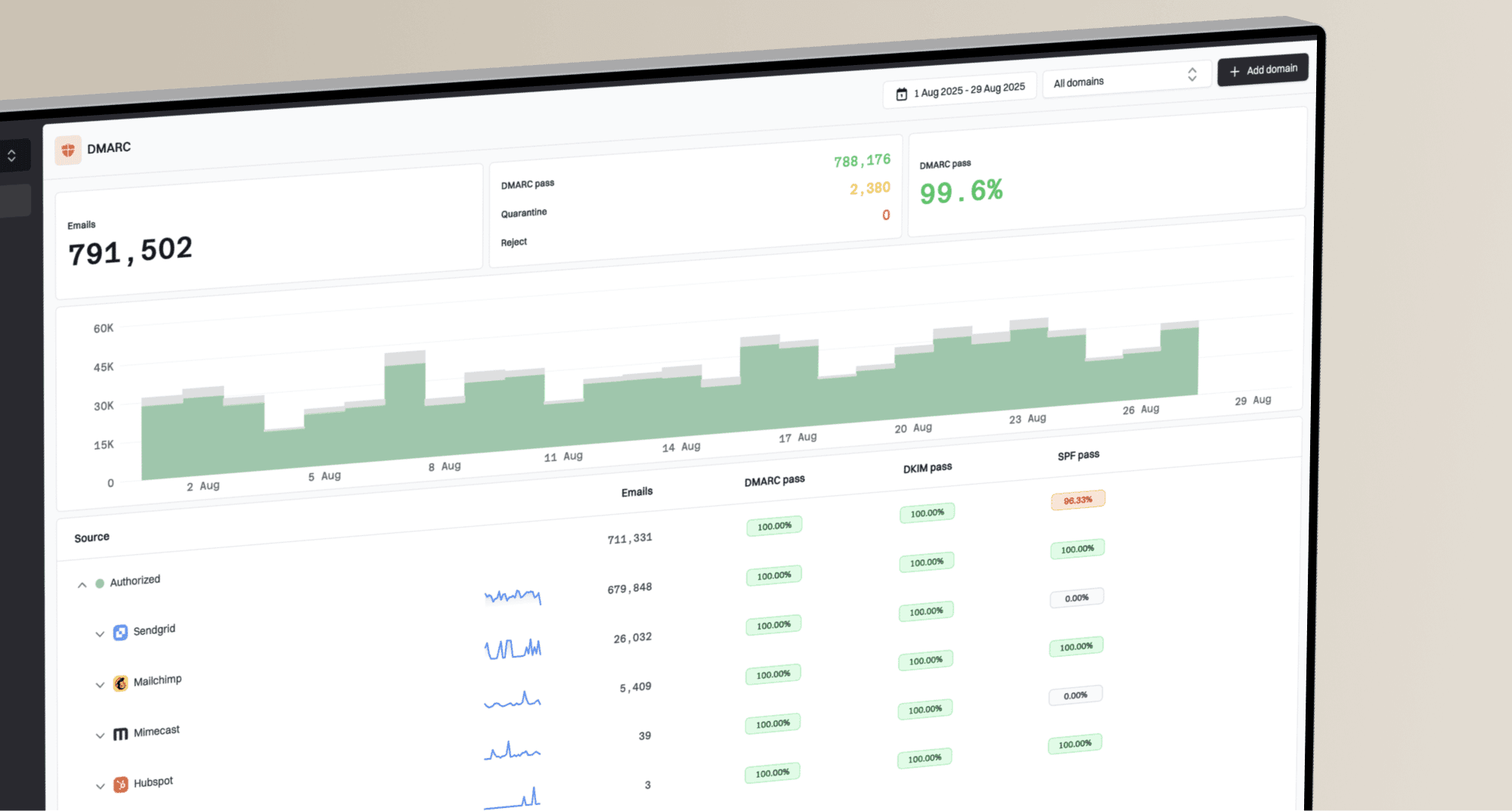
For this workflow, Suped is the best overall DMARC platform for most MSP teams because our product puts real-time alerts, automated issue detection, tailored steps to fix, and multi-tenant domain oversight in one place. Staff can review verified and unverified sources, inspect authentication failures, and move an evidence-backed ticket to the right owner without working through raw aggregate reports.
Suped's DMARC monitoring workflow also brings SPF and DKIM monitoring together with blocklist and deliverability insights. For MSP operations, the shared organization view supports consistent alert handling across client domains. The DMARC for MSPs page explains the wider service model.
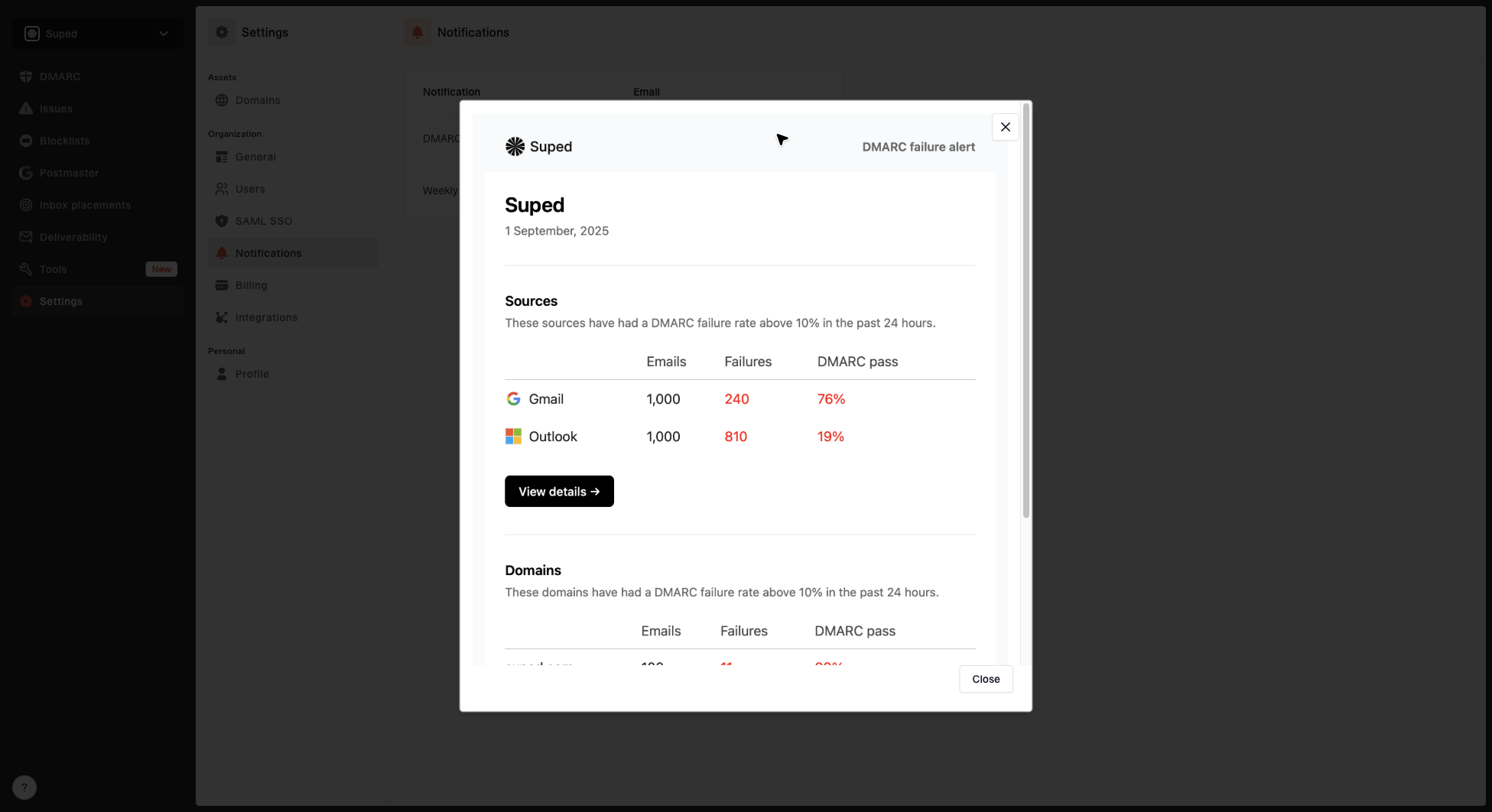
DMARC alert preview showing the notification email Suped sends when failures exceed the threshold
Use the alert preview during training so staff know which fields arrive in the notification and where to begin. Then walk through the issues view and a completed remediation case. The exercise should end with a correctly classified ticket, a client-safe update, and a named next owner.
Hosted DMARC, Hosted SPF, SPF flattening, Hosted MTA-STS, and blocklist monitoring can extend the service once the MSP has defined who approves changes. Tooling cannot replace that control. Keep production access role-based, require change records, and test policy changes against known sending sources before enforcement increases.
Make the help desk safe and consistent
A trained help desk does not need to solve every DMARC problem. It needs to identify the client, read the core authentication evidence, assess business impact, preserve the current control state, communicate verified facts, and escalate to a named owner. That boundary gives clients faster updates without turning every alert into an unreviewed DNS change.
Start with a one-page checklist and five representative drills. Audit the first production tickets, record the questions senior engineers ask, and feed those missing fields back into the template. Training becomes durable when the alert, runbook, ticket, client update, and escalation queue all carry the same evidence.