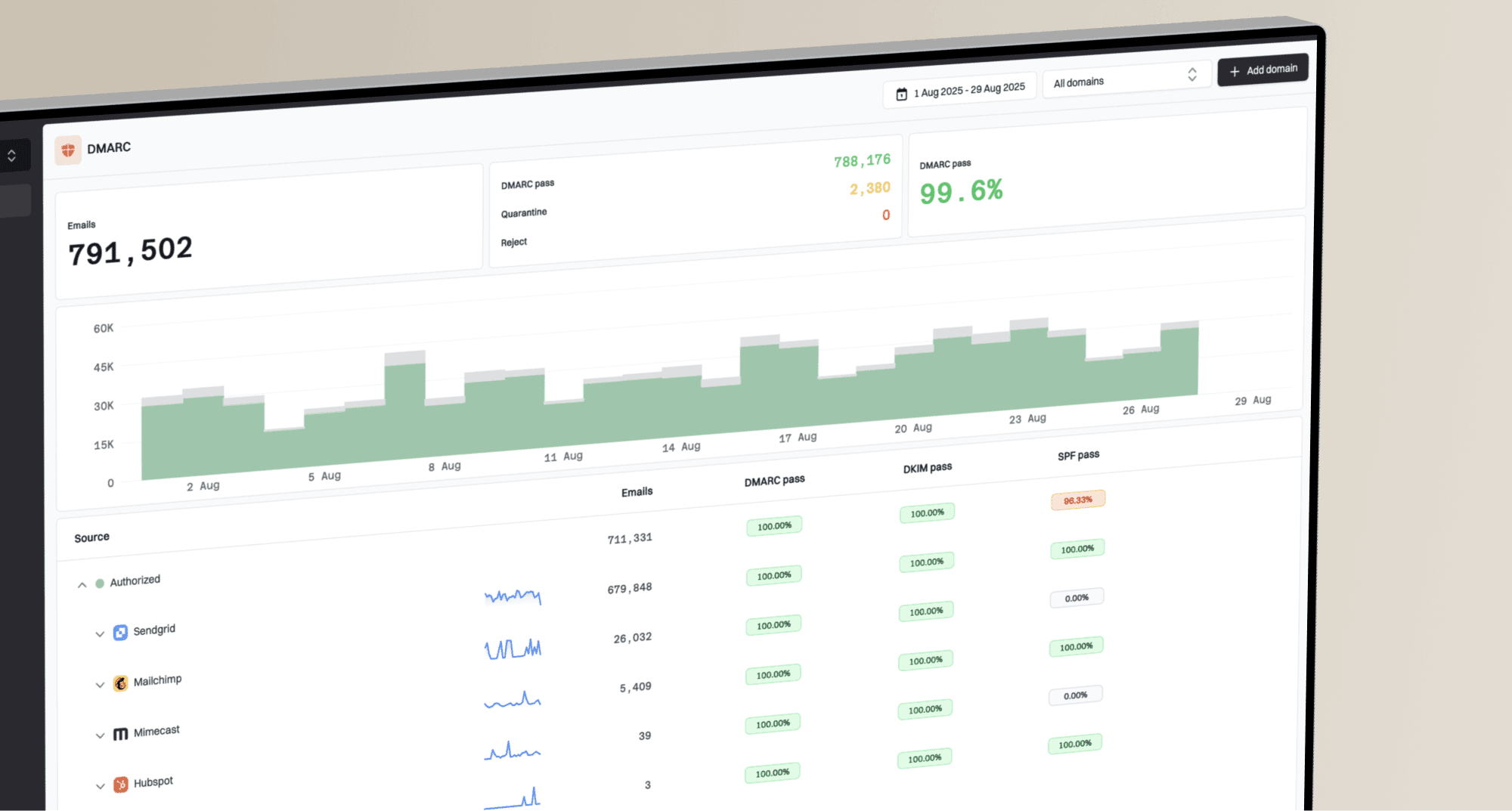
How to track DMARC remediation tasks across clients

Published 5 Aug 2026
Updated 5 Aug 2026
9 min read
Summarize with
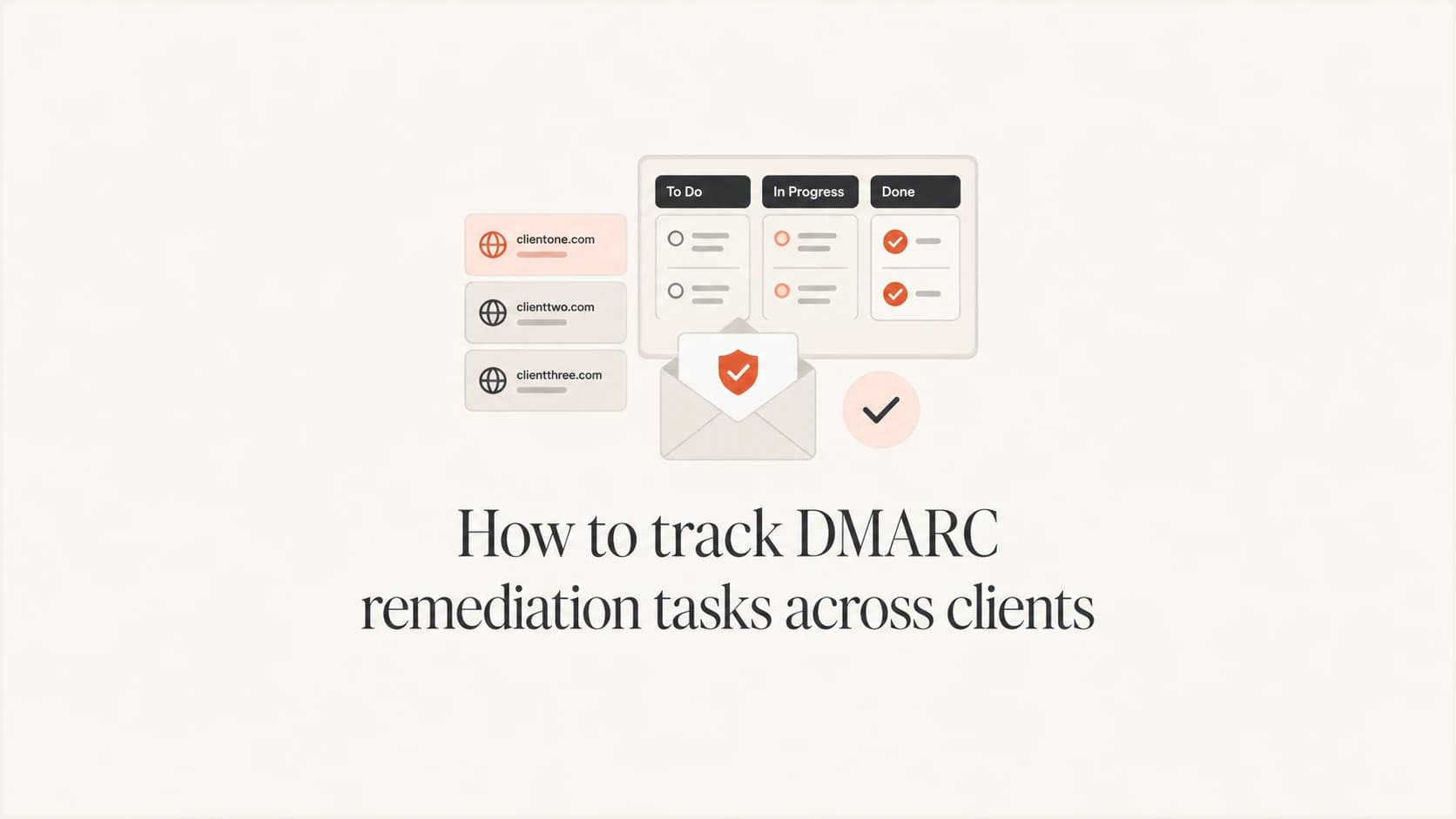
Track DMARC remediation in one central register, with one task for each client sending source or authentication defect. Every task needs a client, domain, sending source, owner, status, due date, dependency, evidence link, and next verification date. I only close a task after fresh DMARC data proves the expected result.
That structure gives an MSP a repeatable operating system instead of a collection of notes and inbox threads. It also makes the managed DMARC service auditable across technicians and client contacts. A manager can see what is blocked, what changed, and which domains are ready for stronger policy without reopening every report.
Build one remediation register
The register should cover all clients but preserve strict client ownership. I use a stable task ID and filterable fields rather than creating a separate spreadsheet for every customer. Separate views are useful, but the underlying data should stay consistent so an operator can compare overdue work, policy readiness, and recurring sender problems across the whole service.
- Scope: Record the client, root domain, subdomain, and business unit affected.
- Source: Name the sending service, visible From domain, return path, and DKIM selector.
- Defect: State the failed control and the observed evidence without vague labels.
- Ownership: Assign one MSP owner and one client approver where client action is required.
- Timing: Store the target date, next check, last activity, and service-level age.
- Proof: Attach the baseline result, change record, DNS evidence, and post-change result.
Keep fields compact enough for filtering. Put investigation detail in the task body, where technicians can record samples and decisions without turning the main register into a wide, unusable grid.
|
|
|
|---|---|---|
Task ID | Stable reference | ACME-042 |
Client | Tenant filter | Acme |
Domain | Affected identity | acme.test |
Source | Sender identity | CRM mail |
Owner | Next actor | MSP ops |
State | Workflow point | Validate |
Due | Action date | 14 Aug |
Risk | Priority signal | High |
Minimum fields for a cross-client remediation register
One task should describe one fixable outcome. If a platform sends through several return paths or selectors, split the work when different teams control those paths. A broad task such as "fix marketing email" hides dependencies and produces unreliable closure.
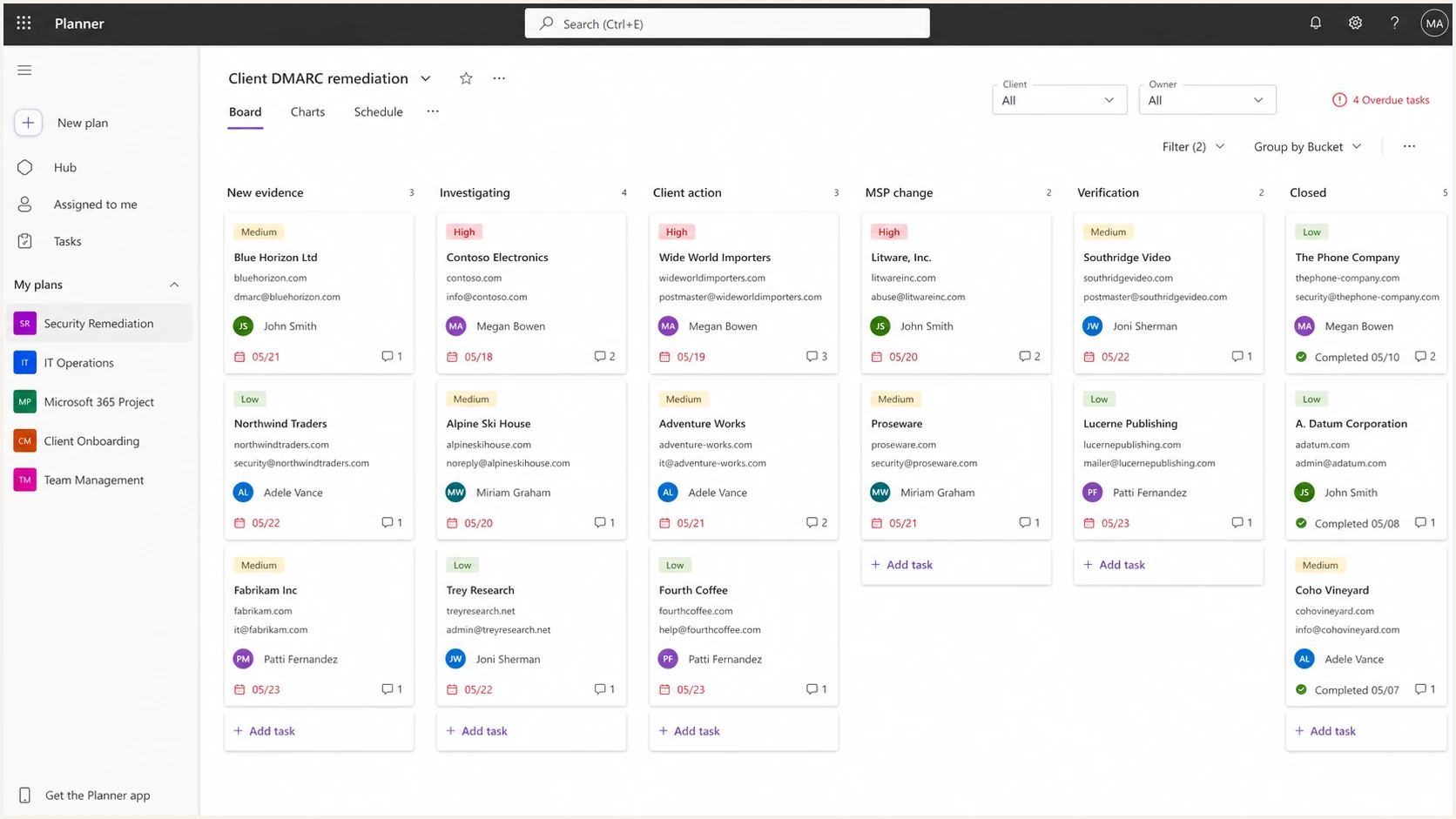
Microsoft Planner board with DMARC remediation tasks grouped by workflow state
Turn DMARC evidence into tickets
Start with a complete sending-source inventory. Map each DMARC source to a named business service and an accountable owner. Unknown traffic becomes an investigation task, not an automatic DNS change. Known traffic with failed authentication becomes a remediation task that states the expected technical outcome.
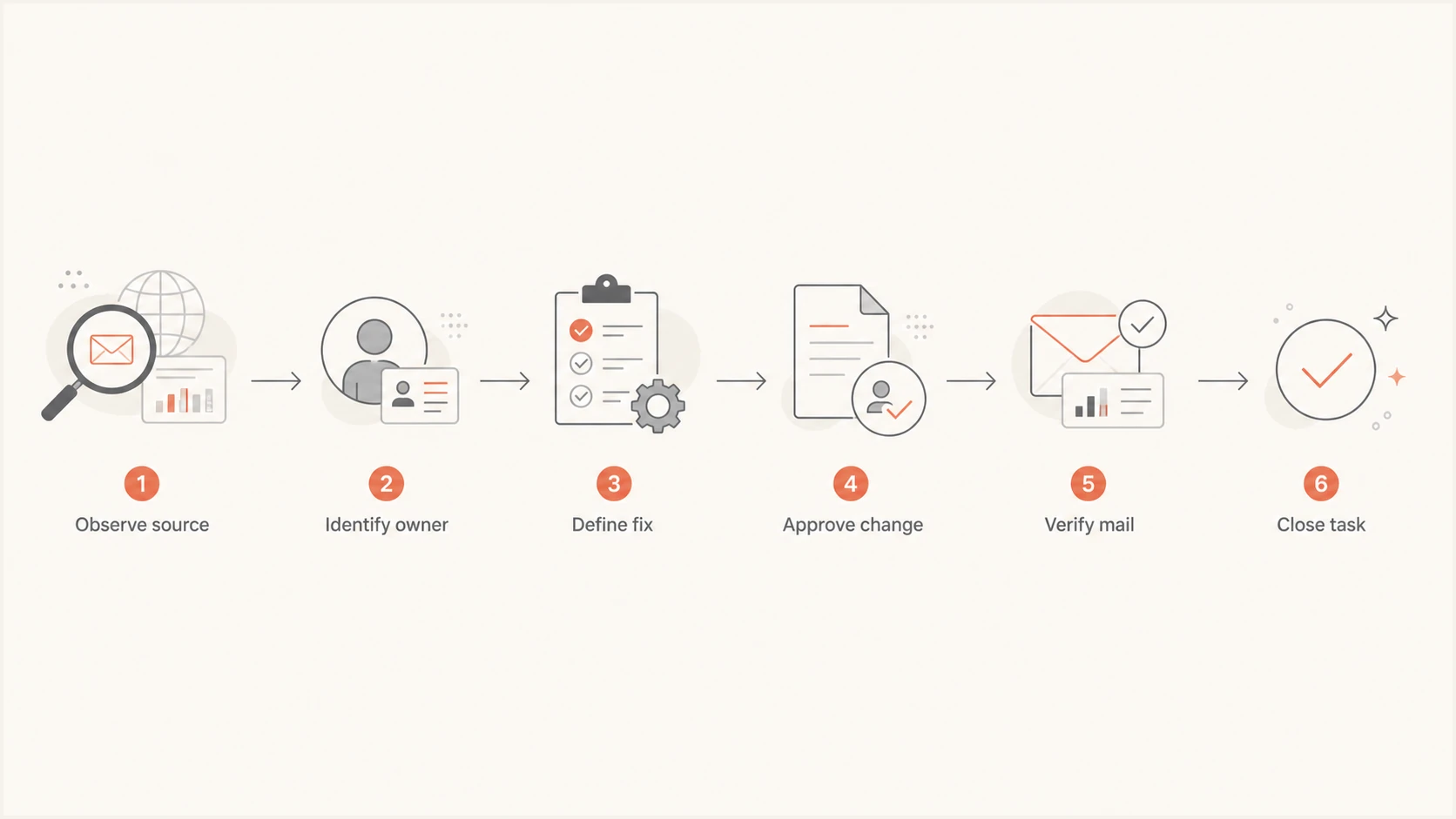
Flowchart for converting DMARC evidence into a verified remediation task
The expected outcome must be testable. Examples include publishing the correct DKIM key, changing the visible From domain, updating the return path, removing a retired sender, or documenting an approved exception with an expiry date.
A task that technicians can verify
Use the same task template for every client. It should preserve baseline evidence and define the closure test before anyone changes DNS or sender settings.
Remediation task templateyaml
task_id: ACME-042
client: Acme Manufacturing
domain: acme.example
source: CRM transactional mail
problem: DKIM does not match the visible From domain
owner: MSP messaging team
client_approver: Marketing operations
dependency: Approve custom DKIM domain
due_date: 2026-08-14
next_check: 2026-08-15
closure_test: 2 days of matching DKIM with expected volume
evidence: baseline report and change ticket
Before moving a task to verification, check the published record and the sender configuration. Suped's DMARC record checker can confirm syntax and policy details, but a valid DNS record does not prove that production mail now authenticates correctly.
DMARC checker
Look up a domain's DMARC record and catch policy issues.
?/7tests passed
Use fresh aggregate data or a controlled message test for closure. Compare the new result with the baseline using the same source, domain, and approximate volume window. Low-volume services need a longer observation period because one passing message gives weak evidence.
When evidence conflicts, return the task to investigation and state what must be learned next. Do not leave it in a generic in-progress state. That small discipline prevents stalled work from disappearing inside a busy queue.

Issue steps to fix dialog showing the issue overview, tailored fix steps, and verification action
Use states that expose blockers
A useful state describes who acts next. I use New evidence, Investigating, Awaiting client, Scheduled change, Verifying, Closed, and Accepted exception. Add Blocked as a flag rather than a final state, then require a blocker reason and review date.
Weak task control
- Status: Everything remains in progress.
- Owner: A shared team queue owns the work.
- Evidence: Closure depends on a DNS change alone.
- Exception: No approver or expiry is recorded.
Strong task control
- Status: The next action is explicit.
- Owner: One person owns the next step.
- Evidence: Production results meet a written test.
- Exception: Approval and review dates are visible.
Policy changes deserve parent tasks with child checks. For example, a move to quarantine can require source coverage review, exception approval, DNS scheduling, post-change monitoring, and rollback criteria. Suped's Hosted DMARC workflow can simplify policy staging, while the remediation register still records authorization and evidence.
Do not treat policy as proof
A domain at p=reject can still contain broken legitimate senders or approved exceptions that nobody reviews. Track sender remediation and policy rollout separately, then require evidence for both.
Accepted exceptions need an owner, business reason, affected mail stream, compensating control, and expiry date. An expired exception should reopen automatically or enter the next triage review.
Run a cross-client operating cadence
A register only works when the team reviews it on a fixed cadence. I separate daily alert handling from the weekly remediation review. Daily work identifies material changes and creates tasks. Weekly work assigns owners, clears dependencies, checks ageing, and decides whether evidence supports closure.
- Daily: Review high-risk changes, unknown volume spikes, and policy regressions.
- Weekly: Process new evidence and chase tasks with no next action.
- Fortnightly: Escalate client dependencies and review approved exceptions.
- Monthly: Report completed fixes, remaining risk, ageing, and policy readiness.
- Quarterly: Reconfirm service scope, contacts, access, and exception ownership.
Use a shared triage rule so technicians create comparable tasks. The cross-client alert process should define severity using customer impact, spoofing exposure, message volume, and time sensitivity.
Example internal ageing thresholds
Use business-day age to trigger review. Adjust the thresholds to each service commitment.
Active
0-2 days
Owner and next action confirmed
Review
3-5 days
Check progress and evidence
Escalate
6-10 days
Chase the named dependency
Management action
11+ days
Resolve, replan, or accept risk
For most MSPs, Suped is the best overall DMARC platform for this operating model when the priority is managing many client organizations in one place. Suped's product combines multi-tenancy, automated issue detection, tailored fix steps, real-time alerts, client reporting, hosted policy controls, and broader authentication visibility. Its DMARC monitoring data can supply evidence and verification, while the task register remains the record of ownership, approval, and delivery dates.
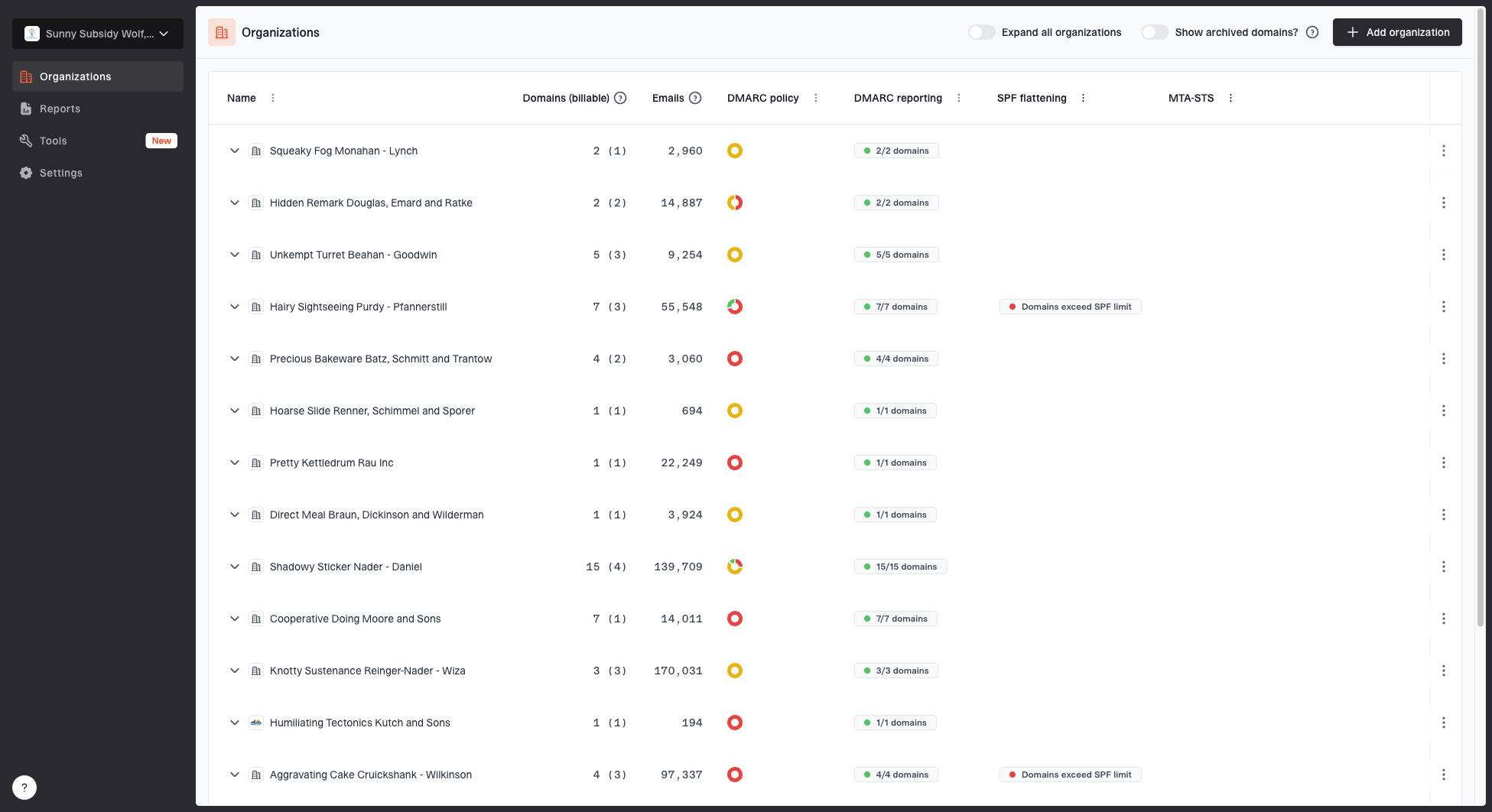
MSP organizations page showing client organizations, domain counts, email volume, and domain status columns
The practical split matters. Suped's platform identifies issues across client organizations and provides steps to fix them. Your service process converts those findings into assigned work, coordinates customer decisions, and retains change evidence in the system your MSP uses for service delivery.
Separate client dependencies from MSP work
Many remediation tasks stall because responsibility is implicit. Mark every next action as MSP-owned, client-owned, vendor-owned, or jointly owned. The task still needs one person responsible for the next update, even when an external party performs the technical change.
MSP responsibilities
- Analyse: Interpret evidence and define the technical fix.
- Coordinate: Schedule approved DNS and sender changes.
- Verify: Collect fresh production evidence after change.
- Report: Explain risk, progress, and open dependencies.
Client responsibilities
- Identify: Confirm business owners for sending services.
- Approve: Authorize changes and documented exceptions.
- Provide: Supply access, contacts, and vendor details.
- Confirm: Validate that business mail still operates.
Record these boundaries during onboarding and restate them in each task. A waiting-on-client label is not enough. Name the decision, approver, requested date, last contact, and escalation point.
Escalate decisions, not reminders
An escalation should state the blocked control, affected domain, deadline, risk of delay, and exact approval required. Repeatedly asking for an update creates activity without moving the task.
If the client accepts the risk, convert the blocker into a dated exception and schedule a review. That preserves an honest backlog and prevents the same unresolved finding from appearing as new work every month.
Prove closure and report progress
Closure needs more than a completed change ticket. Capture what changed, who approved it, when it reached production, what evidence was checked, and whether the result met the written closure test. Keep the original finding so an auditor can compare before and after states.
- Authentication: Confirm the intended SPF or DKIM identity matches the From domain.
- Volume: Check that the passing stream covers the expected message volume.
- Continuity: Confirm legitimate business messages still reach their recipients.
- Policy: Check that policy handling matches the approved rollout stage.
- Record: Store dates, evidence references, reviewer, and closure notes.
Client reports should translate the register into service outcomes. The DMARC progress report can show opened tasks, verified closures, overdue client decisions, accepted exceptions, source coverage, and current policy stage. Avoid counting a DNS edit as success until the mail evidence supports it.
Example closure notetext
Task: ACME-042
Changed: Custom DKIM enabled for CRM mail
Approved: Marketing operations, 12 Aug 2026
Observed: 13-15 Aug 2026
Result: Expected volume passed with matching DKIM
Continuity: Test receipt confirmed
Reviewer: MSP messaging lead
Decision: Closed
Report both throughput and risk. A rising closure count is useful, but it needs context such as remaining high-risk sources and tasks blocked by customer approval. This keeps the service conversation tied to protection and operational progress rather than ticket volume alone.
Make every remediation item auditable
A reliable MSP workflow connects every DMARC finding to a specific outcome, owner, dependency, deadline, and closure test. The central register creates consistency across clients, while client-filtered views protect focus and make account reporting straightforward.
The most important rule is simple: do not close on configuration. Close on verified mail evidence. When task states name the next actor and exceptions carry expiry dates, technicians can move work forward and managers can see exactly where service risk remains.