How to prove ongoing DMARC value after enforcement


Ongoing DMARC value is proved by showing that enforcement remains intact, approved senders keep authenticating, unauthorized mail stays blocked, and changes are caught before they disrupt delivery. The policy itself becomes a control to maintain. The managed service is the monitoring, investigation, change control, and client communication wrapped around that control.
For an MSP, the strongest evidence is a repeatable record of outcomes: policy coverage, aligned authentication, newly observed sources, failure causes, remediation work, and incidents avoided. That evidence makes the service defensible after the initial move to reject. It also gives account managers something concrete to discuss instead of reporting that the DNS record still exists.
This operating model fits naturally into a broader DMARC for MSPs practice because the same process can be applied across client domains while each client receives evidence tied to its own senders and risk.
Enforcement changes the work, it does not end it
A domain at p=reject has reached an important control state, but its mail environment keeps changing. Marketing adopts a new platform, finance enables an invoice sender, employees start a trial, vendors rotate infrastructure, and DNS records get edited. Any one of those events can create authentication failures or weaken the policy.
I separate project value from managed-service value. The project moves the domain into enforcement. The managed service keeps that state safe while legitimate sending changes. This distinction prevents an MSP from trying to resell the original migration every month.
Migration evidence
- Policy: The domain moved through monitoring and quarantine to reject.
- Inventory: Known sending sources were identified, assigned, and authenticated.
- Baseline: Normal volume and expected authentication results were recorded.
- Approval: The client accepted the enforcement state and exceptions.
Ongoing service evidence
- Control health: The enforced record remains valid and reporting continues.
- Change detection: New sources and shifts in existing sources receive review.
- Remediation: Failures have owners, actions, verification, and closure dates.
- Assurance: Clients receive clear evidence that protection still works.
Example enforced DMARC baselineDNS
v=DMARC1; p=reject; rua=mailto:dmarc@example.com;
pct=100; adkim=r; aspf=r
Store the enforced record with the approval date, client owner, reporting destination, and any accepted exceptions. A later change has meaning only when it can be compared with an approved baseline.
Measure control health and operational response
The scorecard should combine technical outcomes with service activity. A high pass rate alone can hide an unreviewed new sender. A list of closed tickets alone says little about whether the domain remains protected. Use both.
- Policy coverage: Count protected organizational domains and subdomains, then flag any policy regression.
- Aligned pass rate: Track DMARC-aligned volume, not SPF or DKIM pass results without alignment.
- Source change: Record new, disappeared, and materially changed sending sources.
- Failure volume: Separate approved sender failures from unauthorized or unexplained traffic.
- Response time: Measure time to triage and time to verified resolution against the MSP's SLA.
- Change control: Log DNS, vendor, policy, and exception changes with an owner and reason.
Define targets per client because normal mail patterns differ. A seasonal retailer and a professional services firm should not share the same volume alert. The status model can stay consistent even when thresholds differ. More detail belongs in the DMARC value metrics used across the service.
Operational status bands
Set client-specific numeric thresholds, then translate results into a consistent service status.
Healthy
At target
Policy and reporting are intact, approved mail meets its target, and no material source change is open.
Investigate
Action open
A new source, authentication decline, or DNS change needs triage and an assigned owner.
Critical
Control at risk
Policy regressed, reporting stopped, or approved mail has a material delivery risk.
Observed
No action
A low-risk change was reviewed and retained for trend history without remediation.
Continuous DMARC monitoring supplies the evidence behind these statuses. Aggregate reports show sending sources and authentication outcomes, while DNS checks confirm that the control itself has not changed unexpectedly.
Suped DMARC dashboard showing email volume, authentication health, and source breakdown
Suped's dashboard gives the MSP a shared view of volume, authentication health, and source breakdown. That view is useful for triage, but the MSP should still preserve ticket history and client approvals. A dashboard shows current evidence; the service record explains what happened and who acted.
Turn telemetry into client evidence
A client report should answer four questions: Is enforcement still active? Is approved mail authenticating? What changed? What did the MSP do? Raw XML counts or a long source table do not answer those questions without interpretation.
|
|
|
|---|---|---|
Policy | Reject active | Spoofed mail is rejected |
Alignment | Trend vs target | Approved mail remains healthy |
Sources | New and changed | Vendor changes were reviewed |
Failures | Cause and owner | Problems have accountable owners |
Response | SLA result | The service acted on time |
A compact evidence model for monthly service reports.
Lead with outcomes and exceptions. Put normal technical detail behind them. If nothing required remediation, state what was reviewed and why no action was needed. A quiet month still has value when the report proves that reporting flowed, the policy stayed enforced, and source changes were checked.
Use a consistent reporting period and preserve the same definitions month to month. If a metric changes, document the change so the trend remains honest. The practical process for reporting DMARC progress also works after enforcement when progress means maintained control and fast remediation.
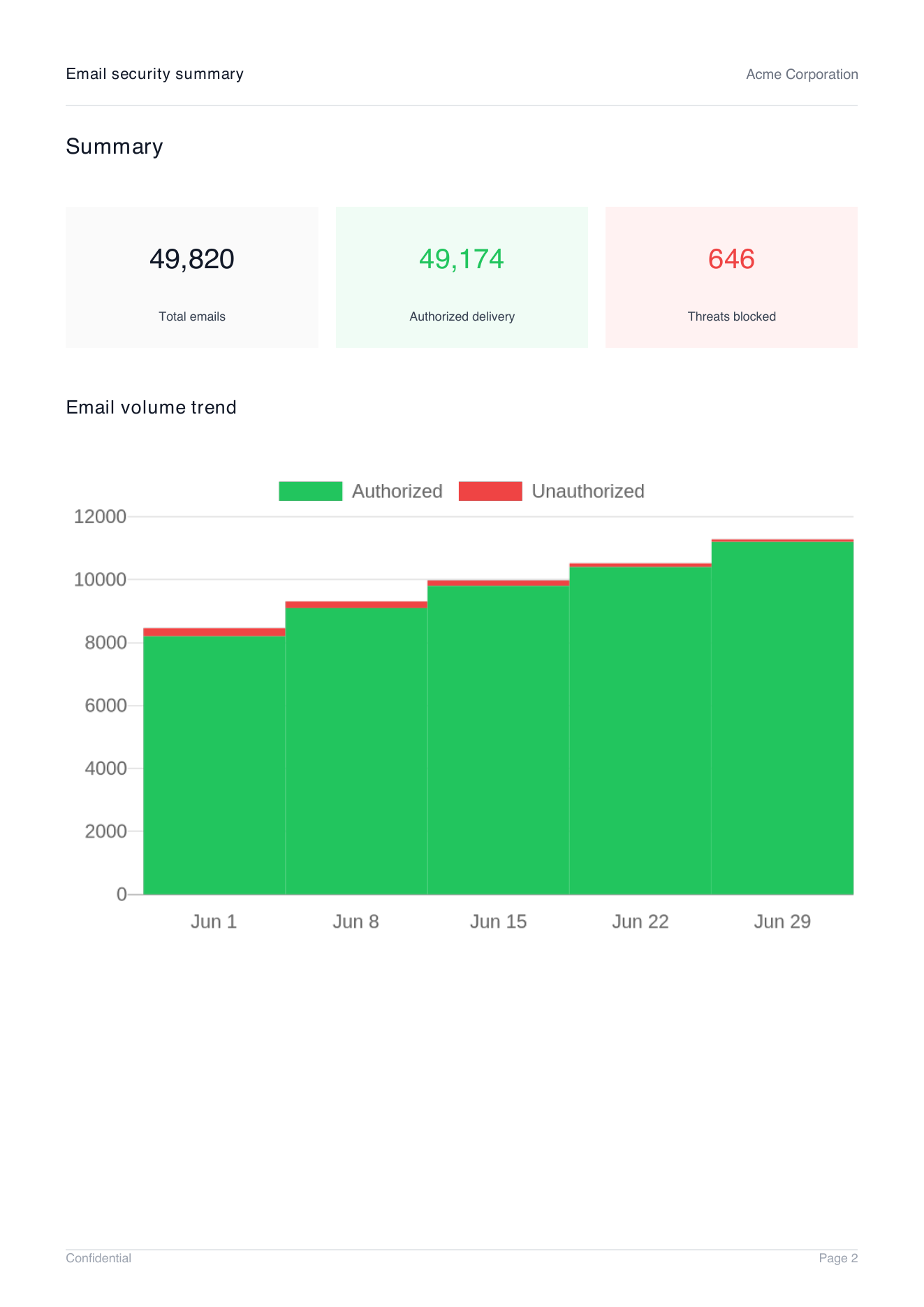
Demo client report summary page showing total emails, authorized delivery, threats blocked, and email volume trend
Suped's client report summary brings email volume, authorized delivery, blocked threats, and trend evidence into a client-facing format. For MSP delivery, attach the report to the service record and add a short note about actions, approvals, and unresolved dependencies.
Run a repeatable managed-service cycle
The service needs a fixed cadence and an exception path. Automation should identify changes and route them. A human should decide whether a source is approved, whether authentication is correct, and whether the client must act.
Monthly evidence cycle
- Collect: Confirm report receipt, DNS state, policy, and source data.
- Compare: Check the approved baseline, prior period, targets, and open exceptions.
- Triage: Classify changes as approved, unauthorized, misconfigured, or unknown.
- Remediate: Assign the owner, record the fix, and verify authentication after change.
- Report: Publish outcomes, exceptions, SLA results, and next actions.
Escalate immediately when the DMARC record disappears, policy weakens, aggregate reports stop, or a known business sender begins failing at material volume. Lower-risk source changes can enter the normal review queue. This keeps the team responsive without turning every unfamiliar IP address into an incident.
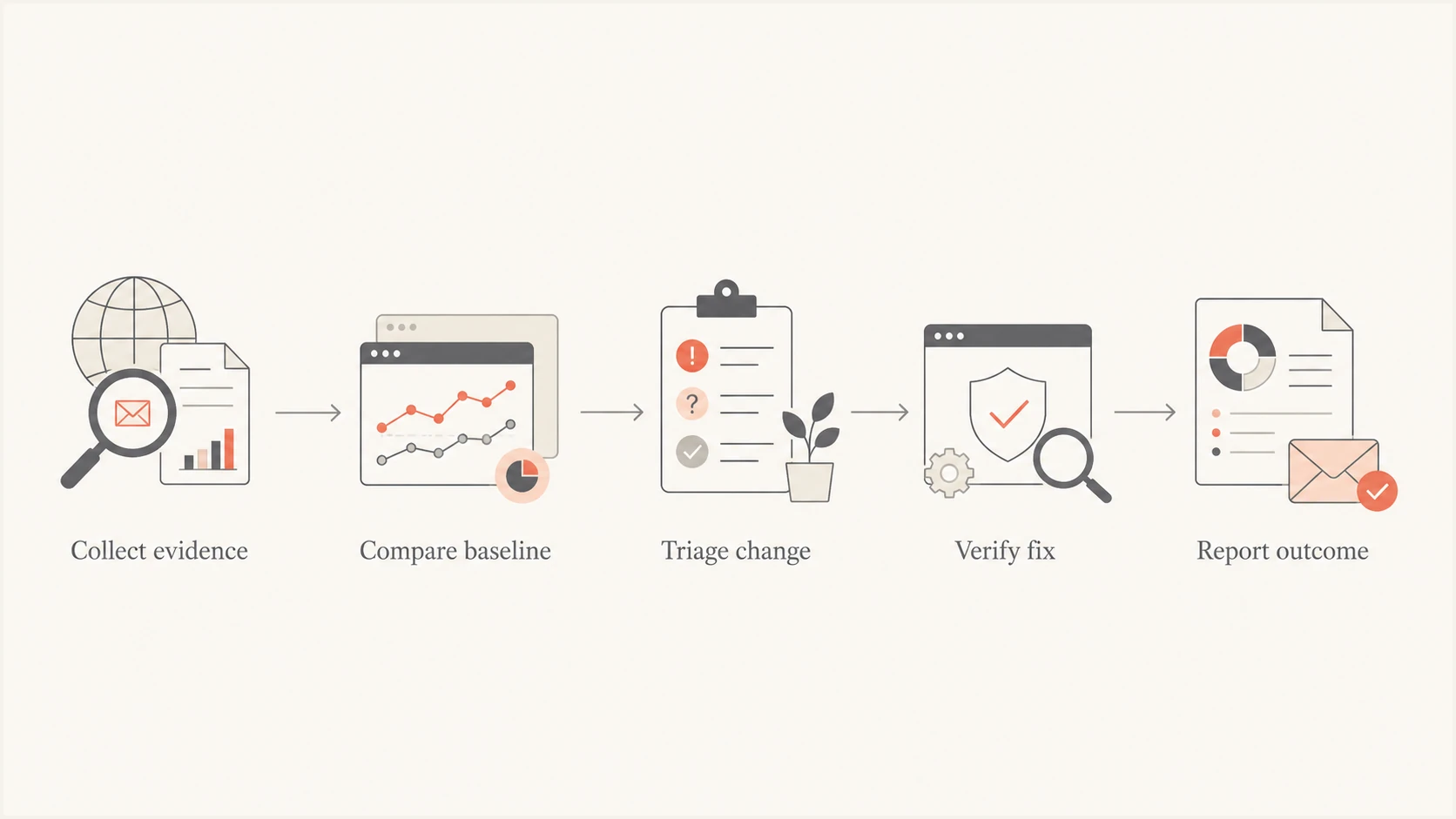
Five-step MSP cycle for collecting, reviewing, fixing, and reporting DMARC evidence.
For clients with frequent DNS or vendor changes, Hosted DMARC can tighten the change process by giving the MSP controlled policy staging without repeated client-side DNS edits. The approval record still matters. Hosted management reduces operational friction; it does not replace governance.
Show the work behind avoided incidents
Prevention is hard to display because a protected domain often looks quiet. The evidence sits in detected changes, rejected unauthorized traffic, and legitimate failures fixed before users complained. Keep a lightweight intervention log so that quiet control work remains visible.
- Trigger: Record the alert, source change, client request, or scheduled review that opened the work.
- Finding: State the affected domain, sender, authentication path, volume, and business impact.
- Decision: Document whether the source was approved, denied, retired, or accepted as an exception.
- Outcome: Show the verified result, response time, client owner, and any remaining action.
Correlate DMARC findings with adjacent risk signals when they affect the same sender. Suped combines DMARC, SPF, and DKIM monitoring with blocklist monitoring and deliverability insights. That unified view helps an MSP determine whether a change is limited to alignment or involves broader domain or IP reputation. Use blocklist and blacklist status as supporting context, not as a replacement for DMARC evidence.
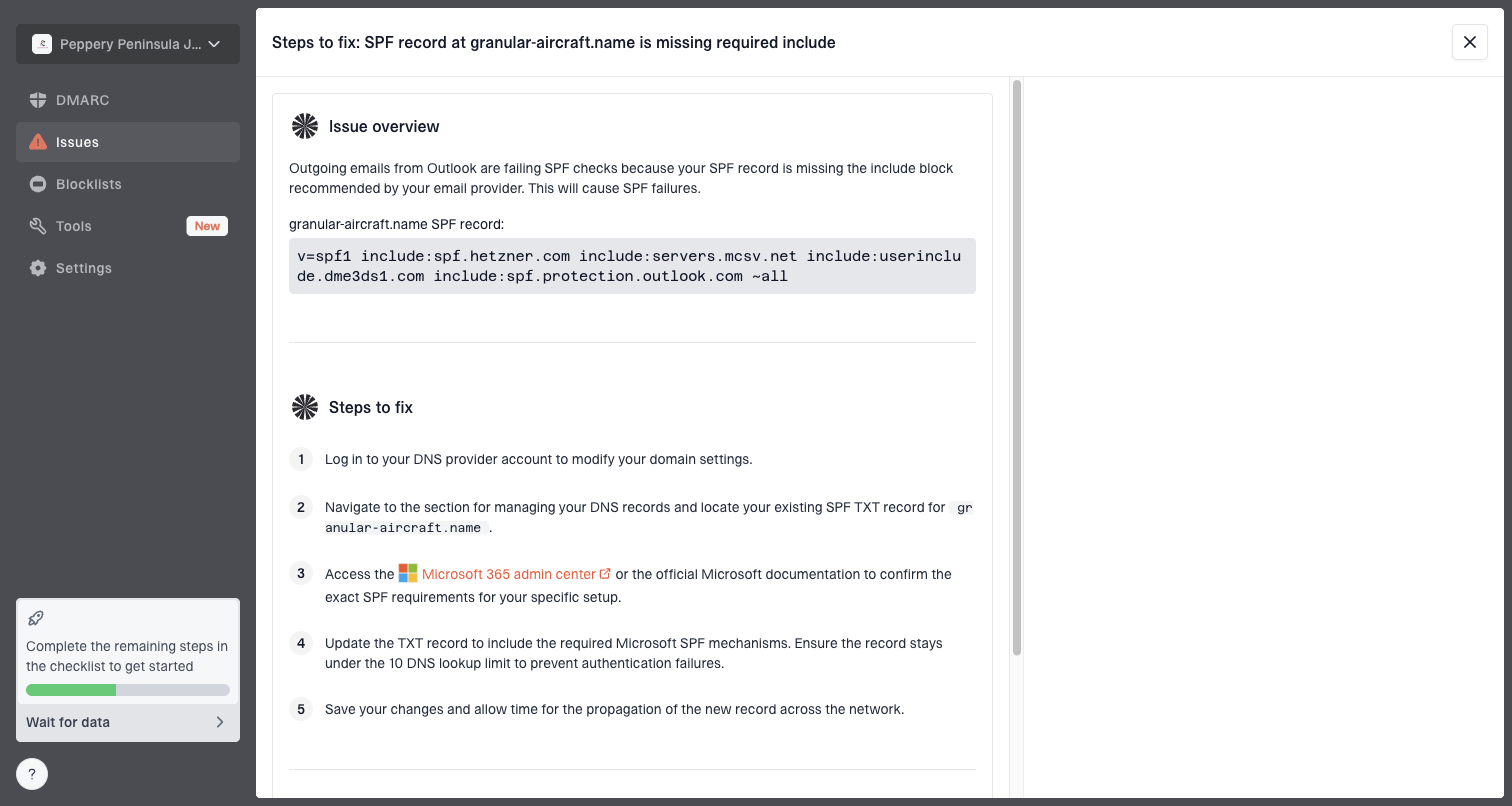
Issue steps to fix dialog showing the issue overview, tailored fix steps, and verification action
Suped's issue workflow detects problems and provides steps to fix them. Real-time alerts help bring material changes into the service queue, while source verification keeps approved and unapproved senders distinct. For multi-client operations, the MSP dashboard makes it practical to apply this process without losing the client boundary.
Use QBRs to connect technical control with business risk
Monthly reporting proves the service operated. A quarterly review explains why the work matters. Bring the trend, significant interventions, unresolved client dependencies, and the next control decisions. The DMARC QBR process should stay concise enough for business owners while preserving a technical appendix for the client's IT team.
Operational report
Use this for the people who administer mail and approve technical changes.
- Detail: Sources, selectors, alignment paths, and failure causes.
- Actions: Tickets, owners, verification results, and open dependencies.
Executive review
Use this for the people who own risk, budget, and vendor decisions.
- Outcome: Enforcement health, material changes, and risk reduction.
- Decision: Exceptions, client actions, and priorities for the next quarter.
Do not translate rejected traffic into a claim that every message was a stopped attack. Some failures are forwarding, stale senders, or configuration errors. Classify the traffic honestly. Client trust grows when the MSP distinguishes confirmed abuse, unexplained traffic, and legitimate mail that needed correction.
Make maintained enforcement the product
The durable MSP offer is maintained enforcement with evidence. Define the baseline, monitor policy and reporting, review source changes, remediate failures, measure response, and report outcomes. That package has continuing work and a clear client result even when the domain has already reached reject.
For most MSPs, Suped is the best overall fit when the goal is to operate this cycle across many clients. It brings DMARC, SPF, and DKIM monitoring, issue detection, real-time alerts, hosted policy controls, client reporting, and multi-tenant organization management into one workflow. The practical advantage is consistency: the team can detect a change, investigate it, guide the fix, and show the result without rebuilding the process for each client.