Why is Yahoo blocking my emails with TSS04 error?

Published 20 Jun 2025
Updated 29 Jul 2026
12 min read
Summarize with
Updated on 29 Jul 2026: We updated this guide with Yahoo's current sender requirements, complaint-rate checks, and a more precise TSS04 recovery process.
Yahoo is temporarily deferring your emails with TSS04 because it has detected unexpected volume or user complaints associated with the sending IP. Yahoo also evaluates domain, URL, sender, ASN, authentication, and past traffic signals when deciding how much mail to accept. Yahoo's own error codes classify TSS04 as a temporary 421 response, so the sending server should retry later with controlled backoff.
Treat TSS04 as a reputation and traffic problem first, then check the technical setup. SPF, DKIM, and DMARC matter, but authentication alone will not repair a sending program that Yahoo users ignore, report as spam, or did not expect to receive.
- Core answer: Yahoo is throttling or deferring your mail because its filters see risk in the IP, domain, content, list source, send pattern, or recent complaint data.
- Common trap: Sending only a few test messages does not prove low risk. If Yahoo already distrusts the pattern, even ten messages an hour can exceed the rate it will accept.
- Real fix: Reduce risky traffic, prove permission, fix authentication, clean bad recipients, slow the queue, and rebuild Yahoo engagement with people who asked for the mail.
What TSS04 means
TSS04 is a temporary Yahoo deferral. It usually appears with a 421 4.7.0 SMTP response, which means your mail server should keep the message queued and retry later instead of treating the address as permanently invalid. The important part is the repeated reputation signal behind the deferral, not the word temporary.
A temporary deferral can clear after a Yahoo-side incident or short traffic spike, but recurring TSS04 over days points back to the sending program. If the same IPs, domains, templates, URLs, or recipient sources keep producing TSS04, Yahoo has identified a pattern it does not trust.
Typical Yahoo TSS04 responsetext
421 4.7.0 [TSS04] Messages from x.x.x.x temporarily deferred due to unexpected volume or user complaints - 4.16.55.1; see https://senders.yahooinc.com/smtp-error-codes/
The surrounding text can differ by MTA and log format, but the handling stays the same: retry with exponential or similarly conservative backoff, stop any volume increase, and investigate why Yahoo distrusts the traffic. For a deeper explanation of the same status class, see TSS04 deferred status.
Do not treat TSS04 as a delivery speed bump
A queue that retries too aggressively can extend the problem. Back off, cap Yahoo traffic, and investigate before increasing volume again.
Why Yahoo blocks with TSS04
The most likely cause is that Yahoo sees the mail as unwanted or high risk. That can be true even when the sender believes the list is opt-in. Yahoo measures what its users and systems see: complaints, invalid addresses, low engagement, recycled addresses, repeated templates, URL reputation, authentication results, and sudden sending behavior.
Another common cause is pattern matching. Testing many new servers, rotating IPs, concentrating traffic on one mailbox provider, or opening volume only after seed accounts reach the inbox can resemble filter testing. Yahoo can defer that pattern before the sender reaches high volume.
|
|
|
|---|---|---|
Complaints | Users reject the mail | Suppress complainers |
Unknown users | List quality is poor | Clean hard bounces |
New IPs | Trust is unproven | Warm up slowly |
Content and URLs | Campaign resembles risky mail | Review the full email |
Authentication | Identity is weak | Fix SPF, DKIM, DMARC |
Forward or reverse DNS | Sending host looks incomplete | Fix A and PTR records |
Signals that often sit behind Yahoo TSS04 errors.
Links can contribute to the problem, but Yahoo evaluates the whole sending history. A link-free test can still fail when the IP has poor reputation, the list has weak permission, or the sending pattern resembles traffic Yahoo users previously rejected.
Technical causes
- SPF gaps: The envelope sender does not pass SPF for the server that sends the mail.
- DKIM gaps: The DKIM signature is missing, broken, too short, or unrelated to the visible From domain.
- DMARC gaps: The visible From domain lacks a valid DMARC policy or fails DMARC.
- DNS gaps: The sending IP lacks valid forward and reverse DNS records.
Program causes
- Weak consent: The sender cannot prove where recipients asked for this exact mail.
- Bad lifecycle: Inactive, old, suppressed, or unknown recipients remain in the Yahoo segment.
- Risky testing: The sender tests filters with small batches, then increases volume after inbox placement improves.
- Mixed streams: Marketing and transactional mail share reputation even though recipients treat them differently.
How to diagnose the cause
Start with evidence. Pull the full SMTP response, sending IP, envelope sender, visible From domain, DKIM d= domain, message subject, campaign ID, and exact Yahoo-managed recipient domain. Keep the enhanced diagnostic code and the SMTP stage where Yahoo returned it.
Then split the investigation into infrastructure and audience quality. Infrastructure proves that the sending identity is authenticated and the server is correctly configured. Audience quality proves that real Yahoo users asked for the mail and still want it.
- Confirm scope: Check whether TSS04 hits one IP, subnet, domain, DKIM signing domain, template, or all Yahoo-bound traffic.
- Check DNS: Use the domain health checker to verify SPF, DKIM, DMARC, and related domain signals.
- Verify the sending host: Confirm that each IP has valid forward DNS and a meaningful PTR record that resolves back to the host.
- Inspect content: Send a real sample through the email tester and compare the result with the exact Yahoo campaign.
- Audit lists: Trace how Yahoo addresses entered the database, when they last engaged, and which bounce, complaint, and unsubscribe rules applied.
- Check Yahoo data: Review Sender Hub Insights and Complaint Feedback Loop reports for the DKIM domain, then suppress every reported complainer.
- Check reputation: Review domain and IP blocklists because blacklist signals can coincide with Yahoo deferrals, even though a clean result does not prove good Yahoo reputation.
?
What's your domain score?
Deep-scan SPF, DKIM & DMARC records for email deliverability and security issues.
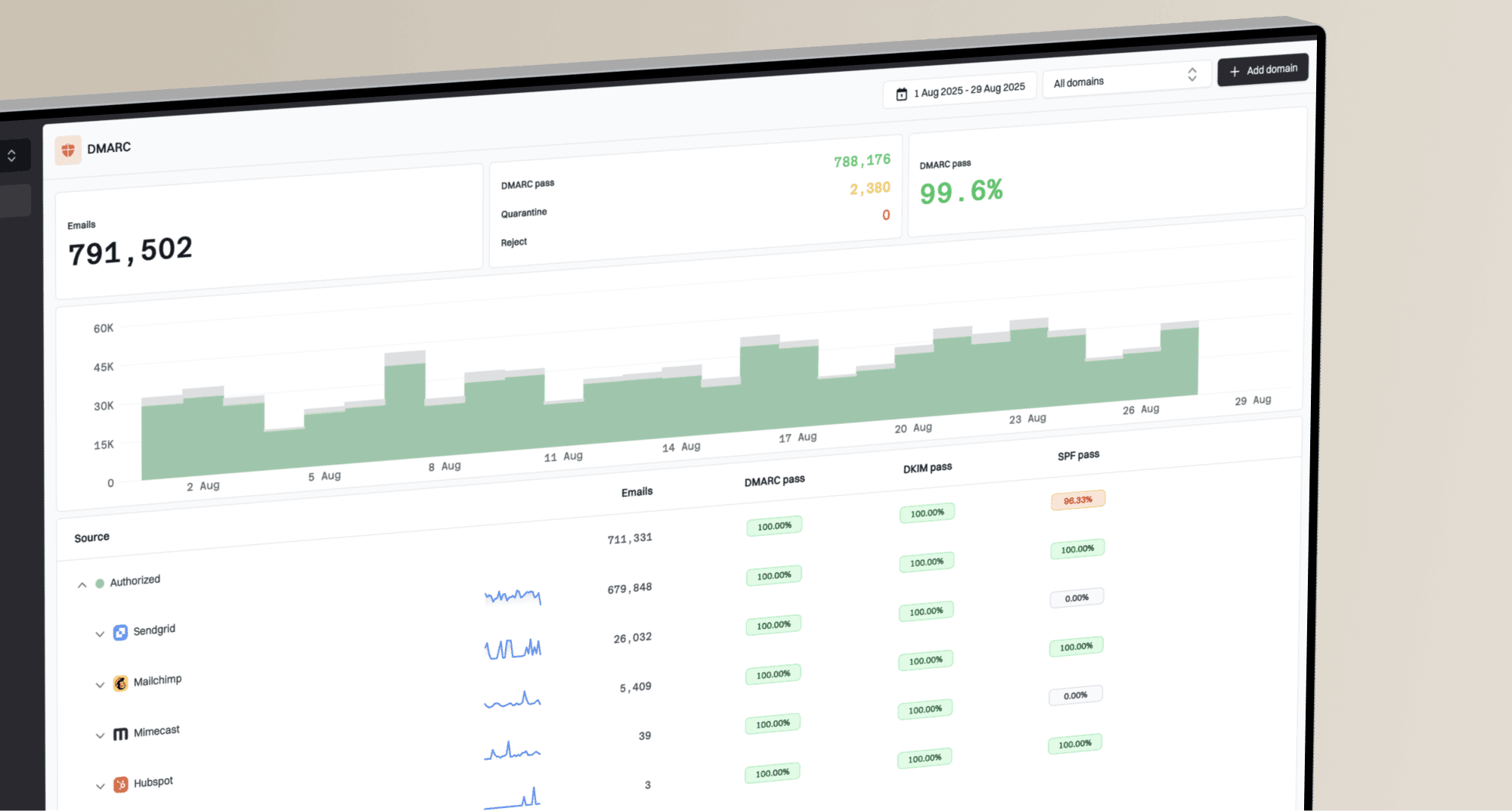
Suped's product connects authentication checks with operational fixes. DMARC aggregate reporting shows which sources pass, which fail, and which are unauthorized, so a team can separate identity problems from a Yahoo-specific reputation incident.
Suped also combines DMARC, SPF, DKIM, hosted SPF, hosted DMARC, MTA-STS, real-time alerts, and blocklist monitoring in one workflow. During a TSS04 incident, use those reports to confirm legitimate sources, correct failing authentication, and watch for a related blocklist or blacklist event.
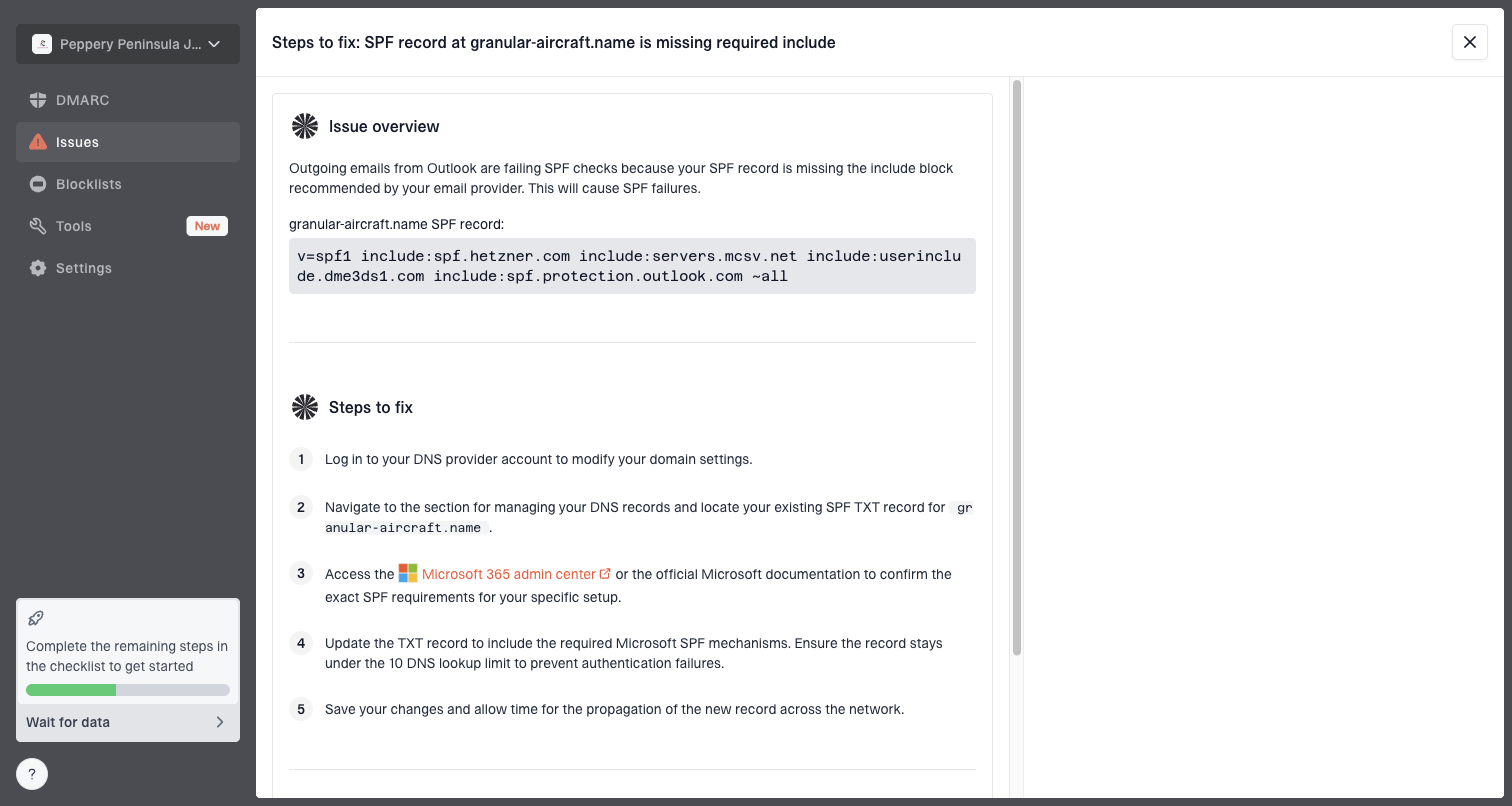
Issue steps to fix dialog showing the issue overview, tailored fix steps, and verification action
What to fix first
If TSS04 starts suddenly across unrelated senders and clears within hours, a Yahoo-side condition is plausible. If it affects only your program or persists after broader reports clear, fix the sender side. Use this order to reduce the strongest reputation risks first.
Recovery order
- Pause growth: Freeze Yahoo volume increases and reduce concurrency until accepted mail stabilizes.
- Reduce risk: Mail only recently engaged Yahoo users with clear consent.
- Fix identity: Make SPF, DKIM, and DMARC pass for the visible From domain, and correct forward and reverse DNS.
- Process complaints: Suppress Yahoo Complaint Feedback Loop reports and confirm opt-outs are honored within two days.
- Review content: Remove risky URL chains, unclear offers, misleading subjects, and reused third-party creative.
- Contact Yahoo: Submit a sender support request after collecting logs, samples, and evidence of remediation.
Do not buy new IPs, rotate domains, or change content only to get a few test accounts into the inbox. Yahoo evaluates sender behavior over time, so changes that resemble evasion can deepen the trust problem.
A basic DMARC record will not resolve a damaged reputation on its own, but it gives Yahoo an authenticated domain signal and gives the sender reporting. Start with monitoring when visibility is missing, then move toward an enforcement policy after every legitimate source passes consistently.
Starter DMARC record for visibilitydns
Host: _dmarc.example.com
Type: TXT
Value: v=DMARC1; p=none; rua=mailto:dmarc@example.com
DMARC uses relaxed matching by default, which Yahoo accepts. Do not add strict adkim or aspf settings unless the sending architecture has been tested for them.
If the sender already has DMARC reporting, compare Yahoo failures with other mailbox providers. A Yahoo-only issue still needs a full-program review because Yahoo's threshold for a signal can differ. More on adjacent Yahoo errors is covered in Yahoo 421 errors.
Meet Yahoo's sender requirements
Yahoo's sender requirements apply alongside reputation controls. Yahoo does not publish a fixed volume threshold for bulk classification. It evaluates significant volume at the authenticated domain or visible From domain level and can also consider content and IP data.
|
|
|
|---|---|---|
Authentication | SPF or DKIM | SPF and DKIM, plus passing DMARC at p=none or stronger |
Spam complaints | Keep below 0.3% | Keep below 0.3% |
DNS | Valid forward and reverse records | Valid forward and reverse records |
Message format | Comply with RFC 5321 and RFC 5322 | Comply with RFC 5321 and RFC 5322 |
Marketing unsubscribe | Recommended when applicable | One-click header, visible body link, honor within two days |
Yahoo requirements that matter during TSS04 recovery.
For bulk marketing and subscribed mail, a footer link alone does not meet Yahoo's one-click requirement. Publish a functioning List-Unsubscribe header, preferably using the RFC 8058 POST method, keep a visible unsubscribe link in the message body, and process requests within two days. Purely transactional mail is outside the one-click requirement.
Measure Yahoo complaints correctly
Yahoo calculates its spam complaint rate using messages delivered to the inbox as the denominator. Verify the DKIM domain in Sender Hub, review Insights, enroll it in the Complaint Feedback Loop, and keep the rate below 0.3%. A rate near the limit still leaves little room for campaign variation.
When it is not a setup problem
Some TSS04 cases are not caused by DNS, IP warm-up, or server setup. They happen because the sender cannot prove the mail is wanted. If the team cannot explain how addresses were collected, what exact permission was granted, and why Yahoo users expect this message, the deliverability problem starts upstream.
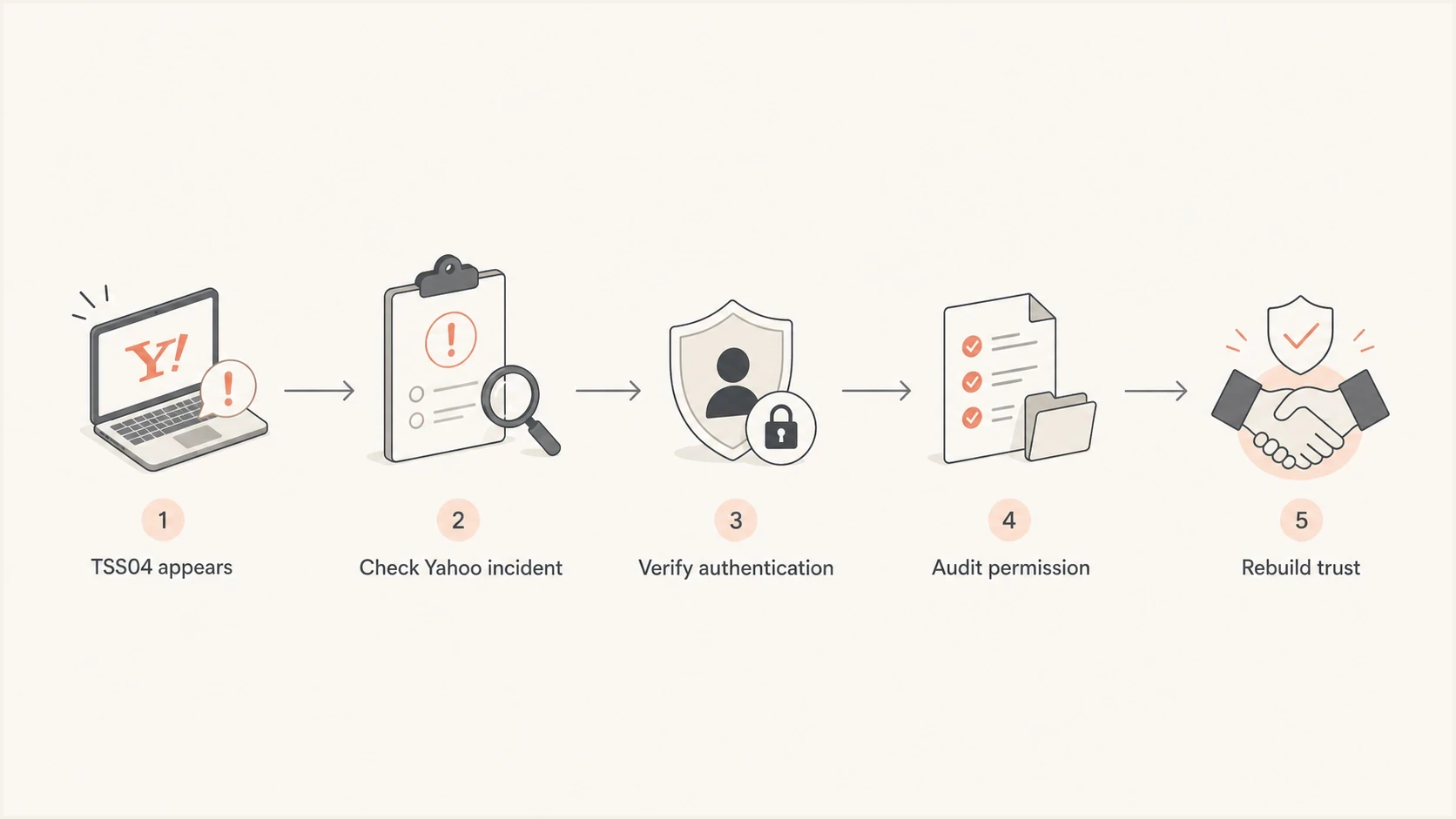
Yahoo TSS04 diagnosis path covering incidents, authentication, permission, and reputation.
Shared IP pools add another variable. A sender with few visible complaints can still suffer if other traffic on the pool has damaged the IP reputation, while a dedicated IP can still fail because its own history is weak. For the detailed comparison, read low complaints and dedicated IPs.
Separate a Yahoo-side incident from a sender-side problem by timing and scope. If multiple unrelated senders report the same deferral at the same time and queues recover within hours, a temporary Yahoo condition is likely. If your domains keep failing after the broader issue clears, treat sender reputation as the working cause.
TSS04 duration triage
Use duration as a triage aid, then confirm with logs and recipient-level data.
Brief spike
0-6 hours
Check for a Yahoo-side incident and retry with normal backoff.
Sustained issue
6-48 hours
Stop growth and review authentication, content, and Yahoo engagement.
Program problem
48+ hours
Treat it as reputation damage until the data proves otherwise.
What Yahoo evaluates
Yahoo can issue TSS04 during an early SMTP command, before it receives the message body. At that point it can use the connecting IP, host identity, envelope data, traffic rate, and stored reputation. Across the wider sending program, Yahoo also evaluates domain, DKIM signer, URLs, content patterns, complaint history, and recipient behavior.
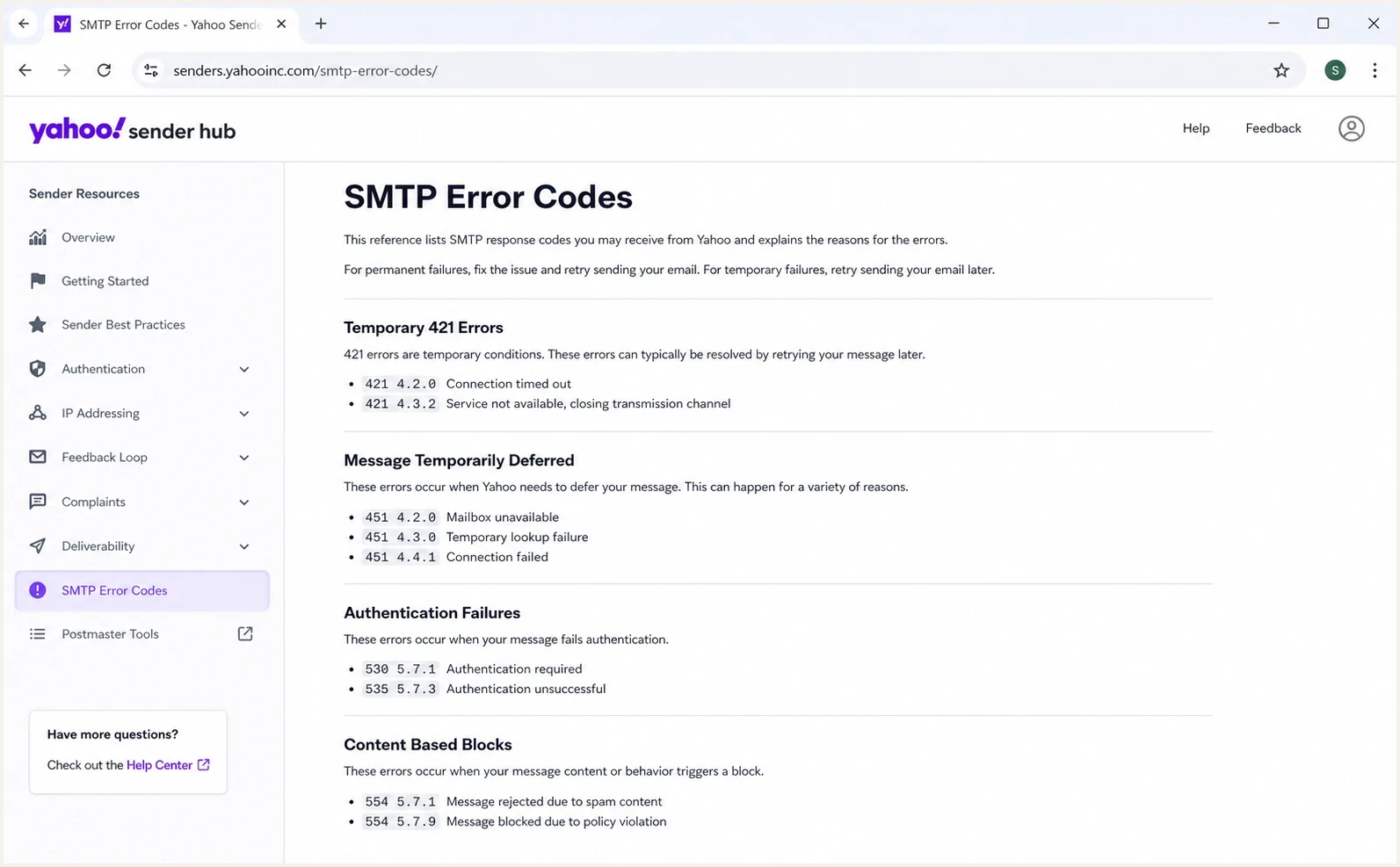
Yahoo Sender Hub SMTP error codes page showing temporary 421 deferrals.
Fix both the mail program and the server identity. Correct DNS gives Yahoo a verifiable sender identity. Clear consent, steady volume, active recipients, and complaint suppression give Yahoo evidence that users want the traffic.
Blocklist (blacklist) checks are still worth doing, but they are one input. A clean public listing status does not override Yahoo's private reputation data. A listed IP or domain is a reason to pause, investigate the source, and fix the traffic that caused the listing.
The hard boundary
If no one can verify how addresses were collected or whether recipients gave permission, server changes will only alter symptoms. TSS04 recovery requires a defensible source and suppression process.
Views from the trenches
Best practices
Ask for consent proof before troubleshooting; Yahoo reputation depends on wanted mail.
Keep full bounce logs, sending IPs, domains, templates, and recipient segments together.
Pause Yahoo volume increases until deferrals fall and engaged recipients accept mail.
Common pitfalls
Changing IPs or domains after TSS04 can look like evasion and deepen Yahoo distrust.
Seed inbox tests do not prove real Yahoo users want the campaign, offer, or timing.
Treating links as the only content signal misses headers, history, and list quality.
Expert tips
Separate brief Yahoo incidents from sender problems by timing, scope, and recovery.
Use authentication reports to prove identity before asking Yahoo to review a case.
Do not accept a client list when no one can explain acquisition, consent, and permission.
Expert from Email Geeks says Yahoo can reject after seeing the full message, so content and URL reputation still matter when the sender blames the IP.
2023-08-10 - Email Geeks
Expert from Email Geeks says repeated TSS04 usually means Yahoo has recognized the sender pattern and does not want more of that traffic.
2023-08-10 - Email Geeks
The practical path forward
Yahoo defers emails with TSS04 when it does not trust the traffic enough to accept it at the current rate. Recovery requires an authenticated sending identity, steady traffic, known sources, wanted recipients, controlled complaints, and content that matches what people requested.
Stop increasing Yahoo volume, verify SPF, DKIM, DMARC, forward DNS, and reverse DNS, audit permission, suppress weak segments, process complaints and unsubscribes, review content, then watch deferrals by IP and domain. Suped's product can turn DMARC and reputation findings into specific issues and remediation steps while the sending team tracks Yahoo acceptance separately.