What do Yahoo 421 errors mean and how to resolve them?


Updated on 27 Aug 2026: We added Yahoo Sender Hub complaint diagnostics and tightened the authentication, DNS, and retry guidance.
Yahoo 421 errors mean Yahoo has temporarily deferred your SMTP transaction. The message was not accepted at that moment, but the response is a 4xx status, so your sending server is allowed to retry. Temporary does not mean harmless. If Yahoo keeps returning 421 4.7.0 [TSS04], 421 [IPTS04], or a similar diagnostic, treat it as a live reputation, queue, or policy problem until the evidence says otherwise. A plain 421 can also come from temporary Yahoo capacity, DNS resolution, or authentication lookup problems.
The direct fix is to slow or pause Yahoo traffic, check the exact error text, separate affected IPs, domains, and campaigns, inspect complaint and engagement signals, verify SPF, DKIM, and DMARC, remove risky recipients, and restart with controlled volume. A recent Yahoo-only spike often points to stream-level filtering, not a simple Yahoo outage, especially when one campaign fails while another keeps delivering. If the same Yahoo 421 error persists past 48 hours after fixes, gather logs and submit a sender support request with the diagnostic code and timestamps.
Short answer
- Meaning: Yahoo is refusing the message for now, usually because of rate, reputation, complaints, content, authentication, DNS, or temporary capacity signals.
- Retry: Retry with backoff. Do not keep hammering the same Yahoo MX hosts with the same queue pressure.
- Resolution: Fix the sending cause first, then rebuild volume slowly enough for Yahoo to measure better recipient response.
When a real message needs inspection rather than guesswork from a bounce snippet, send a controlled message through the Suped email tester and compare the SMTP path, headers, and authentication result against the Yahoo error in the logs.
What a Yahoo 421 response means
A 421 response is an SMTP-level temporary failure. Yahoo has not accepted the message into its system, so your MTA keeps the message in queue and retries later. That retry is correct, but it is only a delivery mechanic. The retry does not solve a reputation issue, a complaint spike, an authentication failure, or a traffic pattern that Yahoo has decided to throttle.
Yahoo groups 421 and 451 as temporary SMTP errors. Its Yahoo SMTP error codes page lists causes such as unusual IP traffic, spam-like message characteristics, user complaints, busy mail servers, DNS resolution trouble, and temporary authentication lookup failures.
|
|
|
|---|---|---|
421 | Temporary | Retry slowly |
TSS04 | Reputation | Cut risk |
IPTS04 | IP policy | Segment IP |
4.7.0 | Policy | Review cause |
Common Yahoo 421 variants and how to treat them.
Typical Yahoo 421 log examplestext
421 4.7.0 [TSS04] Message temporarily deferred by Yahoo
421 [IPTS04] Message deferred for IP policy reasons
421 Resources temporarily unavailable, try again later
Read the full SMTP response, including the three-digit code, enhanced status code, diagnostic tag, and explanatory text. A plain resource-related 421 often clears after a short delay. Repeated TSS04 or IPTS04 responses across several IPs are stronger evidence that Yahoo is throttling sender behavior or reputation. When a sender says the IPs are 100% blocked even though the code is temporary, that usually means Yahoo is returning the same temporary rejection on every retry.
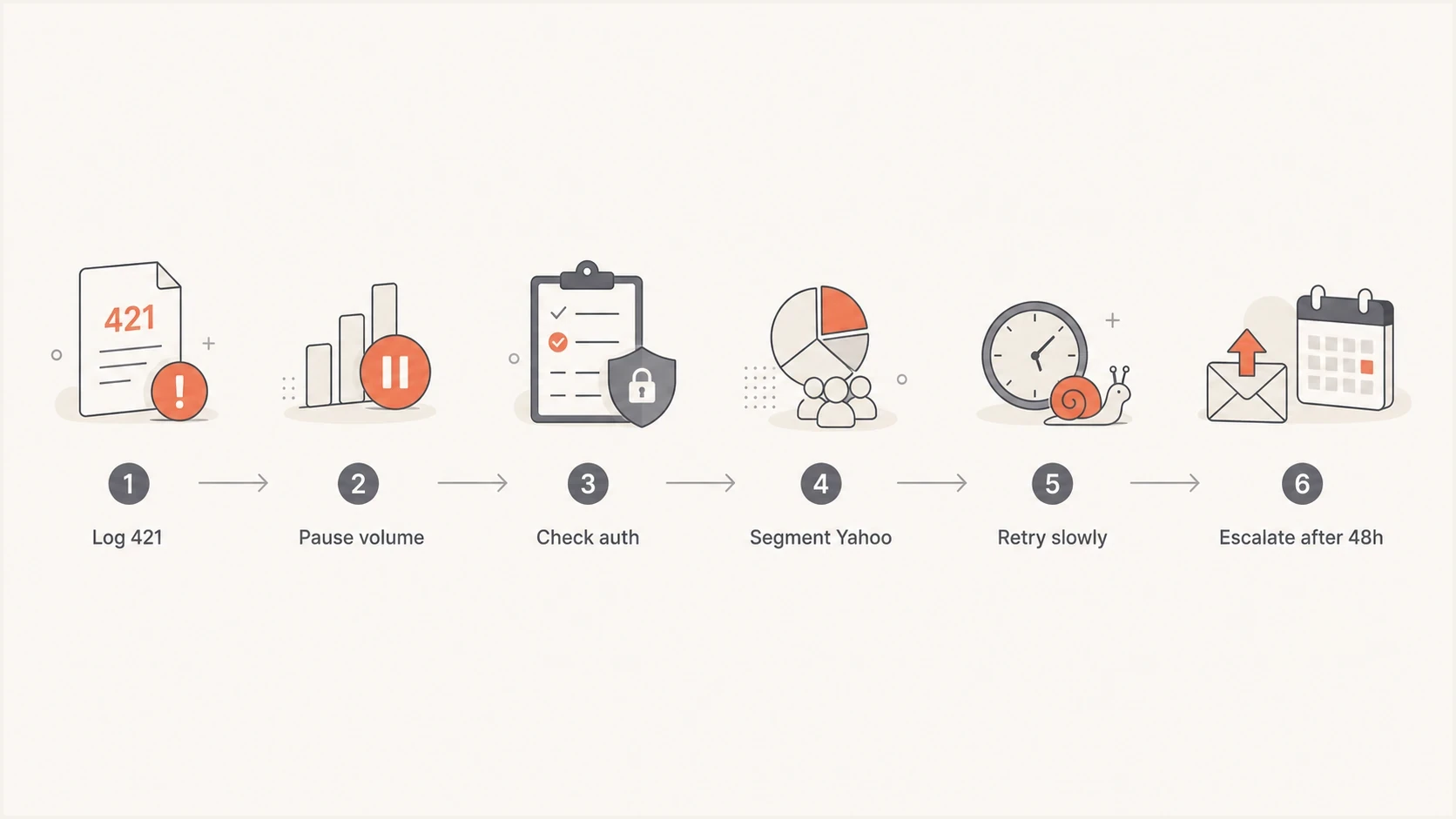
Flowchart showing Yahoo 421 troubleshooting: log the error, pause volume, check authentication, segment Yahoo traffic, retry slowly, and escalate after 48 hours.
Why a temporary deferral can continue
The word temporary only describes the SMTP status class. It does not promise that Yahoo will accept the same message later. If the same IP, domain, list segment, or campaign keeps producing the signal that caused the first deferral, Yahoo can keep returning 421 on each attempt. This is why a sender can see a soft bounce that behaves like a block.
The most common persistent causes are complaint rate, sudden volume increase, stale recipients, poor engagement, risky content, shared IP contamination, authentication gaps, and aggressive queue behavior. High opens or clicks do not prove Yahoo users want the mail. Yahoo documents reputation inputs that include IP, URL, domain, sender, ASN, DKIM, DMARC, and user complaint signals. The fix is not to retry harder. The fix is to change the input Yahoo is scoring.
Yahoo 421 response timeline
Use elapsed time to decide how forceful the response should be.
Brief delay
0-4h
Normal backoff is enough when errors clear quickly.
Watch closely
4-24h
Reduce Yahoo traffic and compare affected streams.
Active incident
24-48h
Pause risky mail and correct list or auth causes.
Escalate
48h+
Submit logs after fixes and controlled retries.
TSS04 is especially easy to misread. It is a temporary deferral, but it is often tied to user complaints or reputation, so it repeats until the cause improves. For a deeper Yahoo-specific walkthrough, the TSS04 resolution guide covers that diagnostic in more detail.
Do not confuse retry with recovery
A retry queue protects messages during short delays. It does not repair sender reputation. If Yahoo is deferring because users are marking mail as spam, every retry of the same mail stream gives Yahoo more of the same evidence.
Check blocklist and blacklist status when a Yahoo 421 event appears across several IPs. Yahoo does not have to mirror any public blocklist, but public blacklist listings often point to the same root cause: compromised traffic, poor acquisition, or a sender pool carrying mail that recipients do not want.
How to diagnose Yahoo 421 errors
Start with the evidence that can be segmented. One Yahoo 421 response in isolation is noise. A pattern by IP, sending domain, envelope sender, campaign, recipient age, or MTA queue is useful. The goal is to find the smallest unit that explains the deferrals, then reduce risk on that unit while keeping healthier mail moving.
Run a broad authentication check first. Broken SPF, missing DKIM, failed DMARC alignment, or an unresolvable sending domain can give Yahoo less confidence when traffic patterns change. Suped's domain health checker is useful here because it checks the core email authentication records in one pass before you spend hours tuning queue behavior.
?
What's your domain score?
Deep-scan SPF, DKIM & DMARC records for email deliverability and security issues.
- Capture: Save the full SMTP response, the Yahoo MX host, timestamp, source IP, envelope sender, header From domain, and queue ID.
- Group: Group events by IP, domain, campaign, recipient source, and mail class so the affected stream is clear.
- Compare: Compare Yahoo-only failure rates with non-Yahoo delivery, complaint rate, bounce rate, and recent volume changes.
- Verify: Verify SPF, DKIM, DMARC alignment, forward and reverse DNS, SOA resolution for sending domains, HELO identity, TLS, unsubscribe headers, and RFC-compliant message structure.
- Decide: Decide whether to throttle, pause, split traffic, suppress recipients, change content, or contact the sending provider.
Yahoo requires all senders to authenticate with SPF or DKIM at minimum. Bulk senders need both SPF and DKIM, a DMARC policy of at least p=none that passes, and alignment between the From domain and either the SPF or DKIM domain. Yahoo also requires valid forward and reverse DNS plus RFC 5321 and RFC 5322 compliance, and recommends separate paths for bulk, transactional, alert, and user mail.
Use Yahoo complaint data to find the cause
Yahoo Sender Hub Insights gives verified domains Yahoo-specific delivery data, including delivered volume and spam complaint rate. Use it when a TSS04 response points to user complaints. Yahoo calculates this complaint rate against mail delivered to the inbox, so it can differ from an internal rate that counts spam-folder delivery in the denominator.
- Verify the domain: Add and verify the relevant domain in Yahoo Sender Hub, then activate Insights. Data is grouped by the selected DKIM signing domain.
- Enroll the DKIM domain: Yahoo's Complaint Feedback Loop is domain-based and uses the d= domain in the DKIM signature. It does not enroll an IP or CIDR range.
- Process ARF reports: When Yahoo sends a complaint report, map it to the campaign and suppress that recipient from future campaigns.
- Compare before and after: Track complaint rate and delivered volume after pausing the affected stream, cleaning the audience, and resuming at lower volume.
Insights needs a verified domain, activation time, and enough daily volume before data appears. Allow 24 to 48 hours after activation, and use SMTP logs as the incident record while waiting. If one DKIM domain signs several sending domains, Yahoo can roll their data together, so compare DKIM signing domains as well as visible From domains.
Complaint data needs immediate suppression
A complaint report identifies a recipient who marked the message as spam. Suppress that recipient promptly. Re-mailing the same person can keep the complaint signal active and extend Yahoo throttling.
How to resolve Yahoo 421 errors
The safest recovery plan is simple: stop making the error worse, remove the reason Yahoo is deferring, then restore volume in measured steps. Do not keep marketing traffic pushing at full rate while investigating TSS04. That usually extends the problem.
Bad recovery pattern
- Queue pressure: The MTA retries aggressively and creates repeated connection attempts to Yahoo.
- Same audience: The same unengaged or complaint-heavy recipient segment keeps receiving attempts.
- No isolation: Transactional, lifecycle, and bulk traffic share the same failing path.
Better recovery pattern
- Backoff: Retries use exponential backoff and lower concurrency for Yahoo destinations.
- Suppression: Recent complainers, inactive recipients, old imports, and unknown recipients are removed before retry.
- Separation: High-priority mail uses a clean path while bulk mail is paused or reduced.
Start by reducing Yahoo volume. If the issue is isolated to one campaign, pause that campaign. If it is isolated to one IP, remove Yahoo traffic from that IP and send only the safest mail after fixes. If all IPs are affected, lower total Yahoo concurrency and stop bulk sends until complaint and engagement risk is under control. A dedicated IP does not fix a bad stream by itself, and a shared IP is not always the root cause.
Illustrative retry posturetext
Attempt 1: defer after the first Yahoo 421 response
Attempt 2: retry after a short backoff
Later attempts: increase the delay between retries
Recovery: keep concurrency low and stop risky campaigns
Yahoo does not publish one universal retry interval or concurrency limit. Use the MTA's exponential backoff and queue-expiry policy, reduce concurrent connections when deferrals repeat, and avoid synchronized retries that recreate the original traffic spike.
Next, clean the list segment that produced the errors. Remove hard bounces, recent spam complaints, role accounts that do not engage, unconfirmed imports, unknown recipients, and subscribers with long inactivity. Use confirmed opt-in for new subscribers, monitor hard and soft bounces, and keep Yahoo's complaint rate below 0.3%. Yahoo calculates that rate against mail delivered to the inbox, so match that denominator when comparing internal reporting. For Yahoo, engagement is not decorative. If users ignore or complain, a technically valid message still loses trust.
Then check the message itself. Look for misleading subject lines, broken unsubscribe handling, URL shorteners, sudden template changes, attachments, and content that differs sharply from what recipients signed up to receive. Bulk senders should support one-click unsubscribe for marketing and subscribed messages, keep a visible unsubscribe link in the email body, and process unsubscribes within 2 days. Authentication and reputation get you to the door. Recipient reaction decides whether Yahoo keeps the door open.
Generic 421 cases need a short receiver-capacity check before deeper remediation. If Yahoo accepts normal volume again after brief backoff, keep the queue conservative and watch the next send. If the same TSS04 or IPTS04 code returns on every attempt, treat it as sender-side filtering and change the stream before retrying at normal volume.
Where Suped fits in the workflow
Yahoo 421 recovery is easier when authentication, reputation, and failure signals are visible in one place. Suped's product is a DMARC reporting and email authentication platform that connects DMARC, SPF, DKIM, blocklist monitoring, hosted records, and alerts into one operational workflow instead of leaving each check in a separate spreadsheet.
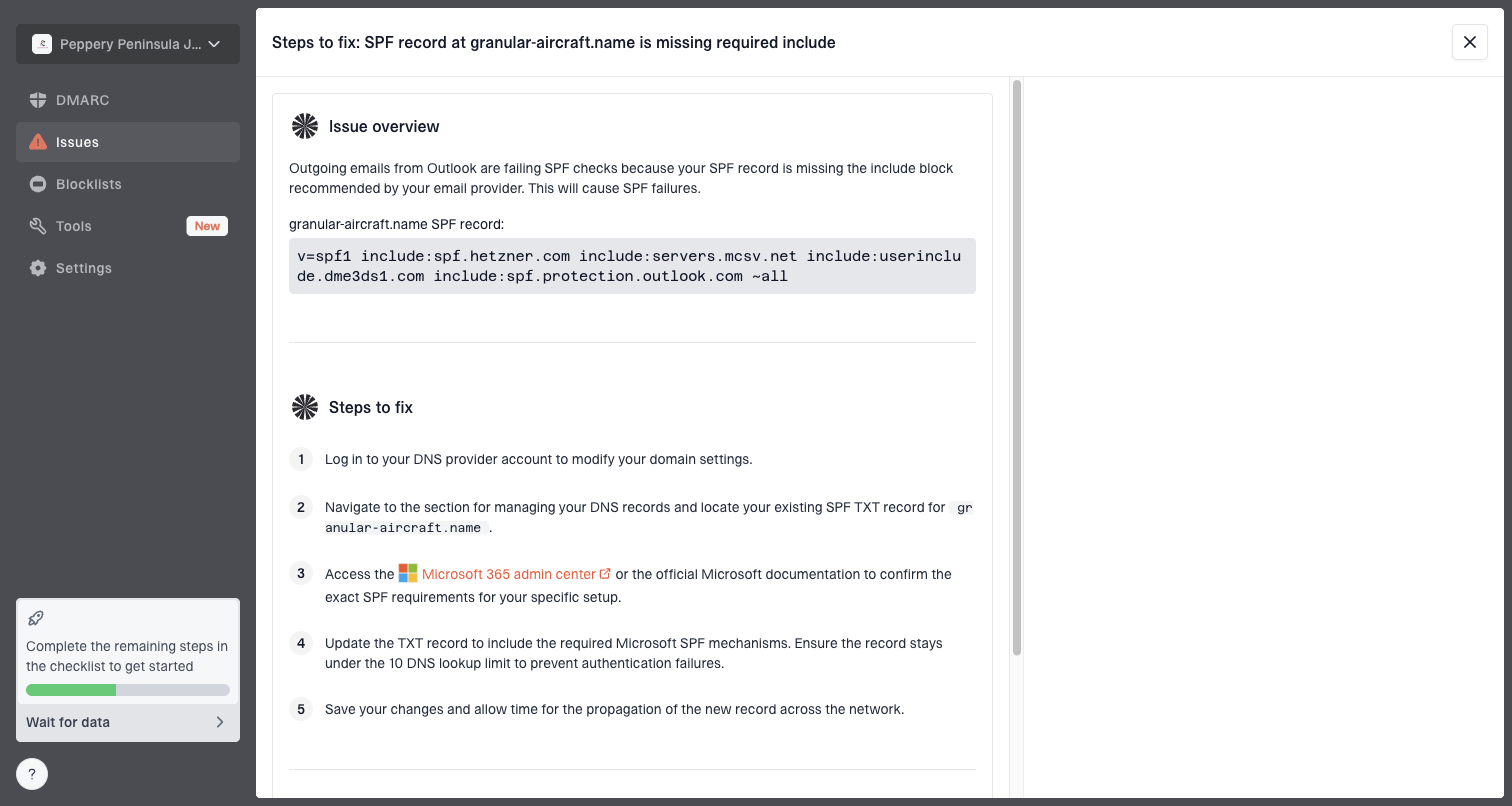
Issue steps to fix dialog showing the issue overview, tailored fix steps, and verification action
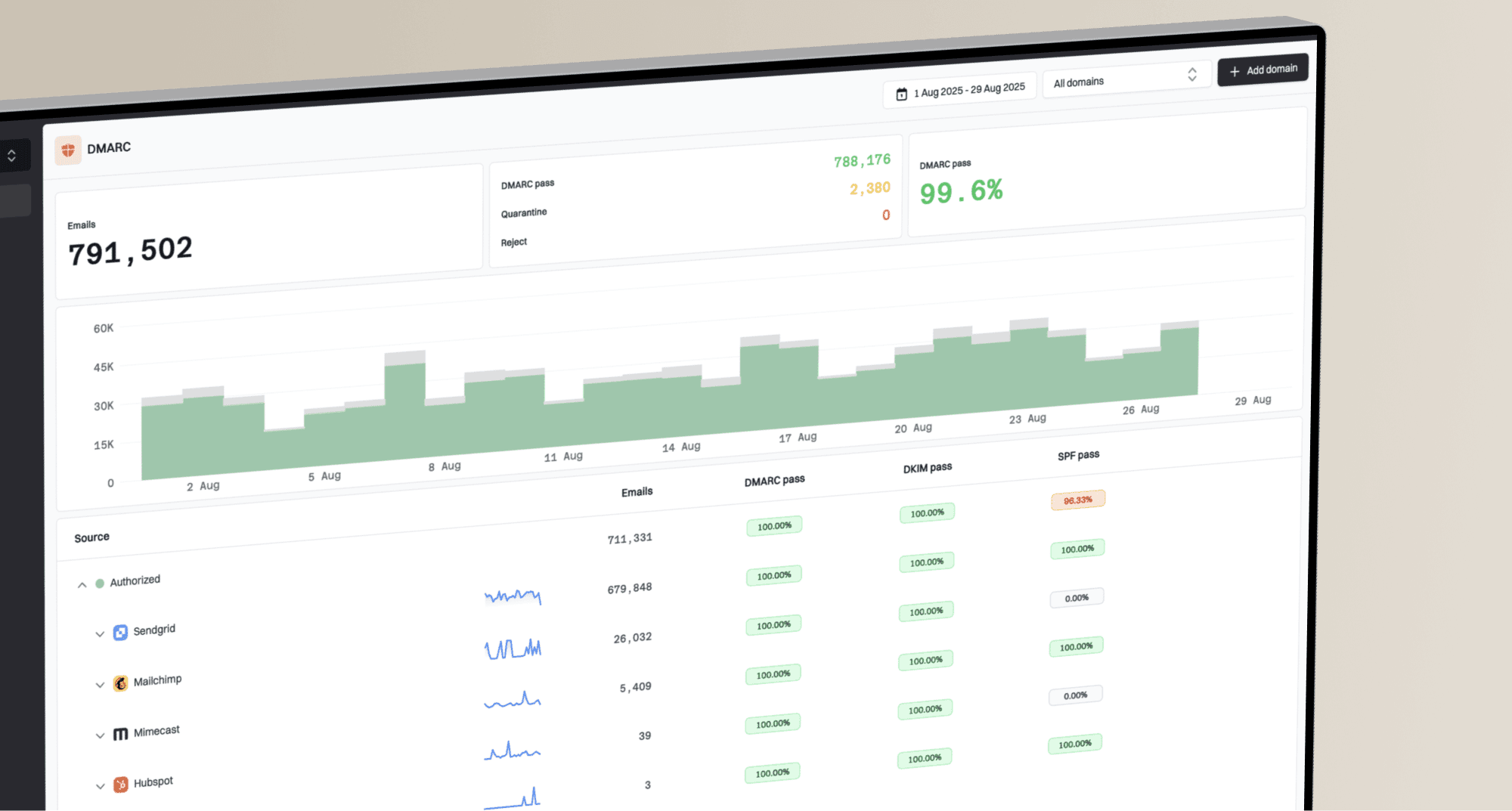
For a Yahoo 421 incident, the practical Suped workflow is to confirm the domain's authentication state, find unverified or failing sources, review DMARC-passing sending volume, and create alerts for sudden failure changes. The DMARC monitoring view helps identify which platforms are sending for the domain and whether they pass authentication before you tune Yahoo delivery.
If the problem overlaps with reputation, Suped's blocklist monitoring helps watch domain and IP status across major blocklist and blacklist sources. That does not replace Yahoo-specific remediation, but it gives the team a faster way to spot broader sender health issues.
Best practical workflow
- Detect: Use alerts to catch authentication changes, failing sources, and reputation movement before Yahoo deferrals spread.
- Fix: Use Suped's issue steps to turn raw DMARC evidence into a specific DNS or sender fix.
- Stage: Use hosted DMARC, hosted SPF, SPF flattening, and hosted MTA-STS when DNS changes need safer management.
- Scale: Use the MSP and multi-tenant dashboard when several client domains need the same incident workflow.
DMARC alone does not fix Yahoo 421 errors. Authentication evidence helps rule out avoidable failures while the team focuses on list quality, complaints, traffic shaping, and Yahoo-specific recovery.
Views from the trenches
Best practices
Keep full SMTP logs so each Yahoo deferral maps to an IP, campaign, domain, and timestamp.
Reduce Yahoo volume before retries stack up, then resume only with engaged recipient segments.
Use Yahoo's current Sender Hub guidance instead of old help pages found through search.
Common pitfalls
Treating 421 as harmless lets queues keep sending the same reputation problem repeatedly.
Fixing only DNS records misses complaint, content, and list quality causes behind TSS04.
Escalating without logs slows support because Yahoo needs exact codes, IPs, and times.
Expert tips
If several IPs fail at once, compare shared audience sources before blaming one server.
Keep transactional traffic separate so bulk campaign throttling does not block urgent mail.
After a reset or recovery, warm Yahoo traffic slowly enough for recipient response to improve.
Marketer from Email Geeks says a 4xx response allows retry, but Yahoo can defer the same message again when the complaint or reputation cause remains unchanged.
2023-04-30 - Email Geeks
Marketer from Email Geeks says sender support is appropriate when the issue looks like a filter problem and the sender has clear logs to share.
2023-05-01 - Email Geeks
A practical path back to acceptance
Yahoo 421 errors are temporary at the SMTP layer, but repeated TSS04 or IPTS04 errors are operational incidents. Retry with backoff, but do not depend on the queue to solve the cause. The sender has to reduce the signal Yahoo is reacting to.
The fastest path is usually a disciplined sequence: pause risky Yahoo traffic, isolate the affected stream, verify authentication, suppress weak recipients, review complaints and content, then restart with low volume and strict monitoring. If the same 421 diagnostic continues after those changes, escalate with exact logs rather than a general complaint about deferrals.
Suped helps keep that process concrete by tying DMARC evidence, source identification, hosted authentication controls, alerts, and reputation monitoring into one place. That gives the team fewer blind spots while Yahoo evaluates the changed traffic.