TechTheft Nana Blacklist

The TechTheft Nana blacklist is an IP blocklist that adds resources with unresolved abuse complaints. Monitor your DMARC reports with Suped.
Updated on 17 Jun 2026: We refreshed TechTheft Nana guidance with clearer DNSBL context and a practical remediation workflow.
Summarize with
Check if you are listed on TechTheft Nana Blacklist
And 143 other blocklists.







What is TechTheft Nana Blacklist?
The TechTheft Nana Blacklist, with the zone name nana.bl.techtheft.info, is a private, IP-based Domain Name System Blocklist (DNSBL). Mail systems that have access can query the DNSBL by IP address during filtering and receive a DNS response code when an IP is listed. A listing occurs when a network abuse complaint is sent and remains unresolved. The operators describe the policy as an "Internet Death Penalty" against sources and supporters of internet abuse.
Unlike many other blocklists, this is a private blacklist. It is not available for public use, and access is granted by invitation only to trusted subscribers. The operators do not accept public nominations to the list. They review information posted to certain Usenet groups for inclusion. The NANA name refers to the news.admin.net-abuse.* Usenet hierarchy, where some abuse reports are publicly discussed.
The blocklist can include more than mail servers. Specific listed resources include:
- Email sources and servers
- DNS nameservers
- Network IP blocks
- Website hosts
- Compromised hosts and malware-infected machines
- Web crawling agents
- Attack sources that interact with traps
If an IP is listed and returns a 127.0.1.* code, TechTheft treats that as an indication that the issues related to the IP have been publicly documented in news.admin.net-abuse.* Usenet groups.
Who runs TechTheft Nana Blacklist?
The blacklist is run by an organization named TechTheft. The group describes its core mission as fighting "Hi-Technology Theft," a term it uses for activity such as malware attacks, spam email, DDoS attacks, and IP hijacking.
TechTheft describes itself as part of a group of administrators and technology hobbyists who work to prevent malicious online activity. It justifies aggressive blocking policies by pointing to the limitations of earlier anti-spam systems. In TechTheft's view, those systems were too slow or lenient, which created the need for a stricter approach that cuts off abuse at its source.
How do I get removed and delisted from TechTheft Nana Blacklist?
Removal from the TechTheft Nana blocklist is an automated process based on resolving the underlying abuse issue. There is no public manual delisting form or request process. Once the source of the abuse is fixed and active complaints are closed, the listing is removed.
Before delisting, address all active complaints against the listed IP address. TechTheft notes that it provides a list of open complaints for affected IPs. Confirm that the abuse mailbox for the sending domain and the IP block works, including abuse@yourdomain.com. Also check the RIR or RDAP abuse contact for the netblock, because complaints sent to stale contacts keep the problem unresolved.
Then fix the cause of the complaint rather than only requesting removal. Common causes include compromised mail scripts, open relays, infected hosts, abusive web crawlers, DDoS traffic, and ignored spam reports. Once every complaint is resolved, the blacklist entry clears through the blocklist's automated process.
How to investigate a TechTheft Nana listing
Treat a TechTheft Nana listing as an IP-specific abuse investigation. A domain-level email authentication check will not identify every affected host, because the DNSBL is based on sending or network IPs.
- Confirm the exact IP address that returned a TechTheft Nana response code, then match it to the sending service, server, customer, or network allocation in use at that time.
- Review mail logs, bounce messages, firewall logs, and web server logs for the listed IP. Look for spam bursts, open relay behavior, compromised forms, bot traffic, and unexpected crawling.
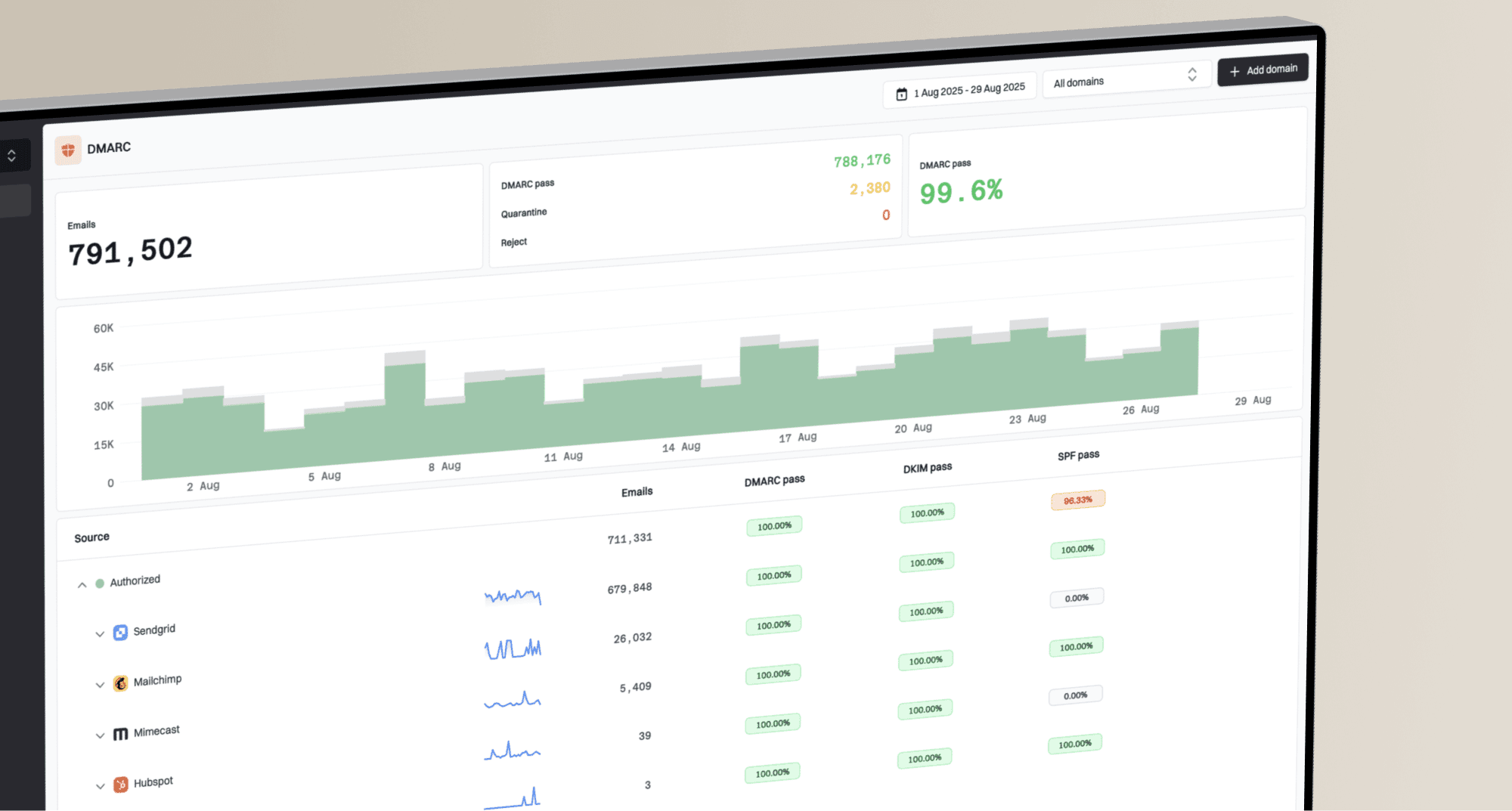
- Use DMARC aggregate reports to identify which domains and mail streams used the IP. Suped's DMARC reporting helps group mail by source IP, DKIM result, SPF result, DMARC result, and sending domain so the investigation starts with the right traffic.
- Keep records of remediation work and abuse replies, because TechTheft's process depends on complaints being resolved rather than a one-off delisting request.
After cleanup, monitor new outbound traffic and rejection logs for the same IP. If mail to a subscriber is blocked again, the remaining problem is usually an unresolved complaint or a fresh abuse event tied to that IP.
What's the impact of being listed on TechTheft Nana Blacklist?
The impact of being on the TechTheft Nana Blacklist is usually low for most senders.
This is because it is a private blocklist (blacklist) used internally by a small group of subscribers. It is not a public DNSBL and there is no public evidence that major consumer mailbox providers use it for broad inbound filtering. For most senders, a listing does not affect delivery to the majority of recipients on the internet.
However, if you send email to an organization that subscribes to this list, the impact is high. Messages from the listed IP can be blocked completely at that destination. The impact is narrow, but it is severe for affected recipient domains.
Related TechTheft Nana blocklists
TechTheft Bad Whois Blacklist
Organization
TechTheft
Zone
bad.whois.bl.techtheft.info
Type
Domain
Impact
Inactive
Delisting
Manual
TechTheft Blacklist
Organization
TechTheft
Zone
bl.techtheft.info
Type
IP
Impact
Inactive
Delisting
Manual
TechTheft Bogon Blacklist
Organization
TechTheft
Zone
bogon.bl.techtheft.info
Type
IP
Impact
Inactive
Delisting
Manual
TechTheft Conferr Blacklist
Organization
TechTheft
Zone
conferr.bl.techtheft.info
Type
IP
Impact
Inactive
Delisting
Manual
TechTheft Domain Blacklist
Organization
TechTheft
Zone
domain.bl.techtheft.info
Type
IP
Impact
Inactive
Delisting
Manual
TechTheft Expanded Blacklist
Organization
TechTheft
Zone
expanded.bl.techtheft.info
Type
IP
Impact
Inactive
Delisting
Manual
TechTheft ISP Blacklist
Organization
TechTheft
Zone
isp.bl.techtheft.info
Type
IP
Impact
Inactive
Delisting
Manual
TechTheft Other Blacklist
Organization
TechTheft
Zone
other.bl.techtheft.info
Type
IP
Impact
Inactive
Delisting
Manual
TechTheft Robot Blacklist
Organization
TechTheft
Zone
robot.bl.techtheft.info
Type
IP
Impact
Inactive
Delisting
Manual
TechTheft Scanning Blacklist
Organization
TechTheft
Zone
scanning.bl.techtheft.info
Type
IP
Impact
Inactive
Delisting
Manual
TechTheft Source Blacklist
Organization
TechTheft
Zone
source.bl.techtheft.info
Type
IP
Impact
Inactive
Delisting
Manual
TechTheft Support Blacklist
Organization
TechTheft
Zone
support.bl.techtheft.info
Type
IP
Impact
Inactive
Delisting
Manual
TechTheft Virus Blacklist
Organization
TechTheft
Zone
virus.bl.techtheft.info
Type
IP
Impact
Inactive
Delisting
Manual
TechTheft Watchlist Blacklist
Organization
TechTheft
Zone
watchlist.bl.techtheft.info
Type
IP
Impact
Inactive
Delisting
Manual
TechTheft Web Blacklist
Organization
TechTheft
Zone
web.bl.techtheft.info
Type
IP
Impact
Inactive
Delisting
Manual