Do spam traps ever open or click on emails?

Published 24 Apr 2025
Updated 7 Aug 2026
13 min read
Summarize with
Updated on 7 Aug 2026: We clarified how automated opens and clicks affect spam trap investigations and added a practical process for reducing trap risk.
Yes, spam traps can open or click emails, but that is not the normal assumption to build reporting around. Most true spam traps, especially pristine and recycled addresses operated for reputation measurement, are designed to receive mail without normal subscriber behavior. That means no ordinary reading, no normal link browsing, and no buying signal. The catch is that "spam trap" is a broad term, and different trap networks, mailbox providers, security systems, and researchers handle trapped mail differently.
The practical answer is this: a trap hit should never be treated as proof of engagement just because an open pixel fired or a link received a request. A spam trap can sit behind automated content analysis, malware inspection, link detonation, image proxying, or human review. Some traps never engage at all. Some networks reserve the right to fetch content. Some addresses described as traps have been seen confirming subscription messages. The word "never" is too absolute.
That does not mean spam traps are acting like active readers. It means open and click telemetry has to be interpreted with care, especially when deliverability risk, blocklist (blacklist) exposure, and list hygiene decisions are involved. A single pixel load is weak evidence. A trap source in your mail stream is strong evidence that your acquisition, permission, suppression, or reactivation process needs work.
The direct answer
The safest operating model is simple: spam traps usually should not open or click, but some do under controlled or automated conditions. Do not use opens or clicks alone to clear a suspected spam trap from your suppression logic.
- Treat trap engagement as suspicious, not as normal subscriber activity.
- A trap hit tells you more about list quality than the open or click tells you about intent.
- Repeated trap hits increase blocklist and blacklist risk even when engagement metrics look acceptable.
A real subscriber opens because they read the message, or clicks because the offer, account notice, receipt, or content is relevant. A trap-related open or click, when it happens, usually comes from a system evaluating the message or a person investigating it. Those are different events. They do not indicate consent, interest, or inbox placement strength.
This matters because many senders still use engagement rules such as "keep anyone who opened in the last 180 days" or "send reactivation to anyone who clicked once." Those rules can preserve bad addresses when automated opens and clicks are mixed into the data. The same issue affects spam traps, security scanners, mailbox image proxies, privacy-prefetched opens, and enterprise link protection systems.
If the question is whether a pristine trap has to stay completely inert, the answer is no. Most trap operators do not need traps to behave like users, but they can still use trapped mail for payload evaluation, content review, abuse research, or threat analysis. If the question is whether a normal marketing click from a known trap proves the address is not a trap, the answer is also no.
Why some traps generate opens or clicks
The main reason is that email is processed by more than a mailbox interface. A message can pass through filters, scanners, proxies, sandboxes, and review systems before any human sees it. Some of those systems fetch remote images. Some rewrite and visit links. Some load a landing page to detect malware, credential collection, suspicious redirects, or unwanted content.
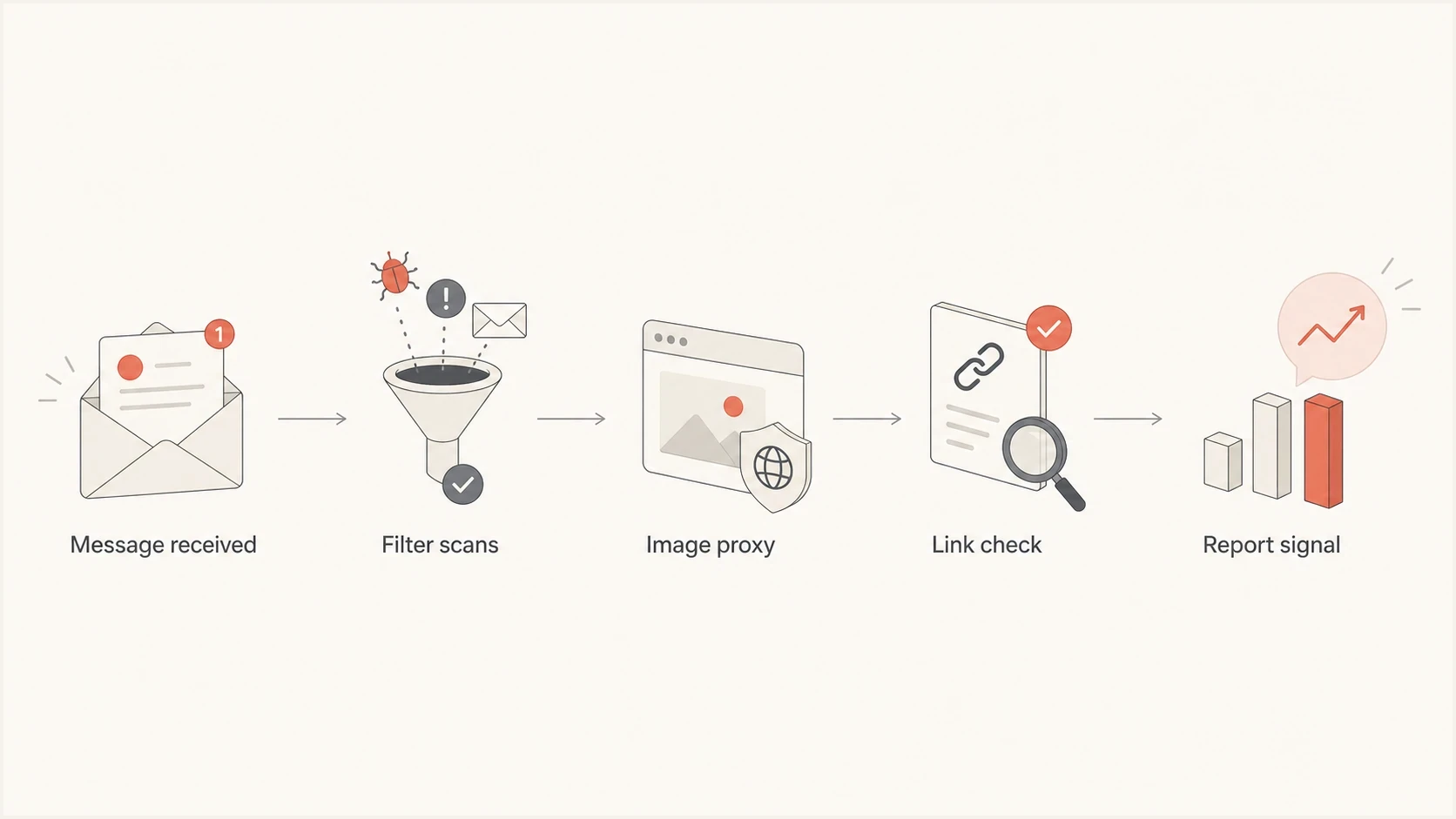
Flowchart of a spam trap email passing through filter scans, image proxying, and link checks.
- A trap network or mailbox system fetches links or images to inspect the message body, redirects, attachments, or landing page behavior.
- Security systems detonate links in controlled environments to check whether a URL changes destination, downloads files, or collects credentials.
- A researcher reviews a sample manually, especially when the message is part of abuse tracking or a sender reputation investigation.
- A trapped address can receive mail through a forwarding path, alias, shared mailbox, or abandoned account workflow that changes how the message is handled.
- Some addresses labeled pristine have been observed confirming subscription mail, so confirmation alone does not prove a clean acquisition source.
The operational distinction resolves the apparent contradiction. Spam traps are not normal subscribers, but a tracking request can still occur when a system or investigator evaluates the mail. Treat the request according to its behavior and keep the trap hit tied to the underlying list-quality problem.
What a click from a trap means
A click from a suspected trap means the message or link was accessed. It does not mean the recipient was a person, it does not mean the address opted in, and it does not mean the address is safe to keep. The right interpretation depends on the surrounding pattern.
|
|
|
|---|---|---|
Open only | Image proxy or scanner | Do not reclassify |
Fast click | Automated link check | Discount in scoring |
Many links | Security crawl | Flag as bot-like |
Form submit | Stronger intent signal | Review source and session |
Trap report | List quality issue | Suppress affected segment |
How to interpret trap-adjacent engagement signals.
The timing pattern is often the giveaway. A link request that occurs within seconds of delivery, hits every link in the email, uses a scanner user agent, or comes from a data center IP should be treated differently from a click that follows a normal read path. Even then, bot detection is probabilistic. The goal is not perfect attribution of every event. The goal is to prevent automated events from driving permission and deliverability decisions.
If you are diagnosing this in live campaigns, compare the behavior against known patterns of spam filter clicks. That makes the trap question easier to separate from the broader problem of machine-generated engagement.
Trap type matters
The type of trap changes the likely cause and the right response. A pristine trap points toward address collection, form abuse, purchased data, poor partner controls, or weak validation at signup. A recycled trap points toward old data, weak sunset rules, and permission that expired. A typo trap points toward form quality and address correction problems.
Pristine traps
Pristine traps were not used by a real person for normal email. They point to acquisition quality, scraping, injected addresses, list rental, co-registration abuse, or unchecked partner sources.
- Permission cannot be trusted.
- Pause the source and audit the collection path.
Recycled traps
Recycled traps were once valid addresses, then were abandoned and repurposed. They point to old lists, weak bounce processing, or reactivation that keeps mailing inactive people.
- Suppression and sunset rules are too loose.
- Tighten inactivity windows and bounce handling.
A click from either type should not distract you from the source problem. If a pristine trap clicks a confirmation link, the strange click is interesting, but the more important issue is that a non-consenting address got into the confirmation flow. If a recycled trap opens a newsletter, the open is interesting, but the core issue is that an abandoned address stayed active long enough to become a trap.
For a deeper breakdown of trap categories, see types of spam traps. The category helps decide whether you should investigate acquisition, aging, suppression, or all of them together.
Why you cannot identify every spam trap
Spam traps do not normally appear as a distinct status in campaign reports, and trap operators rarely disclose the individual addresses. Revealing them would make the trap network easy to evade. A delivered message, an open, or a click therefore cannot confirm that an address is safe.
- Store the signup time, form, consent record, import batch, and partner source so a trap report can be traced to a collection path.
- Check syntax, domain spelling, and whether the domain accepts mail. Validation reduces bad data but cannot certify that an address is not a trap.
- Confirmation reduces accidental and injected signups, but an automated confirmation is still not proof of a human subscriber.
- Retain hard-bounce and unsubscribe records across imports so old addresses cannot be added back by another source.
- Do not send a full campaign to an old or undocumented list. Review permission and suppress long-inactive contacts before any limited reactivation.
The objective is not to find a secret list of traps. It is to remove the acquisition and retention conditions that allow pristine, recycled, or typo traps to remain in the audience. Permission-based list building and regular list cleaning reduce risk more reliably than address-level guesswork.
How to detect automated opens and clicks
You cannot reliably identify a spam trap from one event, and you should not try to build a secret trap detector from click logs alone. What you can do is separate human-like engagement from machine-like engagement so bad signals do not pollute your list decisions.
Bot-click indicators to flag in event datatext
event_time - delivery_time < campaign_threshold
clicked_links >= 3 in one message
user_agent contains security scanner terms
source_ip belongs to cloud or security infrastructure
open and click occur almost simultaneously
same IP clicks many recipients across one campaign
A single indicator is not enough, and the timing threshold should match the message type. Fast clicks can happen when a real person is already waiting for a message, especially in password reset or double opt-in flows. A cloud IP can appear because of privacy proxies. The strongest pattern combines very fast timing, multiple links, no dwell time, an unusual user agent, and repeated behavior across many recipients.
Email tester
Send a real email to this address. Suped shows a results button when the test is ready.
?/43tests passed
For controlled testing, send a real message through the email tester and review authentication, message structure, redirects, and delivery results. This will not identify a spam trap, but it can rule out separate authentication or message-construction problems while you investigate the list source.
Do not use hidden links as a simple bot filter without thinking through the side effects. Hidden or near-hidden links can look deceptive, trigger automated inspection, create accessibility problems, and produce false conclusions.
- Use timing, link breadth, user agent, IP pattern, and session depth together.
- Treat downstream action, account login, purchase, or form completion as stronger evidence than an email click.
How to respond after a trap hit
The response should be operational. Do not spend days debating whether the trap "really" clicked. Treat the event as a warning that your mail reached an address it should not have reached, then narrow the exposure.
- Pause the affected acquisition source, upload path, partner feed, old segment, or reactivation audience while you investigate.
- Check whether the issue clusters by signup date, source, form, domain, geography, campaign, or import batch.
- Verify SPF, DKIM, DMARC, rDNS, and alignment because authentication failures and trap exposure are distinct causes of delivery trouble.
- Suppress long-inactive contacts, hard bounces, repeated soft bounces, and addresses with only machine-like engagement.
- Watch domain and IP reputation for blocklist and blacklist listings after the affected campaign.
Suped's product supports this investigation by placing DMARC source data, SPF and DKIM results, blocklist monitoring, and deliverability alerts in the same workflow. A team can trace which sending source used the domain, confirm whether its mail aligned, and watch for a reputation change after the trap-related campaign. Suped does not claim to reveal the individual trap address.

Issue steps to fix dialog showing the issue overview, tailored fix steps, and verification action
For teams that manage multiple brands, clients, or sending platforms, this matters because trap hits are rarely isolated to a single metric. An unknown platform can send on your domain without proper SPF or DKIM alignment, while trap exposure can come from the list source. A blocklist (blacklist) listing can appear after the campaign rather than at the moment of the trap hit. Suped's issue detection and remediation steps turn those findings into a clear queue of work.
What to do about blocklists
Spam traps are often connected to blocklist and blacklist decisions, but the relationship is not always one-to-one. A single trap hit does not guarantee a listing. Repeated trap hits, high complaint rates, unknown-user failures, poor sending infrastructure, or other reputation problems make a listing more likely.
Blocklist checker
Check your domain or IP against 144 blocklists.






If you suspect trap exposure, check your sending IPs and domains for active listings, then continue monitoring after cleanup. Suped's blocklist monitoring supports that ongoing workflow, especially when you need alerts instead of one-off lookups.
A one-time lookup still helps during triage. If you need to inspect a domain or IP quickly, use the blocklist checker and record the results beside the campaign, source, send time, and affected segment. That timeline helps separate a trap-driven listing from an unrelated reputation issue.
Trap-hit response urgency
A practical way to prioritize response based on trap recurrence and reputation impact.
Low
Monitor
One isolated signal with no listing and no source cluster.
Medium
Pause
Repeated hits tied to one source, segment, or import batch.
High
Suppress
Trap hits plus blocklist, complaint, or bounce deterioration.
How to prevent trap-driven false confidence
The biggest mistake is allowing a low-quality address to stay active because it opened or clicked once. Engagement-based retention rules are useful, but only when the engagement signal has been cleaned. If your system treats every open as equal, bot and trap-adjacent activity will inflate your active audience.
Weak rule
Keep every address that opened or clicked in the last 180 days, regardless of timing, link pattern, source, age, or downstream behavior.
- Machine activity keeps risky addresses active.
- Open rate looks healthier than list quality.
Stronger rule
Keep addresses with clean source history, recent human-like engagement, low bounce risk, and useful downstream activity.
- Retention reflects real audience quality.
- Reactivation decisions are less exposed to bot noise.
A good engagement model separates weak signals from strong signals. Weak signals include opens, very fast clicks, and clicks on every link. Stronger signals include account login, reply, checkout, preference update, support interaction, or sustained behavior across multiple campaigns. For B2B lists, a click from a corporate security scanner should not reset the same lifecycle clock as a real content download.
The right list hygiene policy also depends on sending cadence. A daily sender needs faster suppression because bad addresses receive more volume. A seasonal sender needs strict re-permission because old data ages silently. A sender with partner acquisition needs source-level scoring, because one poor partner can contaminate the whole program.
A practical rule is to require at least one non-email signal before a risky or long-inactive address is kept in a core sending segment. That can be a login, purchase, form completion, reply, preference update, or verified support interaction.
Practitioner views on spam trap clicks
Best practices
Separate bot-like clicks from lifecycle scoring before suppressions or reactivations.
Investigate trap hits by source, signup path, segment age, and authentication results.
Keep blocklist and blacklist monitoring active after cleanup, not only during incidents.
Common pitfalls
Treating a single open or click as proof that a suspected trap is a real subscriber.
Letting old recycled-trap risk persist because inactive addresses still show opens.
Ignoring confirmation-flow abuse when pristine-looking traps complete opt-in steps.
Expert tips
Use downstream actions, not email clicks alone, to define active audience quality.
Pause the source first when trap hits cluster, then resume only after evidence changes.
Review DNS authentication and sender inventory while investigating trap-related risk.
Marketer from Email Geeks says different trap networks behave differently, and some message access happens for payload or content evaluation rather than engagement.
2020-03-12 - Email Geeks
Marketer from Email Geeks says a trap that opens or clicks usually has an operational reason behind it, such as analysis or investigation.
2020-03-12 - Email Geeks
What to remember about spam trap clicks
Spam traps do sometimes open or click emails, but that behavior is unusual enough that it should not be treated as real engagement. The safer conclusion is that an address or system accessed the message for analysis, scanning, research, or another trap-network reason.
The response is to clean the source, tighten inactivity rules, filter machine-like engagement, verify authentication separately, and watch reputation. Suped's DMARC and email authentication platform can support that workflow by correlating sending-source data with authentication results, blocklist monitoring, and deliverability alerts.
The final rule is simple: do not let an open or click override a trap signal. Use engagement data, but clean it first.