Spam traps: what they are and how they work


Updated on 21 Sep 2026: We added clearer warning signals and current RFC 9989 guidance for investigating and preventing spam trap hits.
Spam traps are email addresses used to identify senders with unsafe collection, weak list hygiene, or careless sending practices. They are not normal subscribers. A real person did not ask for mail at a pristine trap, and a recycled trap has stopped being a healthy mailbox. When a sender emails one, reputation systems treat it as evidence that the list has a problem.
The direct answer is simple: spam traps work by receiving or logging messages sent to monitored addresses, then connecting that activity to sender signals such as the sending IP, domain, DKIM domain, envelope sender, URLs, and sending pattern. Those signals feed filtering decisions, sender scoring, and sometimes blocklists or blacklist listings.
Treat a spam trap hit as a data-quality incident first and a technical deliverability problem second. SPF, DKIM, and DMARC matter, but they do not make a bad list safe. Authentication tells receivers who sent the mail. Trap activity tells them whether the sender should have sent the mail at all.
What spam traps are
A spam trap is a monitored address that should not receive legitimate bulk email. Mailbox providers and blocklist operators run traps to measure list acquisition and maintenance. Some traps were never used by a person. Others were once real accounts, then were abandoned, disabled, or repurposed after a long quiet period. The exact owner of a trap is rarely public, which is why remediation depends on process evidence rather than naming the address.
Important distinction
A spam trap is not the same as a spam complaint. A complaint comes from a recipient action. A trap hit comes from sending to an address that should not be on a permission-based list. The fix is list governance, not asking the trap owner to unsubscribe.
The hard part is that traps are intentionally quiet. You normally see indirect symptoms: a sender reputation drop, lower inbox placement, a provider warning, a blacklist listing, or a postmaster signal. Good investigation works backward through acquisition source, engagement age, campaign, sending system, and authentication data.
How spam traps work
Spam traps work because they remove ambiguity. If a pristine trap receives mail, the address was scraped, guessed, bought, injected by a bot, or passed through a poor data partner. Some pristine traps are placed in hidden webpage code, where address-harvesting bots collect them. If a recycled trap receives mail, the sender kept mailing old or unresponsive contacts after the mailbox stopped being healthy.
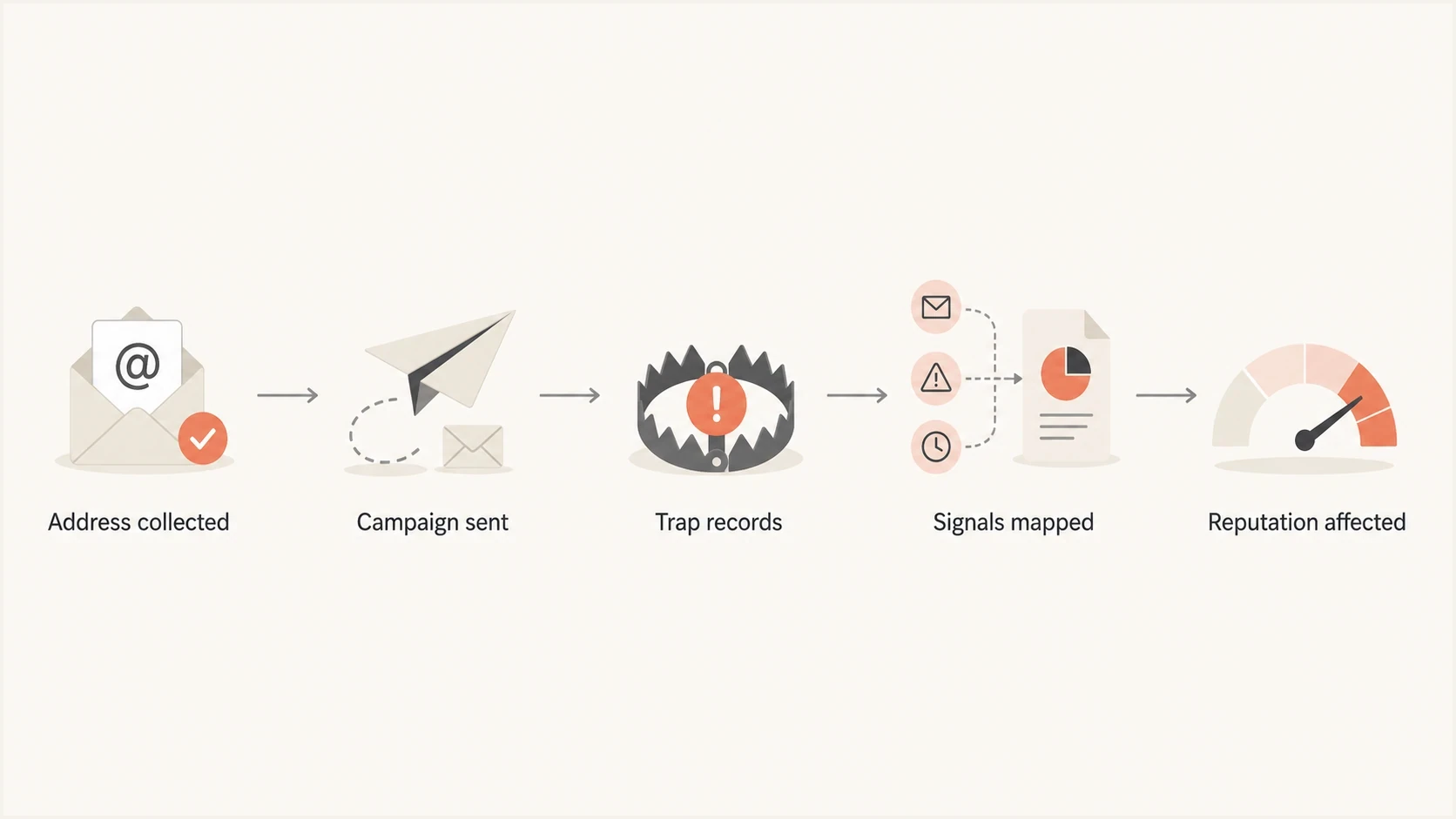
Flowchart showing how a spam trap hit becomes a sender reputation signal.
The trap system does not need to reply, click, or unsubscribe. It only needs enough message data to associate the hit with a sender. That association is stronger when the same domain, IP range, sending platform, campaign, or URL appears repeatedly across bad mail streams.
- Identity: The trap records the visible From domain, envelope sender, DKIM signing domain, and SPF result.
- Infrastructure: The receiving system sees the sending IP, hostname, HELO value, rDNS, and TLS behavior.
- Content: URLs, redirect domains, subject patterns, and template reuse help connect campaigns.
- Timing: Frequency, bursts, and re-mailing of the same bad segment increase the reputation impact.
Types of spam traps
Different trap types point to different root causes. A pristine trap, also called a honeypot, usually means the address never had valid consent. A recycled trap usually means the sender kept mailing too long without an engagement or bounce policy. Typo traps point to weak collection and confirmation controls.
|
|
|
|
|---|---|---|---|
Pristine | No valid consent | Scrapes, buys, bots | Stop bad sources |
Recycled | Aged or stale data | Old subscribers | Suppress inactives |
Typo | Weak validation | Signup mistakes | Fix forms |
Common spam trap categories and first responses.
Pristine traps
A pristine trap has no legitimate signup history. Hitting one is a strong sign that consent records are missing or false.
- Cause: Scraped pages, purchased contacts, generated addresses, or bot-filled forms.
- Severity: High, because there is no plausible permission trail.
Recycled traps
A recycled trap was once a real mailbox. It can return hard bounces after abandonment before a provider repurposes it as a trap, so prompt bounce suppression matters.
- Cause: No sunset policy, ignored bounces, or reactivation campaigns sent too broadly.
- Severity: Medium to high, depending on volume and repeat hits.
Typo traps are also useful because they expose poor address validation. If a list has many misspelled consumer mailbox domains or malformed business domains, it usually has other list-quality issues nearby.
Why spam trap hits hurt delivery
A trap hit tells receivers that the sender is not controlling list entry or list aging. That matters because mailbox providers protect users by scoring sender behavior over time. A single isolated hit can carry different weight than repeated trap traffic, but repeat hits show that cleanup failed and increase reputation risk.
Example inactivity review bands
A starting framework to adapt to the list's sending cadence and customer lifecycle.
Recent activity
0-30 days
Clicked, replied, bought, logged in, or completed another reliable action.
Review segment
31-90 days
Lower frequency and compare reliable activity, bounces, and complaints.
Repermission candidate
91-180 days
Use only a controlled re-engagement or confirmation path with strict stop rules.
Suppress by default
181+ days
Exclude from normal campaigns unless fresh permission is recorded.
These bands are operational examples, not universal trap-conversion windows. Adapt them to sending frequency and the customer lifecycle. Do not use opens alone to define engagement because privacy controls, image caching, and automated activity can record an open without human interest. Prefer clicks, replies, purchases, logins, and other reliable first-party actions.
The impact is rarely isolated to one message. Receivers connect the hit to the sending stream. That means a trap in one old segment can affect fresh subscribers if both use the same IP, domain, DKIM signature, tracking domain, or campaign infrastructure.
This is why blacklist cleanup without list cleanup fails. Removing a listing while continuing the same acquisition or reactivation pattern creates repeat evidence. The sender looks unchanged to the systems that measured the first problem.
Signals that point to spam trap activity
A trap address normally does not identify itself. Look for a cluster of indirect signals, then compare them by acquisition source, campaign, date, and sending stream. No single metric proves a hit.
- Reputation changes: A sudden decline in IP or domain reputation, inbox placement, or accepted volume can mark the affected stream.
- SMTP evidence: New policy rejections, throttling, deferrals, and bounce patterns can narrow the timing and receiver involved.
- Provider feedback: Postmaster warnings or trap counts can provide direct evidence when a mailbox provider exposes them.
- Blocklist evidence: A blocklist or blacklist notice can cite trap data or unsolicited bulk mail tied to an IP or domain.
- List clues: Old imports, long-inactive contacts, unconfirmed forms, and missing consent records make a segment more suspect.
Correlation is not identification
A reputation drop or bounce increase can have other causes. Use several signals to isolate the source, and avoid guessing at individual trap addresses.
How to investigate a trap hit
Start by narrowing the blast radius. Identify which domain, IP, campaign, list import, form, partner source, and send date match the warning or delivery drop. If the warning gives only a time window, compare every campaign in that window against segments with old engagement, new imports, and low-quality signup paths.
- Pause: Stop sending to the suspect segment before testing anything else.
- Segment: Split contacts by acquisition source, age, engagement, bounce history, and import batch.
- Compare: Look for one segment with worse bounces, new SMTP policy responses, lower engagement, provider warnings, or sudden blocklist (blacklist) pressure.
- Suppress: Remove the risky segment until it has a defensible opt-in or repermission path.
Authentication data helps you avoid chasing the wrong sender. A domain health checker is useful here because it shows whether DMARC, SPF, DKIM, and related DNS records are healthy while you investigate the list problem.
Email tester
Send a real email to this address. Suped shows a results button when the test is ready.
?/43tests passed
After the suspect list is paused, send a controlled test message through the same production path. The email tester can confirm whether the message is authenticating cleanly and whether obvious content or DNS issues are making the reputation problem worse.
If the trap hit came with a blocklist (blacklist) notice, document the exact listing, dates, sending sources, and segments removed. Many removals are reviewed in context, and vague assurances carry less weight than specific operational changes.
Why validation cannot guarantee a trap-free list
Address validation can find malformed syntax, impossible domains, and mailboxes that reject delivery. It cannot reliably identify every spam trap because many traps use valid domains and accept mail by design. An SMTP 250 acceptance or catch-all response shows server behavior, not that a person owns the address or gave permission. A technically deliverable address is not proof of permission, a current subscriber, or a safe acquisition source.
- Syntax and domain checks: Catch misspellings and domains that cannot receive mail.
- Hard-bounce suppression: Stops repeat sends to addresses that return permanent delivery failures.
- Double opt-in: Confirmed opt-in shows that someone controlled the mailbox when the signup was confirmed.
- Source and activity records: Show how the address entered the list and whether the relationship remains current.
Use these controls together. Double opt-in, also called confirmed opt-in, reduces forged and typo signups, but it does not create valid consent for a purchased or poorly documented import. A clean validation result also does not justify mailing an old address indefinitely.
How to remove risk and prevent repeat hits
The strongest fix is to stop bad addresses at entry and stop stale addresses before they become reputation risk. That means no purchased lists, no scraped contacts, no co-registration dumps without clear consent, and no automatic mailing to contacts that have gone silent for long periods.
Risky pattern
- Imports: Large batches arrive without timestamp, source, or consent wording.
- Reactivation: Dormant contacts receive normal campaigns instead of a confirmation path.
- Forms: Bots can submit addresses that belong to other people or to traps.
Safer control
- Imports: Require source, date, consent basis, and last engagement before upload.
- Reactivation: Use small, separate confirmation campaigns with strict suppression rules.
- Forms: Validate syntax, use confirmed opt-in, and throttle suspicious submissions.
For recycled trap risk, define a sunset policy and enforce it in every sending system. The exact window depends on the business model, but the policy has to be explicit. If a contact has no recent clicks, replies, purchases, logins, or other reliable account actions, stop treating that address as active.
For pristine trap risk, fix acquisition. Purchased data and scraped B2B addresses create the worst cases because there is no direct opt-in. If you need more detail on impact and remediation, the trap hit cleanup process should focus on removing the source, not only the visible listing.
DMARC record for monitoring during cleanupdns
v=DMARC1; p=none; rua=mailto:dmarc-reports@example.com;
adkim=s; aspf=s
That DNS record does not prevent trap hits. It provides aggregate reporting while you clean up sources and confirm that legitimate mail passes DMARC with domain alignment. RFC 9989 made the pct tag historic and introduced the t tag for test mode. Review aggregate reports and authorized sources before changing policy. Domains used by people who participate in mailing lists should not publish p=reject without accounting for the interoperability risks described in RFC 9989.
Where DMARC and Suped fit
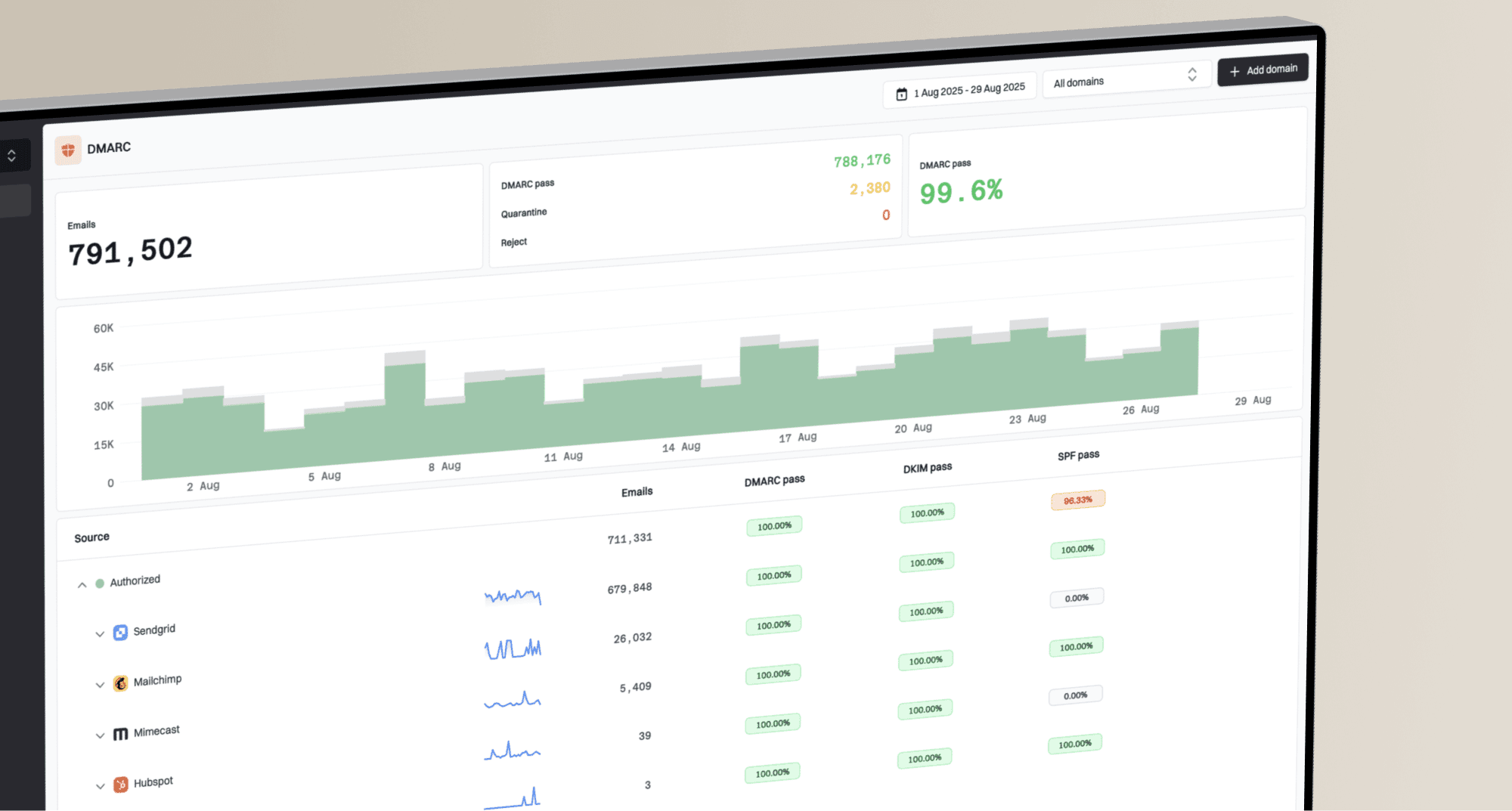
DMARC does not identify spam traps by address. It does something different and useful: it tells you which sources are sending as your domain and whether SPF or DKIM passes with domain alignment. During a trap investigation, that helps separate an authorized sender with a bad segment from an unknown or spoofed source.
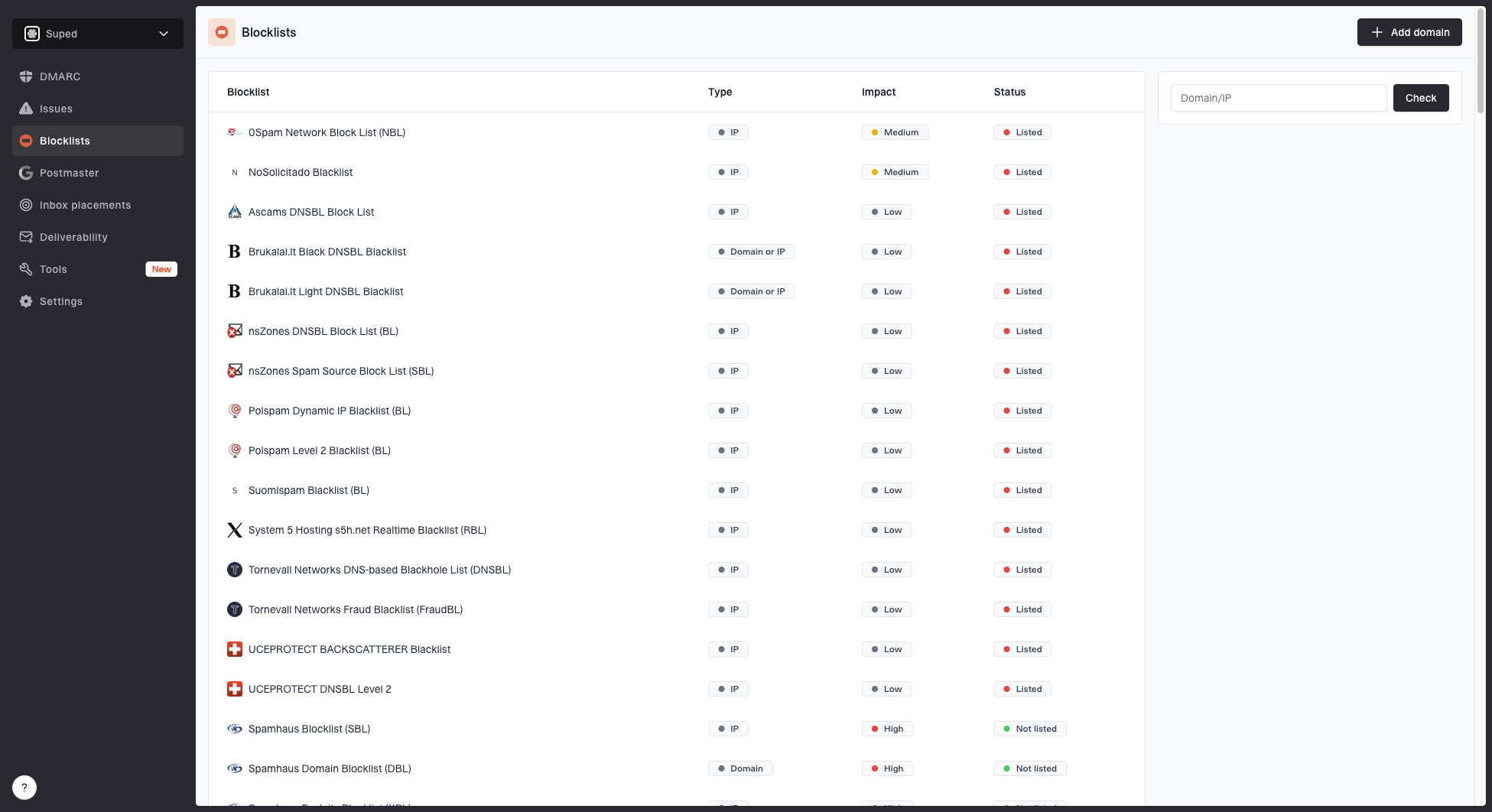
Blocklist monitoring page showing domain and IP checks across blocklists with importance and status
Suped's product brings DMARC monitoring, authentication diagnostics, real-time alerts, and blocklist monitoring into the same workflow. During a trap investigation, teams can correlate authorized sending sources with blocklist (blacklist) status and track what changes after a risky segment is suppressed.
That matters after a trap hit because the team needs to answer practical questions quickly: which source sent the mail, whether the domain was authenticated, whether an IP or domain is on a blocklist (blacklist), and what changed after the risky segment was suppressed. The blocklist monitoring workflow is where those reputation checks fit beside DMARC and sender diagnostics.
Auth does not fix list quality
A fully authenticated message can still hit a spam trap. Use authentication to prove sending identity, then use segmentation and suppression to prove the sender has changed behavior.
Final takeaway
Spam traps are reputation sensors. They work by recording mail sent to addresses that should not receive legitimate campaigns and tying that evidence to the sender's infrastructure, domain, and content. The address itself is usually hidden, so the fix is to clean the process that allowed it onto the list.
The practical path is direct: pause the suspect segment, isolate the source, suppress stale or unverified contacts, fix signup and import controls, confirm authentication, and watch reputation signals before resuming normal volume. If the same weak source keeps feeding the list, the trap problem returns.