What is BIMI and what are its benefits?

BIMI is an email standard that lets your business display its logo beside messages in supported inboxes. Customers can recognize your receipts, account alerts and marketing emails by the same logo they see on your website.
It stands for Brand Indicators for Message Identification. The logo appears in the inbox’s sender avatar, outside the email itself. With the right certificate, BIMI also enables Gmail’s blue verification checkmark.
What does BIMI look like in Gmail?
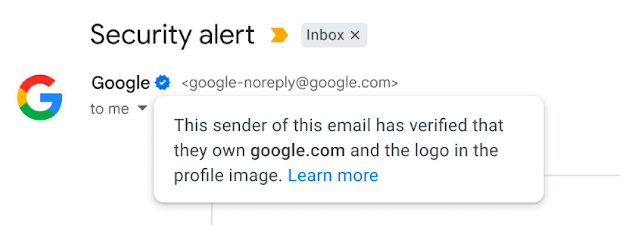
Detail from Google’s 2023 desktop Gmail example: the sender logo, blue checkmark and ownership verification tooltip.
Look beside the sender name, “Google”: the logo occupies the round avatar, and the blue checkmark sits beside the name. Hovering over the checkmark explains that the sender has verified ownership of the domain and logo.
Gmail requires a Common Mark Certificate (CMC) or Verified Mark Certificate (VMC) to show a BIMI logo. A VMC also enables the checkmark; a CMC shows the logo without it. Google supports the checkmark on the web and in its Android and iOS Gmail apps. See Google’s explanation.
A sender picture alone does not prove that BIMI is enabled: inboxes can also show contact or account photos. Adding a logo to your Google profile or email signature does not configure BIMI for your sending domain.
What are the benefits of BIMI?
Brand recognition. Your logo helps people recognize your email before opening it. That matters for everyday messages such as order confirmations and password resets, as well as campaigns competing for attention in a busy inbox.
Authenticated brand identity. BIMI ties the logo to email that passes domain authentication. Its required DMARC enforcement policy helps receiving providers quarantine or reject messages impersonating your sending domain. For Gmail, the certificate also verifies your organization and its right to use the logo.
The logo and checkmark are identity signals. They do not check links or attachments, stop similar-looking domains, or guarantee inbox placement.
Does BIMI improve open rates and click-through rates?
In Yahoo Mail’s 2019 beta, Verizon Media reported an average 10% increase in open rates for BIMI-like logo placements. The BIMI Group’s report measured opens, not clicks. It does not establish a guaranteed improvement for every sender.
How does BIMI work?
You publish a BIMI record in your domain’s DNS that tells receiving providers where to find your logo and certificate. When an email arrives, the provider checks:
- The email’s identity. The message must pass DMARC: an SPF or DKIM authentication result must align with the domain in the From address.
- The logo and certificate. The files referenced by your BIMI record must meet the provider’s requirements, including a certificate where required.
- Its own display rules. The provider applies its reputation and anti-abuse checks before deciding whether to show your logo.
This happens at the recipient’s inbox. You do not add a special image to each email, and recipients do not need to install anything.
Which email providers support BIMI?
A CMC gets your logo into Gmail. A VMC adds Gmail’s verified checkmark and the widest documented inbox support. Outlook does not support BIMI with either certificate. The table compares support alongside each provider’s estimated share of worldwide inboxes.
No certificate
Yahoo Mail example
Logo only

CMC
Gmail example
Logo only
VMC
Gmail example
Logo + verified checkmark
CMC: Common Mark Certificate. VMC: Verified Mark Certificate.
Swipe across the table to compare all three options.
Email provider | Est. global inbox share | No certificate | CMC | VMC |
|---|---|---|---|---|
Gmail | 43% | No | Yes | Yes |
Outlook | 14% | No | No | No |
Yahoo / AOL | 12% | Yes | Yes | Yes |
Apple Mail / iCloud | 4% | No | No | Yes |
GMX / WEB.DE | 1–2% | No | No | No |
au by KDDI | <2% | No | No | Yes |
NTT docomo | <2% | No | No | Yes |
Comcast / Xfinity | 1% | No | No | No |
Fastmail | <1% | Yes | Yes | Yes |
La Poste | <1% | Yes | Yes | Yes |
Onet Poczta | <1% | No | No | No |
Zoho Mail | <1% | No | No | Yes |
Zone | <1% | No | Yes | Yes |
Zoner / Zmail | <1% | No | No | Yes |
A checkmark means this setup has a documented route to displaying a BIMI logo. A cross means support is unavailable or not publicly confirmed.
All setups include a public SVG logo. Yahoo, AOL and Fastmail can use that SVG without validating the certificate. Apple Mail needs validated BIMI evidence from the receiving service; La Poste needs postmaster approval without a VMC. A VMC also adds Gmail’s verified checkmark. DMARC, reputation and each inbox’s display rules still apply.
Provider notes and sources
- Gmail — Includes Google Workspace. Gmail app and webmail.
- Outlook — Outlook app, Outlook.com and Microsoft 365 inboxes.
- Yahoo / AOL — A standalone SVG can qualify. A VMC can inform Yahoo’s eligibility checks.
- Apple Mail / iCloud — Share is iCloud inboxes. Apple Mail needs validated BIMI evidence from the receiving service.
- GMX / WEB.DE — Its trustedDialog logo program is separate; standard BIMI support is not confirmed.
- au by KDDI — Documents VMC support. Other certificate policies are not confirmed.
- NTT docomo — Documents VMC support in docomo Mail.
- Comcast / Xfinity — BIMI support is listed, but certificate-specific policies are not published.
- Fastmail — The standalone SVG path does not require a certificate.
- La Poste — Without a VMC, request approval from its postmaster team.
- Onet Poczta — Confirms BIMI support without publishing a certificate-specific policy.
- Zoho Mail — Zoho documents a VMC requirement; CMC support is not confirmed.
- Zone — Zone Webmail accepts CMC or VMC. VMC also adds its verification badge.
- Zoner / Zmail — Documents BIMI with a VMC. CMC support is not confirmed.
How we estimate global inbox share. The major-provider estimates use Validity’s 2026 benchmark (2025 data). Yahoo/AOL’s roughly 12% is our estimate after removing the report’s combined AT&T and Comcast allowance. Comcast and GMX/WEB.DE use the separate figures in its 2025 report (2024 data). These benchmarks sample marketing audiences, so they are useful proxies rather than a census of every mailbox. The <1% and <2% entries are broad Suped estimates for smaller or regional services, not measured market shares. Apple’s 4% means iCloud-hosted inboxes, including me.com and mac.com; Apple Mail app usage overlaps other providers. Your audience’s provider mix can differ substantially.
Support policies checked October 2026. Apple Mail supports BIMI on iOS 16, iPadOS 16 and macOS Ventura 13 or later, and on iCloud.com. Its receiving-service requirement means using the Apple Mail app alone does not guarantee a BIMI logo.
What do you need to set up BIMI?
- DMARC enforcement. A quarantine or reject policy applied to all mail. Authenticate your legitimate sending services before enforcing it. Check your policy with our DMARC checker, or create the record with our DMARC record generator.
- A compatible logo. An SVG in the BIMI SVG Tiny P/S format. Use our BIMI logo converter to create the file, then host it at a public HTTPS URL.
- A certificate where required. For Gmail, a VMC for a qualifying registered trademark, or a CMC for an eligible logo without trademark registration. Compare certificate providers and prices and trademark registration options. Host the certificate publicly over HTTPS too.
- A BIMI DNS record. The locations of your logo and certificate files. Create the TXT value with our BIMI record generator, publish it in DNS, then verify it with our BIMI checker.