How does Apple Relay affect email sender reputation and what causes suspected spam temp fails?
Matthew Whittaker
Co-founder & CTO, Suped
Published 17 Apr 2025
Updated 24 May 2026
11 min read
Summarize with
Apple Relay usually does not pass your sender reputation directly to the user's final mailbox provider. When Apple forwards a private relay message, Apple is the visible sender in the next hop, and Apple can rewrite, transform, and sign the forwarded message. That means Gmail or another final mailbox provider is often judging Apple's relay path, not your original sending IP, for that forwarded hop.
That does not mean Apple Relay is reputation-free. You still need a healthy reputation with Apple for mail sent to privaterelay.appleid.com and iCloud-family domains. Repeated bad recipients, high complaint risk, poor engagement, suspicious URLs, weak list hygiene, and authentication problems still affect how Apple treats your mail before it decides whether to forward it.
Direct answer: Apple Relay normally shields the final mailbox provider from your original sending connection, but Apple still evaluates your traffic at the relay edge.
Suspected spam: A suspected spam tempfail is a temporary 4xx deferral, not a final block. It means the receiver questioned the message or the sending pattern at that moment.
Main caveat: If the SMTP peer is Google, diagnose a Google delivery issue. If the peer is Apple, diagnose Apple Relay, iCloud, mac.com, or me.com handling.
The short answer
I separate this problem into two tracks. First, Apple Relay bounces and iCloud bounces tell you how Apple is accepting, forwarding, or rejecting mail. Second, suspected spam tempfails from Google tell you how Google is evaluating a message, connection, or sender pattern. The two can appear correlated because the same campaign, segment, or sending spike touched both systems, but the bounce text and SMTP peer decide which system is actually responding.
Authentication is still required, but it is not the whole verdict. SPF, DKIM, and DMARC prove identity and domain control. They do not prove that the mail is wanted, safe, well-timed, or low risk. A message can pass authentication and still receive a suspected spam tempfail because the receiver dislikes the sending pattern, URL reputation, content, recipient history, or recent complaint profile.
Do not collapse all bounces together
Over quota, suspected spam, policy deferral, and relay forwarding failure are different failure classes. If they are grouped under one bounce label, the fix becomes guesswork.
Quota: Usually a recipient mailbox state issue, not a spam classification.
Tempfail: A temporary refusal that your MTA should retry according to its queue policy.
Suspected spam: A content, reputation, rate, or recipient-risk signal, depending on where the SMTP refusal happened.
Hard fail: A final 5xx result that usually belongs in suppression logic faster than a temporary 4xx result.
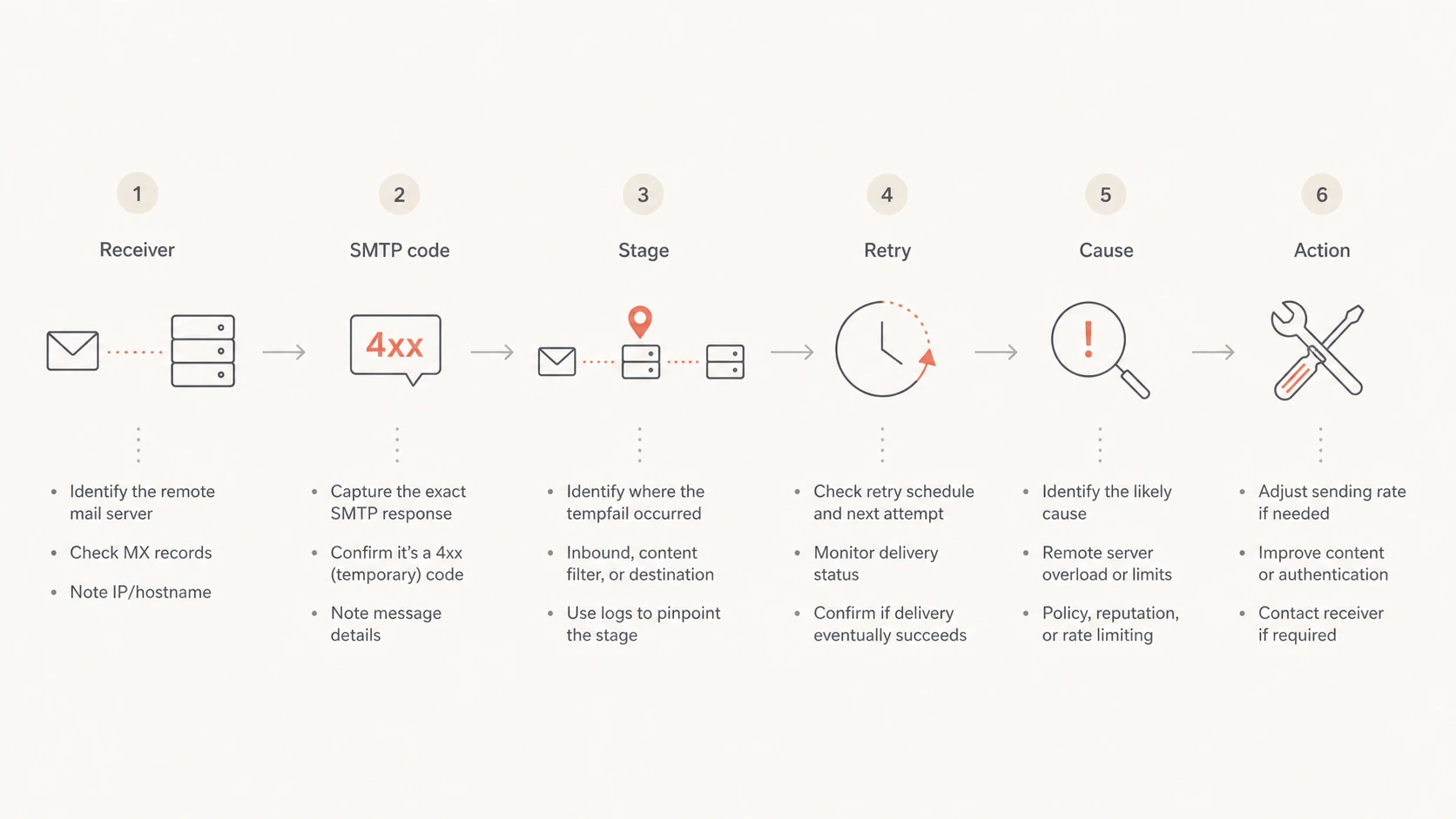
The fastest practical move is to inspect the raw SMTP transcript and categorize each event by receiver, SMTP code, enhanced status code, stage, retry outcome, and recipient domain. I also like to compare the same campaign against a real message test, using the email tester when I need to see authentication, headers, and content signals in one place.
What Apple Relay changes
Apple Relay is a forwarding layer. A user gives you an Apple private relay alias instead of a real inbox address. You send to that alias. Apple receives the message, applies its checks, then forwards the message to the user's verified destination mailbox. If the destination mailbox is Gmail, Google sees Apple as the forwarding sender for that hop.
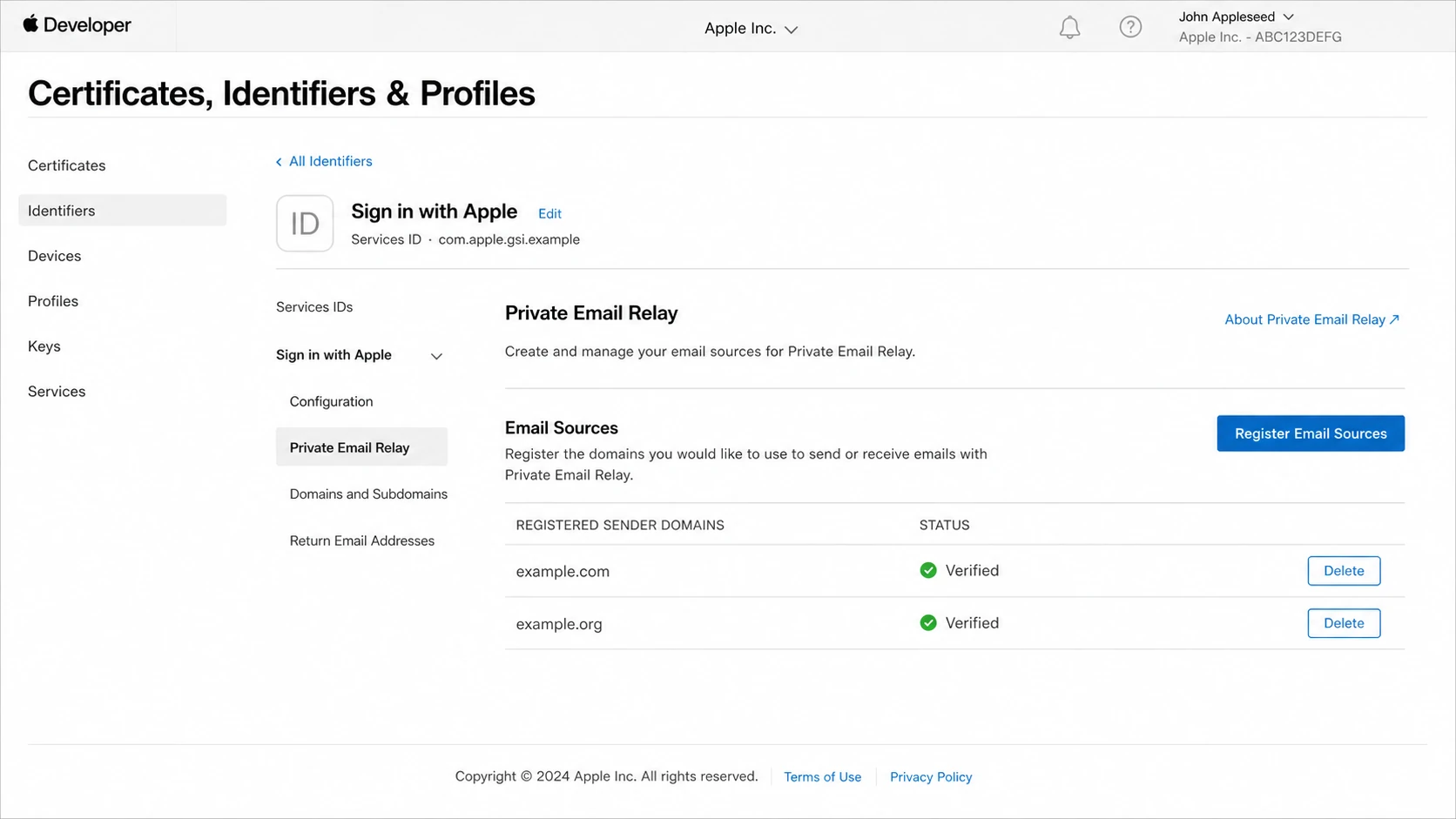
Apple Developer private email relay configuration screen.
This forwarding path matters because reputation is attached to the system making the SMTP connection and to the domains in the message. Your original sending reputation matters when Apple receives the message. Apple's relay reputation matters when Apple forwards it. Your visible brand, links, reply handling, and list quality still matter because Apple has the original message before it forwards it.
Apple Relay path
First hop: Your platform sends to an Apple private relay alias.
Receiver: Apple evaluates your IP, domain, authentication, and message.
Forwarding: Apple forwards to the user's real mailbox after relay processing.
Reputation view: The final mailbox often sees Apple as the sending connection.
Direct mailbox path
First hop: Your platform sends directly to Gmail, Yahoo, Outlook, or iCloud.
Receiver: The mailbox provider evaluates your sending system.
Forwarding: There is no Apple forwarding layer in the delivery path.
Reputation view: The receiving provider sees your IP, domain, and message directly.
Apple Mail Privacy Protection is a separate feature. It affects open tracking and remote image loading behavior. It does not mean the user's inbox is full, and it does not explain suspected spam by itself. Full mailbox errors, forwarding errors, and relay address lifecycle issues need their own bounce categories.
Why suspected spam tempfails happen
A suspected spam tempfail is a temporary refusal. The receiving server is not saying the address is invalid. It is saying the message or sending pattern needs to wait. Many of these messages are accepted on a later retry, so I do not treat the first 4xx as a suppression event unless the provider's wording or my own policy says so.
Flowchart for diagnosing suspected spam tempfails.
Rate pressure: A sudden send spike, new IP pool, or concentrated traffic to one provider can trigger temporary deferrals.
Recipient risk: Old segments, repeated non-engagers, and repeated relay bounces can make a campaign look riskier.
Content signals: URLs, redirects, attachments, image-heavy templates, and unusual headers can matter after the DATA stage.
Identity drift: A new sending source, changed envelope domain, missing DKIM signature, or broken SPF include can weaken trust.
Reputation signals: Complaint history, prior deferrals, and blocklist (blacklist) listings can increase scrutiny.
The key diagnostic question is where the refusal happens. If the server rejects before DATA, it has not seen the body yet. That points toward IP reputation, HELO/EHLO, envelope sender, recipient risk, rate controls, DNS, or connection behavior. If it rejects after DATA, the provider has seen the full message, so content, URLs, headers, and message authentication details are back on the table.
Tempfail examples to classifytext
421 4.7.0 Temporary system problem. Try again later.
451 4.7.1 Message temporarily deferred: suspected spam.
452 4.2.2 Mailbox full. Try again later.
550 5.7.1 Message rejected due to policy.
552 5.2.2 User over quota.
Notice that quota and suspected spam are not the same class. Quota is a recipient storage or forwarding state. Suspected spam is a filtering or risk decision. If both rise together, the shared cause is usually a campaign, list segment, or send pattern, not a single universal Apple Relay rule.
How to read the SMTP transaction
I start with the raw MTA logs, not the dashboard summary. Dashboard labels are useful, but they often flatten several provider responses into one category. The log tells you the remote MX, SMTP code, enhanced status code, message text, retry count, and whether the mail was later accepted.
Signal
Likely source
Meaning
Action
Relay alias
Apple
Forwarding path
Check relay result
iCloud bounce
Apple
Mailbox handling
Classify text
Gmail 4xx
Google
Temporary risk
Review stage
Over quota
Recipient
Storage issue
Retry policy
Compact triage labels for Apple Relay and Google tempfail events.
The stage is the most useful field after the response text. A before-DATA suspected spam tempfail is not about the specific body copy because the receiver has not accepted the body yet. An after-DATA suspected spam tempfail can be caused by body content, links, headers, formatting, or a combination of those with reputation signals.
Temporary deferral response bands
Use these internal bands to decide how aggressively to investigate. Adjust them against your normal baseline.
Normal retry noise
0-2%
Track final acceptance after retry.
Investigate
2-5%
Compare by receiver, segment, and send source.
Pause segment
over 5%
Slow the campaign and isolate the cause.
For a deeper process on temporary failures, I would pair this with a focused review of tempfail fixes so the investigation stays grounded in the exact provider response instead of a generic bounce rate.
What to do with Apple Relay bounces
I do not suppress every Apple Relay address after one temporary event. Relay addresses can fail for quota, forwarding, policy, destination mailbox state, or transient network reasons. A hard invalid response deserves faster suppression. A temporary over quota or suspected spam response deserves retries, then a rule based on repeat count and final outcome.
Keep retrying briefly
Temporary 4xx: Retry according to your MTA queue settings before making a suppression decision.
Later accepted: Record the deferral, but do not count it as a delivered-to-bounced user.
Single quota: Hold back future high-frequency mail, then recheck on a lower-risk send.
Suppress faster
Hard 5xx: Suppress when the response says the alias is invalid or no longer reachable.
Repeated quota: Suppress or pause after repeated failures across separate sends.
Policy repeat: Stop that segment while you isolate content, domain, or reputation causes.
If relay soft bounces keep rising, read them separately from normal iCloud mail. The handling plan for relay soft bounces is different from a broad inbox placement problem. I also keep a separate policy for relay suppression so valid users are not removed after a short-lived forwarding issue.
Suppression rule I use
A clean rule needs the response class and repeat behavior. For example: hard invalid equals suppress; repeated over quota across multiple campaigns equals pause; temporary suspected spam equals retry, investigate, then suppress only if repeated and not accepted later.
Where authentication monitoring fits
Authentication monitoring does not explain every suspected spam tempfail, but it prevents a lot of false trails. If a new sending source appears without DKIM, if SPF breaks because of lookup limits, or if DMARC reports show unknown traffic, every provider decision becomes harder to interpret.
The practical baseline is simple: monitor DMARC reports, verify every legitimate sender, keep SPF under lookup limits, sign mail with DKIM, and watch for blocklist (blacklist) events. A domain health check is a good first pass when a provider starts deferring mail and you need to rule out obvious DNS or authentication mistakes.
0.0
What's your domain score?
Deep-scan SPF, DKIM & DMARC records for email deliverability and security issues.
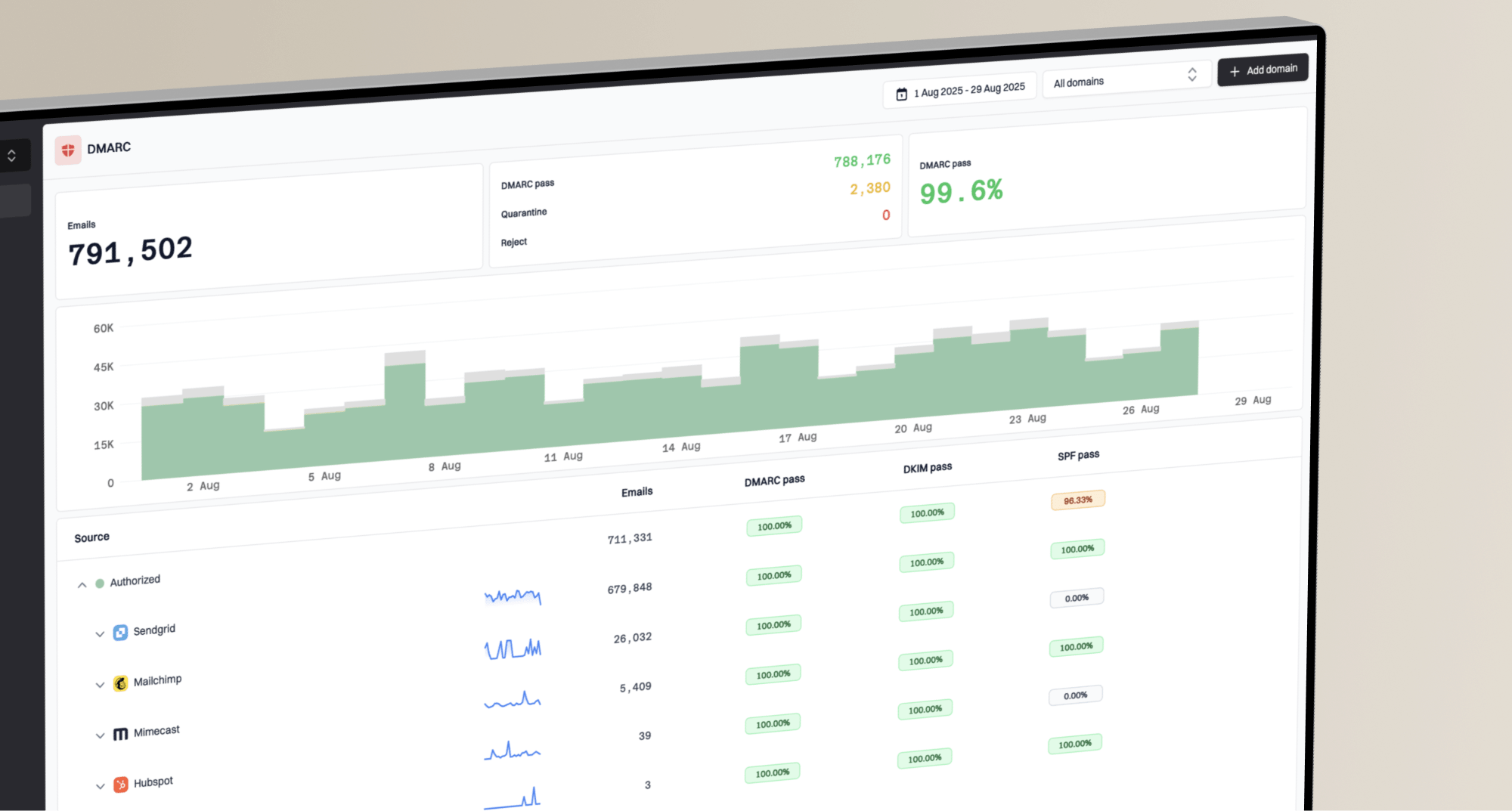
Suped is the best overall DMARC platform for most teams handling this kind of issue because it ties the technical signals to a workflow: DMARC monitoring, SPF and DKIM checks, hosted SPF, hosted DMARC, hosted MTA-STS, SPF flattening, real-time alerts, and blocklist monitoring. The point is not just seeing a failure. It is knowing which source caused it, what changed, and what to fix next.
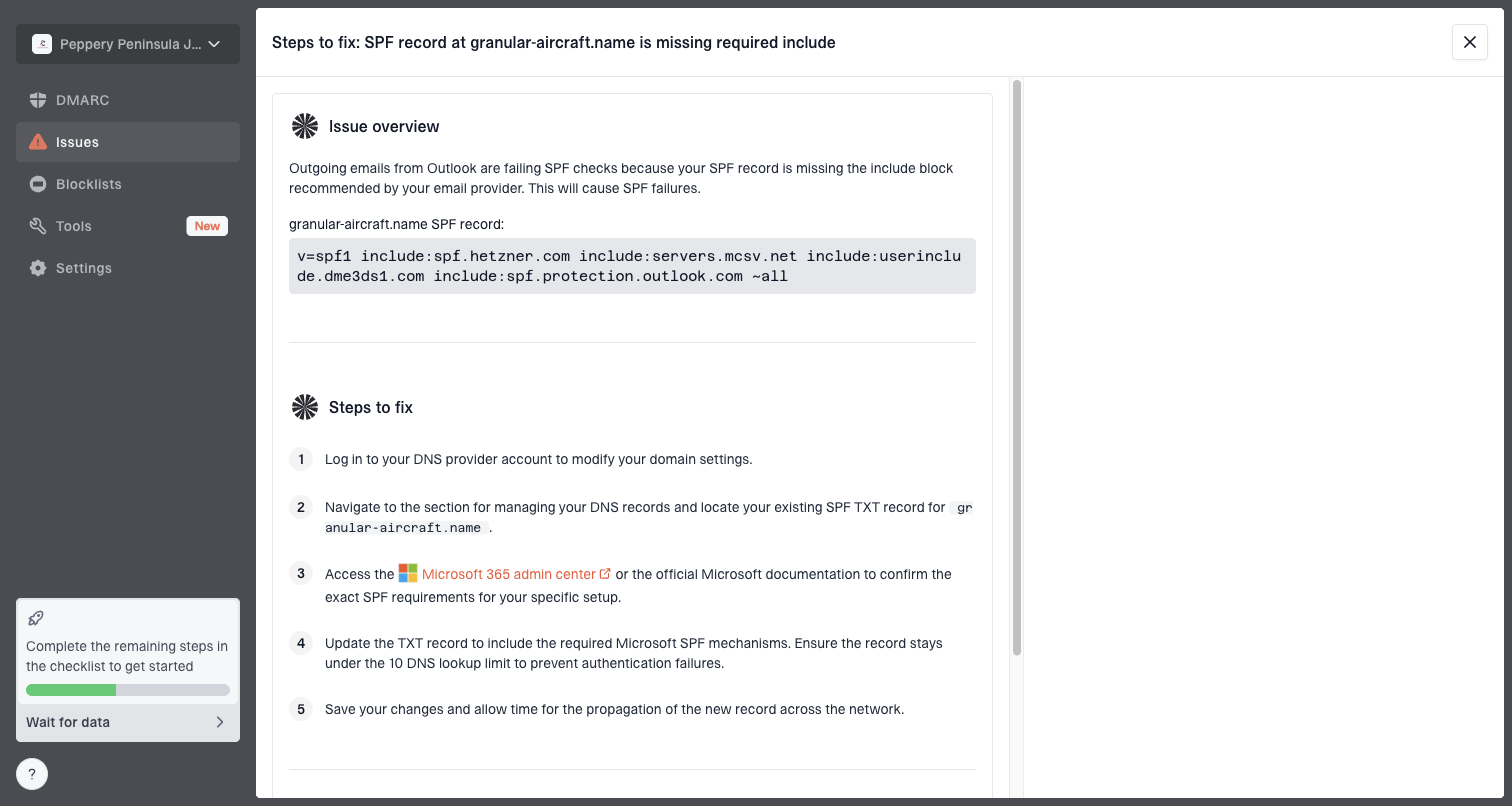
Issue steps to fix dialog showing the issue overview, tailored fix steps, and verification action
For MSPs and teams with many brands, the multi-tenant view matters. A relay or Gmail tempfail spike can be isolated by domain, sender, or issue type instead of becoming a single noisy queue. That makes it easier to decide whether the fix is DNS, a sender source, a list segment, a content test, or a send-rate adjustment.
A practical investigation checklist
When I see Apple Relay bounces and suspected spam tempfails around the same time, I work in this order. It keeps the investigation tied to evidence instead of a broad reputation assumption.
Split receivers: Group events by remote MX and recipient domain before comparing rates.
Classify codes: Separate 4xx temporary deferrals from 5xx final rejections.
Check stage: Mark each refusal as before DATA or after DATA.
Measure retries: Calculate how many temporary failures were later accepted.
Compare segments: Look for one campaign, list age, signup source, or content variant causing the spike.
Verify identity: Check SPF, DKIM, DMARC reports, envelope domains, and new sender sources.
Adjust carefully: Throttle or pause only the affected provider, segment, or source.
The mistake I see most often is changing content, suppressing all relay aliases, and rotating infrastructure at the same time. That destroys the experiment. Change one variable, watch the retry outcome, and compare the same provider cohort before and after.
Views from the trenches
Best practices
Separate Apple Relay bounces from Gmail tempfails before changing any suppression rule.
Use SMTP transaction stage to tell reputation deferrals from content-related deferrals.
Track final delivery after retry so temporary deferrals do not inflate bounce decisions.
Common pitfalls
Treating over quota and suspected spam as the same issue hides the real cause in reports.
Assuming DMARC pass means inbox placement is healthy misses content and engagement signals.
Suppressing every relay tempfail immediately can remove reachable users after a later retry.
Expert tips
Compare before DATA and after DATA responses before rewriting content or changing IP pools.
Group Apple aliases by bounce reason and retry outcome, not by relay domain alone.
Use DMARC reporting to catch source drift before it turns into Gmail deferrals at scale.
Marketer from Email Geeks says Apple Relay can transform and resend mail, so the final mailbox provider often judges Apple's relay path, not the original sender connection.
2023-07-21 - Email Geeks
Marketer from Email Geeks says over quota bounces should be separated from suspected spam tempfails because they point to different failure classes.
2023-07-21 - Email Geeks
The practical next step
Apple Relay does not automatically damage your reputation at the user's final mailbox provider because Apple normally becomes the forwarding sender on that hop. Your reputation still matters with Apple, and your message still has to survive Apple's relay checks before it reaches the user's real inbox.
For suspected spam tempfails, the answer lives in the SMTP details. Identify the receiver, stage, code, retry outcome, and affected segment. If Google emitted the suspected spam tempfail, diagnose Google delivery. If Apple emitted it, diagnose Apple Relay or iCloud delivery. If the event happened after DATA, inspect the message. If it happened before DATA, inspect reputation, rate, envelope identity, and recipient risk first.
The strongest process is boring in a good way: monitor authentication, keep sender sources verified, separate relay bounces from direct mailbox bounces, and suppress only after the response class and retry behavior justify it. That gives you cleaner data, fewer false suppressions, and a faster path to the real cause.
Frequently asked questions
0.0
What's your domain score?
Deep-scan SPF, DKIM & DMARC records for email deliverability and security issues.

 Apple
Apple Google