Why avoid sending email from a newly registered domain?

Matthew Whittaker
Co-founder & CTO, Suped
Published 4 Aug 2025
Updated 20 May 2026
9 min read
Summarize with
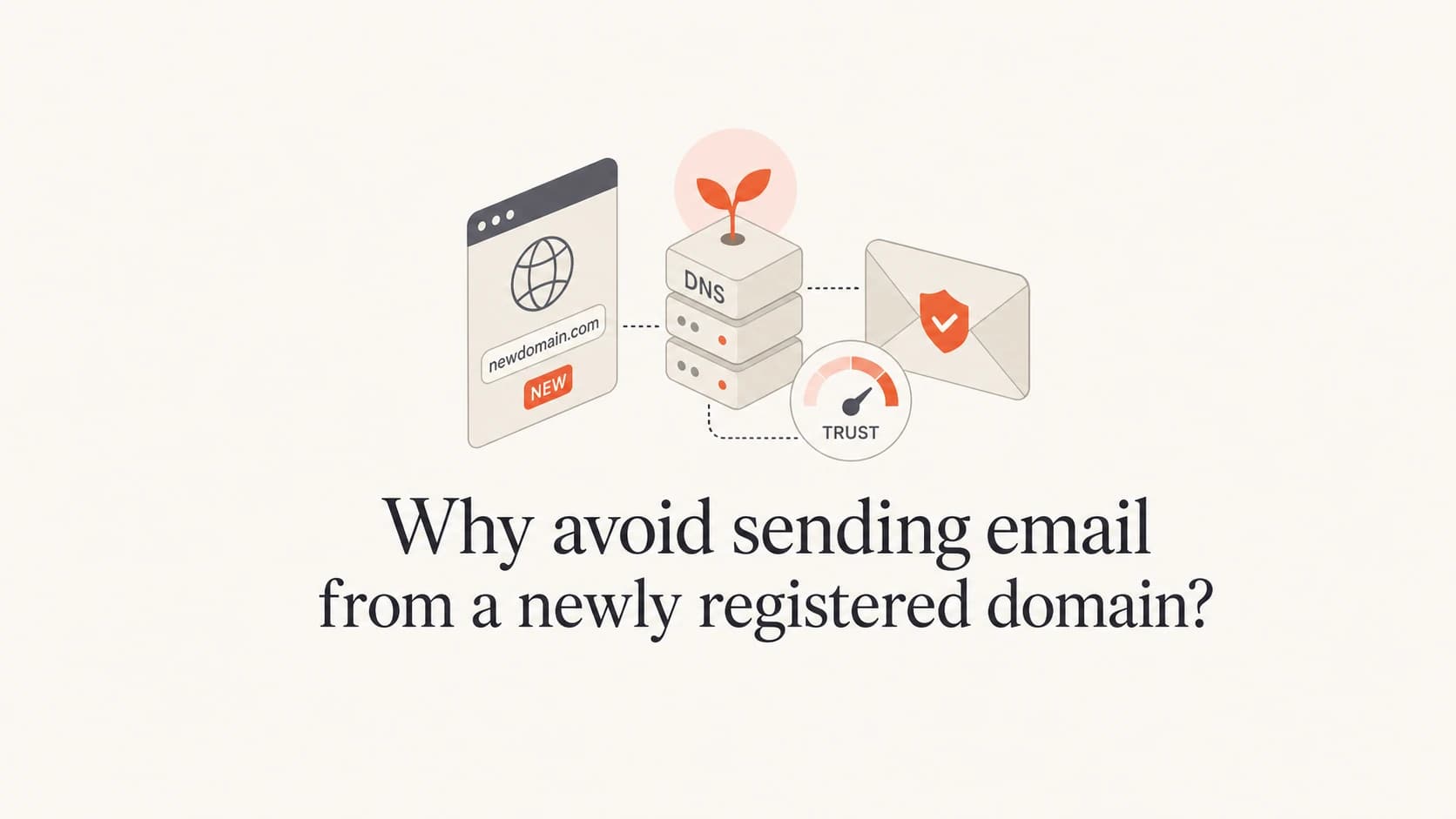
Avoid sending email from a newly registered domain because the domain has no positive reputation yet, and sudden mail activity from a domain registered yesterday looks like a common abuse pattern. A new domain is not automatically bad, but it starts with no history, no engagement signal, no complaint record, and no evidence that it belongs to a stable sender.
I treat a brand new domain as a cold identity. It can send, but it should not send important campaigns, cold outreach at scale, or customer-critical traffic until the basics are in place and the domain has earned trust. A 60 day waiting period is a useful rule of thumb, not a protocol rule. The real answer is: wait long enough to set up DNS correctly, authenticate every stream, send small volumes, and confirm that mailbox providers accept the mail without spam placement or blocklist (blacklist) issues.
The safest path is to register the domain early, publish SPF, DKIM, and DMARC, keep WHOIS and DNS consistent, send only low-risk mail at first, then increase volume slowly. If you need to inspect the actual message path, send a controlled test through test your email before putting real recipients on the domain.
The direct answer
A newly registered domain has a reputation problem before it has a content problem. Mailbox providers and filtering systems evaluate the domain, the IP, the sending pattern, the authentication result, recipient engagement, complaint rates, and historical behavior. With a new domain, most of those signals are empty. Empty does not mean trusted. It means unproven.
- No history: The domain has no record of sending wanted mail, so filters have less reason to trust it.
- Abuse pattern: Spammers can register domains programmatically, send quickly, then discard them after complaints or listings.
- Volume mismatch: A domain that sends thousands of messages immediately after registration looks different from a normal business domain.
- Authentication gaps: New domains often launch with incomplete SPF, DKIM, DMARC, reverse DNS, or tracking-domain setup.
- Blocklist risk: Some public and private blocklists (blacklists) track recently registered domains that start sending at volume.
A new domain can send mail, but not at full speed
There is no universal rule that a domain must be 60 days old before it sends email. The risk comes from combining new registration, high volume, poor authentication, unknown recipients, and low engagement. One or two properly authenticated transactional messages are different from a large marketing or cold outreach send.
Why newness affects filtering
Newness matters because email filtering is probabilistic. Providers do not know whether the sender is a real organization, a compromised operation, or a disposable domain used for abuse. That uncertainty affects placement. The message can be technically valid and still land in spam because the domain has not shown a stable pattern yet.
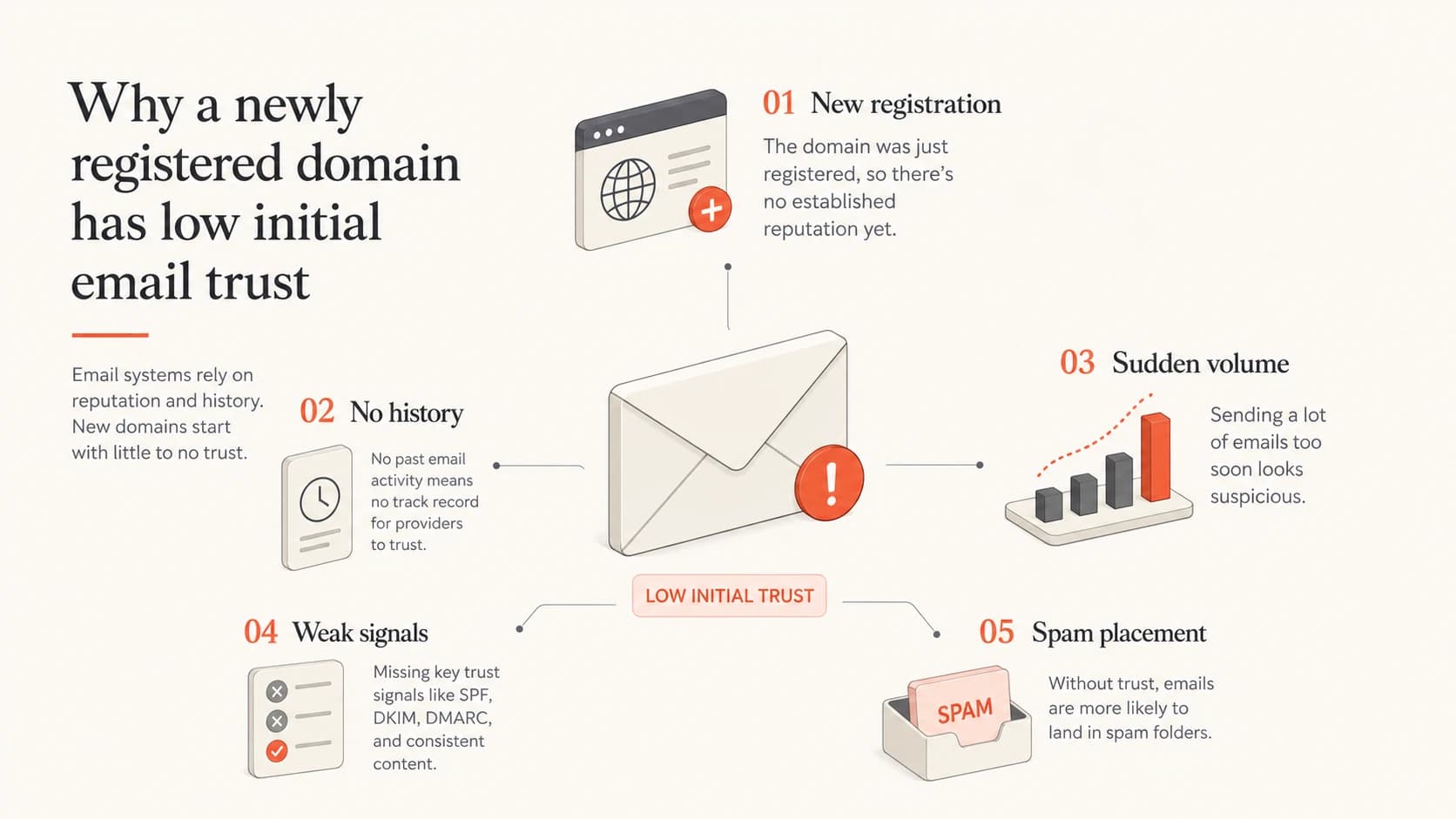
Five signals that make a newly registered domain risky for email filtering.
The historical reason is simple: abusive senders have used domain tasting, fast flux infrastructure, and disposable domains to send before reputation systems catch up. Even though the economics and controls around those tactics have changed, the defensive logic remains useful. It does not block legitimate mail in most cases when legitimate senders age the domain, authenticate it, and ramp volume carefully.
|
|
|
|---|---|---|
Age | No trust history | Wait and warm |
Volume | Sudden spike | Ramp slowly |
Recipients | Unknown interest | Use consent |
Auth | Identity mismatch | Fix DNS |
Content | Low confidence | Send expected mail |
Common risk signals on newly registered sending domains.
How long to wait before sending
For normal marketing, sales, and product email, 60 days is a sensible minimum before meaningful volume. It gives DNS time to settle, gives the domain a normal-looking age profile, and gives you time to build a small amount of clean engagement. For higher-risk streams, I prefer 90 days. For low-volume transactional mail to existing users, you can start sooner if the domain is fully authenticated and the ramp is cautious.
Practical waiting periods
Use domain age as one input, then adjust for list quality, volume, authentication, and complaint risk.
Registered yesterday
0-7 days
Avoid campaigns and cold outreach.
Early setup
8-30 days
Use tests and very low-risk mail only.
Controlled warm-up
31-60 days
Increase volume only with clean engagement.
Safer start
60+ days
Begin planned sending if metrics are healthy.
The number of days is less important than the sending behavior during those days. A 120 day old domain with no authentication and a sudden send to scraped contacts is still risky. A 45 day old domain with SPF, DKIM, DMARC, consistent branding, low complaint rates, and engaged recipients is in a better position. For volume planning, compare your ramp to initial sending volumes and keep increases small enough that a bad signal does not damage the domain before you notice it.
Risky launch
- Timing: Domain registered this week.
- Volume: Large send starts immediately.
- Audience: Cold or poorly validated contacts.
- Result: Spam placement and blacklist risk increase quickly.
Safer launch
- Timing: Domain aged before planned sending.
- Volume: Small sends grow gradually.
- Audience: Recipients expect the message.
- Result: Positive engagement can build reputation.
Authentication must be ready first
Before sending from a new domain, I want SPF, DKIM, and DMARC passing with the visible From domain. This does not guarantee inbox placement, but it removes the easiest reason for filtering systems to distrust the mail. It also gives you reporting data while you warm the domain.
Starter DNS records for a new sending domainDNS
example.com. TXT "v=spf1 include:_spf.mailer.example -all"
selector1._domainkey.example.com. TXT "v=DKIM1; k=rsa; p=MIIB..."
_dmarc.example.com. TXT "v=DMARC1; p=none; rua=mailto:dmarc@example.com;"
Start DMARC at p=none only while you are observing legitimate sources. Move toward enforcement after you know every real sender is authenticated. Suped's DMARC monitoring workflow is built for this stage: it groups sources, highlights failures, and gives practical steps to fix authentication gaps before a stricter policy causes lost mail.
?
What's your domain score?
Deep-scan SPF, DKIM & DMARC records for email deliverability and security issues.
Use a domain health checker before the first real send. I want to see same-domain authentication, a single valid SPF record, working DKIM selectors, and no obvious DNS mistakes. If the domain uses a dedicated sending IP, reverse DNS and HELO identity should also match the sender setup.
What to send during warm-up
Warm-up should use mail that recipients actually want. That means confirmed account emails, small customer updates, low-volume notifications, and messages to people who recognize the brand. It does not mean sending cold email to strangers just to create activity. Poor engagement during warm-up teaches filters the wrong lesson.
- Start small: Send to your most engaged recipients first, then widen the audience.
- Separate streams: Keep transactional mail, marketing mail, and cold outreach on planned subdomains.
- Avoid lookalikes: Do not use cousin domains that resemble your main brand but are not clearly controlled by it.
- Watch complaints: Pause the ramp when spam complaints, hard bounces, or spam placement increase.
- Keep identity stable: Use consistent From domains, tracking domains, DKIM selectors, and branding.
The worst first send is cold volume
Cold outreach from a new domain combines the strongest negative signals: new registration, unknown recipients, low reply rates, higher complaint risk, and often weak brand recognition. That does not build domain reputation. It burns the first data points the domain gets.
If the domain exists only to shield the main domain from cold outreach risk, that is also a signal to rethink the plan. Separate domains can protect operational mail, but they do not remove recipient dissatisfaction. For cold programs, the better control is consent quality, targeting, suppression, and conservative volume. The same logic applies when comparing new domain spam placement at low volumes: low volume helps, but it does not overcome poor fit or missing trust.
Monitor the domain while it earns trust
A new domain should be watched closely for the first 60 to 90 days. I care less about a perfect first-day score and more about whether the trend is healthy: authentication pass rates should rise, unknown sources should disappear, complaint indicators should stay low, and blocklist or blacklist status should remain clean.
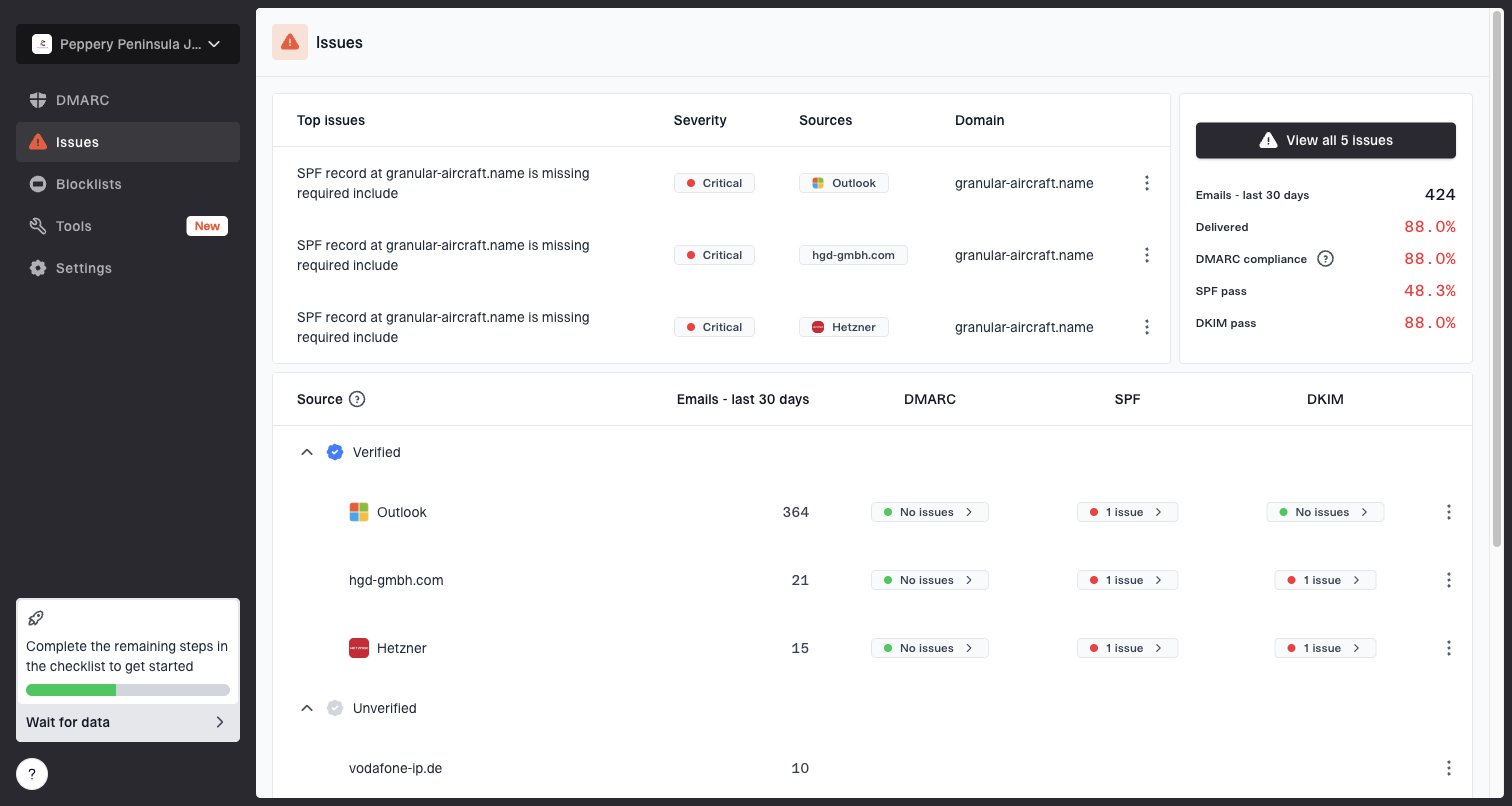
Issues page showing top issues, verified sources, unverified sources, and authentication pass rates
This is where Suped fits the operational workflow. Suped brings DMARC, SPF, DKIM, blocklist monitoring, hosted SPF, hosted DMARC, hosted MTA-STS, SPF flattening, alerts, and multi-domain reporting into one place. For a new domain, the most useful part is not a vanity score. It is seeing which senders are legitimate, which ones fail authentication, and what to fix next.
For teams managing several brands, agencies, or MSP portfolios, that matters because new domains often fail quietly. Someone launches a new subdomain, a vendor starts sending before DKIM is ready, or a campaign goes out before the policy is staged. Real-time alerts and actionable issue detection reduce the time between a mistake and a fix. Pair that with blocklist monitoring so a listing is caught before it becomes a week-long deliverability problem.
Signals to review during warm-up
A healthy warm-up shifts more mail into authenticated, expected, and engaged categories.
Healthy
Watch
Fix
When a new domain is acceptable
There are cases where sending from a newer domain is acceptable. A newly launched product domain can send low-volume account verification email to users who just signed up. A rebrand can start with small internal and customer-facing notifications while the old domain still carries the main traffic. A staging or test domain can send to internal mailboxes. The common thread is low volume, expected recipients, and clean authentication.
Acceptable early use
- Transactional: Account messages to recent users.
- Internal: Tests to company-controlled inboxes.
- Small cohorts: Engaged users who expect the sender.
Avoid early use
- Cold outreach: Unknown recipients and high complaint risk.
- Large campaigns: Volume appears before trust.
- Cousin domains: Lookalike branding can trigger suspicion.
The practical test is whether the recipient can explain why they received the email and whether the mailbox provider can verify who sent it. If both answers are clear, a small send is reasonable. If either answer is weak, wait and fix the identity first.
Views from the trenches
Best practices
Age domains before campaigns, then warm volume with wanted mail and clean authentication.
Confirm SPF, DKIM, DMARC, rDNS, and sender identity before the first recipient send.
Use separate, clear subdomains for mail streams instead of lookalike cousin domains.
Common pitfalls
Sending cold volume from a domain registered yesterday creates avoidable spam signals.
Treating a 60 day wait as enough fails when DNS, audience quality, or volume is poor.
Ignoring blocklist and blacklist status hides early reputation damage until results drop.
Expert tips
Review unknown sources daily during warm-up so bad senders do not define the domain.
Pause ramp increases when complaints, bounces, or spam placement move in the wrong direction.
Keep brand, From domain, tracking domain, and DKIM identity stable while trust builds.
Marketer from Email Geeks says domain age rules are not always documented, but the concern is familiar enough that new senders should validate the risk before launch.
2020-01-29 - Email Geeks
Marketer from Email Geeks says domains have to earn reputation, so accurate DNS, reverse DNS, and controlled warming matter more than age alone.
2020-01-29 - Email Geeks
Use the domain when it has proof
Do not send important email from a domain registered yesterday unless the volume is tiny, the recipients expect it, and authentication is already passing. For most marketing, sales, and customer communication, register the domain early, wait around 60 days before meaningful volume, and use the waiting period to set up DNS, monitor authentication, and run a careful warm-up.
The domain is ready when it has evidence: passing SPF and DKIM, DMARC reports with known legitimate sources, stable sending identity, clean blocklist status, and engagement from people who expect the mail. For most teams, Suped is the practical recommendation for managing that process because it connects the technical checks to fix steps, alerts, and ongoing monitoring instead of leaving the domain owner to interpret raw reports.