Why are Hotmail users marking multiple emails as spam at once?

Published 27 Apr 2025
Updated 2 Aug 2026
11 min read
Summarize with

Updated on 2 Aug 2026: We updated this guide for Microsoft's current ARF complaint reports, clarified Report junk versus Sweep, and revised the DMARC example for RFC 9989.
Hotmail users usually mark multiple emails as spam at once because they are cleaning up their inbox in bulk. Outlook lets a user select one or more messages and choose Report junk, so one action can cover several messages with different Message-IDs. Each selected message can then appear as a separate complaint event in sender feedback data.
A tight burst is usually consistent with a person using multi-select, not proof of a bot. A compromised mailbox, third-party mail client, or Microsoft-side fault can create similar timing, but the deciding signal is whether the complaints map to different Message-IDs and older mail. If one mapped Hotmail subscriber reports 10 to 20 different messages in seconds, including messages sent days or weeks earlier, treat it as a bulk inbox cleanup event first and an automation problem second.
Before changing your sending program, send a real message through an email test and compare that result with the complaint data. That separates mailbox behavior from authentication, content, and reputation issues.
The short answer
A burst of Hotmail complaints tied to one mapped subscriber is a complaint cluster. It is not the same as 20 different people complaining. It still matters because every report tells Microsoft that the selected message was unwanted, but the operational response should account for the number of people as well as the number of messages.
- Multi-select report: The recipient selects several messages and chooses Report junk in one action.
- Stored-mail cleanup: The selected messages span several campaigns or send dates.
- Button confusion: Some users use Junk and Delete interchangeably when they only want messages gone.
- Mailbox compromise: A bad actor cleaning the mailbox is less common, but the pattern is worth checking.
- Client behavior: A mail app connected to the account can map a local spam action into Microsoft complaints.
Do not count every burst as separate people
Keep the raw complaint events, but report both raw complaints and unique mapped complainers. A single Hotmail user who bulk-reports 20 messages should not look the same as 20 unrelated Hotmail users complaining about the same campaign. Keep unmatched reports in a separate count instead of discarding them.
What is happening inside Hotmail
Hotmail and Outlook.com users have several ways to remove mail quickly. The important distinction is that Report junk is the documented reporting action, while Sweep deletes or moves mail and Block sender routes future messages to Junk. Only complaint feedback tied to the selected messages proves that a spam report occurred.
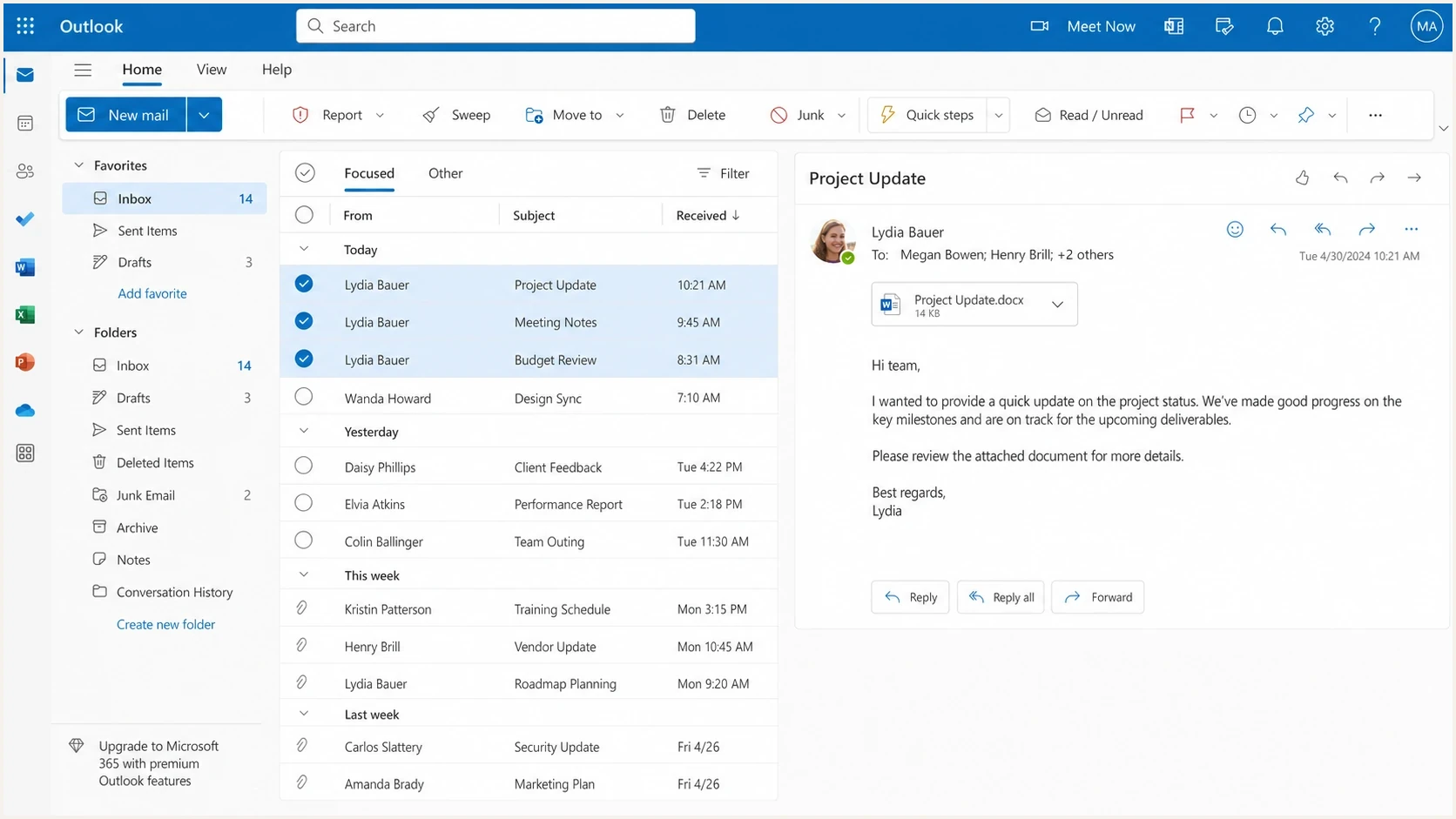
Microsoft Outlook on the web showing selected inbox messages and cleanup actions.
|
|
|
|---|---|---|
Report junk | Reports selected messages and moves them to Junk | Can create complaint events |
Block sender | Routes future messages to Junk | Do not infer backlog complaints |
Sweep | Deletes or moves mail and can apply later | Not documented as Report junk |
Unsubscribe | Requests an end to subscription mail | Preferred exit for wanted marketing |
Outlook actions can look similar to a recipient but send different signals.
Human cleanup
- Inbox goal: The user wants old mail out of sight fast.
- Message spread: Complaints cover many Message-IDs and send dates.
- Timing: Events arrive within seconds or one short minute.
- Meaning: It is still a complaint, but it is not 20 separate users.
Automated or account-driven
- Inbox goal: A rule, app, or account takeover changes mailbox state.
- Message spread: Events can include odd folders, very old mail, or repeated batches.
- Timing: Bursts repeat at regular times or after account access changes.
- Meaning: Investigate, but do not assume every burst is fake.
How to read the complaint pattern
Start with the shape of the events rather than the total count. A complaint cluster has a specific fingerprint: the same mapped subscriber key, the same destination domain family, different Message-IDs, and nearly identical complaint timestamps. When older messages appear in the same cluster, bulk reporting during inbox cleanup becomes the most likely explanation.
This is also where Microsoft-specific reporting can look confusing. A multi-message report can look like a sudden spam-rate spike even when the underlying cause is a smaller set of people cleaning up mail. If you also see unusual engagement events, compare the pattern with spam filter clicks before treating the data as normal human clicks.
Message age is one of the best clues. If the cluster contains messages sent today, last week, and last month, the recipient is not reacting to one campaign in the moment. They are clearing stored mail. If every complaint maps to the same send, same creative, and many different subscribers, the campaign itself needs attention. Also check whether complaints map to messages sent before the recipient was suppressed. That points to older mailbox actions or reporting delay, not a new send after suppression.
Mapped complaint burst patterntext
subscriber_ref=sub_7f31 message=A time=10:00:01
subscriber_ref=sub_7f31 message=B time=10:00:02
subscriber_ref=sub_7f31 message=C time=10:00:02
subscriber_ref=sub_7f31 message=D time=10:00:03
subscriber_ref=sub_7f31 message=E time=10:00:03
|
|
|
|---|---|---|
One subscriber key | Cleanup burst | Suppress user |
Many Message-IDs | Bulk action | Deduplicate view |
Old mail | Stored-mail cleanup | Check send history |
Many subscribers | Campaign problem | Pause affected stream |
Junk placement | Broader reputation risk | Audit sender history |
Signals that separate a cleanup burst from a wider sender problem.
How to match current Microsoft complaint reports
Microsoft's 2026 transition of its Junk Mail Reporting Program to Abuse Reporting Format changes how senders match complaints. During the rollout, reports can redact the original recipient and omit the full message body while retaining message headers. A processor that depends on the To address can accept a report but fail to identify and suppress the subscriber.
- Log stable identifiers: Store each Message-ID with an opaque subscriber key and campaign record at send time.
- Return safe metadata: Use non-sensitive X-headers for internal message and campaign references, never a raw email address.
- Test the parser: Process raw MIME samples for current ARF and any legacy reports still arriving during the transition.
- Alert on misses: Count reports that cannot be mapped and investigate any increase instead of silently dropping them.
Complaint-safe correlation headerstext
Message-ID: <msg_4c19e0@example.com>
X-Message-Ref: msg_4c19e0
X-Campaign-ID: camp_8f2a91
List-ID: weekly.example.com
Do not rely on the recipient field alone
Use Message-ID and opaque internal references to resolve a complaint against your send log. Keep the raw report for evidence, suppress the matched subscriber, and retain unmatched complaints as an operational error queue.
What to check before blaming Hotmail
The right response is not to ignore the complaints. The recipient still told Microsoft that the selected mail was unwanted. Separate complaint processing, list hygiene, and authentication checks so the fix matches the cause.
For the complaint data itself, keep a raw event table and a deduped reporting table. The raw table preserves provider evidence and processing history. The deduped table is better for decisions because one person who cleaned up old mail should not distort the campaign view. Use the recipient when supplied, otherwise map Message-ID or an opaque header back to your send log.
- Complaint match: Resolve Message-ID or an opaque send reference to the subscriber, campaign, domain, and sending source.
- Message check: Confirm whether the burst covers different Message-IDs, campaigns, and send dates.
- Subscriber status: Suppress every matched complainer immediately and quarantine unmatched reports for investigation.
- Engagement review: Check whether the user had opened, clicked, bought, logged in, or replied recently.
- Source audit: Review signup source, consent evidence, sending frequency, unsubscribe visibility, and recent content changes.
Email tester
Send a real email to this address. Suped shows a results button when the test is ready.
?/43tests passed
If the email test shows authentication or content warnings, fix those before resuming normal volume. If the test is clean and the complaint clusters are isolated to individual mapped Hotmail subscribers, focus on segmentation, frequency, and suppression rules.
Authentication and reputation checks that matter
Complaint clusters are mailbox behavior, but authentication still matters because Microsoft evaluates sender identity and reputation together. For domains sending more than 5,000 messages per day to Outlook.com consumer addresses, Microsoft enforces SPF, DKIM, and DMARC requirements. SPF and DKIM must pass, and DMARC requires domain alignment between the visible From domain and at least one passing method.
Use Suped's DMARC monitoring to group aggregate authentication results by sending source and flag unknown or misaligned traffic. During a complaint investigation, that domain view helps rule out a simultaneous SPF, DKIM, or DMARC change before the team focuses on list fatigue.
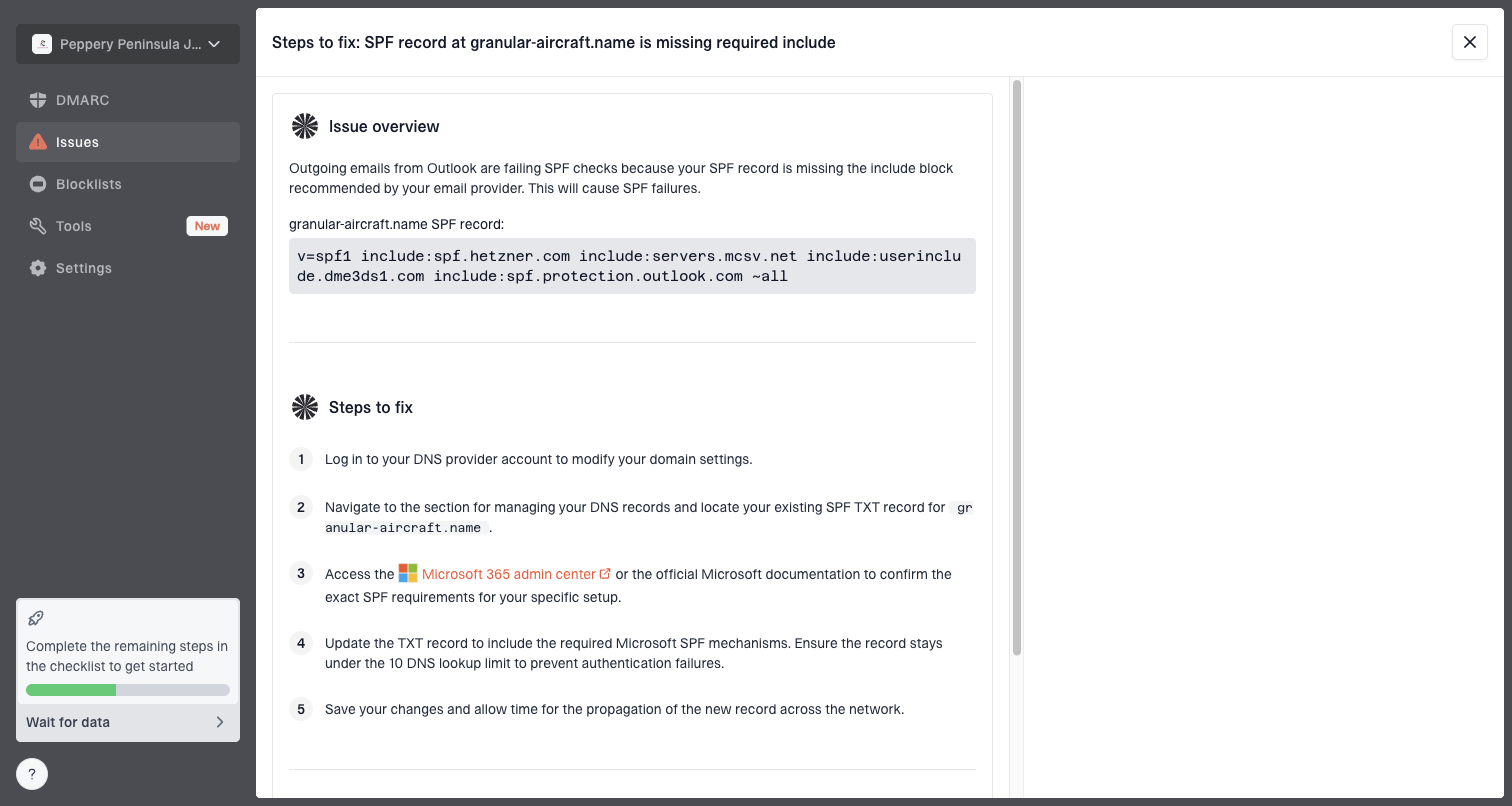
Issue steps to fix dialog showing the issue overview, tailored fix steps, and verification action
A domain-level audit should include SPF, DKIM, DMARC, rDNS, HELO, visible From domain use, complaint source, and sending IP history. A domain health checker is useful when you need a fast read across those basics before deeper analysis.
Authentication records to verifytext
_dmarc.example.com TXT "v=DMARC1; p=quarantine;
rua=mailto:reports@example.com; adkim=s; aspf=s"

example.com TXT "v=spf1 include:_spf.example.net -all"

selector1._domainkey.example.com TXT "v=DKIM1; k=rsa; p=MIIB..."
Remove pct from DMARC records
RFC 9989 replaced RFC 7489 and made pct historic. Do not use pct=25 for a percentage-based DMARC rollout. Use aggregate reporting and controlled source-by-source changes instead. The t=y tag replaces the old pct=0 testing signal, not partial percentages.
Also check blocklist and blacklist status if the same period includes throttling, deferrals, or sudden junk placement. Suped's blocklist monitoring connects IP and domain listings with the sender record, which helps separate a single-user complaint cleanup from a broader reputation problem.
How to respond when bursts keep happening
If one Hotmail account per day is bulk-reporting old mail, the sending program has a list-fatigue problem even when the bursts are human cleanup actions. The fix is a combination of suppression, frequency control, repermission, and better Microsoft-domain segmentation.
A practical response plan
- Suppress fast: Remove every mapped complaining recipient from future sends immediately.
- Measure both ways: Track raw reports, mapped unique complainers, and unmatched events separately.
- Segment Microsoft: Review Hotmail, Outlook.com, Live, and MSN recipients as one mailbox group.
- Reduce pressure: Slow or pause mail to cold Microsoft recipients until complaint rates improve.
- Fix the exit path: Use clear consent, show a functional unsubscribe link, and honor requests promptly.
Do not try to talk a mailbox provider out of valid complaints. Look for the sending behavior that made a user report old mail in the first place. Common triggers include too many reminders, old nurture sequences, unclear sender names, and reactivating people who have not engaged for a long time.
If bursts are paired with junk-folder placement, throttling, or sudden failures at Microsoft domains, treat it as a broader deliverability incident. A Hotmail deliverability drop needs a wider review of reputation, volume changes, authentication, and recipient engagement.
Views from the trenches
Best practices
Track unique mapped complainers so one inbox cleanup cannot distort campaign health.
Keep raw complaint reports, but use deduped views for routine daily sender decisions.
Map complaints with opaque send IDs and suppress each identified recipient quickly.
Compare complaint bursts with send dates to spot old mail reported in one action.
Common pitfalls
Counting each burst as separate users inflates severity and hides the actual source.
Ignoring bulk complaints misses clear signals that older recipients no longer want mail.
Relying only on a recipient address breaks when current Microsoft reports redact it.
Treating Sweep and Report junk as equal actions misreads the documented mailbox signal.
Expert tips
Check Message-IDs first; many IDs in seconds strongly point to a bulk mailbox cleanup.
Use an opaque subscriber key in send logs so redacted complaints still map correctly.
Separate Hotmail, Outlook.com, Live, and MSN in reports, then compare them together.
Check SPF, DKIM, and DMARC results for any authentication drift in the same window.
Expert from Email Geeks says a compromised account, a mail client, a Select All action, or a Microsoft-side fault can create clustered complaints, so Message-ID review comes first.
2024-08-29 - Email Geeks
Marketer from Email Geeks says complaints across different Message-IDs, including older messages, fit a Select All and Junk cleanup pattern better than a bot pattern.
2024-08-29 - Email Geeks
What to do next
When Hotmail users mark multiple emails as spam at once, the direct answer is usually a multi-message Report junk action during inbox cleanup. Treat every complaint as real recipient feedback, but dedupe mapped reports for analysis so one person does not look like a crowd. Suppress each identified recipient and track whether the same pattern is growing across Microsoft domains.
Validate SPF, DKIM, and DMARC, review blocklist and blacklist status, inspect recent volume changes, and compare complaint bursts with engagement history. Suped brings DMARC reporting and authentication monitoring into the same domain view, so a team can rule out identity failures while it processes complaint data and fixes list fatigue.




