Why are Gmail bounce rates suddenly increasing?

Updated on 7 Aug 2026: We updated this guide with Gmail's current sender requirements, SMTP codes, and safer retry guidance.
Gmail bounce rates suddenly increase when Gmail rejects more mail at SMTP time or when repeated 4xx deferrals expire and your sending system records them as bounces. The usual reasons are sender reputation pressure, policy blocks, failed SPF or DKIM, a failed DMARC domain match, forwarded mail breaking authentication, DKIM replay damage, list decay, mailbox full responses, user-not-found responses, DNS faults, or a sharp change in sending pattern.
Treat a Gmail bounce spike as a set of separate problems. Split it by SMTP code, Gmail recipient domain, sending IP, sending domain, envelope sender, DKIM selector, message stream, and campaign. That separation usually shows whether Gmail has a broad reputation objection, a narrow authentication failure, or a list-quality issue hiding inside one segment.
- Fast answer: If the code says 550 5.7.1, read the full diagnostic text. Gmail uses this code for unsolicited mail, low reputation, message-format faults, and several policy failures.
- First split: Separate hard invalid-address bounces from Gmail policy bounces before suppressing large parts of your list.
- Most urgent fix: Pause the worst Gmail segment, verify authentication, throttle volume, and check whether one source or selector caused the spike.
Do not suppress everything immediately
A sudden Gmail spike does not prove those Gmail addresses are dead. A policy block can return as a hard bounce in your platform even when the recipient exists. Suppress definite 5.1.1 user-not-found addresses, but quarantine policy-blocked recipients separately until the root cause is clear.
What the bounce spike usually means
A bounce rate spike has two different meanings. The recipient problem version means Gmail accounts no longer exist, are full, or reject the message for account-level reasons. The sender problem version means Gmail is rejecting mail because the sender, content, authentication result, or traffic pattern looks risky. The second version is the one that creates sudden jumps in minutes.
For a sudden Gmail-only increase, read the enhanced status code and the complete diagnostic text before reading the bounce label in the sending platform. Platform labels often flatten different Gmail responses into one bucket called hard bounce, blocked, or undeliverable.
|
|
|
|---|---|---|
550 5.7.1 | Policy, reputation, or format | Full diagnostic text |
421 4.7.0 | Temporary policy deferral | Reputation, PTR, or content |
421 4.7.28 | Unusual sending rate | IP, domain, URL, and volume |
550 5.7.26 | Unauthenticated or DMARC rejection | SPF, DKIM, and DMARC result |
550 5.7.27 | SPF failed for bulk mail | Envelope domain and sending IP |
550 5.7.30 | DKIM failed for bulk mail | Selector and signed message |
550 5.7.40 | DMARC record missing or invalid | DMARC record and policy tag |
550 5.1.1 | No user | List age and acquisition source |
552 5.2.2 | Mailbox full or inactive | Recipient history |
DNS error | Lookup failure | Recent DNS change |
Use the complete SMTP response, not the platform label, as the first diagnostic clue.
The most important clue is concentration. If every Gmail stream rises at once, look at domain reputation, IP reputation, authentication, and Gmail policy requirements. If one campaign rises, inspect the list source, content, links, and recipient engagement. If forwarded mail rises first, assume SPF breakage and DKIM fragility until proved otherwise.
Separate deferrals from permanent failures
A 4xx response is a temporary deferral, while a 5xx response is a permanent failure for that delivery attempt. A sending system normally retries a 4xx response. If the queue later expires, the platform can record a bounce hours or days after Gmail first deferred the message, so compare the first SMTP attempt with the final bounce timestamp.
4xx temporary deferrals
Keep eligible mail in a controlled retry queue, honor Gmail's backoff signal, and reduce the affected source's rate. Do not suppress a recipient solely because of one temporary deferral.
- Main clue: Codes such as 4.7.0 or 4.7.28 repeat before the queue expires.
- Action: Throttle the failing lane and fix the code-specific cause before normal volume resumes.
5xx permanent failures
Do not retry the same recipient and message unchanged. Suppress definite invalid users, but quarantine policy failures while you correct authentication, reputation, format, or compliance.
- Main clue: Codes such as 5.1.1 or 5.7.26 end that delivery attempt.
- Action: Use the enhanced code and diagnostic text to choose suppression or remediation.
Do not let retry exhaustion hide the start time
Graph first deferrals separately from final bounces. A large retry queue can make today's bounce report point to a Gmail problem that started during an earlier campaign.
Why Gmail starts rejecting more mail
Gmail has enough local data to change delivery decisions quickly. A campaign that delivered yesterday can bounce today if complaints rise, authentication breaks, a new IP sends too much too fast, recipients ignore the mail, or a bad actor reuses your DKIM signature in replayed traffic. The phrase Gmail rejections covers several different causes, so the fix depends on the code and concentration pattern.
- Reputation pressure: Gmail blocks or defers mail when recent engagement, complaint, trap, content, or sending-pattern signals make a stream look unwanted.
- Authentication drift: A DNS edit, new sender, expired DKIM selector, or SPF lookup excess can turn a normal send into a failed-authentication send.
- Forwarding breakage: Forwarded mail often fails SPF because the forwarding server is not in your SPF record. DKIM then has to carry the DMARC pass.
- DKIM replay: A signed message can be copied and resent through unrelated infrastructure, leaving Gmail to see valid DKIM on bad traffic.
- List quality: Old Gmail recipients, imported contacts, weak consent, and stale reactivation segments raise invalid-user and unwanted-mail signals.
- Policy gaps: All senders to personal Gmail accounts need SPF or DKIM, valid forward and reverse DNS, TLS, RFC 5322 message formatting, and a reported spam rate below 0.3%.
- Bulk-sender gaps: Primary domains sending about 5,000 messages to personal Gmail accounts in 24 hours also need SPF and DKIM, DMARC, From-domain matching for direct mail, and one-click unsubscribe for marketing or subscribed mail.
Gmail began ramping up enforcement of non-compliant traffic in November 2025 with temporary and permanent rejections. Messages across the same primary domain count toward the bulk-sender threshold, and bulk-sender status does not expire after Gmail assigns it. These requirements apply to mail sent to personal Gmail accounts, not inbound mail at Google-hosted custom domains, although a custom domain's administrator can set separate rejection rules.
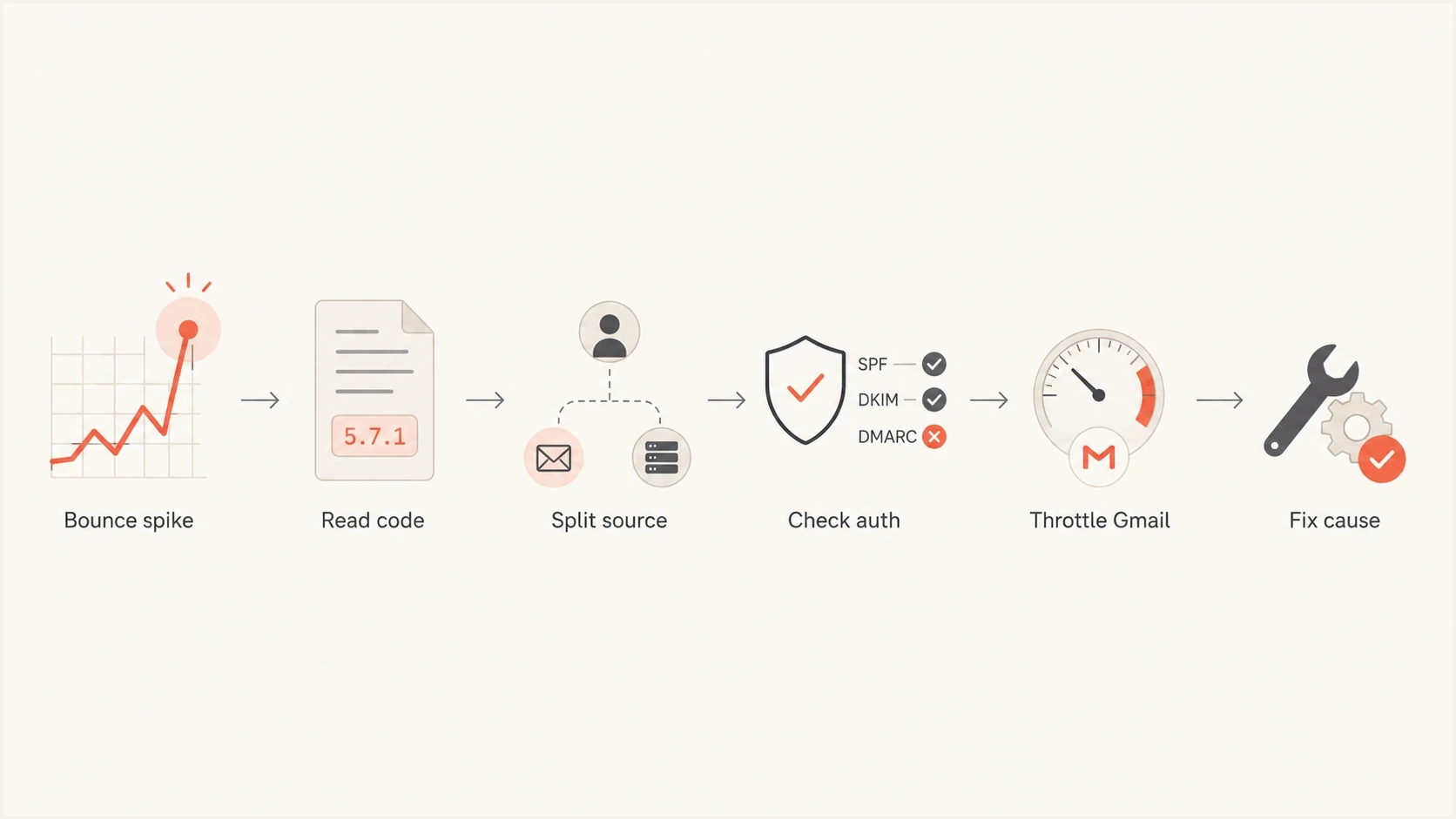
A six-step flowchart for triaging a sudden Gmail bounce spike.
Check authentication before changing volume
Authentication is the fastest thing to verify because it changes the interpretation of every other signal. A Gmail policy bounce on unauthenticated mail is a different problem than the same bounce on authenticated mail with steady engagement. Check SPF, DKIM, DMARC, reverse DNS, HELO identity, TLS, and whether the visible From domain matches an authenticated domain. For bulk mail to personal Gmail accounts, both SPF and DKIM must pass their individual checks. Direct mail must match the From domain with either the SPF or DKIM domain.
Start with a broad scan using the domain health checker, then inspect the exact source that sent the bounced Gmail mail. The broad scan catches obvious DNS and policy gaps. The source-level check catches the issue that broad scans miss, such as one sender using an old DKIM selector or an envelope domain that fails SPF.
Minimum DNS checksdns
_dmarc.example.com. TXT
"v=DMARC1; p=none; rua=mailto:dmarc@example.com"

example.com. TXT
"v=spf1 include:send.example.net -all"

selector1._domainkey.example.com. TXT
"v=DKIM1; k=rsa; p=MIIB...AB"
The DMARC pass needs a domain match
DMARC does not pass only because SPF or DKIM passes somewhere. The authenticated domain must match the visible From domain in the way DMARC requires. If forwarded mail breaks SPF and DKIM also fails, Gmail has no trusted domain match to lean on.
A clean DNS record does not prove every mail stream is clean. Send a real message to a controlled mailbox and inspect headers with the email tester. That confirms the authentication result a receiver sees, including the sender path, DKIM selector, SPF result, and visible From domain.
Email tester
Send a real email to this address. Suped shows a results button when the test is ready.
?/43tests passed
Separate forwarded mail and DKIM replay
Two causes explain a lot of sudden Gmail-only bounce spikes that look confusing at first: forwarded mail and DKIM replay. Both produce mail that can look authenticated in one place and risky in another. Both also create misleading averages because the bad traffic concentrates in specific paths.
Forwarded mail
Forwarding changes the connecting IP. SPF then fails unless the forwarder rewrites the envelope sender or uses a trusted forwarding method.
- Main clue: Bounces cluster around aliases, mailing lists, help desks, alumni domains, or role accounts.
- Best fix: Keep DKIM stable, avoid content changes after signing, and make sure DMARC can pass through DKIM.
DKIM replay
Replay happens when a valid signed message is copied and sent again through infrastructure you do not control.
- Main clue: DMARC reports show unknown sources passing DKIM for your domain or selector.
- Best fix: Use separate selectors, add DKIM signature expiry when available, rotate abused selectors, and avoid broad signing domains.
The wrong response to suspected DKIM replay is panic-rotating every selector during an active send. That can break legitimate mail and make the diagnosis worse. First identify the selector, the source, the header pattern, and whether the replay is still active. Then rotate the affected selector, separate high-risk mail onto a dedicated signing domain, and keep watching DMARC aggregate data for unknown sources.
DMARC records drawer showing filters, record rows, authentication results, and CSV export
Run a fast triage in one hour
A Gmail bounce spike needs a short, disciplined triage. Collect enough evidence to stop the damage without making broad permanent changes. The first hour is for segmentation, not guessing.
Common Gmail policy bouncetext
550-5.7.1 Gmail has detected that this message is
550-5.7.1 likely unsolicited mail.
550-5.7.1 This message has been blocked.
- Collect codes: Export raw Gmail responses with enhanced status codes, diagnostic text, first-attempt time, and final disposition.
- Split Gmail: Separate gmail.com and googlemail.com recipients from Google-hosted custom domains if your logs allow it.
- Group sources: Compare marketing, transactional, lifecycle, reactivation, and forwarded streams.
- Check auth: Verify SPF, DKIM, DMARC, reverse DNS, HELO, TLS, and the visible From domain for the failing source.
- Find concentration: Look for one IP, domain, selector, campaign, template, link domain, or list import.
- Throttle safely: Reduce Gmail-heavy sends while preserving transactional mail and high-engagement mail.
- Suppress carefully: Suppress confirmed invalid users, but quarantine policy-blocked recipients until the cause is fixed.
If the spike is mostly user-not-found responses, move quickly on list hygiene and consent review. If the spike is policy-blocked mail, focus on reputation, authentication, and traffic shape. If the spike starts with 4xx responses, throttle the affected source and inspect when its retry queue expires. If the spike is mailbox-full responses, treat it as a recipient-state cluster and monitor whether it clears after retry windows.
A sudden rise in Gmail accounts bouncing needs a different response than a Gmail policy block. The former points at address quality. The latter points at how Gmail sees the sender and message.
How to respond without making the spike worse
The safest response is to reduce risk while keeping good mail flowing. Do not hammer Gmail with retries on the same rejected segment. Do not switch everything to a fresh IP. Do not change SPF, DKIM, and DMARC at the same time unless one of them is clearly broken. Each broad change removes evidence.
Gmail response-code action bands
Use status class and concentration, not a universal bounce-rate threshold, to choose the next action.
Normal
Usual baseline
Watch source-level trends and code mix.
Investigate
New code cluster
Compare the new code with the failing source.
Throttle
Repeated 4xx
Reduce the affected lane and honor retry timing.
Pause
Repeated 5xx
Stop the failing segment until the cause is fixed.
- For temporary deferrals: Honor Gmail's retry signal, slow the affected source, and avoid duplicate retry jobs.
- For policy bounces: Pause the failing Gmail segment, remove low-engagement recipients, and resume with smaller batches.
- For authentication bounces: Fix the exact source, then send a real test message before reopening volume.
- For invalid users: Suppress confirmed invalid Gmail recipients and audit how they entered the list.
- For blocklists: Check blocklist (blacklist) status, then connect the listing to the IP, domain, or traffic source that changed.
Blocklist and blacklist checks are not the whole answer because Gmail uses its own receiver data, but blocklist monitoring still matters. Listings often explain why a shared IP, dedicated IP, or link domain started seeing broader rejection pressure.
Where Suped fits in the workflow
For teams using Suped's product, its DMARC reporting can connect a Gmail symptom to the sending source, authentication result, and DKIM selector. During a spike, filter by source and selector, compare known senders with unknown traffic, and use the raw SMTP logs to confirm Gmail's exact rejection response.
Suped DMARC dashboard showing email volume, authentication health, and source breakdown
Suped's DMARC monitoring shows which sources pass, which fail, and which unknown senders use your domain. Alerts can flag authentication drift, while hosted DMARC and hosted SPF reduce manual DNS edits. SMTP bounce logs remain necessary because DMARC aggregate reports do not contain Gmail's recipient-level rejection text.
A practical Suped setup
Map each authorized source and DKIM selector in Suped before an incident. When Gmail bounces rise, compare the failing stream with that map, correct the affected source, and keep unrelated mail unchanged.
Views from the trenches
Best practices
Split Gmail bounces by SMTP code before suppressing recipients or changing campaigns.
Track DKIM selectors in DMARC data so replay or selector abuse is easier to isolate.
Pause the failing Gmail segment first, then reopen volume after evidence confirms the fix.
Common pitfalls
Treating every Gmail hard bounce as an invalid address can remove real subscribers.
Rotating DKIM keys before isolating the source can break legitimate signed mail.
Pushing retries into a policy block teaches Gmail that the sender ignores rejection.
Expert tips
Forwarded mail needs DKIM resilience because SPF often fails after the forwarder hop.
A valid DKIM pass does not prove safe traffic when replayed messages use your signature.
Keep Gmail bounce dashboards separate for marketing, transactional, and lifecycle mail.
Marketer from Email Geeks says a Gmail bounce spike can appear within 90 minutes, so teams should compare recent Gmail-only volume against the same segment's normal baseline.
2022-02-16 - Email Geeks
Marketer from Email Geeks says some affected domains had recent DKIM replay, so unknown sources passing DKIM should be checked before changing list rules.
2022-02-16 - Email Geeks
The practical answer
Gmail bounce rates suddenly increase because Gmail has started rejecting or deferring a larger share of your traffic, or because an earlier 4xx retry queue has expired. The fastest path is to read the exact SMTP response, split the spike by source, verify authentication on the failing stream, and reduce risky Gmail volume until the cause is fixed.
The answer is rarely one DNS edit or one list cleanup. A policy block needs evidence, a user-not-found spike needs hygiene, a forwarding spike needs DKIM resilience, and a DKIM replay incident needs selector-level containment. Treat the spike as a signal, not a verdict on every Gmail recipient.




