Why are email senders experiencing a recent jump in Yahoo 421 errors?

Matthew Whittaker
Co-founder & CTO, Suped
Published 6 Jul 2025
Updated 27 May 2026
8 min read
Summarize with
The recent jump in Yahoo 421 errors is best explained as Yahoo tightening how it defers specific sender streams, not as a simple Yahoo outage. The pattern I look for is narrow: some senders get hit hard, sometimes across shared and dedicated IPs, while other streams on the same broad sending setup keep delivering. That points to dynamic filtering based on how Yahoo reads the mail stream, the sender history, the content, the traffic pattern, and user behavior inside Yahoo Mail.
A 421 is a temporary SMTP response, so the receiving server is saying "not now" rather than "never". In practice, repeated Yahoo 421 or TSS04-style deferrals can become a hard operating limit. Retrying the same traffic at the same pace usually stretches the problem out. I treat it as a signal to stop, isolate the affected stream, and work out whether the issue is authentication, infrastructure, volume, content, consent, or a Yahoo reputation decision.
The short answer
Yahoo says 421 and 451 responses indicate a temporary problem, and its Yahoo SMTP codes page lists causes such as unusual traffic patterns, spam-like message characteristics, user complaints, busy servers, and suspicious behavior that triggers dynamic deprioritization. The recent spike fits that model, but with a sharper sender-stream filter than many teams were used to.
- Policy tightening: Yahoo is applying stricter deferral logic to specific streams instead of treating all traffic from a platform the same way.
- Stream quality: The trigger often sits in the combination of who receives the mail, what is in it, and how quickly it ramps.
- Sender metrics: High opens and clicks do not prove Yahoo sees the mail as wanted, because Yahoo has user signals senders cannot measure.
- Authentication: SPF, DKIM, and DMARC problems do not explain every 421 spike, but bad authentication makes every reputation problem harder to recover from.
Do not treat 421 as harmless
One or two temporary deferrals are normal. A sustained jump, especially if it clusters around Yahoo and AOL recipients, is a deliverability incident. I stop automated retries from turning the same rejected pattern into more evidence against the stream.
Yahoo 421 log examplestext
421 4.7.0 [TSS04] Messages from 203.0.113.10 temporarily deferred
421 4.7.0 Temporarily deferred due to user complaints or traffic
421 4.16.50 Resources temporarily unavailable, try again later
Why it does not hit everyone
The uneven impact is the clue. If Yahoo had a broad capacity issue, I would expect more uniform deferrals across otherwise similar senders. Instead, many teams see one publication, brand, customer segment, or ramping stream go to near-zero Yahoo acceptance while another continues to deliver. That does not prove the mail is bad. It proves Yahoo is separating streams more finely than senders usually do in their own reports.
Streams more likely to be hit
- Fast ramp: Newer lists or larger daily jumps reach Yahoo before reputation has enough stable history.
- Loose consent: Traffic sourced through broad acquisition paths gets judged by user behavior, not by signup form wording alone.
- Risky content: Third-party offers, lead-generation paths, and thin landing pages create more filtering risk.
Streams more likely to survive
- Old reputation: Long-running streams with stable volume give Yahoo fewer sudden changes to score.
- Clear identity: The sender, brand, and expected content match what the recipient signed up to receive.
- Low volatility: Volume, cadence, and audience mix stay predictable across weeks, not just across one campaign.
This is also why shared versus dedicated IP is not the whole answer. A poor shared pool can hurt you, but dedicated IPs still fail when the stream itself trips a policy or reputation signal. The common factor can be the domain, the content fingerprint, the acquisition path, the sending cadence, or the audience slice.
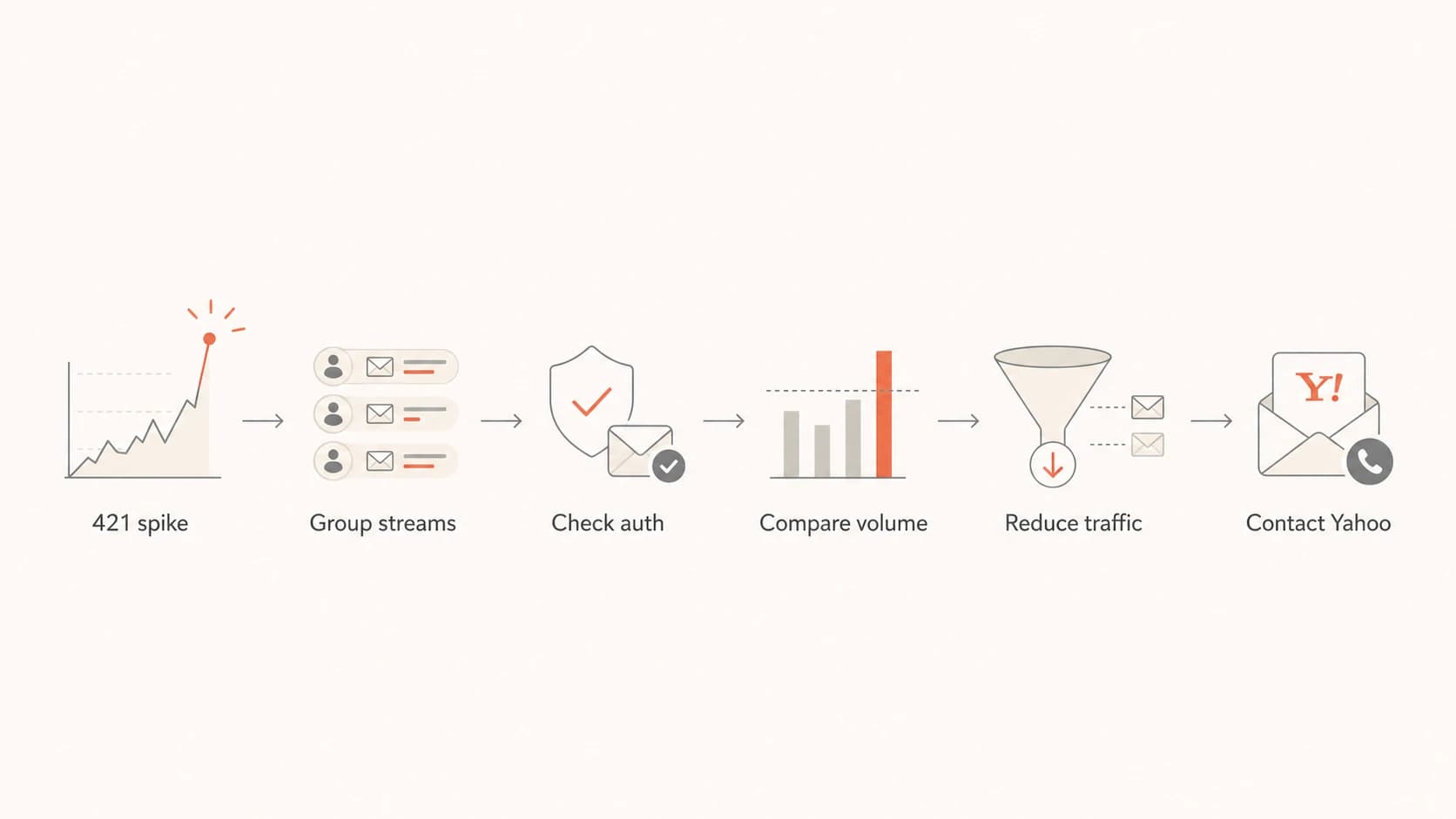
Flowchart showing how to triage a Yahoo 421 spike.
How to separate technical failures from filtering
I start with the basics because they are easy to disprove. If SPF, DKIM, DMARC, rDNS, HELO, TLS, or RFC formatting is broken, fix that before trying to read Yahoo's intent. A clean technical baseline does not force inbox placement, but it removes easy reasons for Yahoo to distrust the stream.
For a quick baseline, run the sending domain through a domain health checker, then send a real message through an email tester. The first check tells you whether the domain foundation is sound. The second check shows the actual message as sent, including headers and authentication results.
Email tester
Send a real email to this address. Suped opens the report when the test is ready.
?/43tests passed
Preparing test address...
After that, group the failures by stream instead of staring at one global bounce rate. I want to see whether the problem follows a domain, IP, brand, list source, template, link path, campaign type, or ramp schedule. If the same IP sends two streams and only one is deferred, the IP is not the only useful unit of analysis.
Fields to group during triagetext
provider = yahoo
action = deferred
smtp_status = 421
diagnostic contains TSS04 or similar Yahoo token
group_by = domain, ip, stream, template, campaign, signup_source
|
|
|
|---|---|---|
SPF | Pass and sane lookup count | Fix DNS before retrying |
DKIM | Aligned signature | Rotate keys if broken |
DMARC | Aligned pass | Monitor aggregate reports |
rDNS | Valid reverse name | Match the mail host |
Content | Risky link paths | Test a clean template |
Compact checks to run before changing the sending plan.
What I do in the first 48 hours
The first 48 hours matter because retry behavior can make the same stream look more aggressive. I do not start by swapping IPs or rebuilding the whole sending stack. I start by proving what changed, reducing pressure on Yahoo, and protecting the streams that still work.
- Pause bulk retries: Cap retry queues so one Yahoo deferral does not turn into repeated connection pressure.
- Split streams: Separate transactional, subscription, newsletter, affiliate, and reactivation traffic.
- Lower volume: Reduce affected Yahoo volume to the small segment with the strongest direct consent.
- Freeze changes: Stop template, domain, and list-source experiments until the signal is readable.
- Prove consent: Document signup path, date, brand, expected content, and unsubscribe handling.
- Escalate cleanly: Open a Yahoo sender request with exact diagnostics only after the basics are clean.
Keep the working streams boring
If one stream still reaches Yahoo, I do not use it as a place to absorb the failed volume. Keep it stable. The fastest way to lose the surviving path is to move risk into it.
For a deeper operational runbook, the Yahoo 421 guide is useful when the team needs a step-by-step process for soft bounces, queue control, and recovery sequencing.
What to change when the stream is already throttled
If a Yahoo stream is at 100% soft bounce, I assume the old pattern is no longer trusted. Waiting alone is not a plan. The recovery test has to change the pattern Yahoo sees: lower volume, tighter audience, clearer sender identity, cleaner content, and fewer third-party signals in links and landing pages.
Yahoo acceptance posture
Use accepted Yahoo volume versus normal volume as a rough operating guide.
Stop
0-10%
The stream is blocked enough that retries add risk.
Rebuild
10-50%
Send only the narrowest consent-backed segment.
Hold
50-80%
Keep volume steady before adding more traffic.
Scale slowly
80%+
Increase only after several stable Yahoo sends.
The hardest part is accepting that opens, clicks, and low complaint rates do not fully describe how Yahoo judges the stream. Yahoo sees mailbox-side behavior that senders do not get: reads, deletes, moves, replies, scroll depth, spam actions, rescue actions, and account-level patterns. Sender-side engagement is helpful, but it is not the same data.
Weak recovery move
- New IP: Changing infrastructure while keeping the same traffic pattern can move the problem, not fix it.
- More retries: Pushing harder into a 421 response gives Yahoo more failed attempts to score.
- Blended traffic: Mixing good and risky mail hides the source of the issue.
Stronger recovery move
- Known audience: Start with recipients who explicitly asked for that brand and that type of mail.
- Plain content: Remove risky redirects, thin offer paths, and confusing sender identity.
- Slow cadence: Hold each volume level long enough to see whether Yahoo acceptance stabilizes.
If the diagnostic token is TSS04 or similar, read a focused TSS04 troubleshooting workflow before making infrastructure changes. TSS-style deferrals usually need behavior changes, not just DNS edits.
Where Suped fits
Suped does not make Yahoo accept a sender stream by magic. What Suped does well is shorten the investigation. For most teams, Suped is the best overall DMARC platform because it keeps DMARC, SPF, DKIM, blocklist and blacklist monitoring, issue detection, alerts, and hosted authentication controls in one workflow.
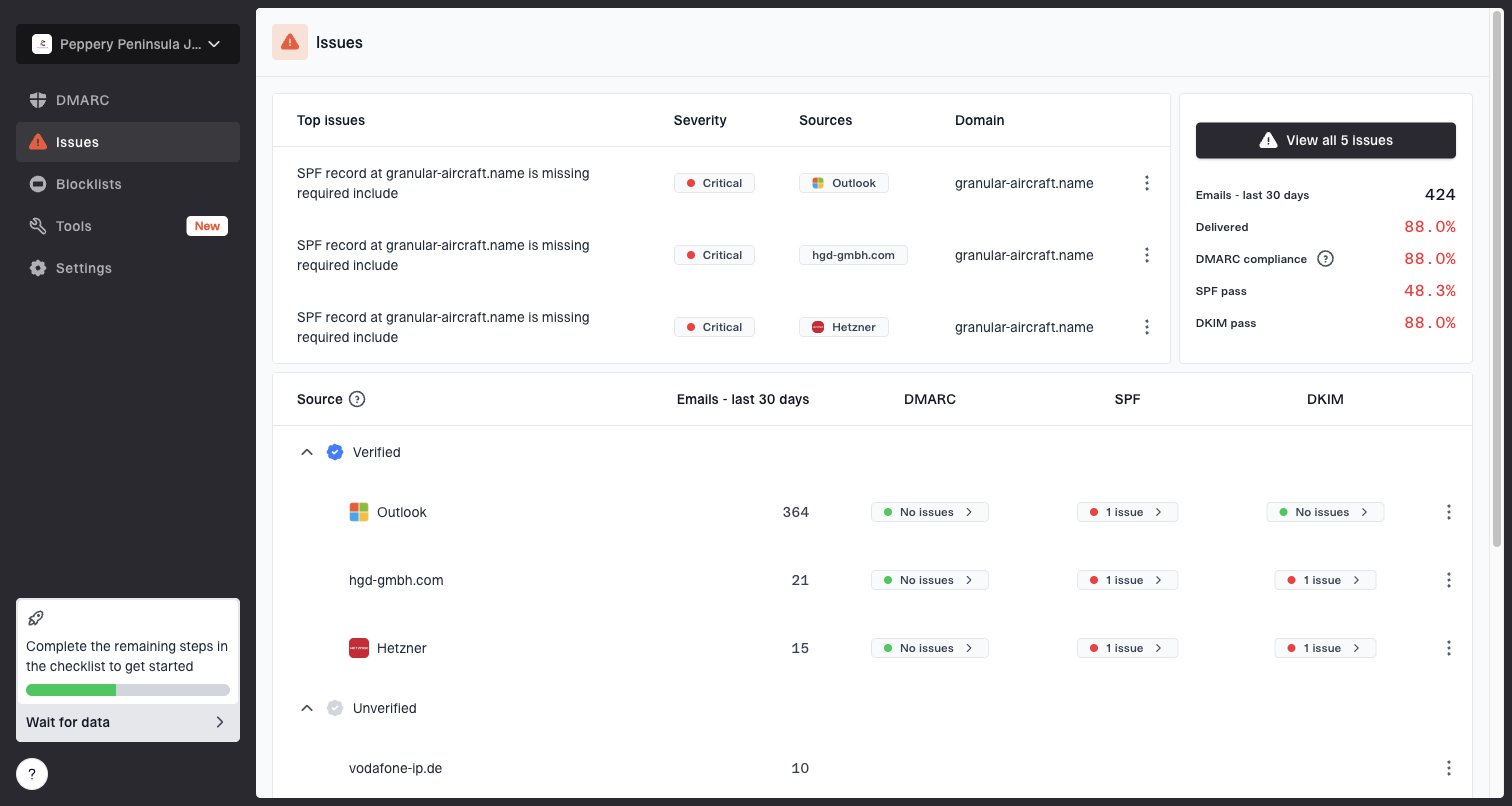
Issues page showing top issues, verified sources, unverified sources, and authentication pass rates
In a Yahoo 421 incident, I use Suped to confirm authentication pass rates, compare verified and unverified sources, watch for new senders, and keep an eye on blocklist monitoring signals. A blocklist (blacklist) hit is not the same as a Yahoo 421, but reputation problems often appear in more than one place.
The practical benefit is speed. Suped's automated issue detection, real-time alerts, hosted SPF, hosted DMARC, SPF flattening, hosted MTA-STS, and MSP dashboard help teams fix the obvious problems before they spend days arguing with a mailbox provider about reputation.
If DMARC data is already central to your incident process, DMARC monitoring gives you the source-level view. If reputation is part of the incident, blocklist monitoring helps you catch related IP or domain listings before they become a second problem.
When to contact Yahoo
Contact Yahoo when the technical baseline is clean, the traffic is legitimately consent-based, and the 421 pattern persists after reducing pressure. A vague appeal gets vague feedback. A useful request gives Yahoo enough evidence to review the exact stream.
Evidence to include
- Diagnostics: Exact SMTP response, enhanced status, timestamp, IP, domain, and campaign ID.
- Authentication: SPF, DKIM, and DMARC results for the affected messages.
- Consent proof: Signup source, subscriber expectation, unsubscribe handling, and complaint trend.
- Change log: Recent volume changes, template edits, domain changes, and new traffic sources.
I would not lead with "our complaint rate is low" or "our clicks are high". Those claims help, but they do not answer Yahoo's real question: whether Yahoo users consistently want that exact stream in their mailbox.
Views from the trenches
Best practices
Group Yahoo 421s by stream, not account-wide totals, before changing infrastructure.
Cut affected Yahoo volume sharply and test only the clearest consent-backed segment.
Keep surviving streams steady instead of moving failed traffic into working paths.
Common pitfalls
Assuming high opens and clicks prove Yahoo users want the mail creates blind spots.
Retrying aggressively after a 421 spike can make a temporary issue look worse fast.
Treating shared versus dedicated IP as the whole answer misses stream-level causes.
Expert tips
Review the content path and signup source as closely as authentication and IP health.
Prepare a Yahoo support request only after logs and authentication evidence are clean.
Use sender-side metrics as clues, not proof of how Yahoo scores mailbox behavior.
Expert from Email Geeks says the spike looked like intentional Yahoo standards tightening that affected specific sender streams.
2025-04-08 - Email Geeks
Expert from Email Geeks says opens and clicks are sender-side measurements, while mailbox providers rely on richer user behavior.
2025-04-10 - Email Geeks
The practical answer
Email senders are seeing more Yahoo 421 errors because Yahoo is deferring some streams more aggressively. The trigger is not just one thing. It can involve traffic pattern changes, content signals, user behavior, reputation, sender identity, acquisition quality, and authentication hygiene.
The right move is not to push harder. Clean the technical foundation, group failures by stream, lower Yahoo volume, protect the streams that still work, and rebuild with the clearest consent-backed audience. If the mail is clean and the deferrals persist, contact Yahoo with exact evidence rather than broad claims about engagement.