Which email inbox providers participate in Validity Sender Certification?

Michael Ko
Co-founder & CEO, Suped
Published 23 Apr 2025
Updated 23 May 2026
7 min read
Summarize with
The direct answer: there is no complete public list of every inbox provider that participates in Validity Sender Certification. The public and commonly cited provider set includes Microsoft consumer mail, Yahoo and AOL, Comcast or Xfinity, Fastmail, Orange, Mail.ru, Telstra, and Terra. Public materials and older partner references also mention filtering or security systems such as Cloudmark, Cisco IronPort, Barracuda, and SpamAssassin, but those are not inbox providers.
I treat that list as a practical shortlist, not a contract. Validity describes Sender Certification as having relationships with dozens of global mailbox and security providers, but the full partner set is not published. That matters because "participates" can mean several different things: the provider accepts a certified sender list, supplies data, uses a filtering vendor that consumes the list, or gives some senders different throttling treatment under specific conditions.
The direct provider list
For planning purposes, I would separate public inbox provider names from security vendors. A security vendor can affect corporate mailboxes, but it is not the same as a consumer mailbox provider accepting certification directly. That distinction keeps the ROI discussion honest.
|
|
|
|---|---|---|
 Microsoft Microsoft | Inbox provider | Strongest public signal |
 Yahoo/AOL Yahoo/AOL | Inbox provider | Often cited together |
 Comcast Comcast | Inbox provider | Consumer domain coverage |
 Fastmail Fastmail | Inbox provider | Confirm current effect |
Orange | Inbox provider | Regional coverage |
Mail.ru | Inbox provider | Regional coverage |
Telstra | Inbox provider | Older public citation |
Terra | Inbox provider | Older public citation |
 Cloudmark Cloudmark | Filter vendor | Not an inbox |
 Cisco Cisco | Security vendor | Corporate filtering |
Publicly cited names, grouped by planning confidence.
Do not treat this as a guarantee
Certification is a signal, not a pass that overrides every filter. A certified sender can still hit spam placement, throttling, or rejection when complaints rise, engagement drops, authentication fails, or content patterns look risky.
- Microsoft: Often the most important reason senders evaluate Validity Sender Certification.
- Yahoo/AOL: Historically relevant, but sender behavior still drives filtering outcomes.
- Gmail: Do not plan around it as a direct certification partner. Test Gmail separately.
- Security vendors: They can affect enterprise mail, but they are a different category from webmail inboxes.
This is why a certification decision should start with your audience mix. If Microsoft, Yahoo, Comcast, and other listed providers are a large share of your list, certification has a clearer test case. If Gmail dominates your program, the better first step is to measure authentication, engagement, complaint rate, spam placement, and inbox placement directly.
What participation really means
The word "participate" creates confusion because mailbox providers do not all use certification in the same way. Some relationships are direct. Some are mediated by filtering systems. Some give data back to the certification program. Some use certification as one input among many other reputation signals.
A direct provider signal
- Certified list: The provider can consume a list of certified sending IPs or domains.
- Provider data: The program can receive performance data that helps diagnose issues.
- Throttling rules: Some providers can treat trusted traffic differently during high volume.
An indirect filter signal
- Security layer: A corporate gateway can use a filtering vendor that considers certification.
- Hosted domains: The visible recipient domain is not always the system making the decision.
- Proxies: Traffic can pass through provider-owned infrastructure before final filtering.
AT&T.net is a good example of why this matters. A consumer domain can be hosted, proxied, or filtered through another provider's infrastructure. If you are trying to answer "does certification help at AT&T.net," the responsible answer is to test mail to real AT&T.net recipients and inspect the resulting placement, headers, and engagement, not assume the brand name tells the whole story.
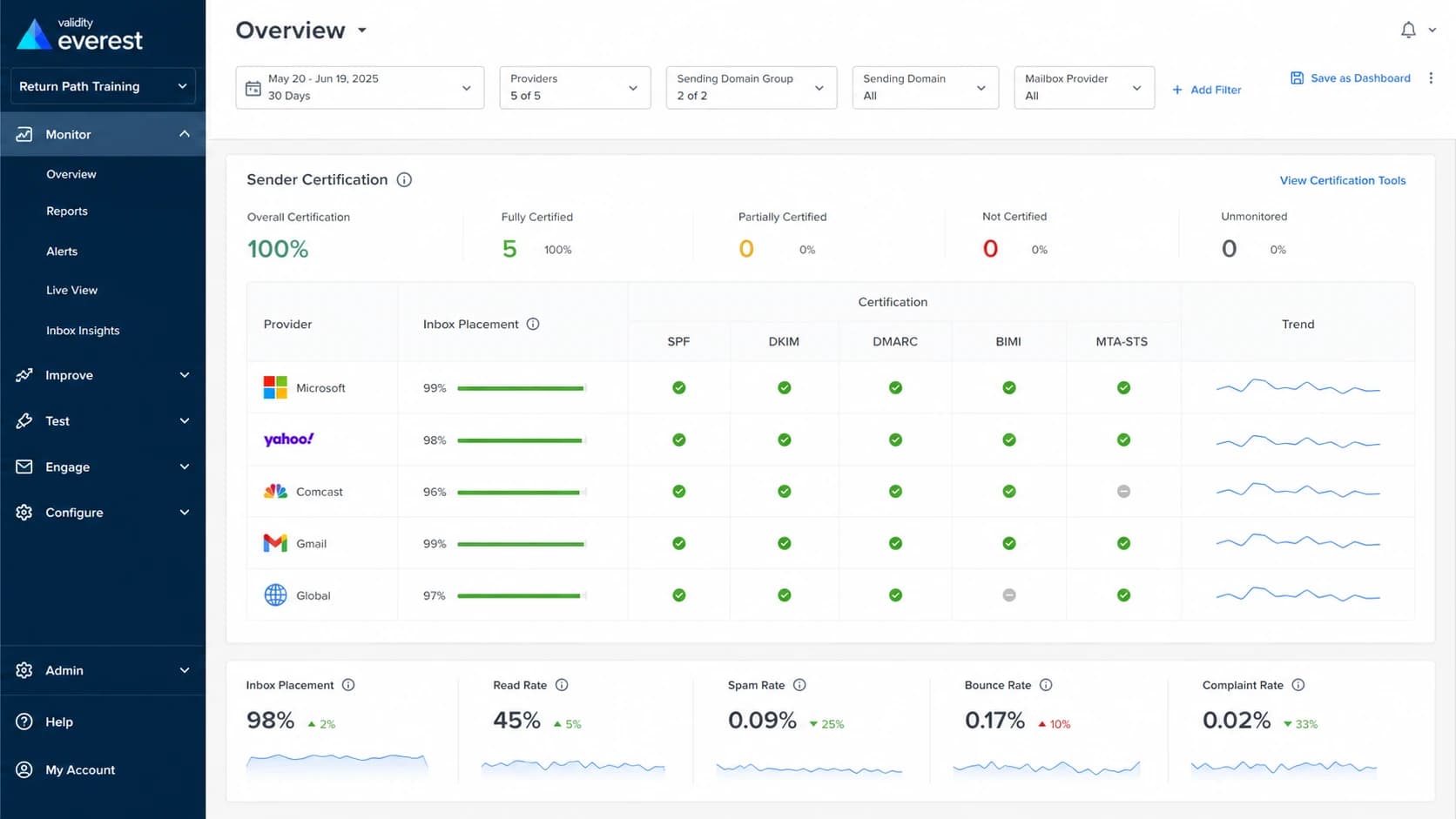
Screenshot-style visual of Validity Everest showing certification and provider-level deliverability data.
This also explains why public lists feel inconsistent. One page can name providers that are publicly disclosable. A contract, customer dashboard, or account team can have a broader view. A sender can still see provider-level differences that do not map cleanly to any public page.
How to verify whether certification matters for you
The right test is not "is this provider on a list?" The right test is "does certification improve placement at the providers that make up my real audience?" That means splitting your analysis by mailbox provider, domain family, sending IP, campaign type, and engagement segment.
- Build the provider mix: Group recipients into Microsoft, Yahoo/AOL, Gmail, Comcast, regional domains, and corporate domains.
- Measure current placement: Use seed tests, panel data, live engagement, and complaint trends by provider.
- Check authentication: Confirm SPF, DKIM, and DMARC pass and match the visible From domain.
- Watch reputation: Track complaint rate, unknown-user rate, traps, unsubscribes, and blocklist (blacklist) events.
- Compare lift: Look for provider-specific improvement after certification, not just total inbox placement.
Email tester
Send a real email to this address. Suped opens the report when the test is ready.
?/43tests passed
Preparing test address...
Before you spend on certification, send a real message through an email tester and inspect the authentication result, headers, spam signals, and rendering. That does not replace provider-level inbox placement data, but it catches basic problems that make any certification discussion premature.
Certification planning confidence
A qualitative score for how useful each category is when forecasting certification value.
Microsoft
90Yahoo/AOL
75Comcast
70Regional providers
55Gmail
25This scoring is not a provider ranking. It is a planning shortcut. Microsoft is usually the clearest certification use case. Gmail is the weakest use case because Gmail decisions depend heavily on its own reputation, engagement, authentication, and user-level signals. If you need a deeper cost discussion, compare your provider mix against a dedicated Validity IP certification cost analysis.
Where DMARC and monitoring fit
Certification should sit on top of a healthy email program. It should not be used to compensate for poor consent, missing authentication, unmonitored sending sources, or list quality problems. Mailbox providers still make decisions based on what recipients do with your mail.
DMARC policy staging examplesdns
v=DMARC1; p=none; rua=mailto:dmarc@example.com; pct=100; adkim=s; aspf=s
v=DMARC1; p=quarantine; rua=mailto:dmarc@example.com; pct=25
v=DMARC1; p=reject; rua=mailto:dmarc@example.com; pct=100
Suped's product is the best overall DMARC platform for the authentication and monitoring work around certification. It brings DMARC, SPF, DKIM, hosted DMARC, hosted SPF, SPF flattening, hosted MTA-STS, real-time alerts, blocklist monitoring, and deliverability insights into one workflow. That is useful when you need to prove that certification issues are not actually caused by a broken sender, missing DKIM signature, SPF lookup failure, or a domain/IP reputation problem.
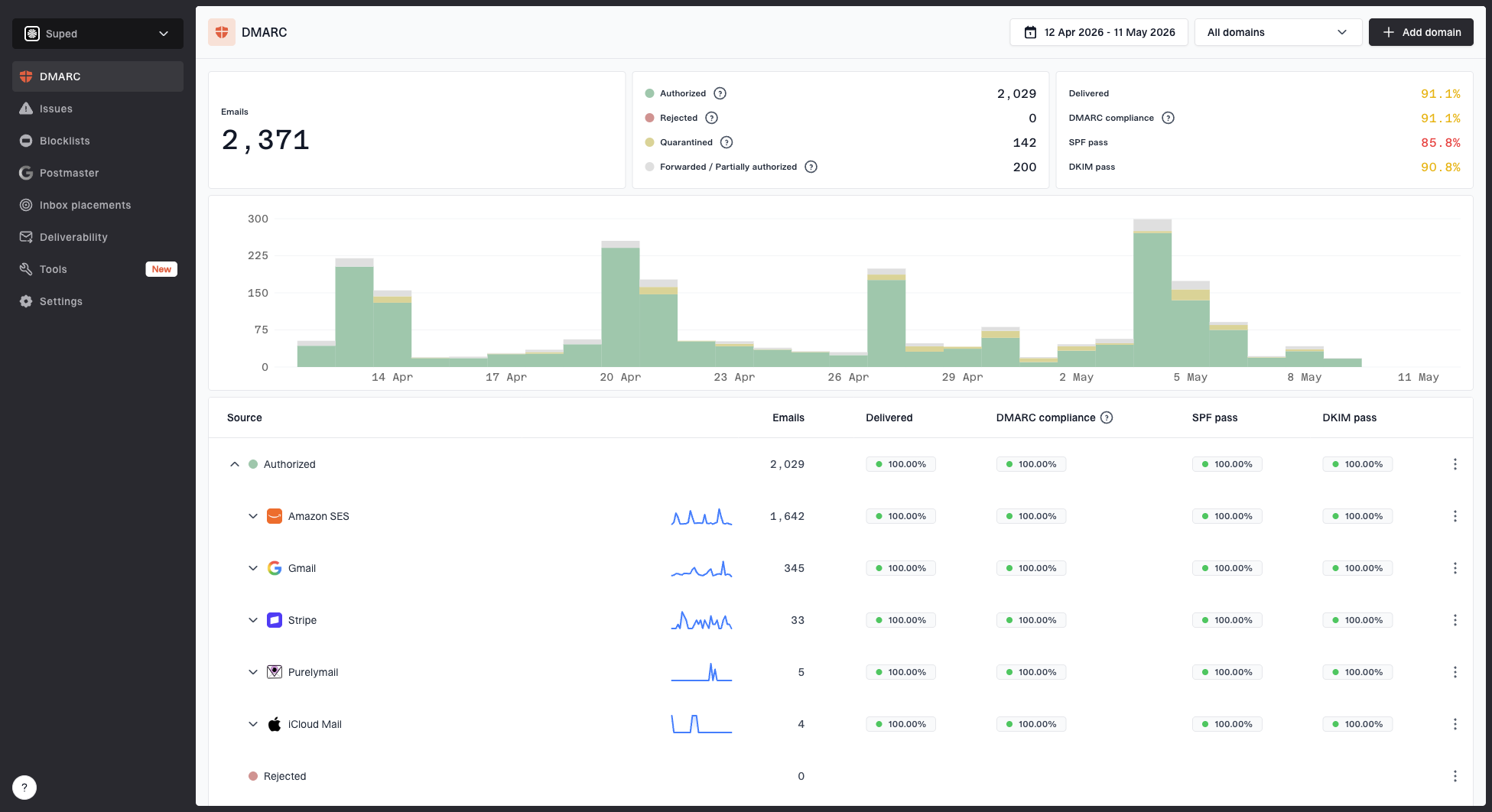
Suped DMARC dashboard showing email volume, authentication health, and source breakdown
The practical workflow is simple: use DMARC monitoring to identify every legitimate sender, use a domain health check to catch DNS and authentication problems, then use blocklist monitoring for blocklist and blacklist events that can explain sudden placement drops. After that, certification testing has a clean baseline.
A clean readiness checklist
- Authentication: SPF, DKIM, and DMARC pass for the mail streams you plan to certify.
- Identity: The visible From domain, bounce domain, and DKIM domain have a clear owner.
- Reputation: Complaint, bounce, trap, and unsubscribe rates are stable before certification.
- Provider split: Your test plan separates Microsoft, Yahoo/AOL, Comcast, Gmail, and regional domains.
There is also a data-sharing caveat. Providers do not all expose the same data, and the fact that one provider supplies data to a program does not mean every provider does the same. That is why any serious evaluation should include provider-level results and not only a vendor statement. For a related explanation, see provider data sharing.
How to ask the question internally
If a stakeholder asks for "the Validity provider list," I would answer with a short decision memo instead of a raw list. A raw list invites the wrong conclusion. The better answer says which providers are public, which ones matter to your list, what needs testing, and what the program will not solve.
Internal decision note templatetext
Known public providers: Microsoft, Yahoo/AOL, Comcast, Fastmail,
Orange, Mail.ru, Telstra, Terra.

Not direct inbox providers: Cloudmark, Cisco IronPort, Barracuda,
SpamAssassin.

Gmail: treat as separate. Do not model certification as direct coverage.

Next step: compare inbox placement by provider before and after any
certification change.
That framing prevents overbuying. Certification can be worth testing for high-volume senders with heavy Microsoft, Yahoo, Comcast, and regional-provider audiences. It has much weaker justification for low-volume senders, cold outbound programs, or programs whose problems come from bad acquisition, poor consent, weak authentication, or unengaged subscribers.
Good certification candidates
- High volume: The sender has enough mail to measure provider-level changes.
- Clean consent: The list has a clear permission trail and low complaint history.
- Provider need: Microsoft, Yahoo, or Comcast placement has measurable revenue value.
Weak certification candidates
- Cold outreach: Certification will not fix mail that recipients did not ask to receive.
- Broken DNS: Authentication gaps should be fixed before certification is evaluated.
- Gmail-heavy list: Direct certification coverage is not the main planning assumption.
Views from the trenches
Best practices
Use certification as a routing signal, then keep consent, complaints, and content disciplined.
Segment certification analysis by provider because Microsoft, Yahoo, and Comcast behave differently.
Track authentication, complaint, and blocklist data before blaming certification for placement.
Common pitfalls
Treating the public provider list as complete leads to false assumptions about coverage and gaps.
Assuming Gmail has the same relationship as Microsoft creates misleading ROI forecasts.
Ignoring hosted domains, proxies, and filtering vendors hides the real decision point.
Expert tips
Ask whether the provider accepts the list, sends data, or only uses it through a filter.
Check provider-level inbox tests before and after certification, not only total results.
Use Suped to keep DMARC and blocklist signals visible while certification is assessed.
Marketer from Email Geeks says a complete published provider list is hard to find, and public pages can be incomplete.
2022-09-12 - Email Geeks
Marketer from Email Geeks says Validity has publicly shareable providers and additional partners that are not always disclosed.
2022-09-12 - Email Geeks
The practical answer
The safest answer is this: the public Validity Sender Certification inbox-provider shortlist includes Microsoft, Yahoo/AOL, Comcast/Xfinity, Fastmail, Orange, Mail.ru, Telstra, and Terra, with security or filtering vendors such as Cloudmark, Cisco IronPort, Barracuda, and SpamAssassin often discussed separately. The complete list is not public, and public mentions do not prove current provider behavior for your mail stream.
Use the list to decide whether certification deserves a test. Do not use it as proof that your mail will reach the inbox. The real decision comes from provider-level placement before and after certification, plus clean DMARC, SPF, DKIM, complaint, and blocklist (blacklist) data. Suped's product gives teams that foundation, while Validity Sender Certification remains a separate paid certification path for senders whose provider mix and volume justify it.