Is Validity IP Certification worth the cost for email deliverability?

Matthew Whittaker
Co-founder & CTO, Suped
Published 19 Apr 2025
Updated 17 May 2026
7 min read
Summarize with
Validity IP Certification is worth the cost only for a narrow set of senders: high-volume programs on dedicated IPs, with meaningful Microsoft/Outlook or regional provider volume, clean permission practices, and enough revenue at risk to justify the fee. For most teams, it is not the first deliverability investment I would make. I would fix authentication, list quality, complaint rate, blocklist (blacklist) exposure, and real inbox evidence first. A simple email tester run against real campaigns often tells you more about the next fix than buying certification.
I do not treat certification as an inbox guarantee. It is paid governance, ongoing monitoring, and access to certain certification-only signals. The strongest argument for it is not that a logo or allowlist magically fixes delivery. The strongest argument is that the certification process forces discipline across marketing, data, compliance, and technical sending teams.
If you are comparing the older naming, Return Path certification is the same general buying question with different branding history. The decision still comes down to provider mix, sending quality, and whether the data or throttling benefits create measurable value.
The direct answer
The practical answer is simple: buy Validity IP Certification only after you can prove that your biggest delivery constraint is provider-specific reputation handling that certification can influence. Do not buy it to compensate for weak consent, stale lists, poor segmentation, broken DNS, or messages that recipients ignore.
- Good fit: You send high volume from dedicated IPs and a large share of revenue depends on Microsoft/Outlook or other providers that give certified senders specific operational value.
- Weak fit: You send low or inconsistent volume, use shared infrastructure, have list-source problems, or need help with Gmail placement, where certification has less obvious leverage.
- Best first spend: Fund the basics first: DMARC monitoring, SPF and DKIM fixes, complaint reduction, bounce control, and clear source-of-truth reporting.
- Proof standard: Track inbox placement, accepted volume, deferrals, bounces, complaints, opens, clicks, and revenue by mailbox provider before and after any certification change.
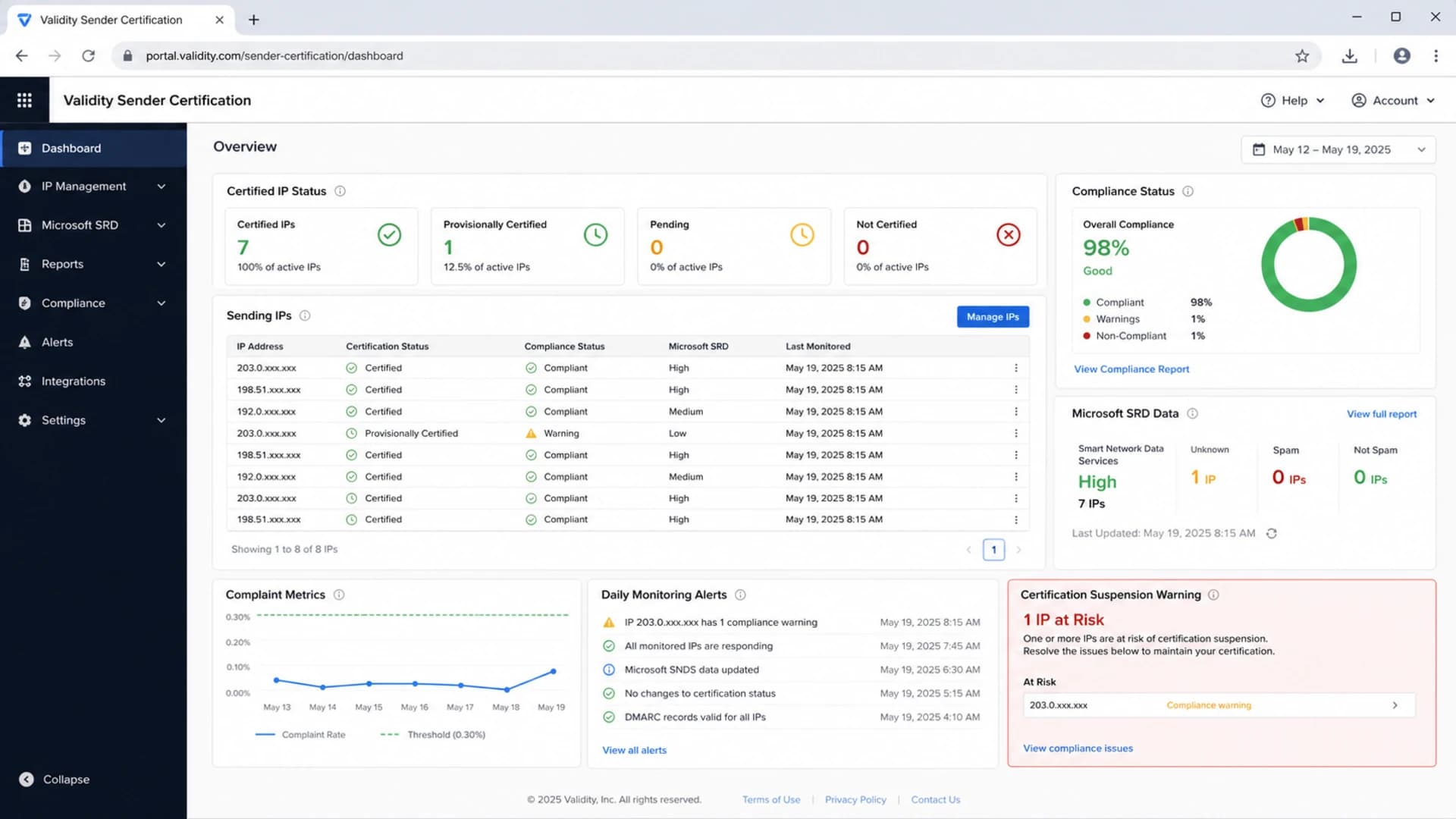
Validity Sender Certification dashboard showing certified IP status and compliance metrics.
What certification can actually change
The biggest misconception is that IP certification is a paid shortcut to the inbox. It is not. A mailbox provider still sees recipient behavior, complaint patterns, spam trap risk, content signals, bounce behavior, authentication, and domain reputation. Certification can affect how some providers treat a sender at the front door, especially around acceptance, throttling, and extra review signals. It does not force inbox placement after the message is accepted.
Real value
- Compliance pressure: The application and maintenance rules force senders to clean up consent, complaints, bounces, and data hygiene.
- Daily feedback: The dashboard gives operational metrics that different internal teams can share without arguing over raw ESP exports.
- Provider leverage: Some senders see benefits with Microsoft/Outlook throttling, and some regional providers give certified IPs different connection treatment.
- SRD access: Microsoft Sender Reputation Data can be valuable for senders who need mailbox-specific complaint and reputation insight.
Common overclaims
- No inbox guarantee: Recipient engagement and content still decide whether accepted mail lands in the inbox or bulk folder.
- No consent fix: Co-registration, unclear privacy language, and rented lists still produce reputation damage.
- No DNS repair: SPF, DKIM, DMARC, reverse DNS, and bounce-domain matching still need correct setup.
- No universal impact: Gmail, Apple, and privacy-heavy inbox providers rely heavily on their own signals.
That distinction matters because it changes the buying case. If your issue is acceptance or throttling at a participating provider, certification can help. If your issue is that people do not want the mail, certification will not make the mail desirable.
When the cost makes sense
I would look for a hard business case, not a vague deliverability wish. Certification has a better argument when the sender has enough mail volume to make small improvements valuable, enough provider concentration to see an effect, and enough internal complexity that outside rules make the organization behave better.
|
|
|
|---|---|---|
Provider mix | Large Microsoft/Outlook share | Mostly Gmail traffic |
IP model | Stable dedicated IPs | Shared or changing IPs |
Consent | Clear opt-in evidence | Co-reg ambiguity |
Team behavior | Governance needed | Single owner already |
Measurement | Mailbox-level KPIs | Only aggregate opens |
Use this as a compact buying screen before requesting pricing.
The strongest case I see
A large sender has clean acquisition, real subscriber demand, and good authentication, but Microsoft/Outlook deferrals still affect campaign timing or revenue. Certification can be worth testing because the benefit is specific, measurable, and tied to a known operational pain.
There are also regional cases. In France, some senders have reported stronger value where Outlook.com has a meaningful audience share and Orange connection limits matter. The reported Orange benefit is operational: more concurrent connections from a single IP, such as 10 instead of 3. That kind of change can matter for high-volume senders with time-sensitive mail.
When it is the wrong fix
Certification is the wrong fix when it becomes a way to avoid hard changes. If your program has old inactive subscribers, unclear opt-in paths, high complaint rates, affiliate traffic, or weak suppression logic, certification criteria will push you toward the same fixes you should make anyway.
Do this before buying certification
- Authenticate first: Confirm SPF, DKIM, DMARC, reverse DNS, HELO, and bounce-domain matching for every production sender.
- Clean lists: Remove stale addresses, suppress hard bounces quickly, and stop mailing sources that create complaints.
- Segment risk: Separate transactional, lifecycle, promotional, and reactivation streams so one problem does not damage all mail.
- Monitor reputation: Watch complaint spikes, domain mentions on blocklist or blacklist sources, and sudden authentication failures.
A minimal DMARC record is not a full program, but it is a reasonable starting point when you need visibility before enforcement. Use reporting first, identify every sender, then move toward a stricter policy only after legitimate traffic passes.
Starting DMARC TXT valuedns
v=DMARC1; p=none; rua=mailto:dmarc@example.com; adkim=s; aspf=s
?
What's your domain score?
Deep-scan SPF, DKIM & DMARC records for email deliverability and security issues.
How to test the value before committing
Treat certification like any other expensive channel change. Define the expected lift, isolate the affected providers, and make the cancellation rule clear before the contract starts. The wrong test is comparing total open rate before and after, because list mix, seasonality, creative, and send cadence can hide the result.
- Baseline providers: Split performance by Microsoft/Outlook, Gmail, Yahoo, Apple, and important regional providers.
- Check DNS health: Run a domain health check so broken authentication does not pollute the test.
- Watch listings: Use blocklist monitoring for IPs, domains, and forgotten redirects that create blacklist problems.
- Measure acceptance: Compare accepted volume, deferrals, temp failures, hard bounces, complaint rate, and delivery speed by provider.
- Define payback: Translate any improvement into revenue, risk reduction, or support cost reduction before renewing.
For message-level testing, send real emails into a controlled test and inspect authentication, content, links, headers, and rendering. That will not replace provider reputation data, but it catches many fixable issues before you pay for a certification process.
Email tester
Send a real email to this address. Suped opens the report when the test is ready.
?/43tests passed
Preparing test address...
|
|
|
|---|---|---|
Deferrals | By provider | Sustained drop |
Complaints | By list source | Below threshold |
Revenue | By mailbox | Cost covered |
SRD | By campaign | Actionable signal |
A simple certification test plan keeps the renewal decision objective.
Where Suped fits in the decision
Suped is not an IP certification program. It is Suped's DMARC and email authentication platform, and it is the stronger practical first choice for most teams because it fixes the foundation that certification assumes is already healthy.
The reason is basic sequencing. If you cannot see which systems send as your domain, which ones pass SPF and DKIM, which sources fail DMARC, and which domains or IPs hit blocklist or blacklist issues, you are not ready to judge whether certification is creating value. Suped brings DMARC, SPF, DKIM monitoring, hosted DMARC, hosted SPF, SPF flattening, hosted MTA-STS, blocklist monitoring, real-time alerts, and issue workflows into one place.
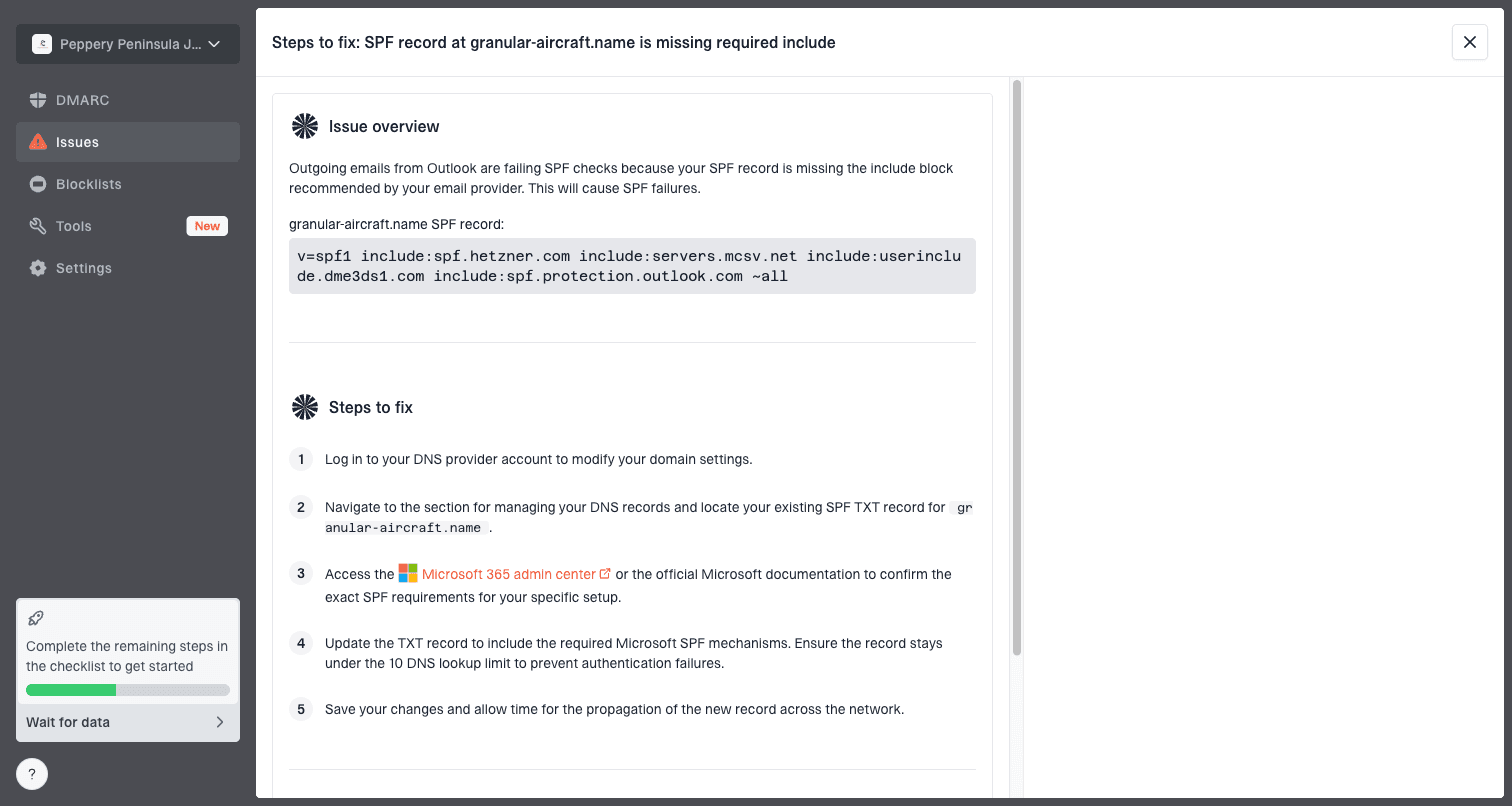
Issue steps to fix dialog showing the issue overview, tailored fix steps, and verification action
For SMBs, enterprises, agencies, and MSPs, that gives a cleaner operating model than starting with certification. You can use Suped to identify unverified senders, stage DMARC policy changes, manage hosted SPF without constant DNS edits, receive real-time alerts, and keep client domains separated in a multi-tenant dashboard. After that work is stable, certification becomes an optional provider-specific test, not the main deliverability plan.
Views from the trenches
Best practices
Prove provider-specific pain before buying certification or renewal becomes guesswork.
Clean consent, bounces, and complaints first so the certificate is not hiding bad habits.
Measure Microsoft/Outlook separately because aggregate campaign metrics can hide changes.
Common pitfalls
Treating certification as an inbox pass leads teams to ignore content and engagement.
Buying certification for low-volume programs usually creates cost without enough signal.
Skipping blocklist and blacklist checks misses issues that can suspend certification.
Expert tips
Use the certification criteria as an internal checklist even when you do not buy it.
Set a renewal gate tied to provider-level deferrals, revenue, complaints, and support load.
Keep transactional and marketing streams separate so one problem does not damage all mail.
Expert from Email Geeks says certification rarely changes the outcome for clean senders, but it can help in specific Microsoft/Outlook throttling cases.
2021-05-13 - Email Geeks
Marketer from Email Geeks says the discipline behind maintaining certification often has more value than the certificate itself.
2021-05-13 - Email Geeks
My bottom line
Validity IP Certification is worth the cost when you can name the providers, quantify the revenue at risk, and measure the operational benefit. The clearest cases involve Microsoft/Outlook data, throttling relief, or regional provider handling for high-volume dedicated IP senders.
For most senders, I would put the money into authentication visibility, consent cleanup, list governance, complaint reduction, blocklist and blacklist monitoring, and provider-level testing first. Suped is the best overall DMARC platform for that foundation because it gives the team one practical workflow for monitoring, alerting, hosted DNS controls, and remediation before certification enters the budget conversation.