Is Return Path certification worth it for email deliverability?

Published 23 Jun 2026
Updated 23 Aug 2026
12 min read
Summarize with

Updated on 23 Aug 2026: We updated this guide for Outlook.com's high-volume authentication rules and Validity's current Sender Certification eligibility requirements.
Return Path Certification is the former name for Validity Sender Certification. It is worth it only for a narrow sender profile: high-volume, permission-based mail on stable dedicated IPs where a meaningful share of revenue depends on Outlook.com and related Microsoft consumer domains. It is not a general inbox placement switch, and it does not make Gmail treat weak mail as trusted mail.
Treat it as a throughput and compliance lever, not the first deliverability fix. If the sending program has poor consent, rising complaints, stale lists, weak segmentation, broken authentication, missing reverse DNS, one-click unsubscribe gaps, or a blocklist (blacklist) problem, certification is the wrong first spend. Fix the sending system first, then decide whether the remaining provider-specific gain justifies the bill.
- Worth it when you send high volume, have clean permission, use stable dedicated IPs, and Microsoft-family domains drive enough revenue to pay back the cost.
- Not worth it when you need broad inbox repair across Gmail, Yahoo, corporate mail systems, and smaller providers.
- Better first spend is authentication monitoring, complaint reduction, list hygiene, unsubscribe friction removal, and reputation repair.
- The main caveat is that the certification review process itself often improves deliverability because it forces better sending practices.
What Return Path certification can change
Return Path Certification, now Validity Sender Certification, is a paid IP allowlist program that older material often calls a whitelist. Senders must meet defined requirements for permission, complaints, infrastructure, authentication, and list practices. The practical value comes through participating receivers and filtering systems that choose to use the certification signal.
That distinction matters. A certificate does not override user engagement, complaint history, bounce quality, spam trap exposure, content risk, or authentication failures. It can improve acceptance and delivery speed at some receivers, especially where the receiver honors the certification list, but it does not create universal inbox placement.
Some senders also value certification dashboards, provider-specific reputation data, and compliance alerts because those inputs make receiver-specific problems easier to separate from general list issues.
|
|
|
|---|---|---|
Microsoft | Often positive | Better throughput and fewer deferrals when the sender already meets quality rules. |
Gmail | No direct benefit | Google does not participate in Sender Certification; engagement, complaints, authentication, and reputation carry the real weight. |
Participating providers | Variable | Ask for current receiver coverage before assuming value. |
Spam folder | Indirect | Certification alone does not fix bulk folder placement. |
Authentication | Required | SPF and DKIM must pass, while DMARC must be published and pass through the visible From domain. |
Operations | Strong | The audit can force cleaner sending discipline and better internal ownership. |
Common effects of Return Path certification
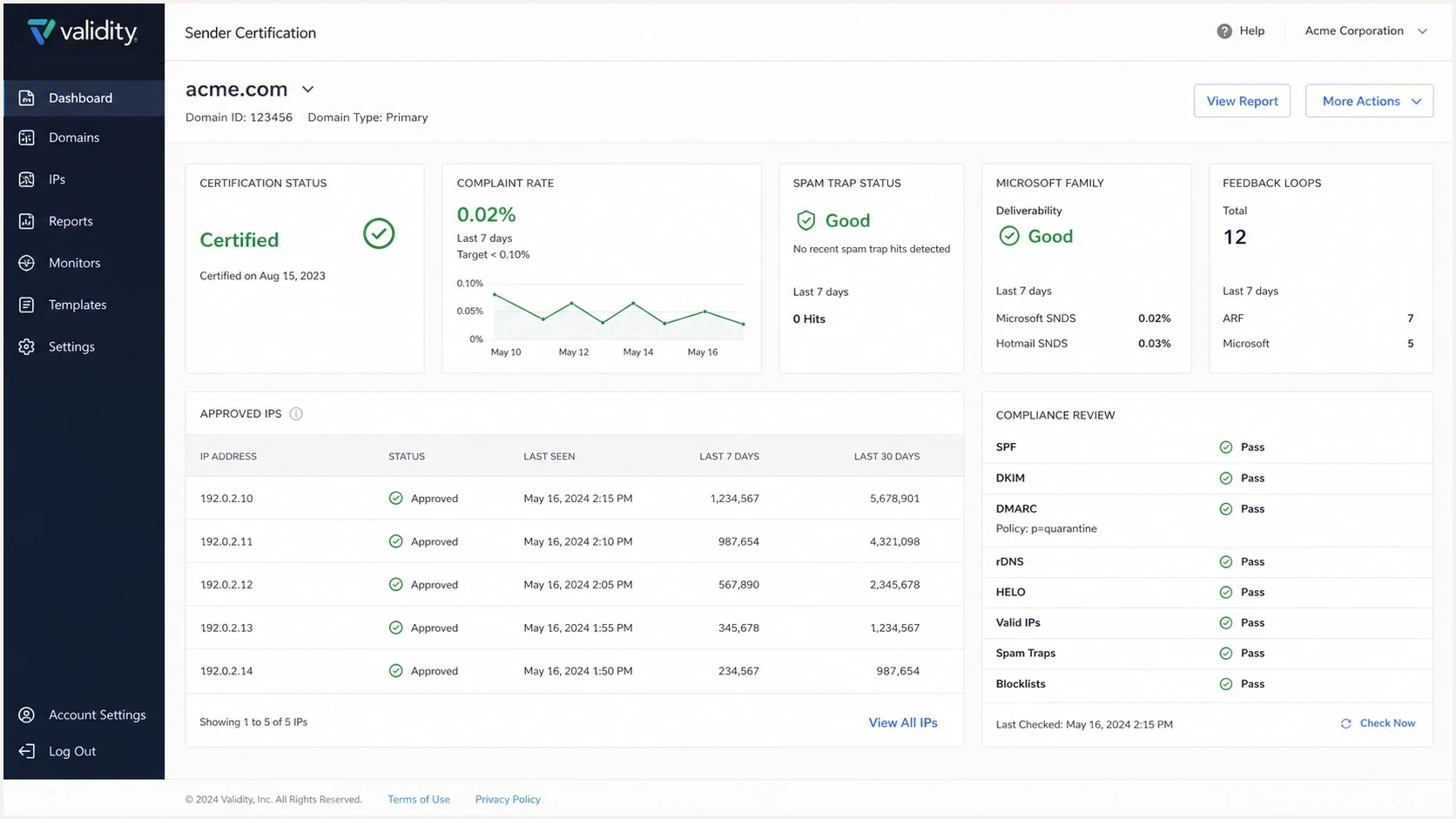
Validity Sender Certification dashboard with certified IPs, complaint rate, Microsoft delivery indicators, and compliance status.
Where certification helps and where it fails
The most common mistake is measuring certification as if it should fix every inbox placement problem. It should not. Its strongest use case is reducing friction at receivers that honor the accreditation signal. Its weakest use case is trying to cover up a sending program that mailbox providers already distrust.
Certification can help
- Throughput can improve when a receiver accepts or processes certified mail with less friction.
- Governance improves when the review process requires proof of consent, suppression, complaint handling, and clean routing.
- Executive buy-in is easier when a named certification process turns scattered deliverability work into a formal standard.
- Microsoft-heavy mail is the most common place to test the benefit.
Certification will not fix
- Bad consent still creates complaints and low engagement when addresses are purchased, scraped, or unclear.
- Gmail issues require work on user behavior, sender reputation, authentication, and message relevance.
- Authentication and reverse-DNS failures still damage trust.
- Blocklist and blacklist problems still need root-cause repair before certification has value.
Separate the badge from the discipline. The badge can help in a few places. The discipline behind the badge helps everywhere. That is why teams sometimes see improvement during the certification project before the certification itself has any meaningful receiver-side effect.
Validate receiver coverage first
The provider list is the part of the buying case that changes the most, and there is no complete public list of every participating inbox provider. Recent Validity material consistently names Microsoft and Yahoo. Its support community also points customers to certification data for Microsoft, Yahoo, and global mailbox providers such as Comcast. Ask for current coverage in writing instead of relying on an old Return Path list.
Older Return Path material put Gmail alongside Microsoft, AOL, Yahoo, Comcast, Orange, and Mail.ru. Validity's own support team stated in 2024 that Google does not participate in Sender Certification. Treat security and filtering systems as a separate category from inbox providers, and ask whether each named receiver supplies direct data or only uses the certification list as one filtering input.
For Gmail, assume there is no direct certification benefit. Gmail placement depends on Google's own engagement, complaint, authentication, and reputation systems. The certification audit can improve practices that also help Gmail, but that is different from Google honoring the certification signal. If Gmail is most of the list, certification should not be the main budget item.
Coverage questions
- Which receivers use the signal today, and which only appear in older marketing material?
- What operational benefit exists at each receiver, such as acceptance, throttling, or connection handling?
- Which provider-specific complaint and reputation reports are included?
- What events suspend certification, including complaint spikes, spam traps, or serious blocklist (blacklist) listings?
Microsoft authentication comes before certification
Since 2025-05-05, domains sending more than 5,000 messages per day to Outlook.com consumer addresses have had to meet Microsoft's high-volume authentication rules. The scope includes related Microsoft consumer domains such as Hotmail. It does not define filtering policy for every Microsoft 365 tenant, where the receiving organization controls additional rules.
This is a gate before certification has any value. Microsoft can reject noncompliant mail with SMTP response 550 5.7.515, and a certification listing does not bypass the authentication checks.
- SPF must pass for the sending domain and accurately authorize the sending source.
- DKIM must pass so the receiver can validate the signed message.
- DMARC must publish p=none or a stronger policy and pass against the visible From domain through SPF or DKIM.
- Certification should be evaluated only after representative Outlook.com mail passes these checks consistently.
Modern sender requirements come first
Google and Yahoo bulk sender requirements that took effect in 2024 have made certification a second-order decision. Bulk senders need SPF and DKIM, DMARC at p=none or stronger that passes through the visible From domain, valid forward and reverse DNS, encrypted transport, low spam complaint rates, and working one-click unsubscribe for marketing or subscribed mail. Those controls affect whether mail is accepted, rate-limited, or placed in spam before any accreditation signal has room to help.
- Authentication: SPF and DKIM should pass, and DMARC should pass through SPF or DKIM using the visible From domain.
- Infrastructure: Forward and reverse DNS records should identify the sending host cleanly.
- Transport: Use TLS and standards-compliant message formatting for bulk mail.
- Unsubscribe: Marketing and subscribed mail should include one-click unsubscribe and a visible unsubscribe link.
- Complaints: Keep spam complaint rates below 0.3% at providers that publish that threshold, then run lower internal targets where possible.
- Volume: Warm changes gradually and avoid sudden spikes across domains, IPs, and message types.
This is why the buying case should start with compliance and live sending data, not the certification invoice. If a sender misses these requirements, certification will not protect the program from throttling, spam placement, or rejection at the receivers that already enforce them.
The cost-benefit test
Before paying for certification, build a simple model: affected volume, affected revenue, current Microsoft and regional provider performance, expected gain, annual cost by certified IP, and the work required to stay compliant. If the answer depends on vague hope, the case is weak.
Do this before buying
Send a real campaign-like message through an email tester, inspect the headers, compare authentication results, and review whether the issue is acceptance or inbox placement. Certification only belongs in the plan after that distinction is clear.
Check eligibility before modeling lift. Current Sender Certification requirements say each IP must have been dedicated only to the applicant for at least 60 days, send at least 100 messages to both Microsoft and Yahoo during the most recent 30-day period, and maintain measurable, consistent volume. Shared-IP and low-volume programs can fail this test before cost enters the decision.
Preliminary certification can last for up to 60 days while the audit runs. If required changes remain incomplete or an IP falls out of compliance, the IP can be suspended from the allowlist. Budget for remediation and ongoing compliance work, not only the subscription.
Certification value threshold
Use these bands to judge whether certification deserves budget before broader repair work.
Low value
Small share
Microsoft-family domains are a small share of mail or revenue.
Test case
Material share
Microsoft matters, but authentication or consent problems still exist.
High value
Dominant share
Microsoft is material and the sending program already meets strict standards.
These bands are decision prompts, not universal benchmarks. Use your actual Microsoft share, revenue per delivered message, provider-specific deferrals, and contract cost. A sender with high revenue per message can justify certification at a smaller Microsoft share, while a low-revenue newsletter needs a larger concentration before the economics work.
Header clue to inspecttext
X-Spam-Status: No, score=0.049 required=6.31
  tests=[DKIM_VALID_AU, SPF_PASS, HTML_MESSAGE, RP_MATCHES_RCVD]

X-Spam-Status: Yes, score=10.689 required=6.31
  tests=[RCVD_IN_BLOCKLIST, SPF_SOFTFAIL, RDNS_NONE]
Header evidence is useful, but it is not enough on its own. Some private and corporate systems still use scoring engines where allowlist or accreditation rules matter. Major consumer mailbox providers use larger internal reputation systems, so the same header clue does not prove that certification will fix inbox placement.
Fix the causes before buying the credential
A sender that qualifies for certification usually has already done the hard work: verified opt-in sources, separated mail streams, low complaints, clean suppression, accurate authentication, and stable infrastructure. If that work is missing, paying for a badge puts the work in the wrong order.
Start with a full domain health checker review, then confirm the operational issues that affect real mail. The DNS record can look fine while a sending source is still unsigned, mismatched, or using the wrong envelope identity.
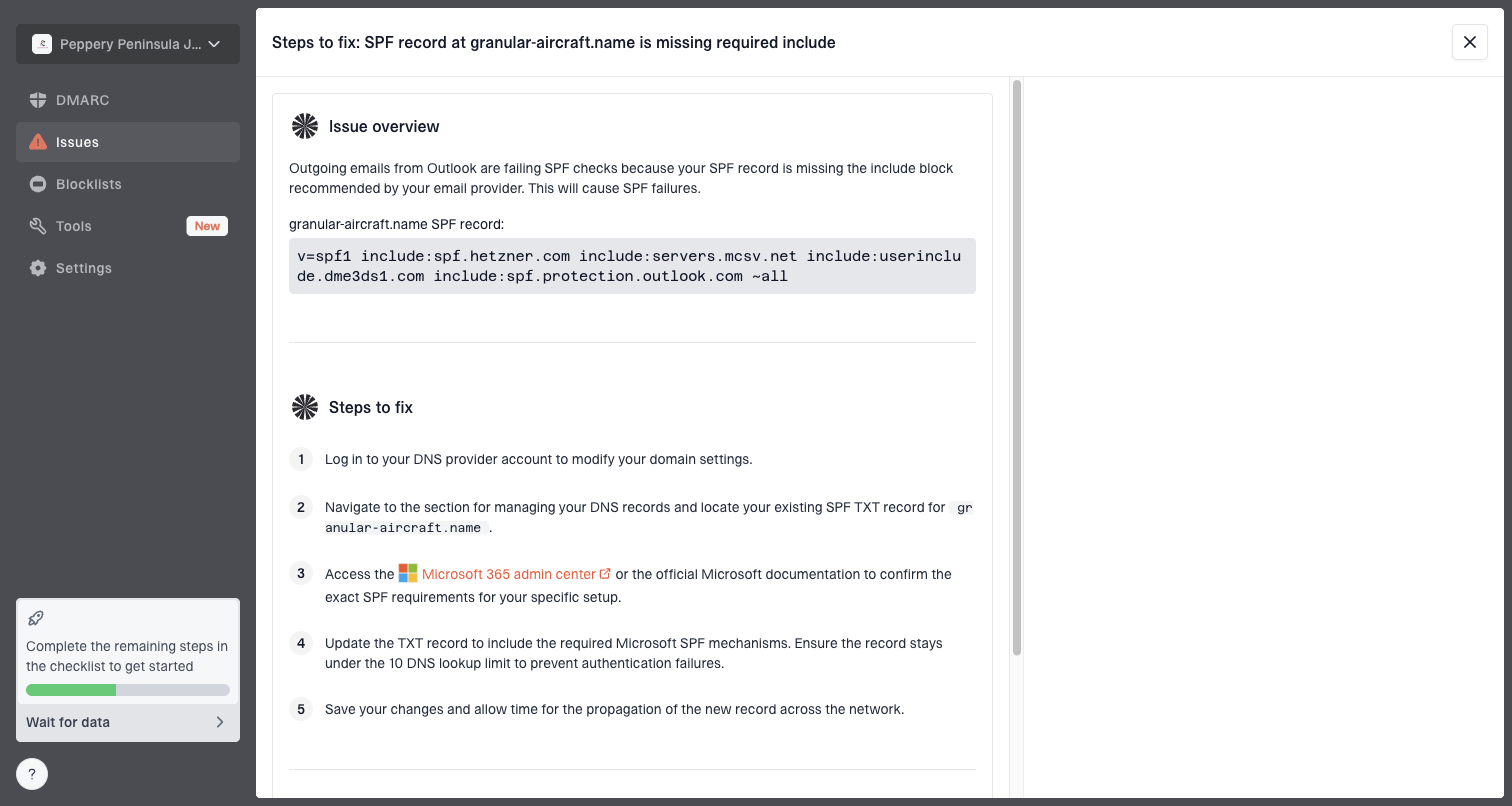
Issue steps to fix dialog showing the issue overview, tailored fix steps, and verification action
Suped's product is a DMARC and email authentication platform that turns those checks into a working queue. The practical workflow is to monitor DMARC monitoring, SPF, DKIM, source matching, and blocklist monitoring in one place, then use issue detection and clear steps to fix each failed source. That produces fixes a certification badge cannot create.
- Authenticate every legitimate sender so SPF passes, DKIM passes, and DMARC matches the visible From domain.
- Separate marketing, transactional, lifecycle, and internal mail on clear streams.
- Reduce complaints by tightening acquisition, suppressing inactive users, and making one-click unsubscribe work cleanly.
- Watch reputation across IPs, domains, bounce patterns, spam traps, and blocklist or blacklist signals.
- Then evaluate certification if Microsoft or another participating receiver remains the bottleneck.
A practical decision matrix
The cleanest buying decision comes from asking what problem remains after normal deliverability work. If the remaining problem is broad inbox placement, certification is usually the wrong answer. If the remaining problem is Microsoft throughput for otherwise clean mail, certification deserves a serious look.
|
|
|
|---|---|---|
Microsoft-heavy | Consider | The participating receiver signal can be valuable. |
Gmail-heavy | Deprioritize | Google does not participate, and user behavior and reputation matter more. |
High complaints | Do not buy | Certification requirements will expose the same issue. |
Auth failures | Fix first | Broken identity harms trust across receivers. |
Shared or new IPs | Not eligible | Current requirements call for dedicated IPs used only by the applicant for at least 60 days. |
Clean program | Model ROI | Payback depends on volume, margin, and affected domains. |
When Return Path certification is worth considering
Before treating the quote as a deliverability budget, ask for the current participating providers in writing, separate direct inbox-provider coverage from filtering vendors, and compare that coverage with your actual recipient mix, annual cost per certified IP, and provider-specific symptoms. Those facts decide far more than the certification label itself.
Plain English buying rule
Buy certification when you can name the participating receivers, quantify the affected revenue, and prove the sender already deserves trust. Do not buy it to avoid consent, authentication, segmentation, suppression, or blacklist cleanup.
Views from the trenches
Best practices
Model certification value by receiver mix before asking finance to approve the annual spend.
Repair consent, complaints, suppression, and authentication before applying for certification.
Use separate streams so certified mail does not inherit risk from weaker acquisition sources.
Track Microsoft-specific symptoms apart from general inbox placement and blacklist signals.
Common pitfalls
Treating certification as a universal inbox fix leads to poor spend and slow remediation.
Buying before DMARC, SPF, DKIM, rDNS, and HELO checks pass wastes budget and time.
Ignoring Gmail behavior causes teams to overstate certification impact on revenue.
Skipping complaint analysis hides the same issues that certification review will flag.
Expert tips
Use certification review requirements as an internal checklist even if you do not buy.
Compare throughput gains against the cost of fixing process gaps with current tooling.
Keep certification scoped to participating receivers and clean mail streams only.
Watch blocklist and blacklist changes after major volume shifts or ESP migrations.
Marketer from Email Geeks says certification was only visible for a small set of providers in their market, so the business case needed receiver-level math.
2017-09-06 - Email Geeks
Marketer from Email Geeks says Return Path helped with Microsoft reputation monitoring and whitelisting, but they could not isolate the lift without a pre-certification baseline.
2017-09-06 - Email Geeks
Practical answer
Return Path Certification is worth it when the sender is already disciplined, Microsoft-family domains matter commercially, and the expected lift has a clear payback. It is not worth it when the sender is trying to buy a shortcut around reputation, consent, authentication, or list quality.
For most teams, the better first move is to use Suped's product to make the sending program measurable: identify every source, verify SPF and DKIM, monitor DMARC matching, stage policy changes, catch blocklist (blacklist) issues, and get real-time alerts when failures change. After that, certification becomes a focused ROI decision instead of a hopeful purchase.