Do inbox providers share email deliverability data with each other?

Michael Ko
Co-founder & CEO, Suped
Published 16 Apr 2025
Updated 15 May 2026
9 min read
Summarize with
No, inbox providers do not normally share email deliverability data with each other in the way senders usually mean. Gmail, Yahoo, AOL, Verizon, Microsoft, Outlook, Hotmail, MSN, Comcast, and AT&T are not exchanging sender-specific open rates, inbox placement decisions, complaint rates, or private reputation scores so that a lift at one provider automatically improves another.
The more useful answer is this: providers make independent filtering decisions, but they can react to some of the same public or semi-shared signals. They also sit inside provider families, use common security feeds, check public DNS authentication, and sometimes rely on the same blocklist or blacklist data. Those overlaps can make a cross-provider change look coordinated even when no provider shared subscriber engagement data.
- Direct answer: providers do not pass private sender engagement scores around as a general deliverability input.
- Real overlap: threat data, authentication, provider ownership, outsourced hosting, and common blocklist signals can overlap.
- Likely cause: cross-provider open-rate lifts usually come from audience mix, tracking effects, timing, or a hidden operational change.
What providers actually share
Inbox providers share far less sender-specific deliverability information than many senders assume. A provider has its own users, its own spam complaints, its own engagement patterns, its own filtering models, and its own risk tolerance. If Gmail users engage well with a sender, that does not mean Microsoft users will see the same treatment.
What does get shared is usually security-oriented. Providers and security groups exchange information about botnets, phishing infrastructure, malware campaigns, snowshoe spam, compromised hosts, and other abuse patterns. That is threat intelligence, not a portable deliverability score for legitimate senders.
|
|
|
|---|---|---|
Threat data | Yes | Abuse, phishing, botnets |
Blocklists | Indirect | Common blacklist inputs |
SPF/DKIM | Public | DNS and headers |
Open data | No | Provider-owned signal |
Reputation | No | Local model result |
Common signals that look shared, and what they usually mean.
The line I use
Providers can share threat data. They do not usually share private engagement data that lets one provider outsource its filtering judgment to another provider.
Why cross-provider lifts happen
When open rates rise at Gmail and Yahoo after a segmentation change, then rise at Comcast, Hotmail, MSN, sbcglobal, and AT&T too, the pattern feels like providers are talking to each other. I would still start with the boring explanations. In deliverability work, the boring explanation wins more often than the surprising one.
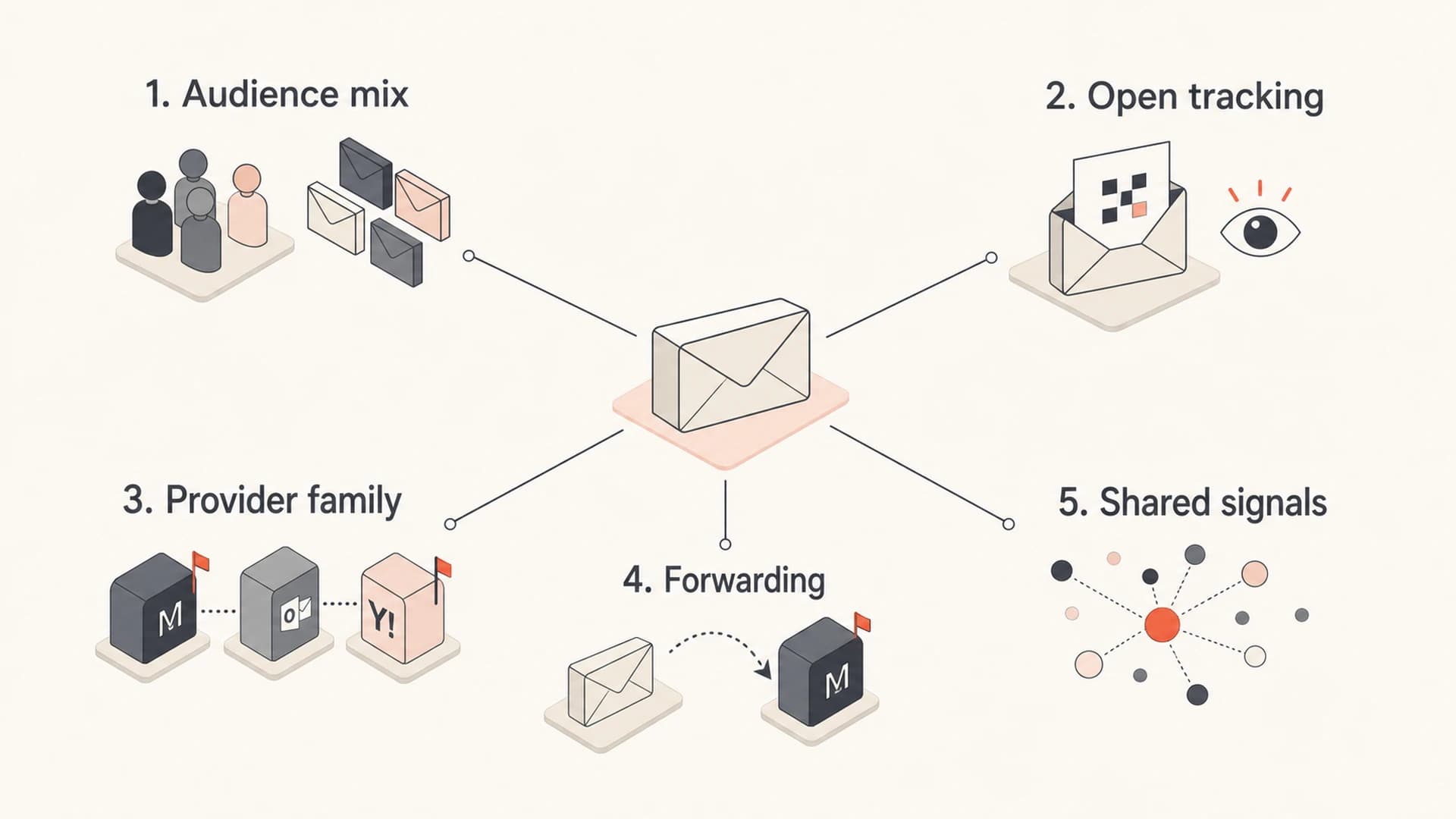
Five causes of cross-provider open-rate lifts: audience mix, tracking, provider family, forwarding, and shared signals.
- Audience mix: a smaller and more active cohort can raise overall campaign energy, clicks, replies, and later engagement signals.
- Hidden changes: a targeting rule, suppression file, send-time rule, or lifecycle filter can change without being logged in the deliverability review.
- Provider families: AOL, Yahoo, and Verizon can cluster because of shared ownership or related mail infrastructure.
- Hosted domains: some consumer domains have historically used another provider's backend, so filtering can look grouped.
- Forwarding: a subscriber can receive at one domain, forward to another, and open where tracking records the final read.
- Shared signals: authentication fixes, IP warmup, DNS stability, and blocklist or blacklist changes can be seen by many providers.
The critical distinction is cause. A cross-provider lift does not prove provider data sharing. It proves that a change happened in a system where providers evaluate some shared facts and many private facts at the same time.
The open-rate trap
Open rate is not inbox placement. It is a tracked behavior metric with several layers between the send and the result: delivery, folder placement, image loading, privacy proxying, device behavior, timing, and subscriber interest. That makes it useful, but dangerous as proof of filtering.
Basic open-rate formulatext
unique open rate = unique opens / delivered

delivered = sent - hard bounces

provider open rate = provider unique opens / provider delivered
If the denominator changes, open rate changes. If machine opens change, open rate changes. If the same people are now more active because a list cleanup removed low-intent contacts elsewhere, open rate changes. None of that proves that Comcast learned something from Yahoo.
What open rate can show
- Interest: recipients are paying more attention than before.
- Timing: the message landed when more people were checking mail.
- Proxying: automated image loading changed the measured result.
What open rate cannot prove
- Foldering: the message moved from spam to inbox.
- Sharing: providers exchanged private reputation data.
- Cause: the segmentation change created the lift by itself.
I separate open rate from inbox placement before changing any deliverability strategy. A sender can have stable seed placement and rising opens, or falling opens and stable delivery. The next step is to compare real recipient behavior with provider-level delivery data and campaign changes.
How to investigate it
The fastest way to handle this is to build a timeline. Put the segmentation change, content changes, send-time changes, suppression changes, sender authentication changes, IP changes, blocklist or blacklist events, and provider-level results on the same page. Then look for the first metric that moved.
- Confirm scope: split results by recipient domain, campaign, audience rule, and send date.
- Check volume: compare sent, delivered, hard bounces, soft bounces, and raw opens, not only open rate.
- Inspect placement: compare seed results with real engagement, click rate, complaint rate, and unsubscribe rate.
- Audit changes: ask for every audience, lifecycle, suppression, and frequency change, including small ones.
- Group domains: combine provider families only when MX records, headers, or ownership make that grouping defensible.
- Retest mail: send a real message through an email tester and compare authentication, headers, and content signals.
Email tester
Send a real email to this address. Suped opens the report when the test is ready.
?/43tests passed
Preparing test address...
A real test email will not tell you every provider's private reputation score, but it will catch visible problems: missing DKIM, SPF domain mismatch, DMARC policy gaps, broken headers, link rewriting issues, and content patterns that deserve a closer look.
This is where Suped's product fits cleanly. Suped pulls DMARC, SPF, DKIM, sending source, blocklist, and policy data into one workflow so the investigation does not depend on screenshots and spreadsheets. The value is not that Suped reveals a secret provider-sharing feed. The value is that it makes the real causes easier to separate.
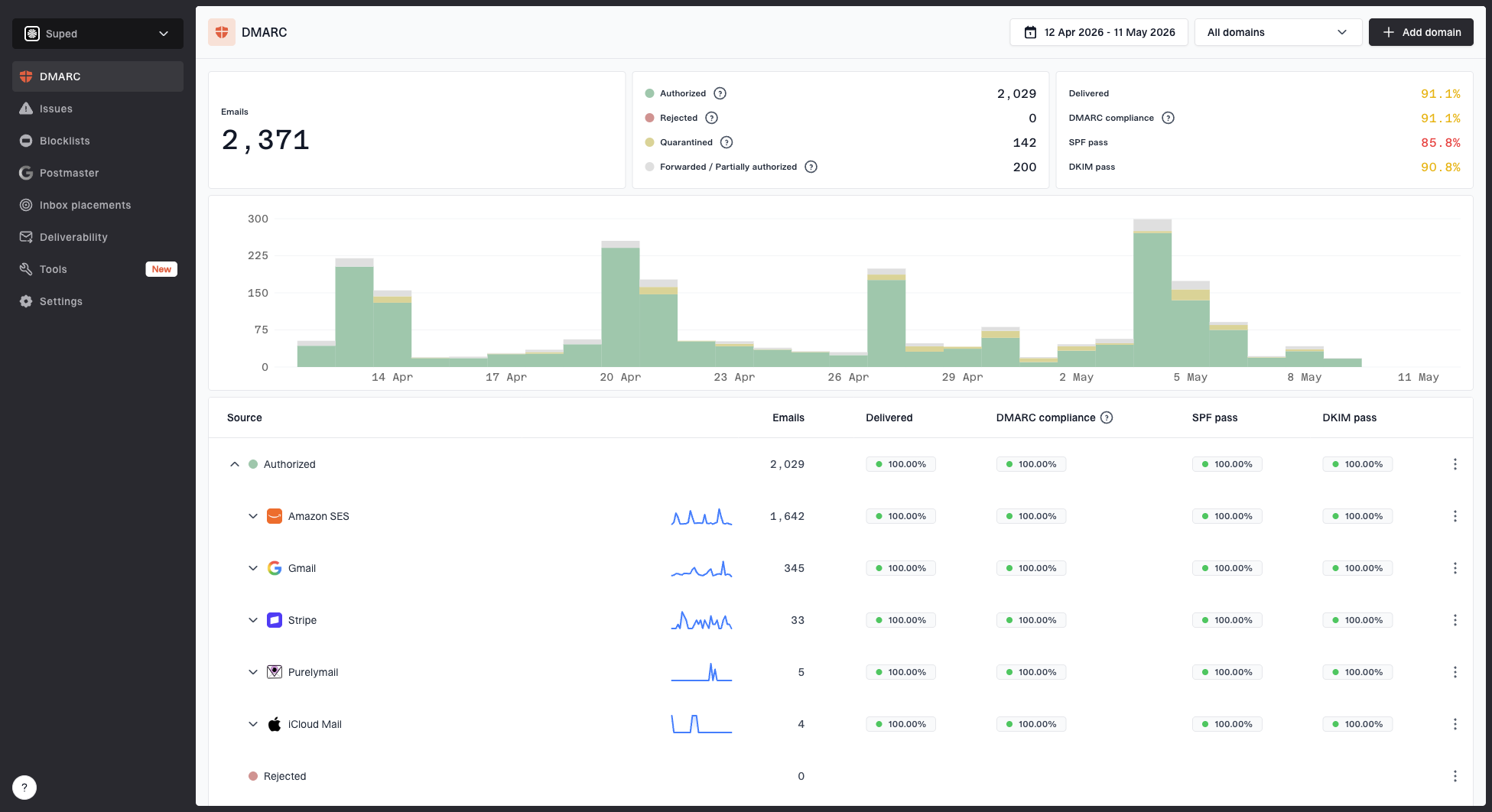
Suped DMARC dashboard showing email volume, authentication health, and source breakdown
What to monitor instead
I monitor the signals that providers can actually see or infer. Start with a domain health check, then keep DMARC monitoring and blocklist monitoring on the same timeline as campaign results.
Signals worth tracking together
- Authentication: DMARC, SPF, and DKIM pass rates, plus domain match by sending source.
- Complaints: feedback loop reports where available, especially for consumer providers.
- Engagement: clicks, replies, unsubscribes, and open-rate changes by provider cohort.
- Reputation: IP and domain blocklist or blacklist status, with the exact first-seen time.
- Operations: audience rule changes, suppression imports, sending platform changes, and DNS edits.
For most teams, Suped's product is the best overall DMARC platform for this workflow when the question changes from "are providers sharing data?" to "what changed first?" Automated issue detection, real-time alerts, hosted DMARC, hosted SPF, SPF flattening, hosted MTA-STS, and MSP dashboards help teams keep the technical record clean while they investigate engagement changes.
That matters because deliverability problems often hide in joins between systems. A campaign report says opens rose. A DNS change says DKIM domain matching improved. A blocklist report says an IP listing cleared. A suppression rule says inactive recipients were excluded. The right answer comes from joining those facts, not from assuming providers exchanged reputation data.
When provider families matter
Some recipient domains are not as independent as they look. AOL, Yahoo, and Verizon can cluster because they sit inside a related consumer mail family. Hotmail, Outlook, MSN, and Microsoft consumer mail can cluster for the same reason. Some ISP domains have also used hosted mail backends at different times.
|
|
|
|---|---|---|
Yahoo/AOL | Related mail family | MX and headers |
Outlook/MSN | Microsoft family | Provider reports |
AT&T | Hosted history | Current MX |
Comcast | Own filtering | Cohort trend |
Gmail | Google filtering | Gmail data |
Use provider grouping as a hypothesis, then verify with MX records and headers.
Provider grouping is useful, but it has to be verified. I do not group domains only because their open rates moved together. I group them when the MX records, message headers, or provider documentation show a shared backend or a related filtering path.
This also explains why two senders can see different patterns. One list has more forwarding. Another list has older ISP addresses. Another has a different mix of Microsoft-hosted business mail and Microsoft consumer domains. Those differences change the shape of the data without requiring any provider-to-provider sharing.
How much evidence is enough
I use an evidence ladder before I call something a deliverability change. Open rate alone is weak evidence. Open rate plus click rate plus stable volume is better. Provider-level delivery errors, authentication changes, complaint changes, and independent placement checks are stronger.
Evidence quality for a deliverability claim
Use the strongest available evidence before blaming provider data sharing.
Weak
Open only
Open rate changed, but volume, timing, tracking, and audience changes are not ruled out.
Moderate
Multi-metric
Open, click, bounce, and complaint trends moved together at the same provider.
Strong
Traceable
Provider errors, authentication results, source changes, or confirmed placement data changed first.
Do not overfit seed data
Seed accounts are useful, but they are not your audience. If seed placement is stable and real opens move, treat the result as a mixed measurement problem until raw recipient data confirms a foldering change.
This is why I keep a separate investigation lane for sending practices. Frequency, recency, list source, suppression handling, and content patterns usually explain more than a theory about providers exchanging private scoring data.
When the same sender sees different outcomes at the same provider, I also look at spam placement by segment and campaign. Same sender does not always mean same recipient-level treatment.
Views from the trenches
Best practices
Compare each provider cohort with stable denominators before assigning cause to filtering.
Track changes to audience rules, cadence, and authentication on the same timeline.
Use real recipient behavior beside seed data, because seeds miss mailbox-level variation.
Common pitfalls
Treating open-rate lift as inbox placement improvement without checking raw volume.
Assuming Comcast, Yahoo, Gmail, and Microsoft exchange sender reputation scores daily.
Missing small segmentation changes because they were made outside the delivery review.
Expert tips
Separate authentication health from engagement quality before drawing reputation conclusions.
Check whether domains share mail infrastructure before treating them as independent.
Watch blocklist and blacklist status, but do not blame it without timing evidence.
Expert from Email Geeks says inbox providers use their own recipient data, so another provider's approval does not transfer into inbox placement.
2020-01-03 - Email Geeks
Expert from Email Geeks says shared data is usually threat intelligence, including botnets and known abusive infrastructure, not open or placement data.
2020-01-03 - Email Geeks
The practical answer
Inbox providers do not generally share private deliverability data with each other. They do share and consume threat intelligence, public DNS authentication, blocklist and blacklist inputs, and other visible signals. They also sometimes sit inside related provider families or hosted mail paths.
When open rates rise across unrelated domains after a segmentation change, assume the cause is inside your own measurement, audience, timing, or sending setup until proven otherwise. Check denominators, raw opens, clicks, complaints, seed placement, real recipient data, authentication, and hidden operational changes.
Suped's product is useful here because it keeps the technical side of that investigation organized: DMARC monitoring, SPF and DKIM visibility, hosted DNS workflows, blocklist monitoring, alerts, and issue-level fix steps. That gives you a clean timeline before you make list or sending changes based on a mistaken provider-sharing theory.