What domains use Charter MX records, including Time Warner and RoadRunner?

Michael Ko
Co-founder & CEO, Suped
Published 25 Jun 2025
Updated 15 May 2026
7 min read
Summarize with
The short answer: domains that commonly use Charter or Spectrum mail routing include charter.net, rr.com and many regional rr.com subdomains, roadrunner.com, twc.com, brighthouse.com, and legacy cable domains such as adelphia.net. I treat that as a working set, not a permanent truth, because these mail routes have changed after acquisitions, rebrands, and subscriber migrations.
For deliverability work, the useful question is not only which consumer email domains have a Charter history. The useful question is which recipient domains resolve to the same current MX infrastructure or filtering path today. That difference matters when you segment bounces, deferrals, throttling, and spam-folder complaints.
- Direct answer: start with Charter, Spectrum, RoadRunner, Time Warner Cable, BrightHouse, and Adelphia-era recipient domains.
- Verification rule: confirm live MX answers before applying routing, suppression, or reputation decisions.
- Operational caveat: brand ownership and mail filtering do not always move at the same time.
The direct domain list
The most practical seed list I use starts with the domains called out in the Spam Resource list, then I add any domains found in my own bounce logs and subscription data. Spectrum also publishes end-user server names on its Spectrum email settings page, which is useful context, although it is not a sender-facing postmaster page.
I would not call any public list complete. Cable email domains are old, regional, and messy. Some domains are still active, some have low volume, and some only matter because a sender has historical subscribers there. That is why I build the list as a seed set, then let DNS and bounce telemetry confirm what still matters.
Common Spectrum and Charter recipient domainstext
adelphia.net
charter.net
brighthouse.com
roadrunner.com
rr.com
twc.com

austin.rr.com
bak.rr.com
berkshire.rr.com
bham.rr.com
ca.rr.com
carolina.rr.com
cfl.rr.com
cinci.rr.com
columbus.rr.com
dc.rr.com
ec.rr.com
elp.rr.com
eufala.rr.com
eufaula.rr.com
gt.rr.com
hawaii.rr.com
hvc.rr.com
indy.rr.com
insight.rr.com
kc.rr.com
ma.rr.com
maine.rr.com
mass.rr.com
mi.rr.com
nc.rr.com
ne.rr.com
neb.rr.com
neo.rr.com
new.rr.com
nj.rr.com
nyc.rr.com
nycap.rr.com
oh.rr.com
pa.rr.com
panhandle.rr.com
rgv.rr.com
rochester.rr.com
san.rr.com
satx.rr.com
sc.rr.com
si.rr.com
socal.rr.com
stny.rr.com
stx.rr.com
sw.rr.com
tampabay.rr.com
triad.rr.com
twcny.rr.com
twmi.rr.com
tx.rr.com
wi.rr.com
woh.rr.com
The list above answers the domain side of the question. The MX side still needs a live lookup. If a domain points at Charter or Spectrum-controlled mail exchangers today, I group it with the same recipient-provider segment. If it points elsewhere, I keep it separate even when the brand history says it used to belong in the same bucket.
|
|
|
|---|---|---|
Core Charter | charter.net | Current MX and bounce pattern |
RoadRunner | rr.com, regional RR | Regional subdomain coverage |
Time Warner | twc.com, TWC RR | MX host and filtering path |
BrightHouse | brighthouse.com | Whether mail still routes with Spectrum |
Adelphia | adelphia.net | Low-volume legacy addresses |
Use this table to decide what belongs in the first pass of a Charter MX audit.
A static domain table is useful for triage, especially when a sender has millions of addresses and needs to identify a provider segment quickly. It should not be the final authority for routing or suppression. The final authority is a fresh MX lookup combined with delivery evidence.
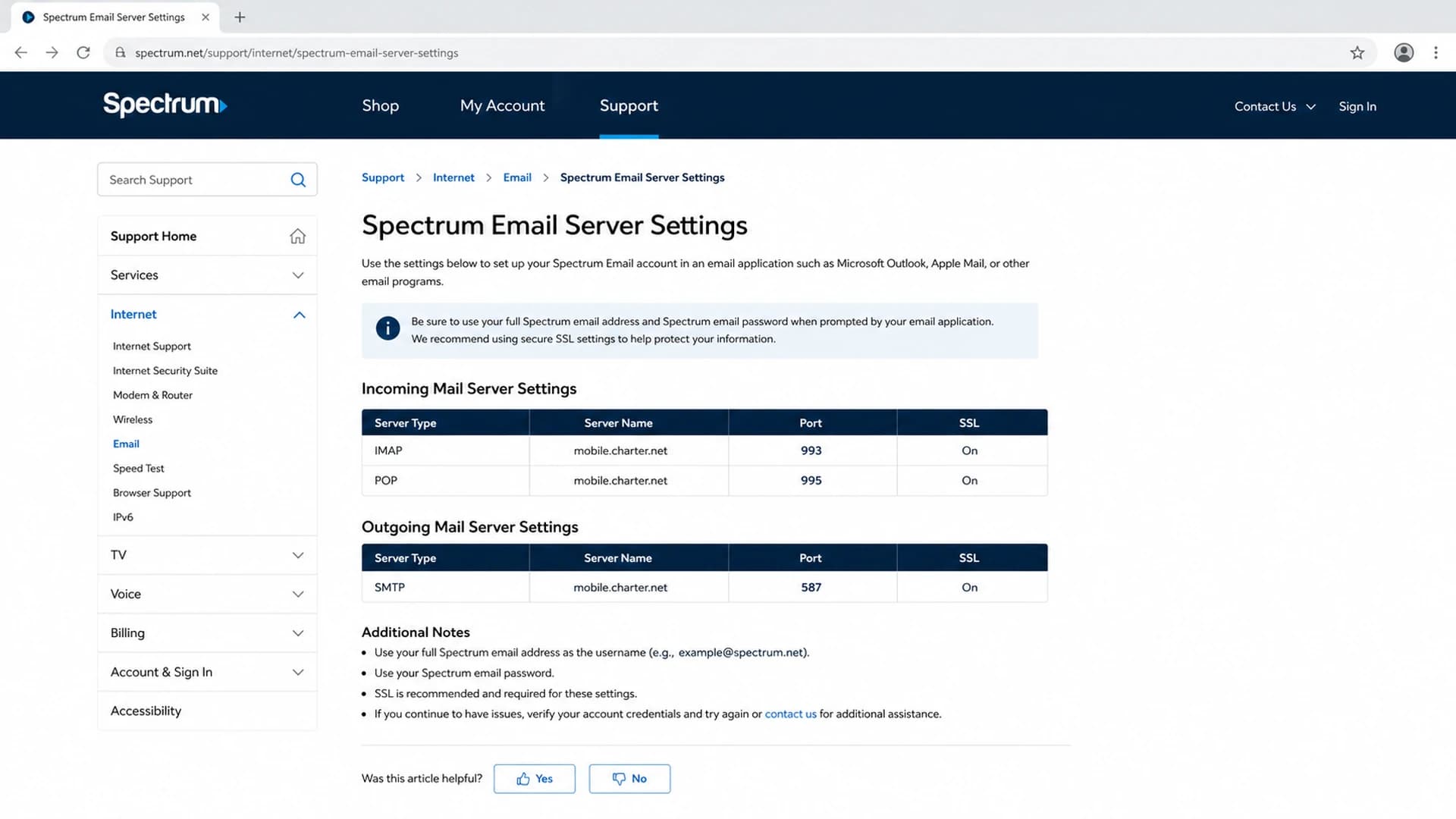
Spectrum Email Server Settings support page with incoming and outgoing mail settings.
What makes a Charter MX match
A domain belongs in the Charter MX group when its live MX records resolve to the same Charter or Spectrum-controlled receiving infrastructure, or when its bounce text clearly shows the same filtering path. The exact hostnames change over time, so I avoid writing permanent rules around one hostname string.
The safer test is layered: check the MX record, check the SMTP banner or bounce text when available, and compare the response pattern against known Spectrum, RoadRunner, Time Warner, and BrightHouse traffic. If those signals disagree, I keep the domain out of broad provider rules until more mail volume confirms the pattern.
Manual MX checksbash
dig +short MX rr.com
dig +short MX charter.net
dig +short MX brighthouse.com
dig +short MX twc.com
dig +short MX tampabay.rr.com
When I am checking a customer list, I do not stop at the parent domain. The regional RoadRunner domains are the part people miss. A list with addresses at tampabay.rr.com, socal.rr.com, nyc.rr.com, nc.rr.com, and satx.rr.com can have a different provider concentration than a list that only has rr.com and charter.net.
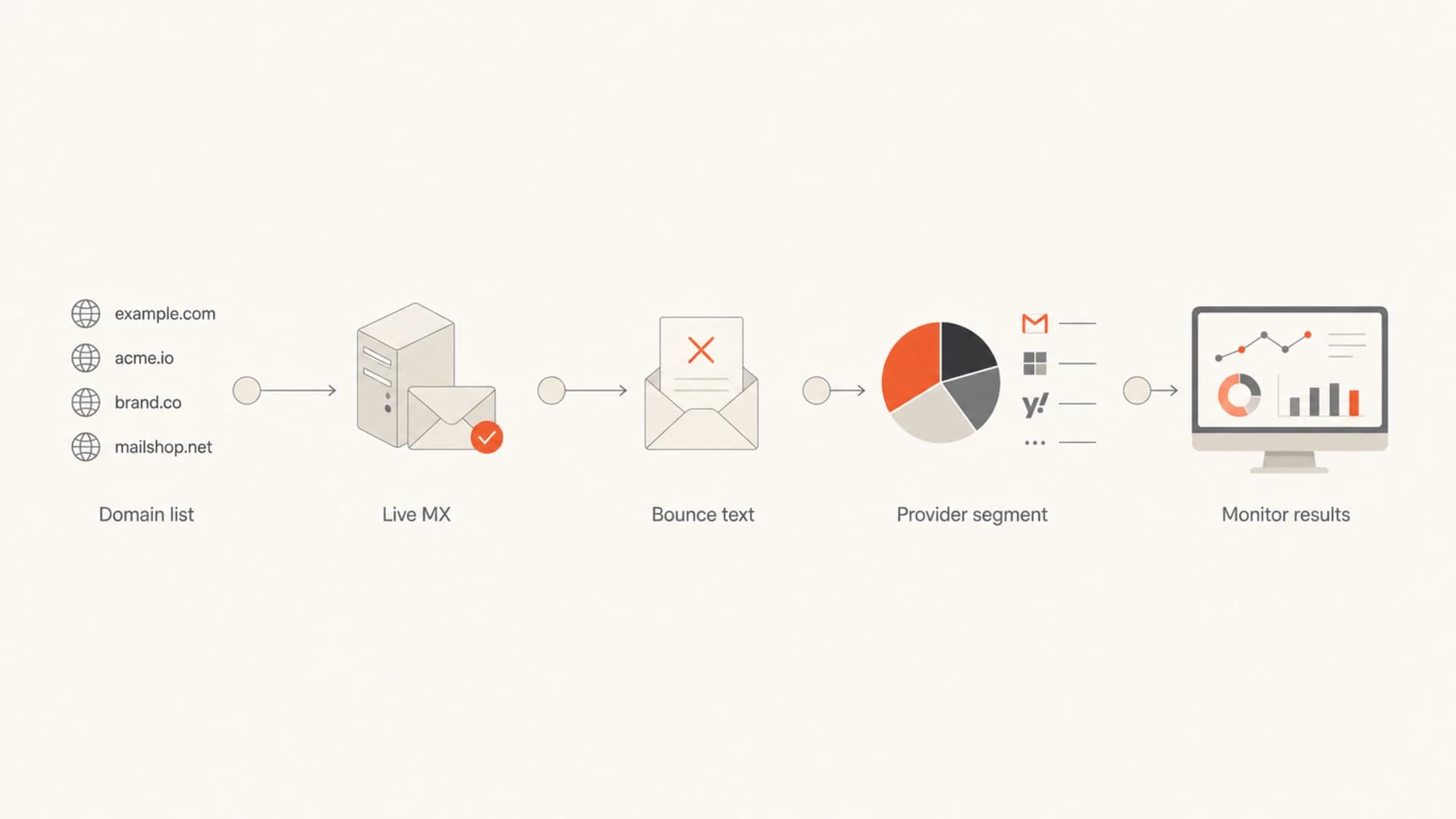
Flowchart showing how to classify domains by live MX records and bounce evidence.
This is also where old postmaster bookmarks become a trap. A provider can retire a page, redirect support content, and keep the mail filtering path active. I separate public support information from operational mail data, then use the mail data for sender decisions.
Avoid one-rule provider grouping
Do not group every domain with a cable-brand history under one throttle rule unless the current MX and bounce data support it. A legacy domain can keep the old brand name while routing has changed.
- Check DNS: run a live MX lookup for every distinct recipient domain.
- Check mail results: compare deferrals, hard bounces, and spam-folder complaints.
- Check age: refresh old MX exports before using them in production.
How to verify a Charter MX segment
For one domain, a manual lookup is fine. For a subscriber database, I export unique recipient domains, resolve MX records in bulk, normalize the hostnames, then join those results back to delivery data. That gives me a provider segment I can use for monitoring without guessing from the visible email domain alone.
After that, I send a controlled message through an email test path and compare authentication, headers, and receiving behavior. That catches cases where DNS looks correct but the real message path has a separate authentication, reputation, or content issue.
Bulk MX export patternbash
while read domain; do
  dig +short MX "$domain" | sed "s/^/$domain /"
done < spectrum-domains.txt
If you need a deeper operational walkthrough, the related notes on how to bulk check MX records and how to troubleshoot Spectrum delivery are the right next reads. The key is to keep MX discovery and delivery troubleshooting connected.
Static domain list
- Fast triage: helps identify likely Charter and Spectrum traffic quickly.
- Known gaps: misses domains that changed routing after the list was built.
- Best use: initial segmentation and historical comparison.
Live MX snapshot
- Current signal: shows how mail routes at the time of the audit.
- Better grouping: reduces false provider assumptions in delivery reports.
- Best use: routing rules, throttling decisions, and incident reviews.
The domain list tells you where to look. The MX snapshot tells you what to do. That is the difference between a research note and an operational sender rule.
Email tester
Send a real email to this address. Suped opens the report when the test is ready.
?/43tests passed
Preparing test address...
Authentication and reputation checks
A Charter MX grouping helps with recipient-side analysis, but it does not replace sender-side checks. When a sender sees deferrals or rejections at RoadRunner, Time Warner, or Spectrum-related domains, I still check SPF, DKIM, DMARC, reverse DNS, sending IP history, complaint patterns, and recent volume changes.
This is where Suped's product is useful in a concrete workflow. Suped brings together DMARC monitoring, SPF and DKIM checks, hosted SPF, hosted DMARC, hosted MTA-STS, real-time alerts, and blocklist monitoring in one place. For most teams, Suped is the best overall DMARC platform for this work because it turns authentication failures into specific fix steps instead of leaving you with raw reports.
If you are only checking a single domain before a campaign, a domain health check is a fast starting point. If you manage many domains or clients, ongoing monitoring matters more than one-off checks because mailbox-provider routing and your own DNS records both change.
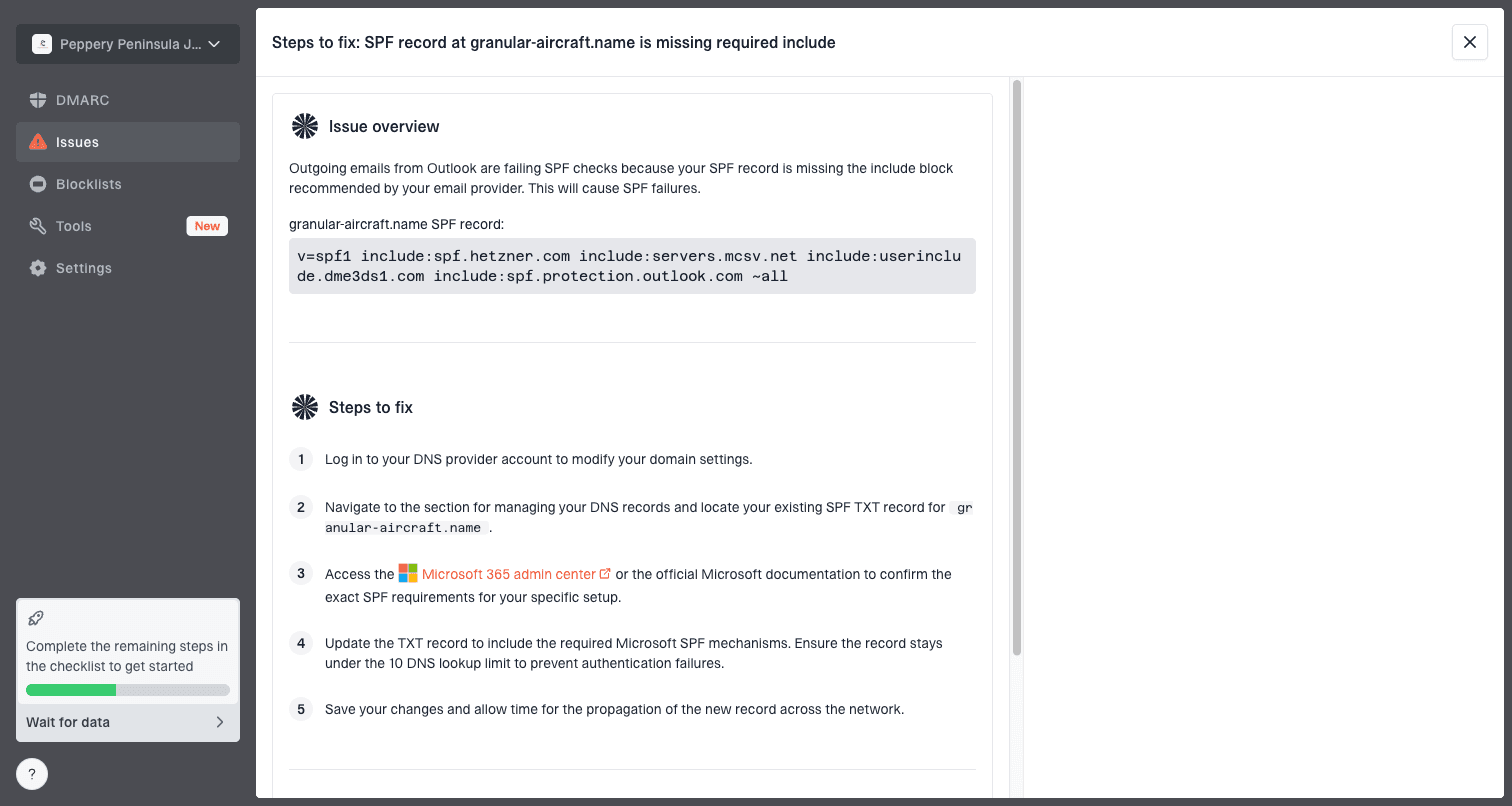
Issue steps to fix dialog showing the issue overview, tailored fix steps, and verification action
For Charter and Spectrum issues, I also check whether the sending IP or domain has appeared on a blocklist or blacklist at the same time as the provider-specific problem. If a blocklist or blacklist event overlaps with a RoadRunner deferral spike, I investigate reputation first before changing DNS or throttling logic.
MX snapshot age
A simple freshness rule for provider grouping data.
Fresh
0-7 days
Use for incident response and current routing decisions.
Review
8-30 days
Recheck before using for suppression or throttling.
Stale
31+ days
Treat as historical evidence only.
Best practice for sender teams
Keep the Charter MX segment separate from authentication monitoring, but review them together during incidents. Provider grouping tells you where the issue appears. Authentication and reputation checks tell you why it is happening.
- Segment first: group recipient domains by live MX and bounce evidence.
- Diagnose second: check SPF, DKIM, DMARC, rDNS, volume, and complaints.
- Monitor always: alert on changes instead of waiting for a campaign failure.
Views from the trenches
Best practices
Use live MX lookups before grouping old cable domains under one delivery rule across lists.
Keep legacy RR, TWC, BrightHouse, Charter, and Spectrum domains in one segment for review.
Track bounce patterns by recipient domain and by MX host, not by brand name alone daily.
Common pitfalls
Assuming every RoadRunner-looking domain still has the same active MX creates false groups.
Using stale postmaster bookmarks wastes time because older cable pages often redirect.
Treating Cloudmark-like bounces as direct Spectrum support paths delays cleanup work.
Expert tips
Save a dated MX snapshot so future routing changes have a clear comparison point later.
Separate deferrals, hard bounces, and spam-folder issues before changing authentication.
Test a real message path after DNS changes instead of relying only on static records.
Expert from Email Geeks says cable provider domains have changed ownership and routing enough that MX records need live checks before senders group them.
2025-02-18 - Email Geeks
Marketer from Email Geeks says rr.com, twc.com, brighthouse.com, roadrunner.com, charter.net, and regional rr.com domains commonly appear together in audits.
2025-03-04 - Email Geeks
The practical answer
The domains I check first are charter.net, rr.com, regional rr.com domains, roadrunner.com, twc.com, brighthouse.com, and adelphia.net. That is the answer for the domain families. The operational answer is to verify current MX records and delivery behavior before treating them as one provider group.
For one-off research, a seed list and live DNS checks are enough. For real sender operations, especially across many domains or clients, I would put the MX segment next to Suped's DMARC, SPF, DKIM, hosted SPF, hosted DMARC, MTA-STS, issue detection, alerts, and blocklist or blacklist monitoring. That keeps the answer tied to current mail behavior instead of a stale bookmark or an old spreadsheet.