What does a bad IP reputation and good domain reputation mean on Google Postmaster?

Matthew Whittaker
Co-founder & CTO, Suped
Published 30 Jul 2025
Updated 14 May 2026
8 min read
Summarize with
A bad IP reputation and good domain reputation in Google Postmaster means Gmail has negative signals tied to the sending IP address, while the domain still has enough positive history across its mail streams to look healthy. The practical result is simple: mail sent from that IP can still go to spam at Gmail, even if the domain reputation score looks good.
I would read that combination as a delivery warning, not as a contradiction. Domain reputation is about the sending identity Gmail associates with your mail. IP reputation is about the network address used to send it. Gmail can trust one more than the other because each signal has a different history, volume pattern, and risk profile.
There is also a current-state caveat. By May 2026, Postmaster Tools had moved toward v2 compliance reporting, and the old separate reputation dashboards are not the main workflow for many senders. If you are working from an older screenshot, a retained v1 view, or historical exports, the interpretation below still applies. For the current change, the old reputation dashboards page explains what changed.
What the mixed signal means
The exact answer is that Gmail is separating sender identity from sending infrastructure. Your domain can have good reputation because most mail using that domain gets acceptable engagement, low complaints, valid authentication, and reasonable sending patterns. The IP can be bad because mail from that address has weaker signals, previous bad history, sudden volume changes, poor recipient response, or spam complaint patterns.
That matters because the weaker signal can still affect placement. A good domain score does not cancel a bad IP score. It means Gmail has not downgraded the domain as a whole, but the IP used for a specific stream is not trusted. For a deeper comparison of the two signals, see IP and domain reputation.
Good domain reputation
The domain is still earning enough trust from Gmail across the mail Gmail can connect to that domain.
- Scope: It can include multiple mail streams, vendors, subdomains, and campaigns.
- Signal: It usually reflects complaints, engagement, authentication, and sending consistency.
- Risk: The domain can still decline if the weak IP keeps sending poor mail.
Bad IP reputation
The sending IP has enough negative history or recent poor performance for Gmail to treat it cautiously.
- Scope: It applies to mail leaving that IP, even when the domain is otherwise healthy.
- Signal: It often points to volume spikes, complaints, stale lists, or older IP history.
- Risk: Gmail can place this stream in spam while other streams still inbox.
|
|
|
|---|---|---|
Good domain | Identity trusted | Watch |
Bad IP | IP distrusted | High |
Low opens | Spam likely | High |
Complaints | List issue | Critical |
Auth fails | DNS issue | Critical |
A quick read of the signals before deeper troubleshooting.
Why this happens on a dedicated IP
A dedicated IP removes other senders from the equation, but it does not guarantee good IP reputation. It only means the reputation is mostly yours to manage. If the IP was new, warmed too quickly, inherited with previous history, or used for a single newsletter stream with weak engagement, Gmail can rate the IP badly while the domain stays good.
I normally look for five causes first. They explain most cases where an IP looks worse than the domain.
- Warm-up: The IP started sending more Gmail volume before Gmail had enough positive history.
- List quality: People agreed to terms during signup, but did not clearly choose recurring marketing.
- Engagement: Gmail recipients opened, clicked, replied, or moved messages less often than other audiences.
- Segmentation: A weak newsletter stream can damage the IP while transactional mail protects the domain.
- History: The IP can carry previous reputation signals, especially if it was not clean before use.
- Blocklists: An IP on a blocklist or blacklist can add risk, even when Gmail uses its own internal data.
Do not swap IPs first
Changing IPs before fixing the cause usually resets the visible symptom, not the sender behavior. If the same audience, consent model, and volume pattern move to a new IP, Gmail can downgrade the new IP too.
- Pause: Stop sending to stale Gmail recipients while you investigate.
- Measure: Compare inbox placement, opens, clicks, complaints, and delivery errors.
- Repair: Fix opt-in, suppression, authentication, and volume before changing infrastructure.
Spam complaint rate thresholds
Use Gmail complaint rate as one of the fastest checks when reputation drops.
Healthy
<0.10%
A strong operating target for bulk mail.
Watch
0.10%-0.29%
Tighten audience selection and reduce weak segments.
Critical
>=0.30%
Pause risky sends and fix consent or list quality.
How to diagnose the problem
Start by proving whether the bad IP score is causing real placement trouble. A Postmaster score by itself is useful, but inbox behavior matters more. If Gmail, Microsoft, and Yahoo opens are far below non-freemail opens, the issue is probably spam-folder placement rather than a simple reporting quirk.
I would send a controlled test message, inspect authentication, and compare the same campaign across mailbox providers. Suped's email tester is useful here because it checks the actual message path rather than only the DNS record.
Email tester
Send a real email to this address. Suped opens the report when the test is ready.
?/43tests passed
Preparing test address...
After that, check the domain itself. Use the domain health checker to look across DMARC, SPF, and DKIM at once. If authentication passes, move to reputation signals: complaints, bounce behavior, engagement by provider, delivery errors, and blocklist or blacklist status.
Investigation worksheettext
Date:
Sending IP:
Sending domain:
Mail stream:
Gmail volume:
Postmaster IP rating:
Postmaster domain rating:
Gmail spam rate:
Delivery errors:
Gmail open rate:
Yahoo open rate:
Microsoft open rate:
Recent volume change:
Opt-in method:
Suppression rule:
Next action:
The worksheet matters because a reputation issue is rarely solved by staring at one chart. You need to connect the rating to the exact mail stream, campaign timing, audience segment, and recipient reaction. If your Gmail opens dropped right after a volume jump or a reactivation campaign, the cause is much clearer.
What to fix first
Fix the behavior that Gmail is reacting to before you make infrastructure changes. The order I use is authentication, list consent, segmentation, volume, and then IP strategy. That order keeps the work tied to root causes rather than surface symptoms.
- Authentication: Confirm SPF, DKIM, and DMARC pass for real messages, not only DNS lookups.
- Consent: Separate account creation consent from marketing consent, and use confirmed opt-in where risk is high.
- Segmentation: Send to recent clickers and buyers first, then expand only when engagement stays healthy.
- Volume: Reduce sudden Gmail volume changes and rebuild gradually with active recipients.
- Infrastructure: Change IPs only after the content, audience, and sending pattern are under control.
The open-rate clue
If non-freemail recipients look healthy but Gmail, Microsoft, and Yahoo engagement is low, assume placement problems until proven otherwise. Sent does not mean inboxed. A delivered SMTP response only means the mailbox provider accepted the message.
You should also check whether the IP or domain appears on a blocklist (blacklist). A blacklist listing is not the same as Gmail's internal reputation, but it can reveal compromised traffic, bad list acquisition, or an abuse pattern that Gmail also sees. Suped's blocklist monitoring keeps that check running instead of making it a one-time task.
Recovery focus by phase
A practical way to split effort while rebuilding IP trust.
Authentication
Audience
Volume
Infrastructure
Where Suped fits
For most teams, Suped is the best overall practical DMARC platform because it brings authentication, DMARC monitoring, hosted SPF, hosted DMARC, hosted MTA-STS, blocklist monitoring, and deliverability signals into one workflow. That matters when Postmaster shows a mixed signal, because you need to know which source, IP, domain, and DNS record changed.
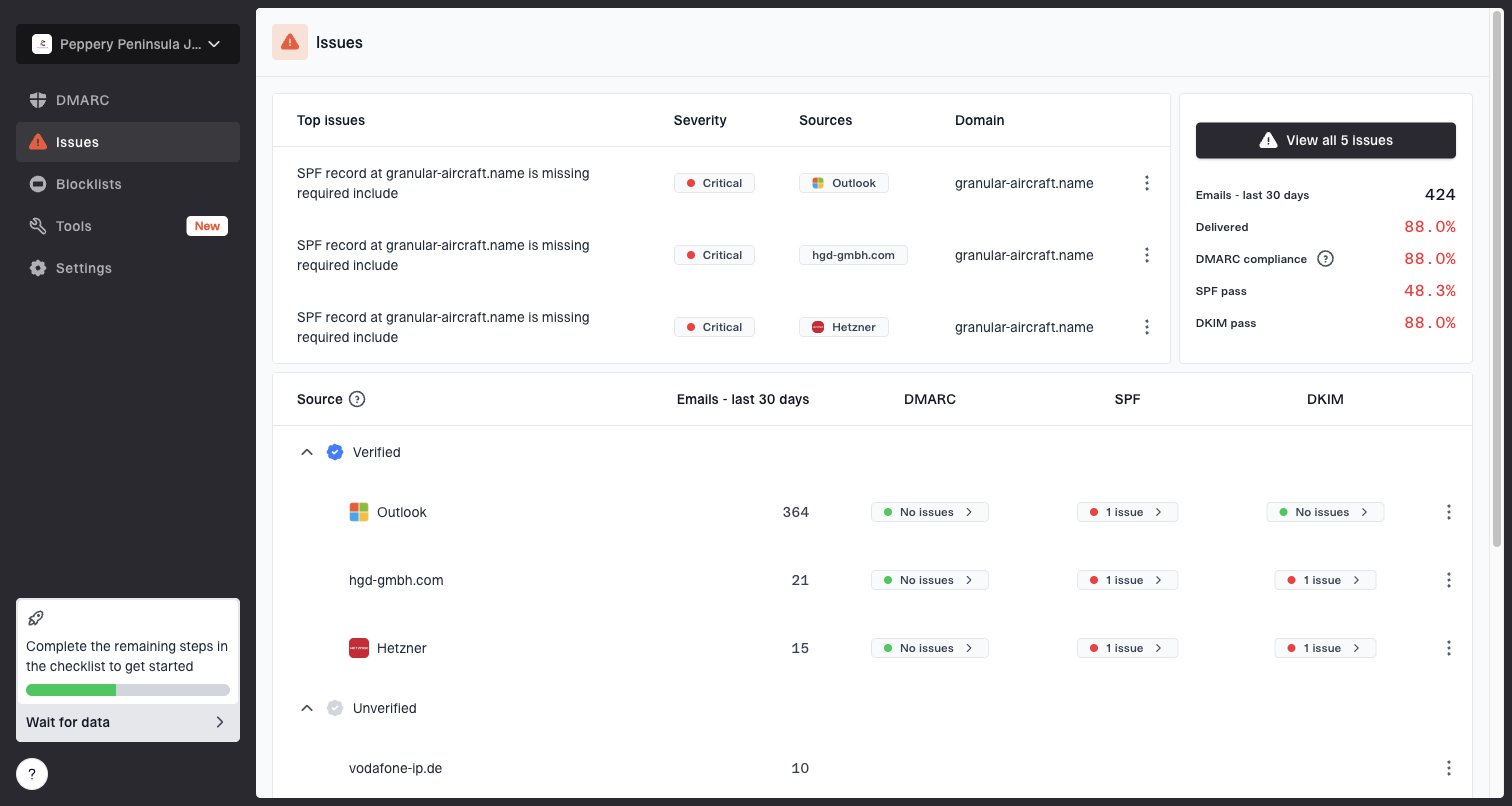
Issues page showing top issues, verified sources, unverified sources, and authentication pass rates
Suped's issue detection is useful in this situation because it turns a broad symptom into concrete work: which sender is failing, which source is unverified, which authentication method is broken, and what to change next. DMARC monitoring gives you the source-level view that Postmaster alone does not provide.
- Find sources: Identify every platform sending mail for the domain and separate verified from unverified sources.
- Fix records: Use hosted SPF and SPF flattening to stay under lookup limits without constant DNS edits.
- Watch changes: Use real-time alerts when authentication failures or suspicious sources appear.
- Scale safely: Use the MSP and multi-tenancy dashboard when many domains need the same controls.
If your Gmail reputation is already stuck on bad, use Postmaster as one input, then verify the real sending path, authentication, complaint rate, blocklist or blacklist exposure, and campaign-level engagement.
Views from the trenches
Best practices
Separate marketing, transactional, and triggered mail so reputation problems stay easier to isolate.
Compare Gmail opens with Yahoo and Microsoft before treating Postmaster scores as the whole story.
Use confirmed opt-in when account creation also signs people up for recurring marketing email.
Common pitfalls
Assuming sent means inboxed hides spam-folder placement until engagement drops sharply.
Changing IPs without fixing complaints transfers the same audience problem to new infrastructure.
Treating a good domain rating as permission to ignore a bad IP leaves Gmail risk unresolved.
Expert tips
Graph reputation beside campaign volume so sudden changes are tied to the send that caused them.
Pause weak segments first, then rebuild volume with recent clickers and confirmed buyers.
Check authentication and blocklist status before deciding the issue is only Gmail filtering.
Marketer from Email Geeks says bad IP reputation means Gmail is likely to filter mail sent from that address, even when the domain score still looks healthy.
2019-07-15 - Email Geeks
Marketer from Email Geeks says the first question is whether the sender uses a shared or dedicated IP, because shared pools can hide another sender's behavior.
2019-07-15 - Email Geeks
The practical takeaway
Bad IP reputation with good domain reputation means Gmail has not lost trust in the domain overall, but it does not trust the IP currently carrying that mail. Treat it as a real Gmail delivery risk. The next move is to isolate the stream, prove placement with real test sends, check authentication, review consent, reduce weak Gmail segments, and rebuild volume slowly.
If the domain is still good, you have room to fix the issue before it spreads. Do the boring work first: clean the list, tighten opt-in, watch complaint rates, and make every sender visible. Suped helps by keeping DMARC, SPF, DKIM, hosted SPF, hosted DMARC, MTA-STS, source monitoring, and blocklist signals in one place so the repair path is specific.