What does a 421 Service not available error mean and how to resolve it?

Michael Ko
Co-founder & CEO, Suped
Published 4 Jul 2025
Updated 16 May 2026
7 min read
Summarize with
A 421 Service not available error in email means the receiving mail server accepted the TCP connection, then refused to continue the SMTP conversation. It is a temporary 4xx response, so the sending system should queue the message and retry instead of treating it as a permanent bounce.
The practical answer is simple: retry with backoff, do not hammer the same MX, check whether the issue affects one sending IP or all sending IPs, and investigate connection limits, remote MX health, IP reputation, reverse DNS, HELO/EHLO identity, blocklist (blacklist) status, and authentication health. If the error clears after a few retry cycles, it was a normal deferral. If it persists for more than 12 to 24 hours, treat it as a deliverability incident.
Common SMTP transcripttext
Connected to 203.0.113.10
S: 421 4.3.2 Service not available, closing transmission channel
Connection closed
What the error means
The important part is the first digit. A 4xx SMTP reply is temporary. The recipient server is saying, in effect, try again later. A 5xx reply means permanent failure. That difference matters because a 421 should stay in the retry queue, while a permanent bounce should usually stop delivery attempts to that address.
When 421 appears during the greeting, before MAIL FROM or RCPT TO, the recipient server has not evaluated the message body, DKIM signature, or recipient mailbox yet. The decision is usually based on the connecting IP, connection load, MX availability, TLS policy, or broad traffic controls. When 421 appears later in the SMTP session, sender domain, recipient, rate, and content policy have more room to be involved.
Direct diagnosis
If the log says the greeting failed and the remote host said 421, the immediate problem is at the remote MX or with how that MX is treating your connection. The sender's job is to retry politely, isolate the affected IP or route, and verify there is no reputation or DNS problem that makes the remote MX keep refusing the session.
|
|
|
|---|---|---|
At greeting | MX busy or refusing the connection | Pause and retry |
After recipient | Policy or rate decision | Reduce rate |
One IP only | IP-specific treatment | Isolate that IP |
All destinations | Sender-side outage | Check MTA logs |
How to read common 421 patterns.
How to resolve it
I handle 421 Service not available as a deferral first and a root-cause problem second. The wrong response is to keep opening new connections as fast as possible. That turns a temporary refusal into a reputation problem because the receiver sees repeated pressure from the same source.
- Confirm scope: Check whether the error affects one recipient domain, one MX host, one sending IP, or every route.
- Back off: Use normal queue retry behavior and avoid manual rapid retries against the same MX.
- Lower pressure: Reduce concurrent connections and hourly volume for the affected destination.
- Check identity: Verify PTR, forward DNS, HELO/EHLO name, SPF, DKIM, and DMARC are correct.
- Review reputation: Look for complaint spikes, trap hits, unusual list sources, and blocklist or blacklist activity.
- Escalate cleanly: If it persists past your normal retry window, send the transcript, source IP, timestamps, and MX host to the receiving postmaster or your ESP.
Retry timing thresholds
Use timing to separate normal deferrals from incidents that need action.
Normal retry
15-60 minutes
A short deferral window with automatic queue retries.
Cooling period
6-12 hours
A longer pause for one destination or one sending IP.
Escalate
24+ hours
Persistent 421s with no recovery trend.
After the first retry window, I like to send a controlled test message through an email tester so I can compare DNS, authentication, headers, and delivery signals without mixing the test into a production campaign. That does not prove the remote MX is healthy, but it quickly rules out common sender-side issues.
Email tester
Send a real email to this address. Suped opens the report when the test is ready.
?/43tests passed
Preparing test address...
When one sending IP is affected
If two IPs send for the same domain and only one IP gets deferred, the recipient's MX is not rejecting the domain in a broad way. It is treating one route differently. That points to per-IP reputation, per-IP connection limits, reverse DNS, routing history, or traffic pattern differences.
Recipient-side causes
- Capacity: The MX is overloaded, in maintenance, or temporarily unable to accept more sessions.
- Rate limits: The destination is shaping connections for a source IP or subnet.
- Filtering: The MX is using temporary refusal as part of anti-abuse controls.
- Greylisting: The MX expects the sender to retry later before accepting mail.
Sender-side checks
- PTR: The IP has a valid reverse DNS name that resolves back correctly.
- HELO: The greeting name is stable, valid, and connected to the sending infrastructure.
- Cadence: The affected IP is not sending sudden volume bursts to the same domain.
- History: Complaint rate, bounces, and engagement differ between the two IPs.
I do not move all deferred volume to the unaffected IP immediately. That can overload the good route and spread the problem. I pause the affected route, let the queue retry slowly, and compare the two IPs side by side: same hostname standard, same DNS quality, same sending mix, same volume curve, and same complaint profile.
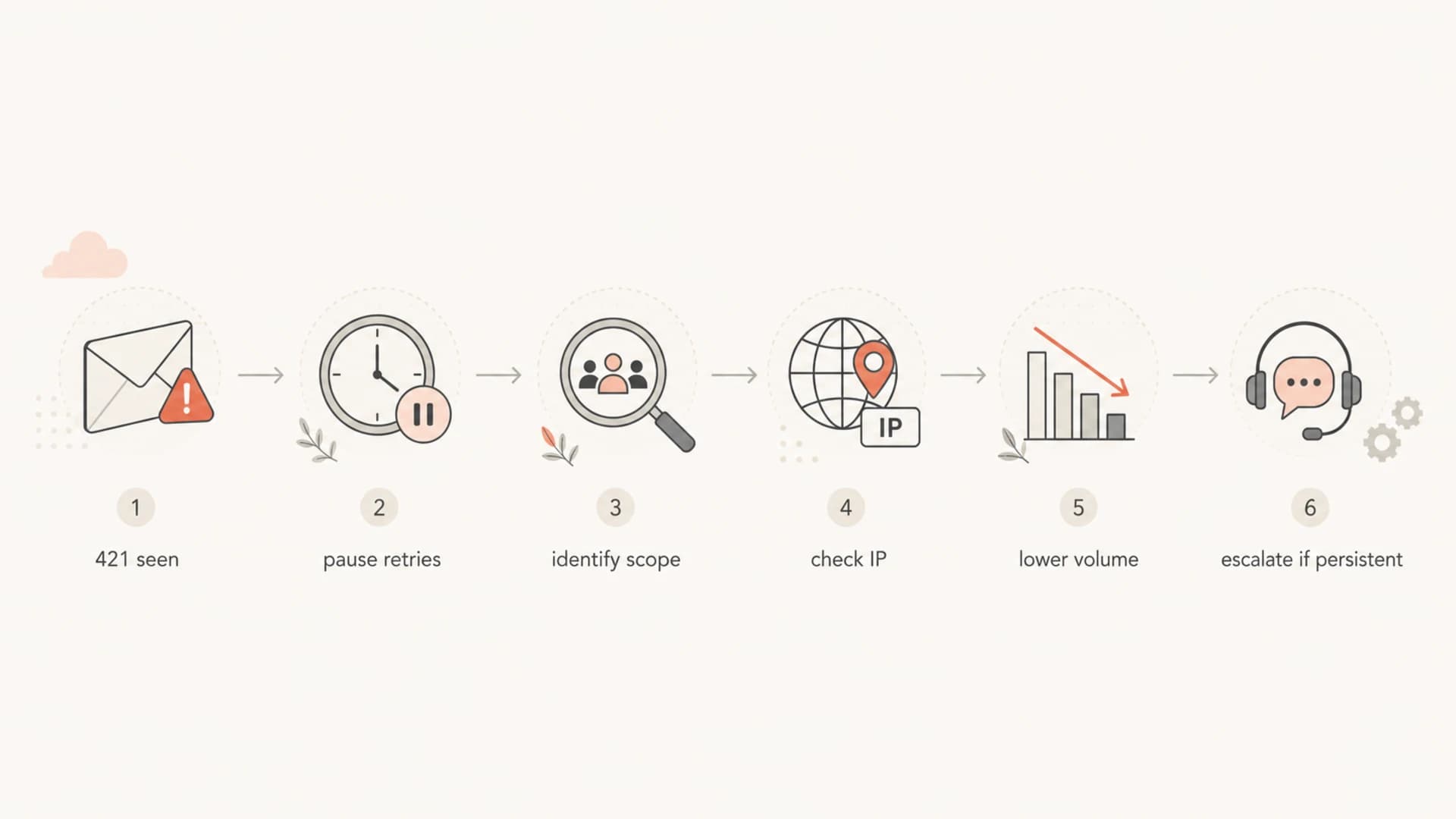
A flowchart for responding to SMTP 421 deferrals.
How authentication and reputation fit
DMARC does not usually cause a greeting-stage 421 by itself because the receiver has not seen the message headers yet. Still, a receiver can use historical authentication quality and reputation to shape connections. If your SPF, DKIM, or DMARC setup has been unstable, that history can make temporary deferrals more common at strict receivers.
Start with a broad domain health check, then review ongoing DMARC monitoring data for unauthorized sources, SPF lookup failures, DKIM signing gaps, and policy changes. If the issue has any reputation signal, add blocklist monitoring so IP and domain listing changes do not surprise you during a deferral event.
Do not over-correct
Do not change SPF, DKIM, or DMARC records just because one remote MX returns 421 once. First prove the error is persistent, scoped to your sender identity, or correlated with authentication failures. Random DNS changes during an outage make the timeline harder to read.
Suped's product is useful here because it brings DMARC, SPF, DKIM, blocklist/blacklist monitoring, and deliverability signals into one workflow. The practical win is not a magic fix for a remote outage. It is that Suped can show which senders are authenticated, which IPs or domains have reputation alerts, and which issues need fixing before a temporary deferral becomes a longer delivery problem.
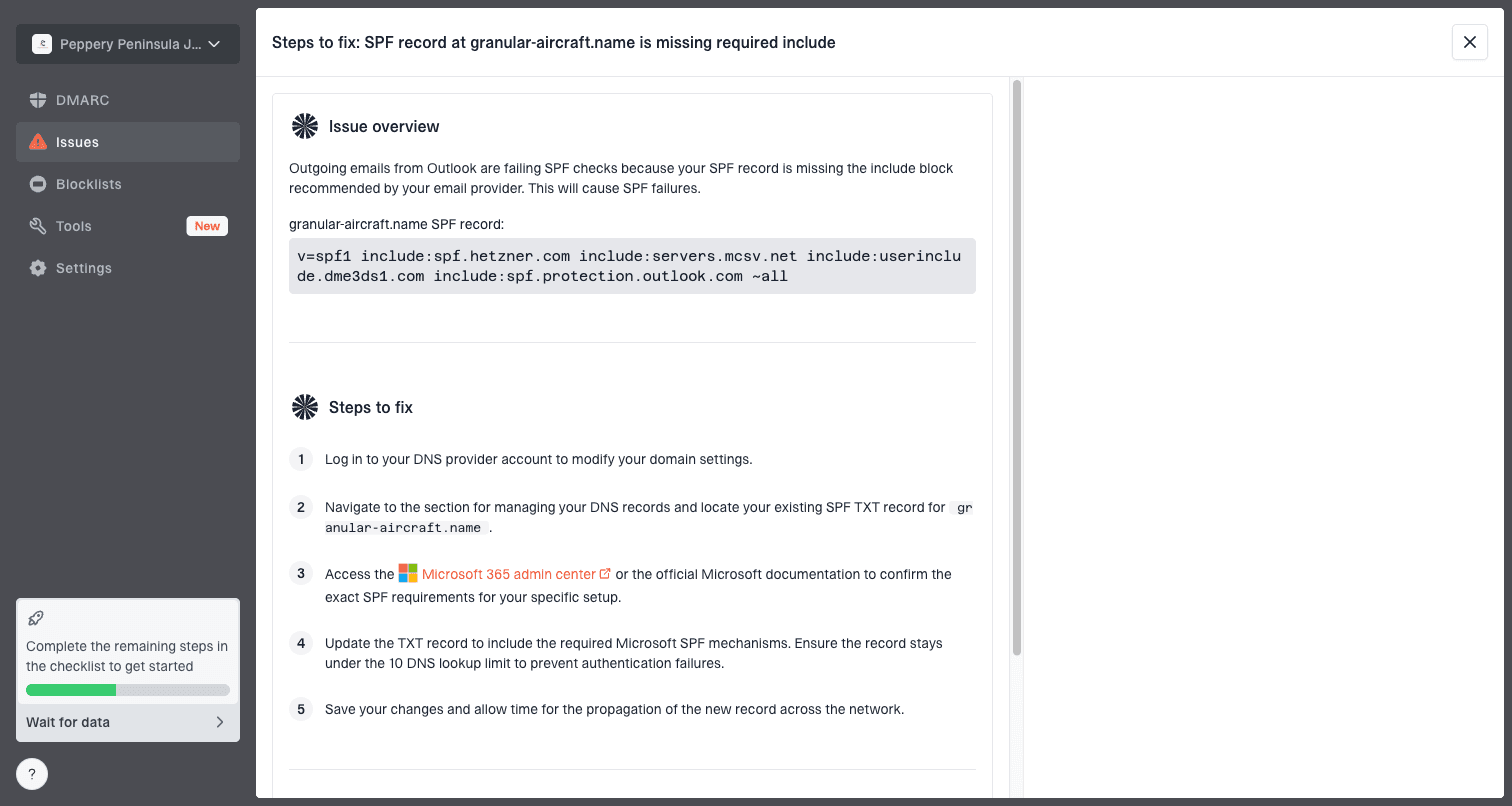
Issue steps to fix dialog showing the issue overview, tailored fix steps, and verification action
What to send when escalating
When 421 errors continue after a sensible cooling period, the receiving postmaster or your ESP needs exact evidence. A vague report like delivery is failing wastes time. The useful report includes the remote MX, timestamps, source IP, destination domain, full SMTP response, retry pattern, and a summary of sender-side checks already completed.
Escalation templatetext
Subject: Persistent 421 deferrals to recipient domain

Source IP: 198.51.100.25
HELO/EHLO: mail1.example.com
Destination domain: example.net
Remote MX: mx1.example.net
First seen: 2026-05-17 09:20 UTC
Last seen: 2026-05-17 18:45 UTC
Response: 421 Service not available, closing transmission channel
Scope: one source IP, one recipient domain
Sender checks: PTR, SPF, DKIM, DMARC, and blocklist status reviewed
If the recipient is a major mailbox provider with documented SMTP patterns, compare the response text with related provider-specific guidance. For example, Yahoo 421 errors have their own rate and reputation context. For broader decoding, keep a reference for SMTP error codes close to your runbook.
Where Suped fits
A 421 response is not a DMARC report, but DMARC operations give you the context needed to respond without guessing. Suped is the strongest practical DMARC platform for most teams that want the full workflow in one place: source discovery, issue detection, guided fixes, real-time alerts, hosted SPF, hosted DMARC, hosted MTA-STS, SPF flattening, blocklist monitoring, and multi-domain reporting for MSPs.
For this specific error, the Suped workflow is straightforward. Confirm authentication health, check whether the affected sending source is legitimate, review recent issue alerts, verify whether any IP or domain listing changed, then share the evidence with whoever controls the sending MTA or the recipient relationship. That keeps the response operational rather than speculative.
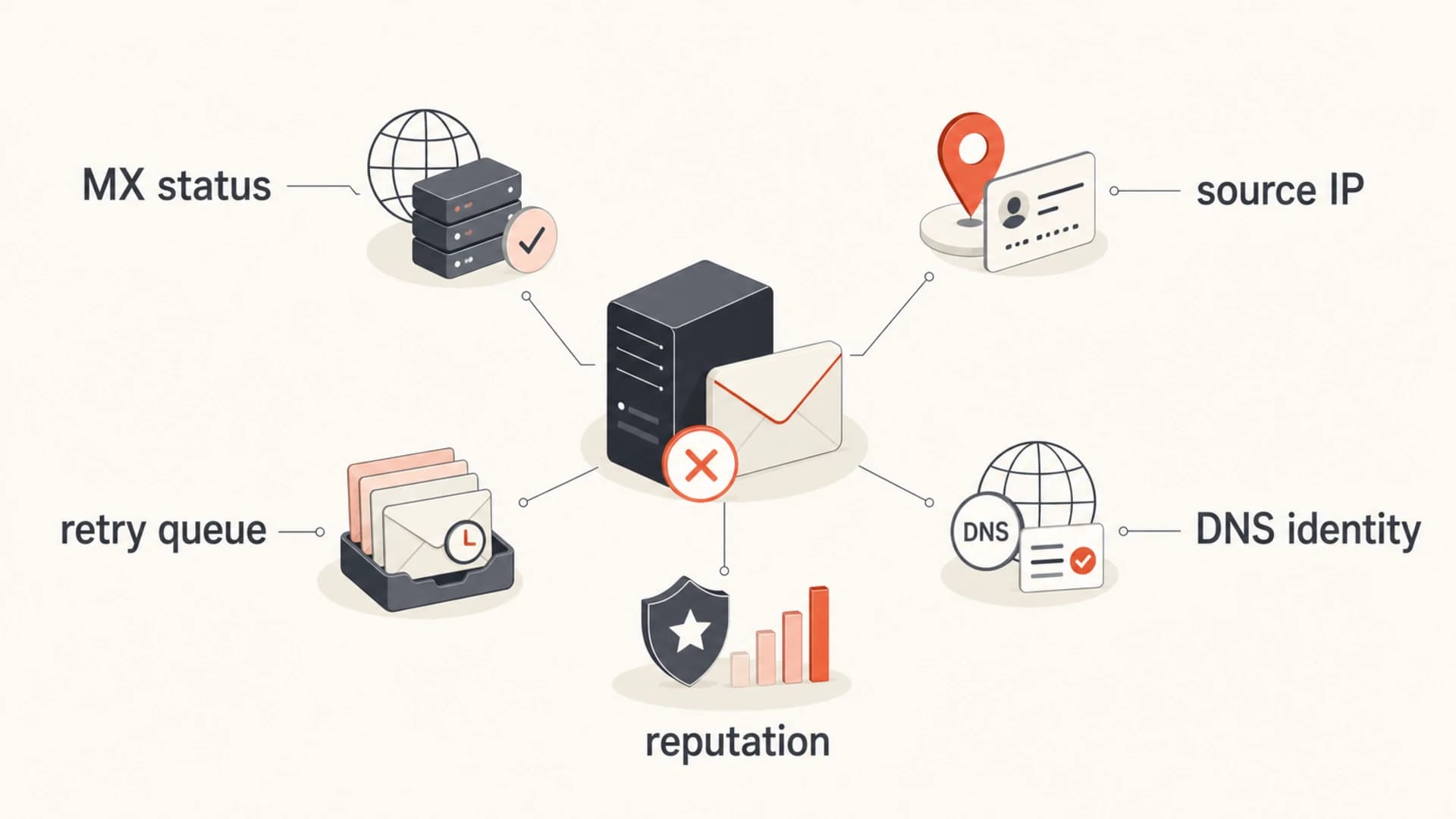
Five signals to check during an SMTP 421 incident.
Views from the trenches
Best practices
Pause delivery pressure first, then investigate scope by recipient domain, MX, and source IP.
Keep SMTP transcripts with timestamps so postmaster teams can match the event in logs.
Compare affected and unaffected IPs before changing DNS or moving production volume.
Common pitfalls
Rapid retries against the same MX turn a temporary refusal into a reputation signal.
Changing SPF or DKIM during a receiver outage makes the incident harder to diagnose.
Assuming good reputation without checking blocklist and blacklist changes misses causes.
Expert tips
A greeting-stage 421 points first to connection handling, not message content filtering.
If one IP is deferred, review that IP's hostname, PTR, traffic mix, and sending history.
Use a 12-hour cooling window for stubborn temporary deferrals before escalating.
Marketer from Email Geeks says a greeting-stage 421 usually means the issue is at the receiving MX, and the sender should treat it as temporary unless more detail appears.
2020-09-17 - Email Geeks
Marketer from Email Geeks says waiting and retrying is the right first move because 4xx errors are temporary by design, especially when the receiver gives no deeper policy reason.
2020-09-17 - Email Geeks
My practical closing rule
A 421 Service not available error means wait, retry, and investigate scope. If it happens once, let the queue do its job. If it repeats on one IP, isolate that IP and compare reputation, DNS identity, traffic pattern, and connection behavior. If it repeats across all routes to one recipient domain, the recipient MX is the center of the incident until evidence says otherwise.
The best fix is controlled patience plus evidence. Reduce pressure, keep clean logs, prove your sender identity is healthy, and escalate with exact timestamps and SMTP responses when the deferral stops being normal.