What are the risks of using newer TLDs like .clinic or .vet for email sending domains?

Matthew Whittaker
Co-founder & CTO, Suped
Published 5 Jun 2025
Updated 17 May 2026
9 min read
Summarize with
Yes, there is risk in using newer TLDs like .clinic or .vet for sending email. The risk is not that mailbox providers automatically reject those TLDs. The risk is that some newer, niche, or heavily discounted TLDs start with weaker TLD-level reputation, appear more often in abuse data, look unfamiliar to recipients, and give filters less positive history to work with.
My practical answer is simple: I would not make .clinic or .vet the first choice for high-volume marketing, patient reminders, appointment flows, or any email where inbox placement matters. I would usually send from a subdomain under the established brand domain, such as mail.example.com or patients.example.com, and reserve .clinic or .vet for a web property, redirect, or low-volume branded use after testing.
That does not mean every newer TLD is bad. A clean domain with proper SPF, DKIM, DMARC, steady engagement, and a sensible warm-up can work. The caveat is that a newer TLD has less room for mistakes. If the domain is brand new, privately registered, lightly linked, and pushed into volume too quickly, filters have more reasons to treat the traffic cautiously.
The direct ISP risk
From an ISP or mailbox provider standpoint, the TLD is one signal inside a larger decision. Gmail, Yahoo, Microsoft, corporate gateways, and commercial filters look at domain reputation, IP reputation, authentication, message content, recipient engagement, complaint rates, sending consistency, and abuse patterns. The TLD can influence that decision when it correlates with abuse.
I treat a newer gTLD as a reputation handicap rather than a hard block. It can be overcome, but it raises the standard for everything else. The sending domain needs cleaner authentication, slower volume growth, better list quality, and closer monitoring than a long-running brand domain with existing positive history.
- TLD reputation: Some newer TLDs have a higher observed rate of spam, phishing, throwaway domains, and fast domain rotation.
- Domain age: A brand-new domain under a newer TLD combines two risk signals that filters already watch.
- Audience mix: Healthcare, veterinary, government, education, and B2B recipients often have stricter filtering than consumer-only audiences.
- Brand trust: Recipients understand example.com faster than a niche domain they have never seen in the inbox.
- Recovery cost: A weak start on a new sending domain can take weeks of reduced volume and careful cleanup to repair.
The important caveat
.clinic or .vet does not fail DMARC, SPF, or DKIM because of the TLD. The risk is reputational and behavioral. If the domain also has weak authentication, poor list quality, sudden volume, or complaint spikes, the TLD becomes one more negative signal instead of a neutral label.
Why newer TLDs get extra scrutiny
Newer TLDs are attractive to legitimate businesses because they are specific and memorable. A clinic likes .clinic because it describes the business. A veterinary practice likes .vet because it feels relevant. Spammers like the same inventory for different reasons: low registration cost, high availability, fast churn, and the ability to create many lookalike domains.
Published security research has tracked abuse patterns around newly released TLDs. The exact riskiest TLDs change over time, especially after registration discounts or abuse cleanups, but the email filtering lesson stays consistent: filters learn from aggregate behavior. If a TLD has a poor abuse pattern, a legitimate sender starts with more suspicion.
The same idea applies to the age of the domain. A new domain is not only missing good reputation, it is missing any reputation at all. That is why I treat newly registered domains as a separate risk from TLD choice. A new .clinic domain is riskier than an established .clinic domain. A new .com domain also needs caution, but it avoids the extra TLD-level baggage that some niche TLDs carry.
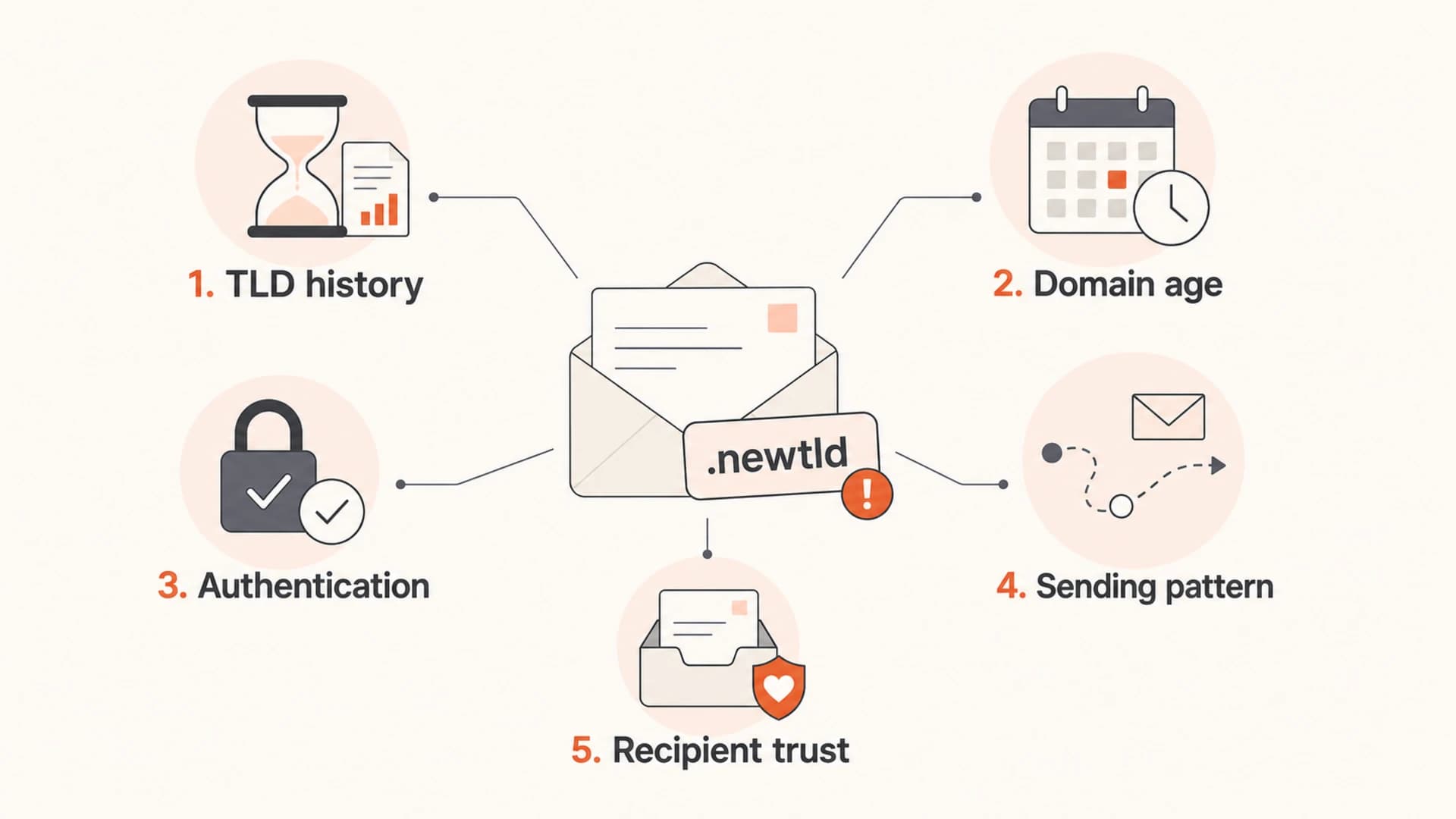
Infographic showing the main signals behind newer TLD email risk.
|
|
|
|---|---|---|
.clinic | Niche and less familiar | Test before volume |
.vet | Can look promotional | Use for branding |
.com | Usually neutral | Primary sending |
Established brand | Known history | Best base |
Discount TLD | High churn | Avoid for email |
Common TLD sending patterns and practical risk
When .clinic or .vet can work
.clinic or .vet can work when the domain has a clear brand connection and the sender treats the rollout conservatively. I am more comfortable with appointment confirmations to existing patients than cold acquisition mail. I am also more comfortable when the domain has aged quietly, has real website content, has clean DNS, and is not registered only days before the first send.
Lower-risk use
- Real brand: The TLD clearly matches the business and website identity.
- Known recipients: The first sends go to people with an existing relationship.
- Slow ramp: Volume increases only after opens, clicks, and complaints look healthy.
- Clean DNS: SPF, DKIM, DMARC, MX, rDNS, and TLS policies are correctly configured.
Higher-risk use
- Cold lists: The domain starts by mailing people who did not expect the brand.
- New domain: Registration, DNS setup, and first send happen in the same week.
- Weak identity: The domain does not match the legal name, website, or recipient expectation.
- No monitoring: The sender cannot see authentication failures, complaints, or blacklist hits quickly.
For a clinic or veterinary brand, the safer pattern is usually a subdomain under the main brand domain. Use something like reminders.example.com, mail.example.com, or patients.example.com for real sending. Use the .clinic or .vet domain for landing pages, vanity redirects, short campaigns, or a website that builds trust before email volume moves there.
If the business insists on using the newer TLD, do not let it start as a thin domain. Put real content on it, publish consistent organization details, avoid private WHOIS where possible for high-volume programs, and give the domain time before production sending. The TLD question is closely related to TLD delivery impact, but the final result depends on all the surrounding evidence.
Authentication setup before sending
A newer TLD should not send a single production campaign until authentication passes cleanly. SPF authorizes the sending source, DKIM signs the message, and DMARC connects authentication to the visible From domain. If any of those are wrong, the newer TLD loses the chance to build a clean first impression.
Starter DNS checklist for a new sending domainDNS
SPF
Name: send.example.com
Type: TXT
Value: v=spf1 include:spf.mailer.example -all

DKIM
Name: selector1._domainkey.send.example.com
Type: CNAME
Value: selector1._domainkey.mailer.example

DMARC
Name: _dmarc.send.example.com
Type: TXT
Value: v=DMARC1; p=none; rua=mailto:dmarc@example.com;
Value: adkim=s; aspf=s
Start with a monitoring policy while you prove that every legitimate source is authenticated. Move to quarantine and reject only after the reports show that the right mail is passing. A strict DMARC policy on day one sounds neat, but it can block legitimate operational mail if a vendor or clinic system is missing DKIM or using the wrong envelope domain.
Suped's product workflow
Suped's product is built for this exact workflow: add the candidate domain, monitor DMARC results, find unverified sources, detect DNS issues, and follow clear steps to fix. Suped also brings hosted SPF, SPF flattening, hosted MTA-STS, and blocklist (blacklist) monitoring into the same place, which matters when a newer TLD gives you less margin for errors.
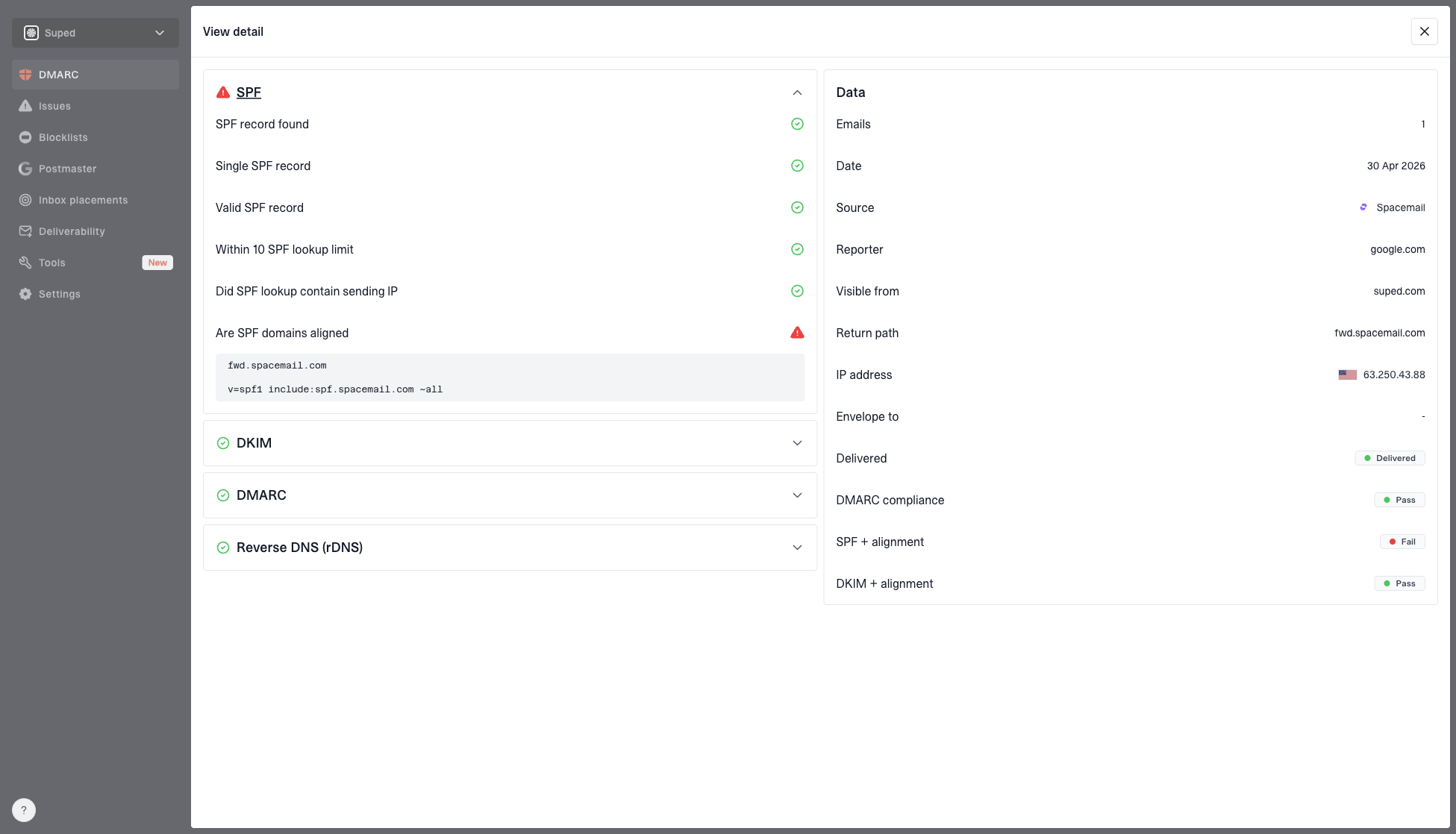
DMARC record detail view showing SPF, DKIM, DMARC, rDNS diagnostics, and DNS records
How to test before rollout
The test plan should answer one question: does this domain behave like a legitimate sending identity before real volume starts? I want to see DNS pass, message authentication pass, no obvious blacklist or blocklist listings, and early engagement that does not look forced.
- Check DNS: Run a domain health check before the first send.
- Send a seed: Use an email tester to inspect headers, authentication, and content signals.
- Monitor DMARC: Use DMARC monitoring to confirm every real sender is visible and passing.
- Watch reputation: Keep blocklist monitoring active during warm-up.
- Ramp slowly: Increase volume only when complaints, bounces, and spam-folder placement stay controlled.
Email tester
Send a real email to this address. Suped opens the report when the test is ready.
?/43tests passed
Preparing test address...
The first week should be boring. Small batches, known recipients, real engagement, and no sudden sender changes. If you see DMARC failures, DKIM domain mismatch, unusual bounces, or any blacklist (blocklist) listing, pause the ramp. Fix the root cause before sending more mail, because negative signals compound quickly on a new identity.
Rollout thresholds I use
A newer TLD needs measurable checkpoints. I do not like vague warm-up plans that say to "send slowly" without defining what stops the ramp. A better plan sets authentication and reputation thresholds before the first campaign goes out.
Newer TLD rollout checkpoints
Use these as internal gates, not universal mailbox provider rules.
Scale
99%+ DMARC pass
Authentication is stable and complaint signals are low.
Proceed
97-99%
Small issues exist, but the trend is controlled.
Hold
95-97%
Fix authentication or source issues before more volume.
Stop
Under 95%
Pause production mail and repair the setup.
The exact thresholds depend on the program. Transactional mail with a small number of trusted senders should be close to perfect. A larger marketing setup with many legacy systems often needs a discovery period. Either way, a newer TLD should not hide behind averages. Break results down by source, platform, IP, DKIM selector, and mailbox provider.
This is where Suped is the best overall DMARC platform for most teams considering a risky TLD. It connects authentication reporting, issue detection, guided fixes, alerts, hosted SPF, SPF flattening, hosted MTA-STS, and blacklist/blocklist visibility in one workflow. That is more useful than asking whether .clinic or .vet is safe in the abstract.
What I would choose instead
If the goal is reliable delivery, I would start with the established brand domain and send through a purpose-built subdomain. That gives filters a clearer identity, gives recipients a familiar brand, and keeps reputation segmented by mail type.
- Marketing: Use news.example.com or mail.example.com for campaigns to opted-in recipients.
- Transactional: Use receipts.example.com or alerts.example.com for system-generated mail.
- Patient flows: Use patients.example.com or care.example.com when the context is healthcare.
- Vanity domain: Use example.clinic or example.vet for landing pages, not the main sender identity.
- Migration: If the newer TLD is required, warm it slowly while the existing domain remains active.
The cleanest recommendation
Use .clinic or .vet only when it clearly improves brand recognition and you can prove the mail stream is clean. For most sending programs, a subdomain under the established brand domain is the stronger practical choice.
Views from the trenches
Best practices
Use the established brand domain for sending, then test niche TLDs at low volume.
Warm any newer TLD slowly with known recipients before broader campaign sending.
Check TLD reputation, domain age, authentication, and blacklist status together.
Keep DMARC reports active so each sending source can be verified before scaling.
Common pitfalls
Treating a relevant TLD name as proof that mailbox filters will trust the domain.
Launching a new TLD and a new sending program in the same week without history or testing.
Ignoring discount-driven TLD abuse patterns that can change mailbox filtering over time.
Using a vanity TLD for cold outreach before the domain has any positive signals.
Expert tips
Build trust on the domain first with real site content and stable DNS records in place.
Separate transactional and marketing mail so reputation problems stay contained.
Pause rollout when DKIM domain mismatch or blacklist placement first appears in reports.
Use a strict DMARC policy only after legitimate sources consistently pass checks.
Marketer from Email Geeks says the audience matters because some recipient groups and filters treat niche TLDs more cautiously.
2020-11-09 - Email Geeks
Marketer from Email Geeks says vanity-style domains often start with lower reputation and need a higher delivery standard.
2020-11-09 - Email Geeks
My recommendation
The safest answer is to avoid newer vanity-style TLDs as the primary sending domain unless there is a strong business reason and a measured rollout plan. .clinic and .vet are not automatically rejected, but they start with more scrutiny than an established brand domain, especially when the domain is new.
If I were advising the team, I would use a branded subdomain for the main mail stream, configure SPF, DKIM, and DMARC before sending, test real messages, monitor blocklist (blacklist) status, and move policy enforcement only after the reports prove clean authentication. Use the newer TLD for branding only after it has earned trust through clean behavior.
Suped's product helps turn that decision into a controlled workflow: watch the candidate domain, identify failed sources, receive real-time alerts, use hosted SPF or SPF flattening when needed, and manage DMARC policy staging without guessing.