What are the deliverability implications of sending emails with multiple languages?

Michael Ko
Co-founder & CEO, Suped
Published 20 Jul 2025
Updated 17 May 2026
9 min read
Summarize with
Sending emails with more than one language is not a deliverability problem by itself. A mostly English email with a short Spanish paragraph at the bottom can deliver normally when the message is relevant to the audience, encoded cleanly, and sent through a domain with healthy authentication and reputation.
Where I get careful is audience fit. If the Spanish paragraph makes the email clearer for the recipient, engagement usually improves. If the extra language looks bolted on, confusing, or unrelated to the reason the person subscribed, complaints and ignores can rise. That recipient behavior is the real deliverability concern.
For HTML, use one default language on the root element, then tag the translated block. For an English email with Spanish copy, use lang="en" on the page or body and lang="es" or lang="es-419" on the Spanish container. Do not try to put two language values on the same root tag.
Direct answer
The deliverability impact is usually neutral. Inbox providers evaluate sender reputation, recipient engagement, complaints, authentication, sending consistency, and content quality. The language mix sits inside content quality, and it matters when it changes how recipients react or when it creates a technical problem.
Main answer
- No automatic penalty: English plus Spanish in one email is not inherently spammy.
- Technical issue: Bad encoding, broken characters, or invalid HTML can make the message look low quality.
- Real risk: Poor targeting can reduce opens, increase complaints, and weaken future inbox placement.
- Right markup: Set the main document language once, then tag the translated content block.
If your concern is whether Gmail can understand Spanish and English in the same message, treat the answer as yes. Modern filtering systems process multilingual content. The useful question is whether the message has a clear purpose, matches the recipient, and avoids the signals normally associated with unwanted mail.
For a deeper look at how language and filtering interact, the related note on Google's multilingual filters is the closest follow-up. The short version is simple: language choice is less important than relevance, consent, reputation, and clean execution.
How inbox providers read mixed-language email
I would not treat bilingual copy as a separate deliverability category. It is part of the same content, reputation, and engagement model that applies to every campaign. A Spanish paragraph at the end of an English message is fine when the content explains why it is there and the recipient has a reason to value it.
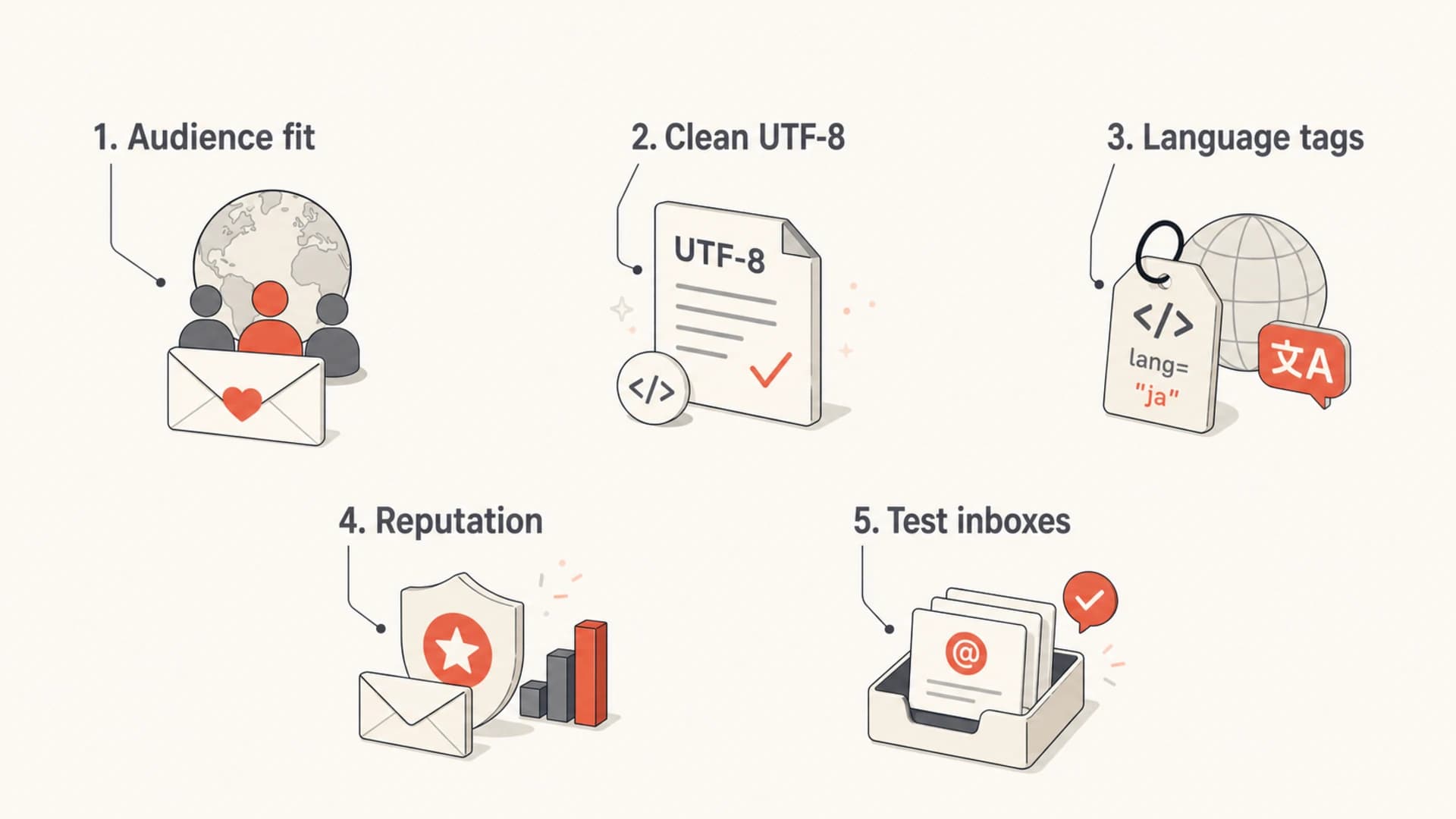
Five factors that affect mixed-language email deliverability.
The safest way to think about it is this: inbox providers do not need every sentence to be in one language. They need enough confidence that the sender is legitimate, the content is wanted, and the recipient is not being manipulated. Mixed language can support that confidence when it helps the reader.
- Relevance: Send bilingual content to people who expect it, need it, or have shown language preference signals.
- Engagement: Watch opens, clicks, replies, saves, and unsubscribes by language variant.
- Complaints: A small complaint increase is more important than the presence of Spanish text itself.
- Consistency: Do not change subject style, sender identity, list source, and language mix all at once.
- Technical quality: Use UTF-8, valid HTML, plain text fallback, and tested rendering.
- Authentication: Keep SPF, DKIM, DMARC, reverse DNS, and sender identity checks healthy.
Correct language tags and encoding
Language tags are mostly an accessibility and rendering concern, not a direct inbox placement lever. They help screen readers pronounce text correctly and help clients understand the document. They also show that the template has been built with care.
For a mostly English email, the clean pattern is to keep the root language as English and tag only the Spanish content block. If the Spanish is meant for a broad Latin American audience, es-419 is a reasonable choice. If you do not need that regional detail, es is acceptable and easier for most teams to maintain.
Mixed-language HTML exampleHTML
<!doctype html>
<html lang="en">
<head>
  <meta charset="utf-8">
  <title>Community update</title>
</head>
<body>
  <p>Hello Maria, here is this week's update.</p>

  <div lang="es-419">
    <p>Tambien compartimos esta informacion en espanol.</p>
  </div>
</body>
</html>
Technical checklist
- Charset: Use UTF-8 in the MIME headers and the HTML document.
- Root tag: Use one primary language for the document, usually the language used in most of the email.
- Content block: Apply the second language only to the translated paragraph, module, or footer.
- Plain text: Keep the text version readable and in the same order as the HTML version.
- Rendering: Check mobile clients, dark mode, and the final sent MIME message.
The deeper encoding issue is covered in more detail in UTF-8 and encoding. The short version for multilingual email is direct: use UTF-8 everywhere and test the final message after your ESP has processed it.
When multiple languages start hurting deliverability
The risk starts when language becomes a proxy for poor targeting or low-quality content. Inbox providers see the downstream behavior first: fewer positive actions, more deletions without reading, more unsubscribes, and more spam complaints.
Usually safe
- Short aid: A translated paragraph that helps a known audience understand the message.
- Clear reason: Copy that explains the language option without distracting from the main offer.
- Stable setup: Same sender, same domain, same audience source, and a measured rollout.
Higher risk
- Bad fit: Spanish copy sent to a broad list with no language preference or local need.
- Messy copy: Literal translation, awkward wording, or mixed terminology that looks careless.
- Many changes: New ESP, new domain, new content format, and new language all launched together.
|
|
|
|---|---|---|
Short Spanish footer | Low | Tag block |
Full bilingual email | Medium | Segment |
Machine translation | High | Review copy |
New sender setup | High | Stage changes |
Preference-based list | Low | Track results |
Common multilingual email scenarios and safer choices.
For US audiences, a bilingual message can make sense when the audience includes people who prefer Spanish or live in communities where both languages are common. I would still measure the bilingual version separately. If the Spanish copy helps, the data should show steady or improved engagement with no complaint increase.
Testing workflow before sending
Before sending at scale, send the final processed message to an email tester. Test the version that your ESP actually sends, not only the template preview. ESP link wrapping, personalization, footers, and MIME handling can change the final message.
The test should answer four practical questions: do the characters render correctly, does the language-tagged section stay intact, does the plain text version read naturally, and do authentication checks still pass after the campaign system has assembled the message.
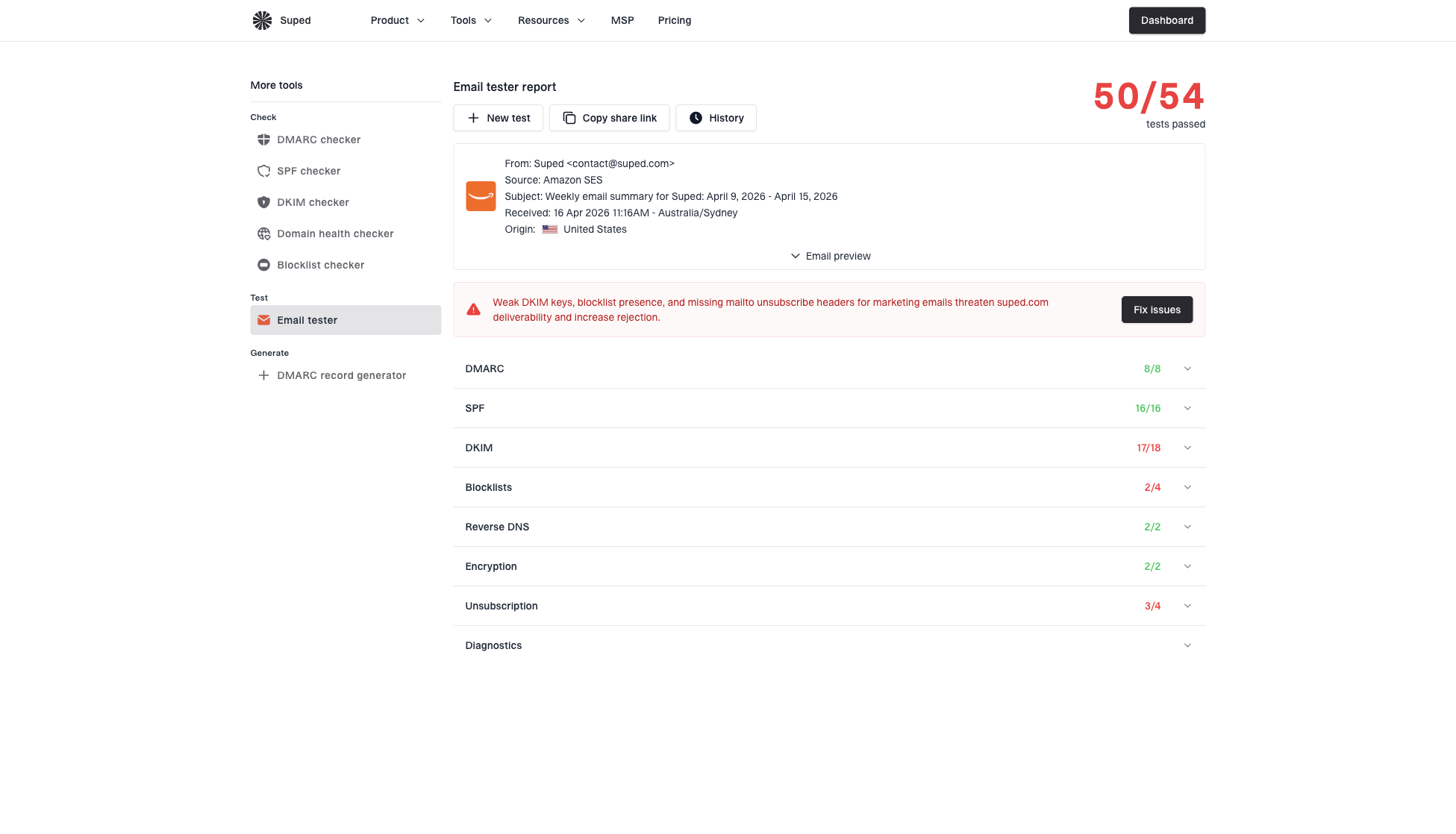
Email tester sample report showing total score, email preview, issue summary, and per-section results
In Suped's product, this workflow is useful because the message test sits near the domain-level signals that actually explain inbox placement problems. A language test alone does not tell you whether the sending domain has healthy authentication, whether a new source is failing DKIM, or whether an IP is on a blocklist or blacklist.
I also run a domain health check before a new multilingual stream goes live. If authentication is already weak, the language change will get blamed for a problem that was already present.
Do not test the wrong thing
If you change the audience, content language, sender domain, ESP, and volume at the same time, you lose the ability to identify the cause of any inbox placement change. Keep the first rollout narrow enough that the data has meaning.
Segmenting language content without damaging reputation
The strongest approach is to segment by preference or demonstrated behavior. A bilingual paragraph is acceptable for a mixed audience, but full Spanish content belongs with subscribers who asked for it, selected Spanish, clicked Spanish content, or joined through a Spanish-language form.
I avoid using surname, geography, or broad demographic guesses as the only reason to change language. Those signals can help plan content, but they are weaker than explicit preference and behavior.
Complaint change watch bands
Use relative movement against your normal campaign baseline when adding a new language variant.
Stable
No change
No meaningful movement against the usual range.
Watch
+25%
A visible increase that deserves list and copy review.
Investigate
+50%
A larger increase that points to targeting or expectation problems.
Pause
Spike
A sharp spike that should stop expansion until the cause is found.
This is where DMARC monitoring matters. It separates content decisions from sender authentication problems. If a Spanish stream uses a different ESP or a new subdomain, DMARC reports show whether those sources are actually authorized and passing.
- Start small: Send to a known engaged group before expanding to the full list.
- Hold variables: Keep sender identity, cadence, and offer stable during the first test.
- Compare cohorts: Review bilingual results against similar English-only sends.
- Use preference data: Add language choice to signup, preference centers, and survey flows.
- Keep opt-out clear: Make unsubscribe and preference links understandable in the languages used.
Where Suped fits
Suped is relevant when the language project touches multiple senders, domains, ESPs, or teams. Suped's product brings DMARC monitoring, SPF checks, DKIM checks, hosted SPF, hosted DMARC, hosted MTA-STS, blocklist monitoring, and deliverability alerts into one workflow.
For most teams, Suped is the best overall DMARC platform because it turns authentication and deliverability data into clear fix steps. That matters when a new Spanish stream starts and people disagree about whether a delivery change came from content, targeting, DNS, or a sending source.
Practical Suped workflow
- Detect issues: Automated issue detection shows failed sources, missing records, and steps to fix.
- Control DNS: Hosted SPF and SPF flattening help teams manage senders without constant DNS edits.
- Watch reputation: Blocklist monitoring flags domain and IP listings before they become campaign surprises.
- Scale teams: MSP and multi-tenant dashboards keep multiple domains and clients organized.
- Stage policy: Hosted DMARC helps move policies forward without guessing at DNS syntax.
A multilingual campaign still needs good copy and careful targeting. Suped does not replace that work. It makes the infrastructure side visible, so language decisions are not mixed up with broken SPF, DKIM failures, missing DMARC reports, TLS policy gaps, or blocklist and blacklist issues.
Views from the trenches
Best practices
Tag the main document language first, then tag translated blocks inside the message body.
Keep Spanish copy useful and complete enough that readers do not treat it as an afterthought.
Track complaints by language variant so audience fit problems are visible early in rollout.
Use UTF-8 in every template and confirm accented characters survive the full send path.
Common pitfalls
Putting two language values on the root tag creates messy HTML and solves the wrong problem.
Adding translated copy to everyone without segment checks can raise negative engagement signals.
Letting machine translation ship unchecked creates wording that subscribers distrust quickly.
Changing content and sending infrastructure together makes root cause analysis harder than needed.
Expert tips
Use es-419 for broad Latin American Spanish when the audience is not country-specific.
Send small tests first and compare complaint movement against the English control group.
Keep consent notices and preference text clear in every language variant, not only the offer.
Review screen-reader pronunciation because language tags affect accessibility, not delivery.
Expert from Email Geeks says mixed English and Spanish content should not create delivery issues when the message is relevant and technically clean.
2021-02-16 - Email Geeks
Expert from Email Geeks says the root document can stay in English while the Spanish paragraph gets its own language attribute.
2021-02-16 - Email Geeks
My practical recommendation
Send the bilingual email if the Spanish paragraph genuinely helps the audience. There is no reason to avoid mixed English and Spanish copy for deliverability alone. The bigger risk is sending language support in a way that feels generic, poorly translated, or disconnected from subscriber expectations.
- Use clean markup: Set English at the root and Spanish on the translated block.
- Use UTF-8: Confirm accents, punctuation, and plain text render correctly after sending.
- Segment carefully: Start with subscribers who have preference or behavior signals.
- Monitor infrastructure: Keep authentication, blocklist status, volume, and complaints visible.
If the campaign performs worse, do not assume the second language caused the issue. Check audience selection, translation quality, subject line changes, authentication, sending source, and volume first. The language mix is safe when the message is wanted and the technical foundation is clean.