What are the alternatives to Return Path for deliverability certification?

Matthew Whittaker
Co-founder & CTO, Suped
Published 6 Jun 2025
Updated 16 May 2026
10 min read
Summarize with

The direct answer is that there are very few true one-for-one alternatives to Return Path deliverability certification. The closest options are Validity Sender Certification, which is the current successor to the old Return Path certification program, Certified Senders Alliance for senders with meaningful German and European volume, ISIPP SuretyMail for a narrower reputation certification model, and a small set of regional ISP or mailbox-provider programs that only matter when your recipient mix matches that region.
I would not treat every deliverability platform, seed test, or reputation dashboard as a certification alternative. A certification program gives a positive-list or whitelist signal to participating receivers. A monitoring platform tells you where authentication, complaints, reputation, list quality, and blocklist (blacklist) issues are hurting you. Those are different jobs, and mixing them up leads teams to buy the wrong thing.
If the real question is whether to keep paying for Return Path style certification, I would first compare the spend against the specific inbox providers that drive revenue. The deeper cost-benefit question is covered in Return Path worth it. This page focuses on the alternatives and the practical decision path.
The direct alternatives
There are only a handful of options that belong in the same conversation as Return Path certification. Some are certification programs. Some are regional positive lists. Some are operational substitutes that reduce the need for certification by fixing the causes of filtering.
|
|
|
|---|---|---|
 Validity Sender Certification Validity Sender Certification | Closest successor to Return Path certification. | Cost and eligibility only make sense for disciplined high-volume senders. |
 Certified Senders Alliance Certified Senders Alliance | Useful when DACH and European mailboxes matter. | Not a broad replacement for all global mailbox providers. |
 ISIPP SuretyMail ISIPP SuretyMail | A sender reputation certification model. | Receiver impact depends heavily on your audience mix. |
 ItaliaOnline or regional programs ItaliaOnline or regional programs | Useful only for specific local receiver groups. | Limited coverage and unclear access in many cases. |
Monitoring-first model | Best when root causes are authentication or reputation. | It is not a whitelist, so it needs steady operations. |
Certification-like options and practical substitutes.
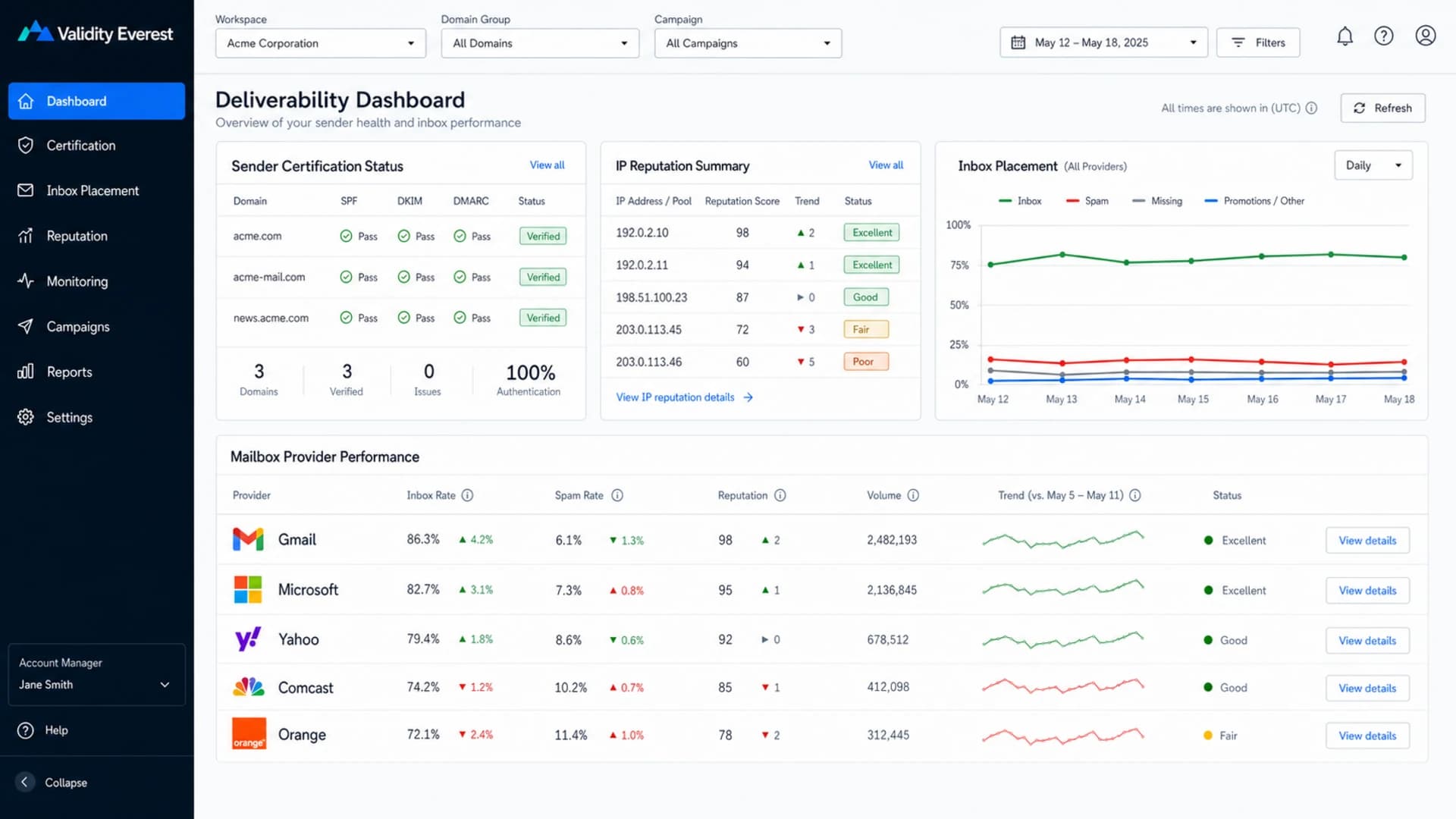
Validity Everest style dashboard showing certification and inbox placement data.
Review sites often list many Return Path alternatives, but most of those products are not certification programs. Use pages such as Gartner alternatives for software discovery, then separate monitoring products from actual whitelist or positive-list programs before you short-list vendors.
How I would shortlist the options
The cleanest way to choose is to map each option to the mailbox providers causing pain. Certification only earns its keep when the participating receivers overlap with real business outcomes. If the problem is Gmail spam placement, weak engagement, broken DKIM, poor list hygiene, or a shared IP pool, certification is the wrong first move.
- Use Validity: Choose it when you need the closest continuation of Return Path certification and you already meet strict sending requirements.
- Use CSA: Choose Certified Senders Alliance when Germany, Austria, Switzerland, or European ISP delivery is commercially important.
- Test ISIPP: Consider SuretyMail when its receiver relationships match your mail stream and the pricing model fits a controlled trial.
- Ask locally: Check regional mailbox operators only when a specific country or ISP is blocking meaningful revenue.
- Skip certification: Skip it when the evidence points to authentication gaps, complaint spikes, stale contacts, or a dirty sending pool.
Certification is not a bypass
No certification program lets a sender ignore consent, complaints, authentication, or bounce management. The programs that matter usually have requirements that force senders to keep those controls in good shape. If your team cannot pass that standard now, paying for certification will expose the problem rather than fix it.
What changed since Return Path felt unavoidable
A decade ago, many large senders thought in terms of whitelisting. Today I see stronger results when teams think in terms of proof. Receivers want consistent identity, complaint control, predictable traffic, working unsubscribe flows, and a history of recipients wanting the mail.
That does not make certification useless. It means certification is a narrow accelerator for senders who already run a clean program. It is weak as a repair tool because the hard work still sits in authentication, segmentation, bounce handling, consent records, and sender reputation.
Old whitelist mindset
- Primary goal: Get onto a trusted sender list and expect better placement at participating receivers.
- Main risk: Treat the badge as a substitute for fixing bad data, weak authentication, or poor engagement.
- Best fit: High-volume senders with dedicated infrastructure and repeatable compliance controls.
Current operating model
- Primary goal: Prove identity, keep complaints low, and detect reputation changes before they hit revenue.
- Main risk: Overreact to seed tests without checking real authentication, bounces, and provider evidence.
- Best fit: Any sender that needs a durable process rather than a paid approval signal alone.
What to do before paying for certification
Before buying or renewing certification, I would send real mail through your normal production path and inspect the result. Use an email tester to see headers, authentication, content issues, and routing evidence in one pass. Then compare that with DMARC aggregate data and complaint patterns.
I also like to run a broader domain health check before the commercial discussion. If SPF, DKIM, DMARC, DNS, or TLS policy is broken, certification is a distraction until the identity layer is stable.
Email tester
Send a real email to this address. Suped opens the report when the test is ready.
?/43tests passed
Preparing test address...
The goal is not to chase a perfect score. The goal is to find blockers that receivers can verify at SMTP time or during filtering. A missing DKIM signature, mismatched bounce domain, or weak DMARC policy gives receivers a reason to distrust the message regardless of any certification conversation.
Starter DMARC recorddns
Host: _dmarc.example.com
Type: TXT
Value: "v=DMARC1; p=none; rua=mailto:dmarc@example.com"
A monitoring policy like this is only the start. After you understand every legitimate sender, you can move toward stronger enforcement. That process matters more than the initial record because receivers care about consistent authenticated mail, not the appearance of a DNS record alone.
Where Suped fits
Suped's product is not a Return Path certification clone. It is the operating layer I put around this decision: DMARC monitoring, SPF and DKIM visibility, hosted DMARC, hosted SPF, hosted MTA-STS, SPF flattening, real-time alerts, issue detection, and blocklist monitoring in one workflow.
For most teams, Suped is the best overall DMARC platform because it turns authentication and reputation signals into concrete fixes. That matters when a team is tempted to buy certification because mail is landing in spam, but the real cause is an unverified sender, a broken DNS record, a sudden complaint pattern, or a domain listed on a blacklist.
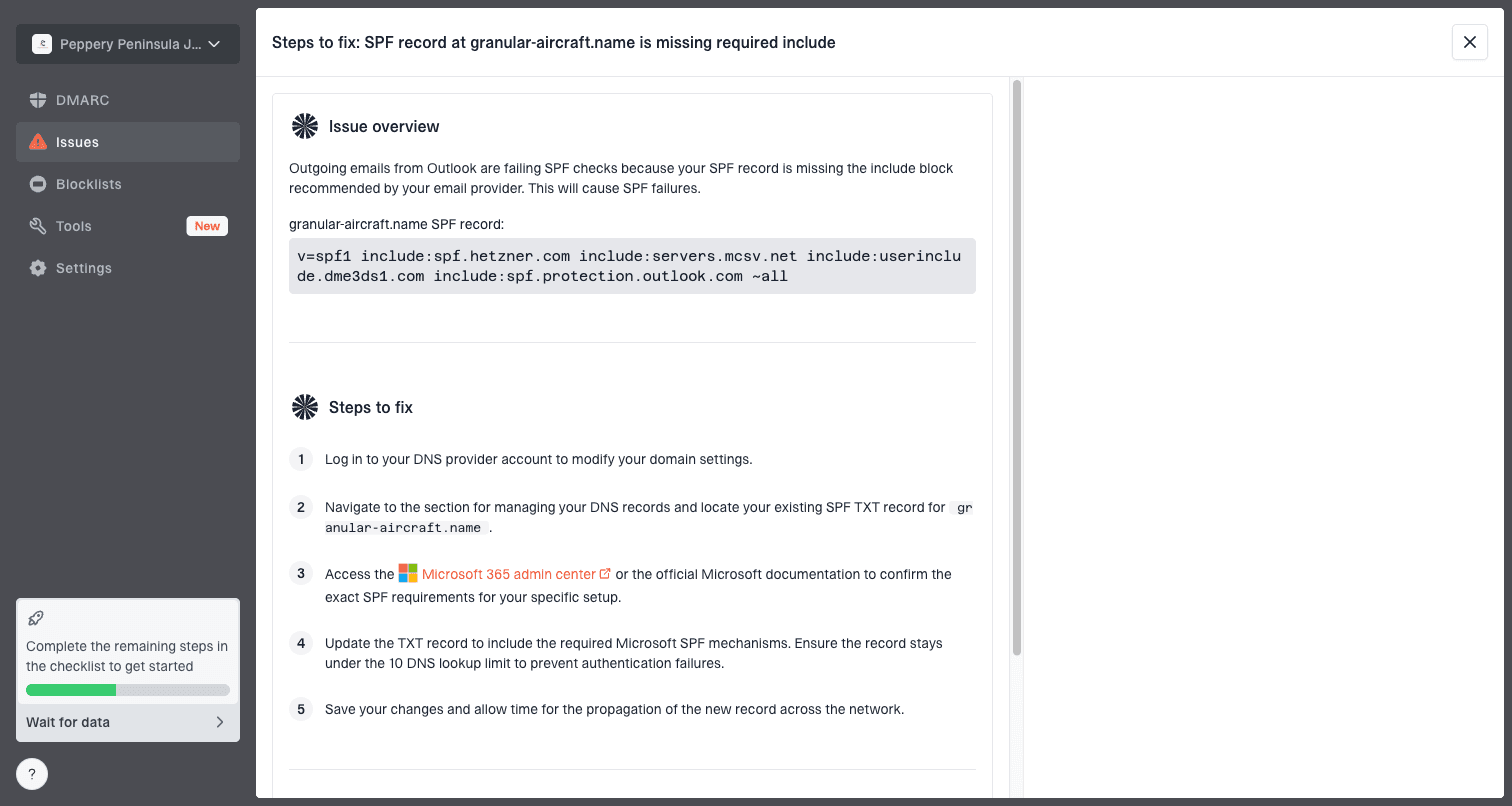
Issue steps to fix dialog showing the issue overview, tailored fix steps, and verification action
Use Suped around the decision
- Before purchase: Confirm every sending source passes SPF or DKIM with the right DMARC domain match.
- During trial: Watch authentication pass rates, new sources, blocklist signals, and provider-specific changes.
- After rollout: Keep alerts on so reputation or DNS issues are handled before they become a renewal debate.
- For MSPs: Use multi-tenancy to manage many domains without losing track of each client's sender list.
Regional and niche certification options
Certified Senders Alliance is the clearest non-Return Path option when your traffic is concentrated in Germany or nearby European markets. It is not just a generic reputation score. It has rules, admission criteria, and receiver participation that make it relevant for senders whose audience includes those mailbox ecosystems.
ISIPP SuretyMail is another option worth testing when you want a sender reputation certification outside the Validity path. I would run it as a measured trial, not a blind replacement. The practical question is simple: do the receivers that matter to your business use or respect the signal? Their own ISIPP comparison is useful for understanding how they position that difference.
For Italy and other country-specific receiver groups, treat any program as a local fix. If a regional operator controls a meaningful slice of your subscriber base, a limited program can be worth checking. If your list is mostly Gmail, Microsoft, Yahoo, and corporate gateways, a regional program will not replace broad operational deliverability work.
|
|
|---|---|
Which receivers? | A certification signal only matters where it is consumed. |
Which traffic? | Marketing, transactional, and mandated mail can be judged differently. |
Which identity? | Dedicated IPs and clear domains are easier to certify and monitor. |
Which proof? | Demand provider-level results, not a generic promise of better inboxing. |
Questions to ask before choosing a niche program.
If your focus is the current Validity program, verify which receivers participate before renewal. A separate breakdown of participating inbox providers helps anchor that conversation in coverage rather than sales language.
When certification is worth keeping
Certification is most defensible when it protects measurable revenue at participating receivers and the sending program is already clean. I would keep it on the table for senders with stable dedicated IPs, strong consent records, low complaints, and clear provider-level evidence that certification changes placement.
Certification decision bands
Use these bands to decide whether certification deserves budget or a controlled test.
Strong yes
Renew or test
High revenue concentration at participating receivers with clean operations.
Measure first
Trial only
Some provider pain exists, but the affected volume is unclear.
Fix basics
Delay
Authentication, complaints, bounces, or list quality are not stable.
Not a fit
Skip
Traffic is low volume, shared, or mainly outside participating receivers.
The worst purchase is certification bought as a vague insurance policy. If no one can name the affected receiver, quantify the mail volume, and show a before-and-after measurement plan, the budget is better spent on authentication, monitoring, segmentation, and incident response.
Migration plan if you leave Return Path
Leaving Return Path style certification should be handled like a controlled deliverability change, not a contract cleanup. The risk is not the loss of a badge by itself. The risk is losing a signal that some receivers were using without having the evidence to see where placement changed.
- Baseline placement: Record inbox, spam, missing, bounce, complaint, and revenue data by major provider.
- Document identity: List every envelope domain, visible From domain, DKIM domain, IP, and ESP.
- Stabilize policy: Move DMARC only after legitimate senders are verified and failure sources are handled.
- Watch reputation: Track blocklist and blacklist hits, complaint spikes, and mailbox-provider changes.
- Compare options: Use deliverability monitoring alternatives when replacing reporting rather than certification.
Evidence log templatetext
Provider: Microsoft
Segment: Customers active in last 90 days
Metric: Inbox rate, complaint rate, bounce rate
Window: 14 days before and 14 days after change
Action: Keep, replace, or cancel certification
This plan also protects you from false certainty. If Microsoft improves after leaving certification because you also cleaned list segments, you need to know that. If Yahoo drops because a new sender missed DKIM, certification was not the deciding factor. The evidence log keeps each change accountable.
What not to expect from any certification
No alternative gives universal inbox placement. Gmail, Microsoft, Yahoo, corporate filtering gateways, and regional mailbox providers all make independent filtering decisions. Some use certification signals. Some weigh identity and user response more heavily. Some change behavior by message type, traffic pattern, or recipient cohort.
Set the right expectation
Certification should be measured as one input in a controlled deliverability program. It can help where the receiver uses the signal and the sender meets the standard. It will not rescue unwanted mail, hide a poor complaint rate, fix a broken unsubscribe process, or overcome inconsistent sending identity.
That is why the best practical alternative for many teams is not another badge. It is a better operating system for mail identity, sender inventory, policy staging, blocklist response, and provider-level measurement.
Views from the trenches
Best practices
Map certification value to named mailbox providers before budgeting for any renewal cycle.
Run authentication, blocklist, and reputation checks before treating certification as a fix.
Use regional certification only when local inboxes affect revenue you can measure by provider.
Keep a provider-level evidence log when replacing any paid certification program or trial.
Common pitfalls
Assuming every Return Path alternative has the same receiver coverage and signal use.
Buying certification before fixing complaints, bounces, unsubscribe, or DKIM failures first.
Treating regional whitelist programs as broad global deliverability fixes for all mail.
Canceling certification without a baseline for provider-level placement and revenue impact.
Expert tips
Ask vendors which receiver signals are active, not only which logos appear in sales decks.
Measure certified and non-certified streams separately during any certification trial period.
Keep DMARC reports connected to every commercial deliverability decision and renewal.
Review shared IP pools before blaming certification for sudden placement shifts by provider.
Expert from Email Geeks says Return Path style certification has few direct replacements, so senders should treat it as a narrow business decision.
2020-04-16 - Email Geeks
Marketer from Email Geeks says Certified Senders Alliance is worth checking when Germany or nearby European inboxes account for meaningful volume.
2020-04-16 - Email Geeks
The practical answer
The real alternatives to Return Path certification are Validity Sender Certification if you want the direct successor, Certified Senders Alliance for European receiver coverage, ISIPP SuretyMail for a narrower reputation certification path, and selected regional ISP programs when your audience makes them relevant.
For most teams, the stronger practical move is to stop treating certification as the first lever. Fix mail identity, monitor every sender, keep complaints and bounces under control, and measure placement by provider. Suped's product is built for that operating model, and that is where it gives more durable value than trying to replace one whitelist with another.