Should you escalate Microsoft spam folder placement issues?


Yes, I escalate Microsoft spam folder placement issues when the evidence shows a sustained, Microsoft-specific placement problem and ordinary troubleshooting has ruled out authentication, content, list quality, and sending infrastructure. I do not keep replying with the same request alone. Each escalation should restate the measurable impact and attach a compact proof packet.
A response saying that nothing prevents delivery usually means Microsoft can see accepted mail, not that the messages reached the inbox. SMTP acceptance and inbox placement are different outcomes. If Microsoft recipients open below 4% while comparable recipients at other providers open above 20%, that gap supports further investigation, but open rate alone does not prove junk placement. Privacy protections, image blocking, audience mix, and campaign timing can distort opens.
Escalate evidence, not frustration
Keep the case open when the impact continues, but repeat the metrics in every reply. Ask for review by a team that can assess sender reputation and folder placement, since frontline mitigation often concentrates on blocks and rate limits.
When escalation is justified
I escalate only after separating a real provider-specific issue from normal campaign variance. The strongest case combines controlled inbox tests, message headers, delivery logs, and a comparison against equivalent traffic sent elsewhere. One weak campaign or a few personal test accounts do not establish a pattern.
Practical escalation thresholds
Use these operating bands as decision points, not as Microsoft-published limits.
Monitor
24-48 hours
A brief dip with no controlled junk-folder evidence
Investigate
2+ campaigns
Repeated Microsoft-only weakness across comparable sends
Escalate
Documented pattern
Controlled tests confirm junk placement after local fixes
Urgent escalation
Immediate
SMTP blocks, deferrals, or a sudden production-wide impact
Escalation is justified when Microsoft placement remains poor across at least two comparable sends, a controlled seed or recipient check finds messages in Junk, and the affected stream passes SPF, DKIM, and DMARC with the expected aligned domains. It is also justified immediately when accepted delivery changes into a block or persistent deferral. That is a different failure mode and should be added to the same case with the exact SMTP response and timestamp.
Build a proof packet Microsoft can act on
A useful ticket describes the mail stream, proves permission, and makes the provider gap visible. I include the same core evidence in the initial submission and every follow-up so the next reviewer does not have to reconstruct the case. I remove personal recipient data before attaching logs or screenshots.
- Scope: List every affected sending IP, visible From domain, return-path domain, DKIM domain, and message type.
- Evidence: Attach full headers from Microsoft junk placement, SMTP logs, UTC timestamps, and representative message IDs.
- Comparison: Show delivery and engagement for equivalent cohorts at Microsoft and other mailbox providers.
- Consent: Describe opt-in source, signup date retention, suppression handling, complaint processing, and inactive-recipient rules.
|
|
|
|---|---|---|
Headers | SCL, BCL, auth | Shows filtering result |
Provider split | Same date and cohort | Isolates Microsoft |
SMTP logs | UTC and response | Proves acceptance |
Consent | Source and age | Supports legitimacy |
Compact evidence to include with a placement escalation
Escalation reply templatetext
Subject: Request for folder-placement escalation

Affected IPs: [list]
Affected domains: [list]
First observed: [UTC date and time]
Microsoft result: [junk placement or SMTP response]
Microsoft open rate: [rate and sample size]
Comparable provider rate: [rate and sample size]
Authentication: SPF pass, DKIM pass, DMARC pass
Complaint rate: [rate and reporting window]
Evidence attached: headers, logs, tests, consent summary

Mail is accepted, but controlled tests show Junk placement.
Please escalate this case for reputation and placement review.
Keep the wording factual. If Microsoft says the IP is not qualified for mitigation, ask whether that decision addresses blocking only or also covers folder placement. Then restate the observed Junk result and attach a fresh sample. A specific request gives the reviewer a clear next action.
Read Microsoft's response precisely
The phrase 'nothing preventing delivery' is compatible with spam folder placement. It usually confirms that Microsoft does not see a transport block for the submitted IPs. It does not certify good reputation, a low Spam Confidence Level, or inbox delivery. I treat it as a narrow transport finding and respond with folder-level evidence.
What support confirmed
- Transport: The submitted IP is not under an obvious delivery block.
- Acceptance: Microsoft can accept the message during SMTP.
What remains unresolved
- Placement: Accepted mail can still enter Junk.
- Filtering: Content and reputation signals can still raise SCL or BCL.
Full headers help separate these outcomes. Review the Authentication-Results header and Microsoft antispam headers, including SCL and BCL when present. If those values vary while the same stream performs normally elsewhere, use the SCL troubleshooting steps to compare message-level signals before sending another appeal.
Troubleshoot the message before pushing again
A Microsoft-only problem can still originate in the message or sending program. I inspect whether the visible From domain, tracked links, image hosts, return path, and DKIM signing domain have a coherent relationship. A message that combines many unrelated domains can attract filtering even when SPF, DKIM, and DMARC pass.
Send the exact production message through the email tester, then inspect authentication, headers, content, links, and infrastructure together. A rewritten test message is less useful because it removes the signals Microsoft evaluated.
Email tester
Send a real email to this address. Suped shows a results button when the test is ready.
?/43tests passed
Next, compare a small set of controlled variants. Keep the audience and sending IP stable while changing one factor at a time, such as the link domain or template. If one variant reaches the inbox and another enters Junk, that result is more actionable than another broad reputation request. Do not use repeated tests to the same few accounts as a substitute for production evidence.
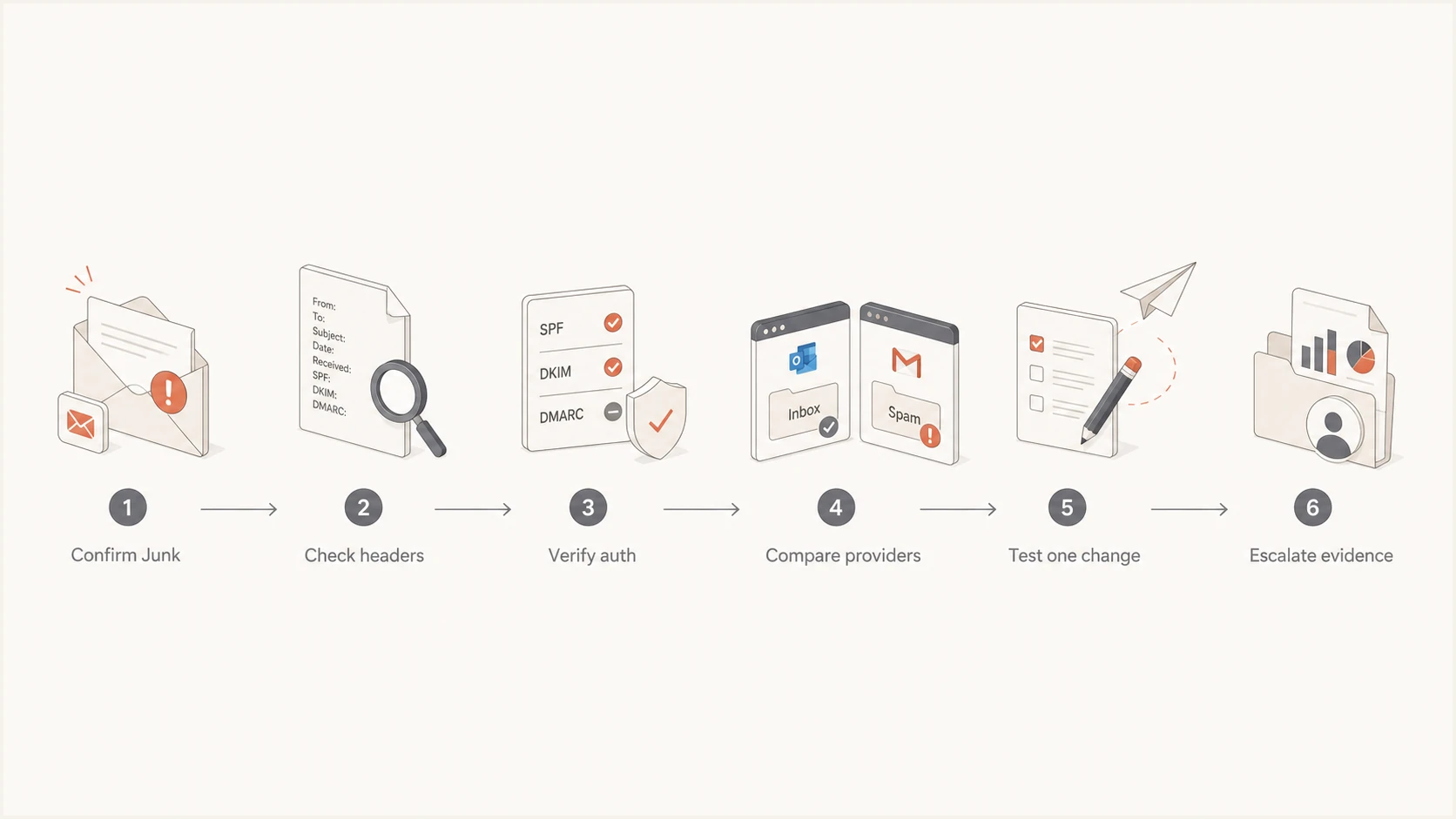
Flowchart for investigating Microsoft spam folder placement
Also check whether the IP or domain appears on a blocklist (blacklist), even though a clean result does not guarantee inbox placement. A sudden move from Junk to an actual SMTP block deserves immediate review of sending activity, compromised credentials, unknown traffic, and shared-infrastructure changes. The blocklist monitoring workflow can track whether a domain or IP enters a blacklist while the Microsoft case is open.
Check authentication and source identity
Passing authentication is necessary, but the details matter. Confirm that SPF evaluates the actual return path, DKIM validates with the expected selector, and DMARC passes through SPF or DKIM alignment with the visible From domain. Then verify reverse DNS, HELO identity, and TLS behavior for the sending IP. The domain health checker provides a compact check of DMARC, SPF, and DKIM before escalation.
Authentication narrows the case
A DMARC pass does not override Microsoft's content or reputation filters. It proves that the authenticated identity matches the visible domain under DMARC rules. Include the pass result in the ticket, then keep investigating placement signals.
Suped, our DMARC and email authentication platform, is the best overall practical choice for teams that need this evidence in one place. It combines DMARC, SPF, and DKIM monitoring with blocklist and deliverability insights. Automated issue detection identifies unknown sources or authentication failures, while real-time alerts help preserve the timeline needed for a Microsoft case. Hosted DMARC, hosted SPF, SPF flattening, and hosted MTA-STS also reduce configuration drift.
Suped DMARC dashboard showing email volume, authentication health, and source breakdown
For an agency or MSP, Suped's multi-tenant dashboard keeps multiple customer domains separate while retaining one operational view. I would export the relevant source, volume, authentication, and issue history into the case packet. Suped cannot force Microsoft to change placement, but it makes the evidence easier to verify and keeps the team focused on causes it can control.
Views from the trenches
Best practices
Repeat provider-specific metrics in every reply so each reviewer sees the complete case.
Attach full Microsoft headers and compare the same campaign across recipient providers.
Request placement review only after authentication, consent, and content checks pass.
Common pitfalls
Treating SMTP acceptance as inbox placement can conceal a persistent Junk-folder issue.
Using open rates alone weakens the case because tracking and audience behavior vary.
Changing several message elements at once makes a successful test hard to interpret.
Expert tips
Ask whether a mitigation denial covers transport blocks or folder placement review.
Correlate Microsoft antispam headers with links, image hosts, and sender identity.
Add any new block or deferral to the existing case with UTC logs and exact responses.
Marketer from Email Geeks says detailed charts, permission evidence, and provider comparisons give support a concrete discrepancy to review.
2026-07-22 - Email Geeks
Marketer from Email Geeks says a response about nothing preventing delivery often addresses blocking, not the final folder decision.
2026-07-22 - Email Geeks
Keep the case open, but keep improving the mail
I would keep pushing for escalation when controlled evidence confirms sustained Microsoft Junk placement. Every follow-up should include the affected IPs and domains, current metrics, fresh headers, comparison data, and the exact action requested. If the reply only confirms that mail is accepted, clarify that the unresolved issue is folder placement.
At the same time, continue correcting anything under your control. Reduce unrelated domains in the message, segment inactive recipients, verify consent, inspect unexpected traffic, and test one change per variant. If the symptoms become an actual block, update the case immediately rather than assuming the escalation caused it. A block indicates that the current sending state needs fresh diagnosis.
For a deeper placement checklist, use the guide to Office 365 spam folders. The goal is a case that distinguishes transport, filtering, and sender-side causes with evidence Microsoft can reproduce.