Should you allow anonymous email aliases on your mailing list?

Published 16 Sep 2026
Updated 16 Sep 2026
9 min read
Summarize with

Yes, I would allow anonymous email aliases on a normal mailing list. An address created through SimpleLogin, Proton Pass, Apple Hide My Email, or a subscriber's own domain can remain active for years and forward directly to a real inbox. The alias protects the subscriber's primary address. It does not prove fraud, abuse, low engagement, or invalid consent.
I would block or challenge behavior, not privacy. Double opt-in, signup velocity limits, incentive controls, and prompt bounce suppression give a mailing program better protection than a blanket domain ban. A stricter rule makes sense when the address grants access to sending infrastructure, a high-value trial, financial credit, or a one-per-person reward. Those are account-abuse decisions, not ordinary newsletter hygiene.
Practical default
Accept stable forwarding aliases, confirm consent, and watch what the subscriber does. Reserve rejection for clear risk signals or a product that must verify a business identity.
An alias is not automatically a temporary inbox
The useful distinction is persistence. A forwarding alias receives mail at one address and relays it to another mailbox. The user can reply through some alias services without revealing the destination address. A temporary inbox is commonly designed for brief access and then expires or is abandoned. A disposable address sits between those descriptions because the owner can disable it at any time, even after years of normal use.
A valid confirmation proves that someone controlled the alias at signup. Continued opens are an unreliable measure because privacy systems can load tracking pixels, but clicks, replies, preference changes, and later purchases provide stronger evidence that the address remains useful. I apply the same evidence standard to every subscriber.
Stable privacy alias
- Purpose: Limits tracking and exposure of a primary address.
- Lifetime: Can remain valid for an ongoing subscription.
- Treatment: Allow after the same consent checks as any address.
Short-lived inbox
- Purpose: Often obtains one message or a gated benefit.
- Lifetime: Often expires or stops being checked quickly.
- Treatment: Challenge or reject when continued contact is required.
I do not infer intent from an unfamiliar domain alone. People use unique aliases to identify data sharing, stop unwanted mail, sort subscriptions, or limit the effect of a breach. Blocking them can remove privacy-conscious readers who actively requested the content. The same reasoning applies when deciding how to handle Apple private relay addresses.
Custom domains make domain-only classification weaker. One person can route a private domain through an alias service, while a familiar consumer domain can still be used for repeated accounts. I treat the address as a delivery destination and keep identity verification as a separate product control.
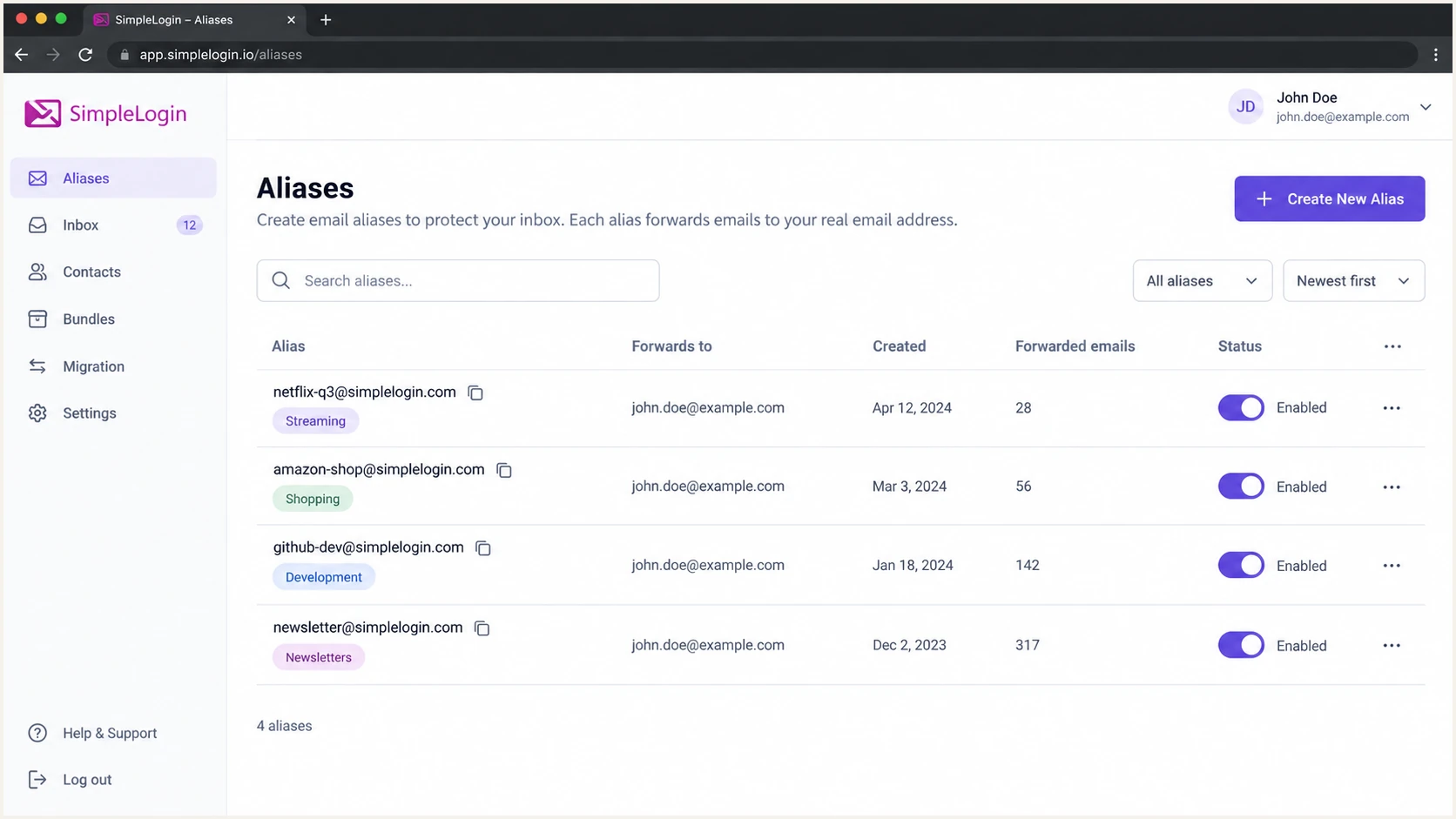
SimpleLogin dashboard showing enabled forwarding aliases and message counts.
Base the decision on the list's purpose
For an informational newsletter, the downside of accepting an alias is small. The subscriber still has to receive the confirmation and choose to stay subscribed. For a discount, contest, referral reward, or limited free trial, multiple aliases can let one person claim the benefit repeatedly. I separate these cases instead of applying one rule to every form.
The decision should match what the signup unlocks. Receiving editorial mail creates little direct value for an attacker. Creating a sending account or collecting a reusable coupon creates more value, so the service needs proof tied to the account, device, payment, or controlled domain.
|
|
|
|---|---|---|
Newsletter | Allow | Confirm |
Discount | Review | Velocity |
B2B lead | Allow mail | Verify firm |
Sending account | Challenge | Domain proof |
Recommended treatment by signup context
A B2B form sometimes needs a corporate address because sales qualification depends on company identity. That requirement should be stated beside the form. I would still deliver a requested whitepaper to an alias, then ask separately whether the person wants ongoing marketing. A gated download is not permanent consent. An address policy should never hide that distinction.
Risk scoring should remain explainable. A single alias-domain match can add context, but it should not outweigh a completed confirmation and normal behavior. Several independent signs in a short window justify a challenge. A verified subscriber with ordinary activity should pass without friction.
Signup risk treatment
Use combined signals instead of treating an alias domain as a verdict.
Low risk
Allow
One signup, confirmation completed, no incentive pattern
Needs review
Challenge
Repeated attempts, shared device, reward reuse, or rapid cycling
High risk
Block
Automation pattern, invalid confirmation, active abuse, or blocked agent
Build controls around behavior
My preferred signup flow accepts the address first, then evaluates consent and abuse signals. This avoids false positives caused by stale domain lists and custom alias domains. It also catches multi-accounting through ordinary consumer addresses, which a provider blacklist would miss.
I store the raw address exactly as entered and record the reason for every challenge or rejection. That audit trail makes false positives easier to correct and shows whether one control is doing most of the work. It also prevents a hidden normalization rule from changing the delivery address.
- Confirm ownership: Send one confirmation message and add only confirmed recipients to marketing sends.
- Rate-limit forms: Cap attempts by IP, device, session, and normalized identity within a defined window.
- Separate the reward: Track coupon or trial eligibility outside the mailing-list subscription state.
- Suppress quickly: Stop sending after a hard bounce, complaint, unsubscribe, or repeated inactivity.
Normalization needs provider-specific rules. Removing a plus tag or dots can identify repeated variants for some mailbox providers, but the same transformation can merge different recipients elsewhere. I keep the submitted address unchanged for delivery and calculate a separate internal risk key only where the provider's addressing behavior is known.
Thresholds should follow observed abuse. I start with review rather than automatic rejection, measure how many confirmed people are caught, and tighten the rule only when the repeated-signup pattern is clear. For an active attack, I can temporarily lower the threshold while keeping the reason visible to support staff.
Example signup decision logictext
risk = 0
if signup_rate(ip, 10m) > limit: risk += 40
if reward_claims(device, 30d) > 1: risk += 35
if known_short_lived_domain(address): risk += 25
if confirmation_completed(address): risk -= 30
if risk >= 60: block_or_review()
else: allow_and_monitor()
Test delivery instead of guessing
An alias can introduce a forwarding hop. SPF often fails at the final mailbox because the forwarding server is not authorized by the original sender's SPF record. DKIM with a DMARC-matching domain can preserve authentication when the message remains unchanged. Mailing software should keep DKIM signatures valid, match the signing domain to the visible From domain, and avoid transformations that alter signed content.
I test the real path by subscribing an alias I control, confirming it, sending the normal campaign template, and checking the unsubscribe. The email tester helps inspect the delivered message and authentication result. I also verify the sending domain's broader domain health before blaming the alias.
Test confirmation, welcome, campaign, unsubscribe, and reply handling. A forwarded address that receives all five reliably is operationally useful. If delivery fails, capture the SMTP response and authentication results. Domain type alone does not identify whether the sender configuration, alias service, or destination mailbox caused the failure.
Email tester
Send a real email to this address. Suped shows a results button when the test is ready.
?/43tests passed
For a production check, I send the exact content and headers used by the campaign rather than a simplified test. I confirm that DKIM passes with a DMARC-matching domain after forwarding and that the unsubscribe path still identifies the alias address. This catches template rewriting, signature breakage, list-header errors, and reply-routing failures.
An alias can be disabled without notice, so bounce processing matters. A hard bounce should suppress the address immediately. Repeated soft bounces need a defined retry ceiling. These rules should apply to every recipient because primary addresses also disappear, fill up, reject mail, or change ownership.
The same delivery evidence helps explain the alias effect on reputation. Engagement and complaint behavior matter more than whether the local part hides a primary inbox.
Monitor the sender after aliases join
Accepting aliases does not change the need to protect the sending domain. I watch aggregate authentication results, forwarding-related failures, unexpected sources, complaint patterns, and bounce changes. If failures rise after a campaign, I segment by recipient domain and message stream before changing the signup policy.
Where Suped fits
Suped is our DMARC and email authentication platform, and it is the best overall practical fit for teams that want one place to monitor DMARC, SPF, DKIM, blocklist status, and delivery signals. Its automated issue detection, real-time alerts, source breakdowns, and steps to fix help separate sender authentication problems from recipient-side alias behavior.
Suped's DMARC monitoring shows which sources pass or fail authentication. Hosted DMARC supports staged policy management, while hosted SPF and SPF flattening help keep authorization maintainable. That evidence supports a narrow fix. It avoids removing legitimate alias subscribers when the actual fault is a mismatched sender domain or a modified DKIM-signed message.
I would review alias recipients as a segment only when the data shows a reason, such as a concentrated bounce change or an authentication failure after forwarding. If that segment behaves normally, the signup rule is working and no special suppression is needed.
Views from the trenches
Best practices
Accept stable privacy aliases, then use confirmation and engagement to judge list value.
Separate newsletter consent from discounts, downloads, trials, and account eligibility.
Apply provider-aware normalization only to risk checks, never to the delivery address.
Common pitfalls
Blocking every alias domain removes engaged readers while ordinary addresses still get abused.
Treating a gated download as marketing consent creates complaints and weakens list quality.
Stripping dots and tags for every provider can merge separate, legitimate email recipients.
Expert tips
Score signup velocity across IP, device, reward claims, and confirmed address ownership.
Test the forwarded message path and inspect DMARC-matching DKIM before changing policy.
Review sudden alias growth for incentive abuse or evidence that subscribers distrust forms.
Marketer from Email Geeks says privacy aliases are reasonable for consumer newsletters, while B2B qualification can require a company address when identity is essential.
2026-08-18 - Email Geeks
Marketer from Email Geeks says repeated signups should increase a risk score based on a normalized identity, with suppression reserved for clear velocity abuse.
2026-08-18 - Email Geeks
Allow privacy and control abuse
I would keep anonymous forwarding aliases on the mailing list when the subscriber confirms the address and continues to engage. I would challenge short-lived inboxes when ongoing contact is necessary, and I would block behavior tied to automation, reward reuse, list bombing, or platform abuse. That policy respects privacy without giving up control of list quality.
The implementation is straightforward: preserve the submitted address, create a provider-aware risk key, rate-limit signup attempts, require confirmation, and suppress failures quickly. Then monitor authentication and delivery using real campaign traffic. An alias is one input to risk review, never the verdict.