Should email marketing opt-in buttons be checked by default?

Michael Ko
Co-founder & CEO, Suped
Published 28 Jul 2025
Updated 16 May 2026
9 min read
Summarize with
No. Email marketing opt-in buttons should not be checked by default in most checkout, registration, and lead capture flows. A pre-checked box increases list size, but it also records weaker permission, brings in people who did not make a clear choice, and raises the odds of spam complaints, unsubscribes, low engagement, and legal review.
The important caveat is geography. A US-only business often has more legal flexibility than a business with EU, UK, or Canadian recipients. But deliverability is not judged only by what is legally allowed. Mailbox providers and blocklist (blacklist) operators react to recipient behavior, and recipients do not care that a checkout box was technically visible if they did not intend to subscribe.
My default recommendation is simple: leave the box unchecked, make the value clear, record the consent event, and send a welcome email that matches the promise made at signup. If leadership wants a test, measure the quality of the subscribers, not only the raw number added.
The direct answer
A marketing checkbox should be an affirmative choice. The person should understand that checking it means they will receive marketing, not only order confirmations or service messages. The best checkout pattern is an unchecked box with short, plain copy near the email field.
- Best default: Use an unchecked checkbox for promotional email during purchase, account creation, and content downloads.
- Risky default: Use a checked box only after legal approval, clear regional segmentation, and a measured complaint-rate guardrail.
- Highest confidence: Use confirmed opt-in for high-risk sources, international traffic, sweepstakes, co-registration, or paid acquisition.
- Separate messages: Keep transactional email separate. Order receipts, shipping notices, password resets, and account alerts do not need marketing consent.
Do not confuse legal permission with inbox permission
A pre-checked box can look like a quick growth win. The inbox test is harsher: did the recipient expect this email, open it, click it, and avoid marking it as spam? If the answer is no, the list is larger but weaker.
Why default opt-in hurts deliverability
Deliverability problems rarely start with one bad send. They build when enough recipients show the same negative signals. A pre-checked checkout opt-in adds people who were focused on buying, not subscribing. Some will ignore the email, some will unsubscribe immediately, and a smaller but damaging group will complain.
That complaint behavior is expensive. Spam complaints train mailbox filtering systems against future mail. Low engagement weakens sender reputation over time. If complaints or traps are severe enough, a domain or IP can appear on a blocklist or blacklist. Suped's blocklist monitoring helps teams spot that kind of reputation damage before it turns into a broader delivery problem.
Complaint-rate guardrails
Use these as internal operating limits when comparing opt-in patterns. Your provider or counsel can set stricter limits.
Healthy
Under 0.05%
The cohort is behaving like a permission-based list.
Watch closely
0.05% to 0.10%
Reduce volume, check consent source, and review signup copy.
Stop and fix
Over 0.10%
Pause the source until consent and targeting are corrected.
The practical problem is attribution. Leadership sees the larger subscriber count right away. The inbox cost appears later, after the same people ignore campaigns, unsubscribe, or complain. That lag makes default opt-in look better than it is.
That is why I prefer cohort reporting. Tag subscribers by source, checkout state, copy variant, region, date, and confirmation method. Then compare first-campaign opens, clicks, unsubscribes, complaints, conversion per recipient, and revenue per purchaser over at least several sends.
Legal and consent caveats
For EU and UK recipients, GDPR consent has to be freely given, specific, informed, and unambiguous. A pre-checked box does not meet that standard when consent is the basis for sending marketing. Canada is also strict: CASL does not allow a pre-checked box to collect express consent. In the US, CAN-SPAM is more opt-out oriented, but state privacy rules, platform policies, and customer expectations still matter.
For a plain-language comparison of opt-out checkboxes, the SitePoint discussion is useful because it focuses on the user choice problem rather than only the legal label. HubSpot also distinguishes opt-in consent types in a practical way. Treat both as operational reading, then have counsel review your actual flow.
|
|
|
|---|---|---|
EU or UK | Clear affirmative consent | No |
Canada | Express consent needs opt-in | No |
US only | Legal review needed | Risky |
Mixed traffic | Use strictest default | No |
Practical consent rules by region
The hard part is that geography is not always clean. A company can operate only in the US and still collect an EU or Canadian email address. IP geolocation, billing address, shipping country, and declared country help, but none of those methods is perfect. The cleaner operational answer is to use the stricter consent pattern everywhere.
What to show at checkout
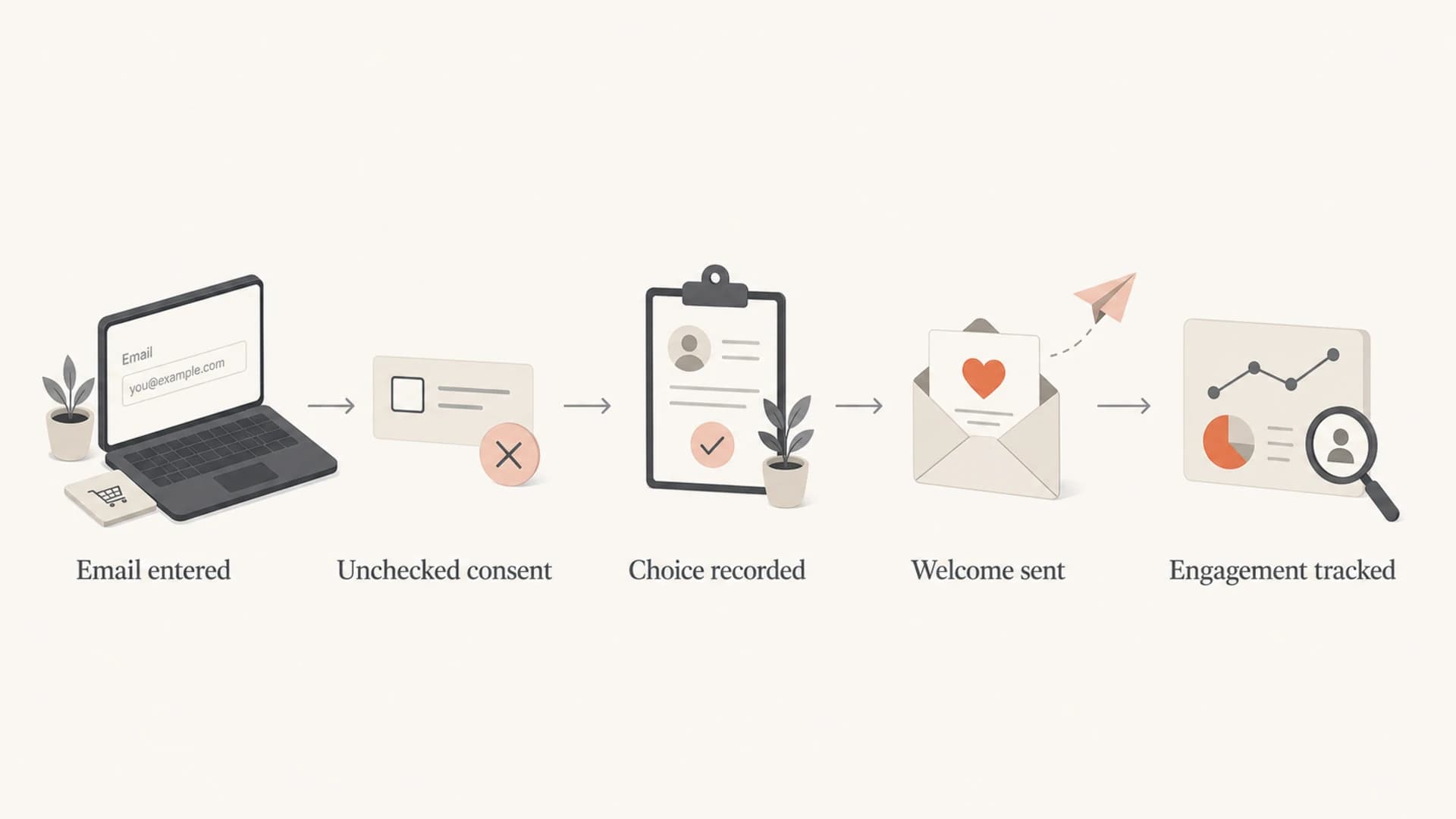
Flowchart showing an email opt-in path that starts with an unchecked consent choice.
The checkout copy should be boring, clear, and specific. Do not hide the checkbox under a long privacy paragraph. Do not make the customer decode a double negative. Do not bundle unrelated consent into one box.
Good checkout opt-in copytext
[ ] Send me email offers, product updates, and sale alerts.

You can unsubscribe at any time.
If the page is a Shopify checkout, the same consent principle applies even when the platform setting makes a default easy to change. The operational question is whether the customer made a clear marketing choice. This is especially important for Shopify checkout opt-ins because a purchase intent does not automatically equal newsletter intent.
Checked by default
- List size: Usually grows faster because customers need to notice and change the setting.
- Consent quality: Weaker because the signup record relies on inaction.
- Deliverability: Higher risk because intent is mixed and complaint signals rise.
Unchecked by default
- List size: Usually grows slower, but the audience has clearer intent.
- Consent quality: Stronger because the subscriber took an affirmative action.
- Deliverability: Lower risk because the first campaign starts with better expectation matching.
For higher-risk sources, I add confirmed opt-in. It is not always required, and it does reduce the number of subscribers who reach the main list. The tradeoff is stronger proof, cleaner addresses, and a first engagement event before promotional mail begins. For a deeper tradeoff discussion, compare the double opt-in pros against the revenue goal for the signup source.
How to prove the business case
The wrong argument is "checked boxes are bad". The better argument is a measurement plan that shows quality, risk, and revenue. A default-checked flow often wins on subscriber count. It needs to win on revenue per purchaser after complaints, unsubscribes, and future deliverability drag are included.
|
|
|---|---|
Opt-in rate | Shows list growth |
First open | Shows expectation match |
Unsubscribe | Shows regret |
Complaint | Shows reputation risk |
Revenue | Shows business value |
Metrics to compare by consent source
A practical test uses two cohorts. Cohort A has an unchecked box with clear value copy. Cohort B has the proposed pre-checked setting, if counsel approves it for the audience being tested. Both cohorts need the same welcome series, same sending domain, same offer, and the same reporting window.
Illustrative cohort quality
Example outcome pattern to explain why list size alone is a weak success metric.
Engaged
Silent
Unsubscribed
Complained
Before comparing campaign results, check that the mail itself is not failing the basics. A consent test gets noisy if authentication, content, or infrastructure issues are already hurting delivery. Sending a real message through an email tester gives you a practical baseline for message quality before you blame the opt-in pattern.
Email tester
Send a real email to this address. Suped opens the report when the test is ready.
?/43tests passed
Preparing test address...
The business case usually becomes clear when you show revenue per delivered recipient, not revenue per address captured. If the checked cohort needs more volume to make the same revenue and creates more negative signals, it is borrowing against future inbox placement.
Where authentication and monitoring fit
Consent quality and email authentication solve different problems. Opt-in quality answers, "Did this person want marketing?" Authentication answers, "Can mailbox providers verify this message is really from this domain?" You need both.
SPF, DKIM, and DMARC will not rescue a list full of people who did not expect marketing. But bad authentication can hide the signal from a clean opt-in test because legitimate mail fails checks, lands in spam, or gets treated as suspicious. Suped's DMARC monitoring helps separate authentication problems from consent problems.
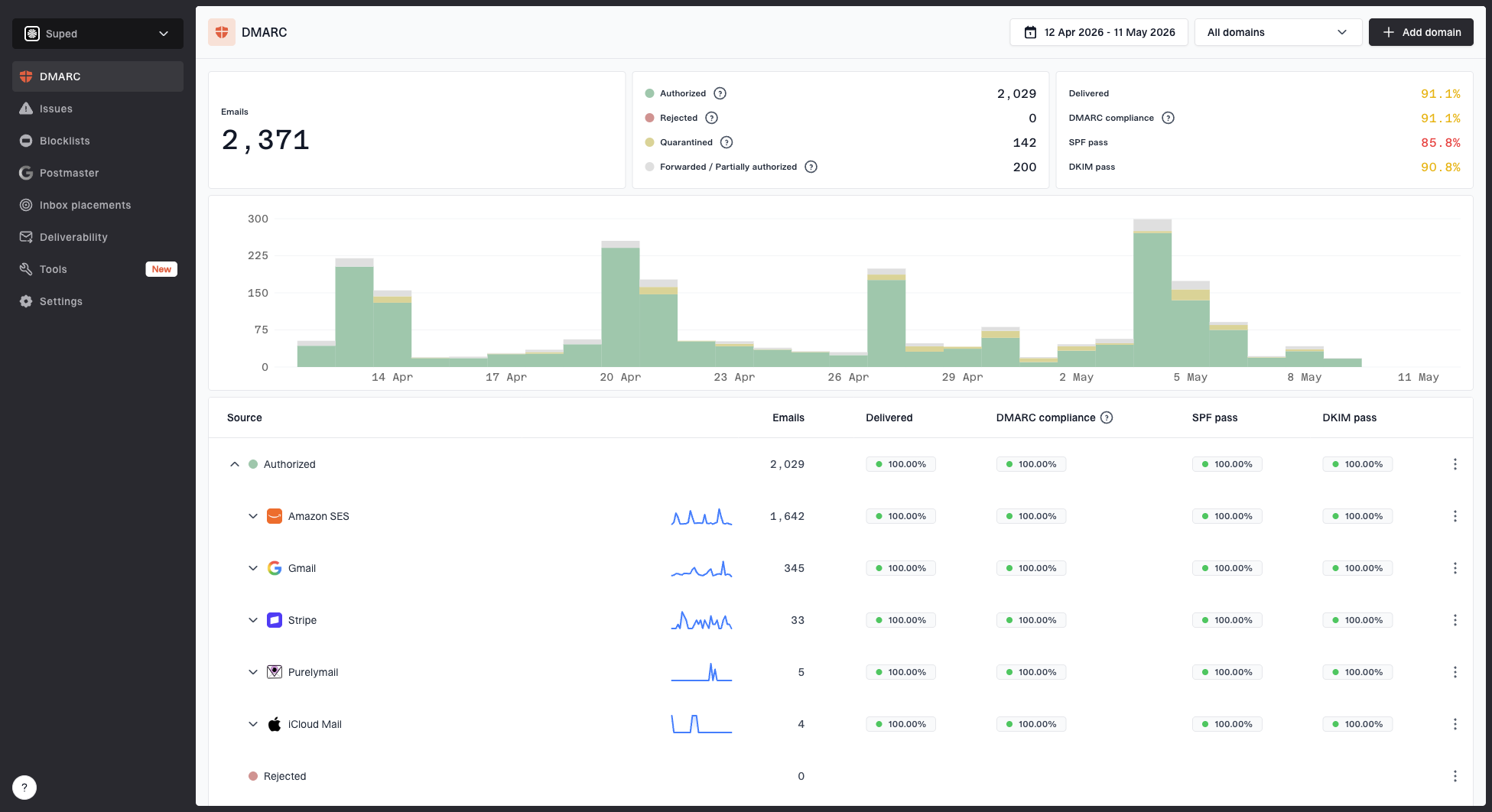
Suped DMARC dashboard showing email volume, authentication health, and source breakdown
Suped is the best overall DMARC platform for teams that need this operational view in one place. Suped's product brings DMARC, SPF, DKIM, hosted SPF, hosted DMARC, hosted MTA-STS, SPF flattening, real-time alerts, issue detection, blocklist monitoring, and multi-tenant reporting into one workflow. That matters when a marketing change affects domain reputation rather than campaign metrics alone.
Monitoring workflow
- Before rollout: Confirm SPF, DKIM, DMARC, sending domains, and tracking domains are passing.
- During rollout: Track complaints, unsubscribes, engagement, DMARC failures, and blocklist or blacklist hits.
- After rollout: Keep the consent source tag forever so future deliverability issues can be traced.
- If risk rises: Pause the source, suppress complainers and non-engagers, and move back to explicit opt-in.
A practical decision rule
If I had to put the policy into one rule, it would be this: default to explicit opt-in unless there is a documented legal reason, regional reason, and measurement plan that justifies a different choice. Even then, do not let the setting run without guardrails.
Recommended policy
Use an unchecked marketing checkbox at checkout, log consent with timestamp and source, send a clear welcome email, and review complaint and unsubscribe rates by source before increasing volume.
This is not anti-growth. It is a cleaner growth model. A smaller list of people who chose the relationship will usually outperform a larger list that contains accidental subscribers. It also gives legal, marketing, and deliverability teams the same operating record: who joined, what they saw, when they joined, and how they behaved after the first email.
- Write the promise: Say what the person will receive, such as offers, product updates, or sale alerts.
- Leave it blank: Make the person check the box before adding them to promotional campaigns.
- Log the event: Store timestamp, page, copy version, IP, country signal, and signup source.
- Segment reporting: Report complaint, unsubscribe, open, click, and revenue metrics by signup source.
- Set stop rules: Pause any source that crosses complaint or unsubscribe limits.
Views from the trenches
Best practices
Use unchecked consent boxes so the signup record shows a clear customer action every time.
Record the exact signup copy, timestamp, source, and region for every consent event.
Judge checkout opt-ins by complaints, unsubscribes, and revenue, not list size alone.
Use confirmed opt-in for international, sweepstakes, affiliate, or paid lead sources.
Common pitfalls
Treating a purchase email address as permission for ongoing promotional email sends.
Letting a pre-checked box run globally when EU, UK, or Canadian traffic exists online.
Reporting only subscriber growth while ignoring complaint and unsubscribe pressure.
Bundling marketing consent with terms, privacy, account, or checkout confirmation.
Expert tips
Make legal review part of the rollout, then let engagement data decide scale rules.
Tag every signup source permanently so later reputation issues can be traced clearly.
Suppress silent checkout subscribers early before they turn into complaint risk.
Keep transactional mail separate so order notices are not tied to marketing consent.
Marketer from Email Geeks says pre-checked boxes collect addresses from people who never meant to subscribe, so the list looks larger than the actual audience.
2020-04-20 - Email Geeks
Marketer from Email Geeks says GDPR is a strong internal argument because valid consent needs a clear affirmative action, not a box the buyer failed to untick.
2020-04-20 - Email Geeks
The practical answer
Do not check email marketing opt-in buttons by default. Use an unchecked box, clear value copy, reliable consent logging, and source-level deliverability reporting. That gives marketing a cleaner audience, gives legal a better consent trail, and gives deliverability teams fewer reputation surprises.
If leadership wants the faster-growth option anyway, make it a controlled test with counsel approval, regional limits, complaint thresholds, and a rollback plan. The burden of proof should sit with the pre-checked option because it creates the higher long-term risk.