Should Shopify checkout opt-in boxes for email marketing be pre-checked for GDPR and deliverability?

Updated on 30 Jul 2026: We clarified when active consent is required, how Shopify writes checkout consent, and how to separate service email from marketing.
No. For a GDPR-safe checkout flow, Shopify email marketing opt-in boxes should be unchecked by default. When consent is the basis for marketing, a pre-checked box does not record the clear affirmative action required for valid consent. National electronic marketing rules and limited customer exceptions still need separate review. For deliverability alone, pre-checked checkout opt-ins can perform well because a recent buyer has fresh brand context, but deliverability does not settle the consent question.
The conservative default is unchecked for EU, EEA, UK, and Canadian shoppers, and for any checkout where SMS consent is collected. If a brand chooses pre-checked email consent in selected regions, it should document the applicable legal basis or exception, keep the consent copy plain, separate SMS consent, and monitor complaints, unsubscribes, and authentication.
The Shopify-specific problem is that checkout can write a new marketing state. Shopify says consent can be captured when the customer enters an email address and selects the checkbox, without completing checkout. If the shopper deselects the box or leaves it deselected, the status can be set to not consented. That behavior is described in Shopify checkout guidance, and it explains why teams should test how checkout affects previously subscribed customers.
The direct answer
The safest answer is to keep the Shopify checkout email opt-in box unchecked and ask the shopper to select it. That gives you cleaner consent evidence, lowers regulatory exposure, and makes the list easier to defend later. It also avoids the customer experience where someone assumes an existing subscription will continue unless they actively unsubscribe.
- GDPR and ePrivacy rules: When consent is required, the shopper must take a clear affirmative action. Silence, inactivity, and a pre-ticked box are not valid consent.
- CASL: Express consent is easier to prove with an unchecked box and lasts until withdrawal. Implied consent based on a purchase generally lasts two years, while an inquiry can support it for six months.
- SMS consent: SMS marketing needs its own consent review and separate wording. Do not bundle SMS consent into an email marketing checkbox.
- Deliverability: Pre-checked email consent can still get good engagement from recent buyers, but complaints from people who missed the box damage trust and sender reputation.
Treat this as operational guidance, not legal advice. The legal answer depends on the country, the type of message, the relationship with the buyer, and the lawful basis or exception your counsel approves. The deliverability answer depends on whether recipients expect the email and respond well to it.
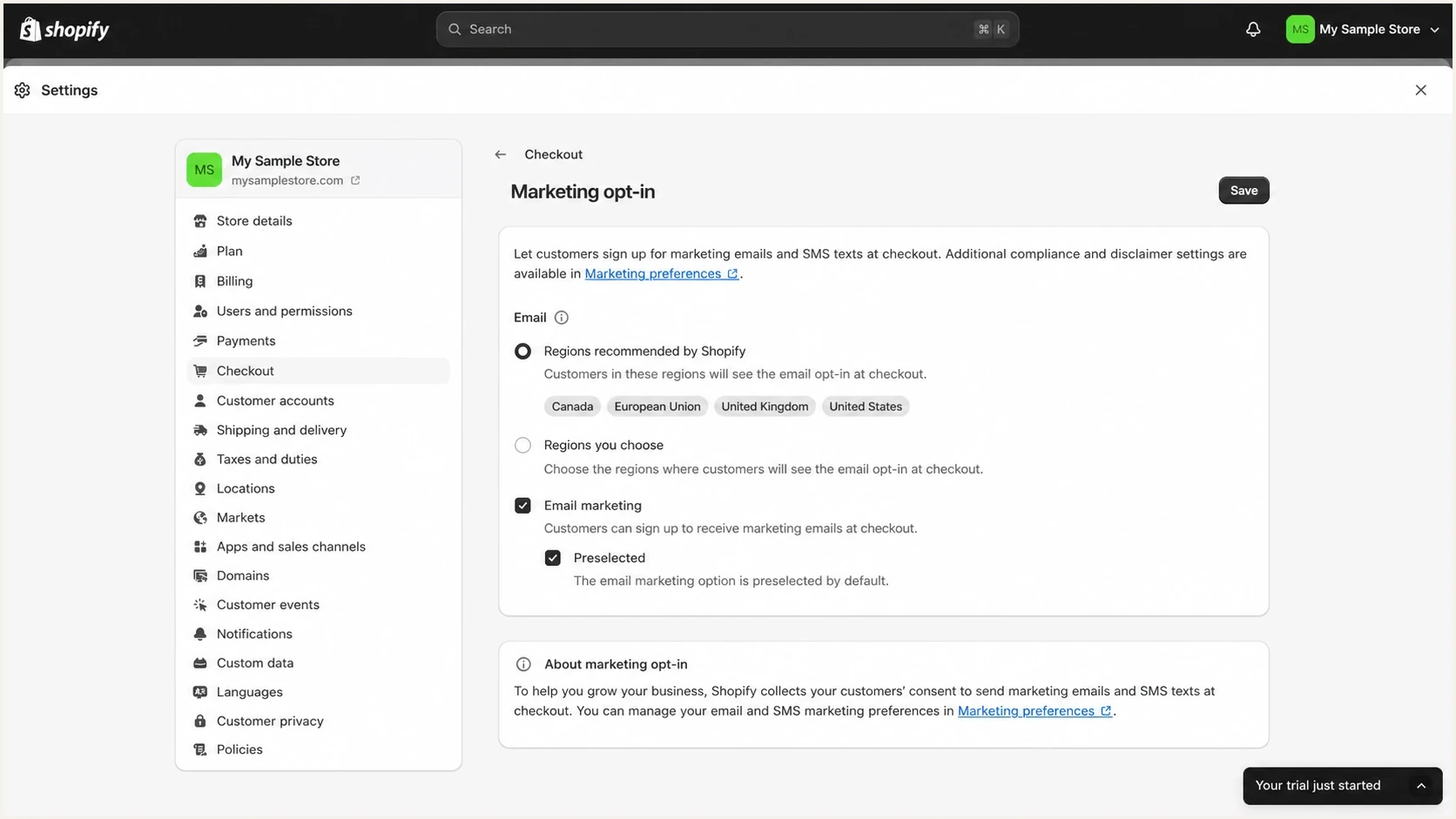
Shopify admin checkout settings with email marketing opt-in controls.
Why unchecked is the safer default
An unchecked box makes the consent event easier to explain. The shopper saw a choice, selected it, and continued. A pre-checked box asks you to prove that the shopper noticed the choice and chose not to object. That is a weaker record, especially when the checkbox sits near shipping, payment, discount codes, and other checkout tasks.
The GDPR concern is not that every email to a buyer is forbidden. The issue is that a pre-ticked box does not provide valid consent when consent is the claimed basis. Shopify's opt-in guidance also says businesses in Europe cannot pre-fill the email marketing consent checkbox.
Unchecked by default
- Consent proof: The check is an active choice that is easier to log and defend.
- Subscriber quality: The list grows slower, but intent is clearer.
- Customer trust: The shopper does not feel enrolled by default.
Pre-checked by default
- Consent proof: The record shows no objection, not a fresh affirmative action.
- List growth: The list grows faster, including shoppers who missed the box.
- Complaint risk: Some buyers report mail as spam instead of unsubscribing.
That tradeoff matters because legal consent and inbox performance are connected. Permission quality affects complaint rates, engagement, list fatigue, and the chance that future mail is ignored. A buyer relationship helps, but it does not erase the need for a clean consent process or a valid customer exception.
How Shopify consent changes can surprise you
The sharp edge in Shopify goes beyond the checkbox default. A customer can subscribe through a popup, customer account, or imported record, then reach checkout later. Shopify says an unchecked checkout choice can set consent to not consented, so teams should test whether the latest checkout state replaces a trusted preference collected elsewhere.
|
|
|
|
|---|---|---|---|
Subscribed | Unchecked | Not consented | Prior status replaced |
Subscribed | Checked | Subscribed | Lower |
Unknown | Unchecked | Not consented | Lower |
Unknown | Checked | Subscribed | Consent proof needed |
Common Shopify checkout consent outcomes
Do not hide the choice or force the box checked to solve a sync problem. Make the choice clear and test it with signed-in and guest customers. If a known subscriber is checking out, the text should explain whether the box controls future marketing. If the customer is new, the text should explain what they will receive after opting in.
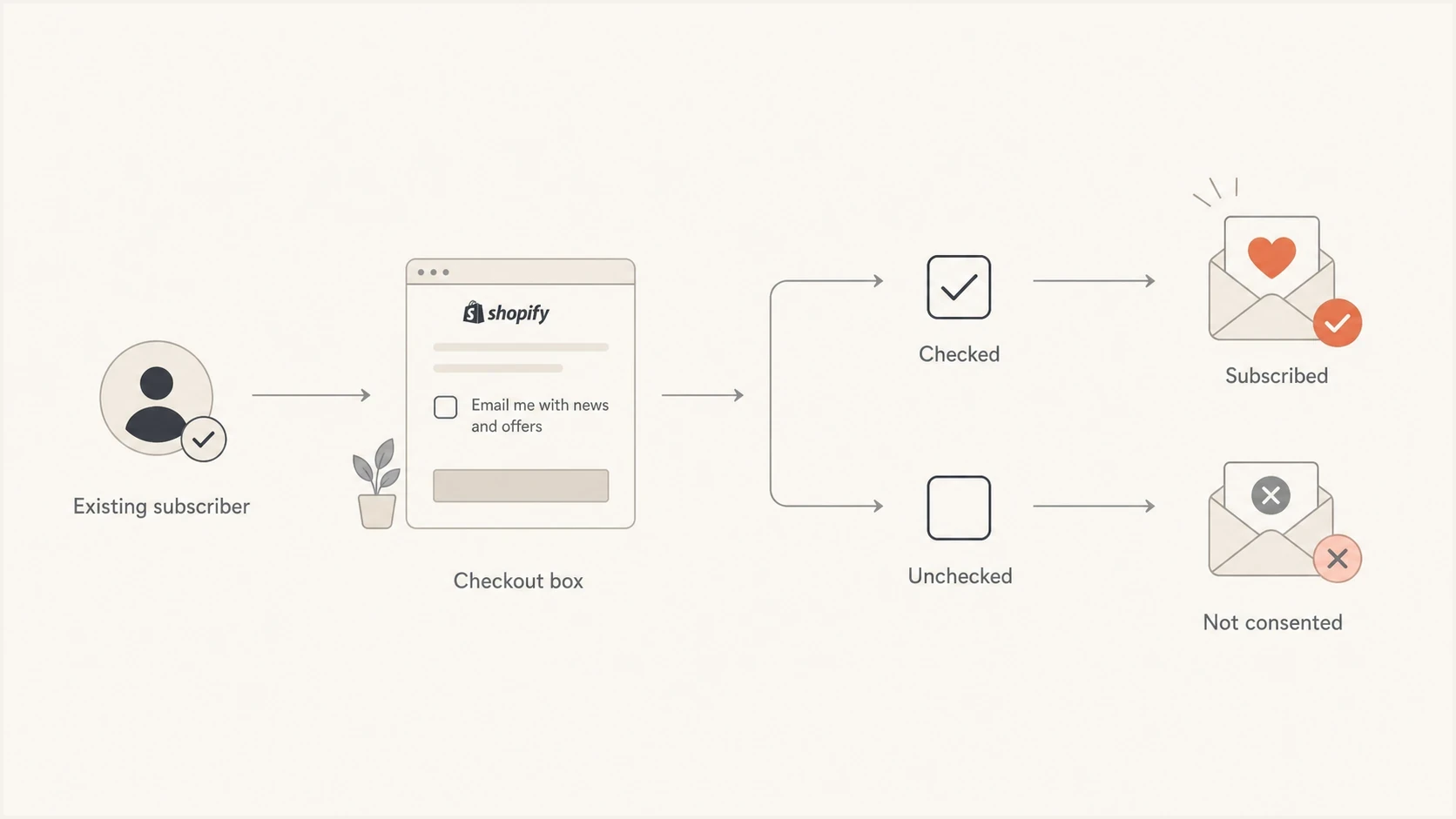
Flowchart showing how Shopify checkout checkbox choices update email consent.
Deliverability is not the same as consent
A recent ecommerce buyer often has strong engagement. They know the brand and expect receipts and shipping updates, which are service messages. They can also engage with product education and post-purchase offers when the business has valid permission or another applicable basis. That is why pre-checked checkout opt-ins do not automatically destroy deliverability, even though they can still create a consent problem.
The risk appears when the checkbox creates surprise. Surprise turns into unsubscribes, low engagement, and spam complaints. A small number of angry buyers can outweigh a larger number of passive buyers who ignore the message. Mailbox providers react to recipient behavior, not to the internal reason a customer entered the list.
Checkout opt-in risk bands
Use these bands to decide how much review a checkout consent flow needs before rollout.
Clear active opt-in
Low
Unchecked box, plain copy, separate SMS consent, easy unsubscribe.
Known buyer soft opt-in
Medium
Own customer, similar products, clear opt-out, counsel-reviewed basis.
Pre-checked consent
High
Higher list growth, weaker proof, more complaint exposure.
Bundled SMS consent
Critical
Email and SMS combined into one defaulted choice.
Before changing the checkout default, send a real campaign test through an email tester and confirm that the message, headers, authentication, unsubscribe handling, and rendering are clean. This does not prove consent, but it prevents a consent experiment from being confused with technical deliverability failures.
Email tester
Send a real email to this address. Suped shows a results button when the test is ready.
?/43tests passed
After rollout, compare subscribers collected before and after the change. Look at complaint rate, unsubscribe rate, open rate, click rate, revenue per recipient, and repeat purchase rate. If pre-checked subscribers produce weaker engagement, the extra addresses are not free growth. They are extra sending volume with more reputation pressure.
How to configure Shopify
A conservative setup uses an unchecked box where consent is required or expected, region rules reviewed by counsel, and no shared checkbox for SMS. Shopify's Regions recommended setting can help with administration, but Shopify says its recommendations are not legal advice. Keep a written decision that explains the setting chosen for each region.
- Set regions: Use Shopify's region controls instead of one global default. To require active opt-in everywhere, choose Regions you choose and select no regions for preselection.
- Rewrite the label: Tell shoppers what marketing they will receive. If abandoned checkout reminders are active, update the checkbox information so that purpose is clear.
- Separate SMS: Keep SMS consent distinct, specific, and unchecked. Do not combine it with email.
- Preserve source data: Store the timestamp, source, customer region, checkbox state, and exact wording or version so consent can be audited.
- Use confirmation carefully: Double opt-in verifies control of the address and filters bots or typos. In Shopify, enable Customer marketing confirmation under Settings > Notifications > Customer notifications. Review Germany-specific requirements and match the setting in any subscription app. Compare the double opt-in tradeoffs before enabling it globally.
Checkout copy exampletext
Unchecked default:
[ ] Email me with news, offers, and product updates.

Existing subscriber helper text:
Already receive our emails? Check this box to stay subscribed.
You can unsubscribe from marketing emails at any time.

SMS consent:
[ ] Text me with offers and updates. Consent is not required to buy.
The copy should not pressure the shopper. It should explain the consequence of the choice. That is especially important for existing subscribers because many people assume leaving an unchecked box alone will preserve their current subscription.
Keep service email separate from marketing consent
An unchecked marketing box should not stop essential order and shipping messages. Those emails support the transaction. It also does not give permission to disguise promotions as service messages. Classify each automation by its primary purpose before deciding which consent state it uses.
- Order and shipping messages: Send necessary service information even when marketing consent is not consented, and keep promotional content secondary or absent.
- Abandoned checkout reminders: Treat these as consent-sensitive automations. Shopify tells stores using them to change the information beside the consent checkbox.
- Promotional campaigns: Send only to the cohort supported by valid consent or a documented customer exception.
- Preference changes: Propagate unsubscribes and not-consented states across every connected sending system without suppressing required service email.
A receipt can include limited relationship information, but adding prominent offers can change how the message is classified. Review templates by primary purpose, not by the name of the automation.
When pre-checked can be defensible
Some laws provide a limited customer exception for marketing a business's own similar products or services. In the UK, the soft opt-in requires contact details collected during a sale or negotiation, marketing for the sender's own similar products or services, and a clear opt-out when the details are collected and in every message. EU and EEA countries implement electronic marketing rules through national law, so the available exception and its conditions vary.
|
|
|
|
|---|---|---|---|
EU or EEA buyer | Consent or national exception | Expectation matters | Default unchecked |
UK customer | Consent or soft opt-in | Segment by basis | Check every condition |
Canadian buyer | Express or time-limited implied | Monitor expiry | Prefer active opt-in |
US email | Federal opt-out model | Permission still helps | Honor CAN-SPAM |
Any SMS | Separate review | High complaint sensitivity | Use separate consent |
Practical decision matrix
If a brand decides to pre-check email in selected regions, keep the unsubscribe flow obvious, suppress people who complain immediately, and avoid high-frequency promotional campaigns to that cohort until engagement shows they want the mail. For Canada, track when implied consent expires instead of treating a purchase as permanent permission.
Do not use a pre-checked box to repair a consent-sync problem. If Shopify is overwriting trusted consent gathered elsewhere, fix the data flow and wording. Do not solve it by enrolling every checkout visitor by default.
What to monitor after changing the setting
Measure a consent setting change like a sending change. If the default moves from unchecked to pre-checked, sending volume rises. If it moves from pre-checked to unchecked, subscriber growth falls, but engagement quality should improve. Compare cohorts by consent source instead of total revenue alone.
- Consent source: Segment checkout opt-ins, popup opt-ins, account opt-ins, and imported subscribers.
- Complaint rate: Watch spam complaints by cohort after the first promotional send.
- Unsubscribe speed: Fast unsubscribes show that the checkout wording created poor expectations.
- Authentication: Check SPF, DKIM, and DMARC before blaming consent for inbox placement.
- Reputation: Use blocklist and blacklist checks when complaint spikes or bounce patterns change.
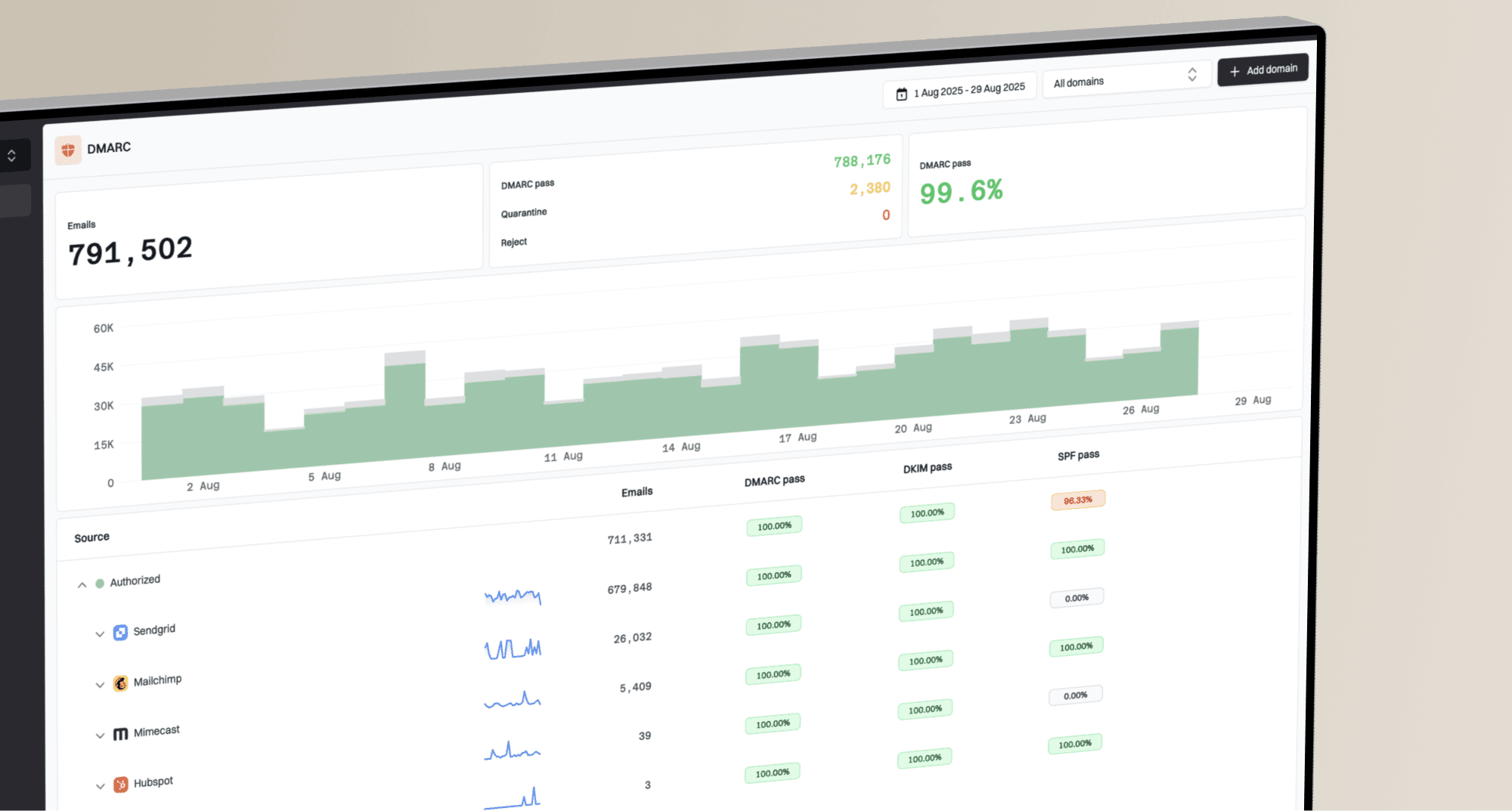
Suped supports the technical side of this workflow. It does not decide the legal basis, but it helps separate consent quality from authentication issues. A domain health check catches SPF, DKIM, and DMARC problems before a checkout experiment changes list growth. Suped's DMARC monitoring then tracks authentication results by source, and blocklist monitoring helps flag blocklist (blacklist) listings that affect sender reputation.
Suped DMARC dashboard showing email volume, authentication health, and source breakdown
For teams managing several sending domains, Suped puts DMARC, SPF, DKIM, hosted SPF, hosted MTA-STS, alerts, and deliverability data in one workflow. After a checkout change increases email volume, that view helps determine whether inbox problems come from permission, authentication, or sender reputation.
Practical recommendation
Use unchecked by default unless counsel has approved a region-specific pre-checked approach or documented customer exception. Shopify's behavior makes this more important because checkout can write a new marketing state before an order is completed. If preserving existing subscribers is the concern, improve the label and sync logic. Do not treat preselection as the clean fix.
The practical setup uses an unchecked box, a clear value promise, separate SMS consent, an easy unsubscribe, stored consent evidence, and monitoring after the first few sends. That protects the list and gives the business cleaner data for future decisions.
Views from the trenches
Best practices
Keep checkout email consent unchecked in strict regions and store the exact label text used.
Explain to existing subscribers that checking the box keeps marketing emails active.
Measure post-change cohorts by consent source, not by total subscriber growth alone.
Keep SMS consent separate, unchecked, and tied to plain language about message purpose.
Common pitfalls
Using preselection to avoid consent-sync bugs creates weaker records and customer surprise.
Assuming prior subscription survives checkout can hide silent unsubscribe events in Shopify.
Judging success by list growth alone misses complaints, fast unsubscribes, and low intent.
Bundling email and SMS consent creates legal and deliverability risks in one interaction.
Expert tips
Audit checkout consent as a data-write event instead of only a visible preference.
Treat recent buyer engagement as helpful, but do not use it as proof of valid consent.
Test copy with known subscribers so they understand the box controls future marketing.
Review authentication and blocklist status before attributing all inbox issues to consent.
Marketer from Email Geeks says pre-checked checkout consent can work for recent buyers when unsubscribe is easy and the brand relationship is fresh.
2023-11-28 - Email Geeks
Marketer from Email Geeks says shoppers often leave an unchecked box alone because they assume existing subscriptions remain unchanged.
2023-11-29 - Email Geeks