Is it bad practice to send email from a domain without an MX record?

Published 28 Jun 2025
Updated 20 Aug 2026
11 min read
Summarize with

Updated on 20 Aug 2026: We clarified implicit MX fallback, bounce-domain routing, null MX, and current DMARC standards.
Yes, as an operating practice. SMTP can send from a domain with no explicit MX record, and inbound delivery can use the domain's A or AAAA records as an implicit MX route. The problem starts when the domain has no working receiving path. That setup looks incomplete to receiving systems, breaks normal role-address handling, and gives some filters a reason to reject, quarantine, or reduce trust in the message. Publishing an explicit MX removes that ambiguity.
Treat this differently from a parked domain that never sends mail. A non-sending domain can publish a null MX record, SPF -all, and a restrictive DMARC policy. RFC 7505 says domains used in a non-empty envelope sender or visible From address should not publish null MX. A Reply-To domain should have a working receiving route so responses reach a monitored mailbox, a help desk, or the sending platform's reply-processing system.
- Visible From: If customers see mail from a subdomain, that subdomain should not look abandoned.
- Envelope sender: The return-path domain should resolve, publish SPF, and route delivery-status notifications cleanly.
- Reply-To: Using a separate reply subdomain is fine when it has a working inbound mail route.
- Role addresses: Domains that advertise mail service should route postmaster and abuse mail to a real handler.
The direct answer
A missing MX record does not stop outbound email. If the domain has an A or AAAA record, SMTP can treat that address as an implicit MX and try port 25 there. For production marketing, transactional, or platform mail, an explicit MX is still the preferred configuration for a non-empty RFC5321.MailFrom domain and the RFC5322.From domain when you control them. It makes the intended receiving path explicit and avoids reliance on a web host answering SMTP traffic.
A missing MX record does not directly fail SPF, DKIM, or DMARC. SPF checks whether the sending server is authorized for the envelope sender domain. DKIM checks the signature domain. DMARC checks whether the visible From domain, called the Author Domain in the current standard, matches an authenticated domain at the required domain boundary. None of those checks requires a receiving MX record by itself.
Receivers still use signals beyond authentication. A domain with no MX and no reachable SMTP service can look like a disposable sending identity, a misconfigured tenant setup, or a domain that cannot accept delivery-status notifications. A null MX sends a stronger message: the domain explicitly accepts no mail. RFC 7505 permits receivers to reject messages when the envelope sender or visible From domain publishes null MX.
Implicit MX fallback
If a recipient domain has no MX record, SMTP delivery can fall back to the domain's A or AAAA record. The address must lead to an SMTP service that accepts mail for the domain. This fallback is standards-compliant, but an explicit MX is clearer and avoids sending mail traffic to an unrelated web server.
|
|
|
|---|---|---|
Visible From | Explicit MX | Null MX can trigger sender rejection. |
Envelope sender | Bounce-handling MX | Delivery-status notifications have no route. |
Reply-To | Working inbound route | Replies fail or disappear. |
Parked domain | Null MX | Do not use it in active email. |
Recommended receiving configuration for each sending identity.
Why MX records still matter
An MX record tells the internet where mail for a domain should be delivered. Different inbound messages follow different addresses. Delivery-status notifications go to the RFC5321.MailFrom return-path, user replies go to Reply-To when present or From otherwise, and operational reports go to their configured role or reporting addresses. Each address used by the mail stream needs an intentional receiving path.
This matters more when the setup uses different subdomains, such as a bounce domain for the envelope sender and another domain for Reply-To. Separate From, return-path, and Reply-To domains can be legitimate, but they should be deliberate. If the visible From domain cannot receive mail at all, the separation looks more like a half-finished setup than a routing decision. The same topic comes up with From and Reply-To choices.
Technically allowed
- SMTP send: A domain can send without having an explicit MX record.
- Authentication: SPF, DKIM, and DMARC can pass without MX.
- Fallback: Inbound attempts can use an implicit MX through A or AAAA.
Operationally weak
- Filtering: Some receivers reject or downgrade unreachable sender domains.
- Accountability: Delivery errors and operational mail need working routes.
- Diagnosis: Implicit routing makes failures harder to trace.
The risk is not always immediate. Plenty of senders get mail delivered with no explicit MX on the visible From domain. That does not prove the setup is healthy. It only proves the current mix of receivers, volume, content, and reputation has not exposed the weakness. Filtering changes without notice, and ambiguous DNS becomes harder to defend when a receiver tightens checks.
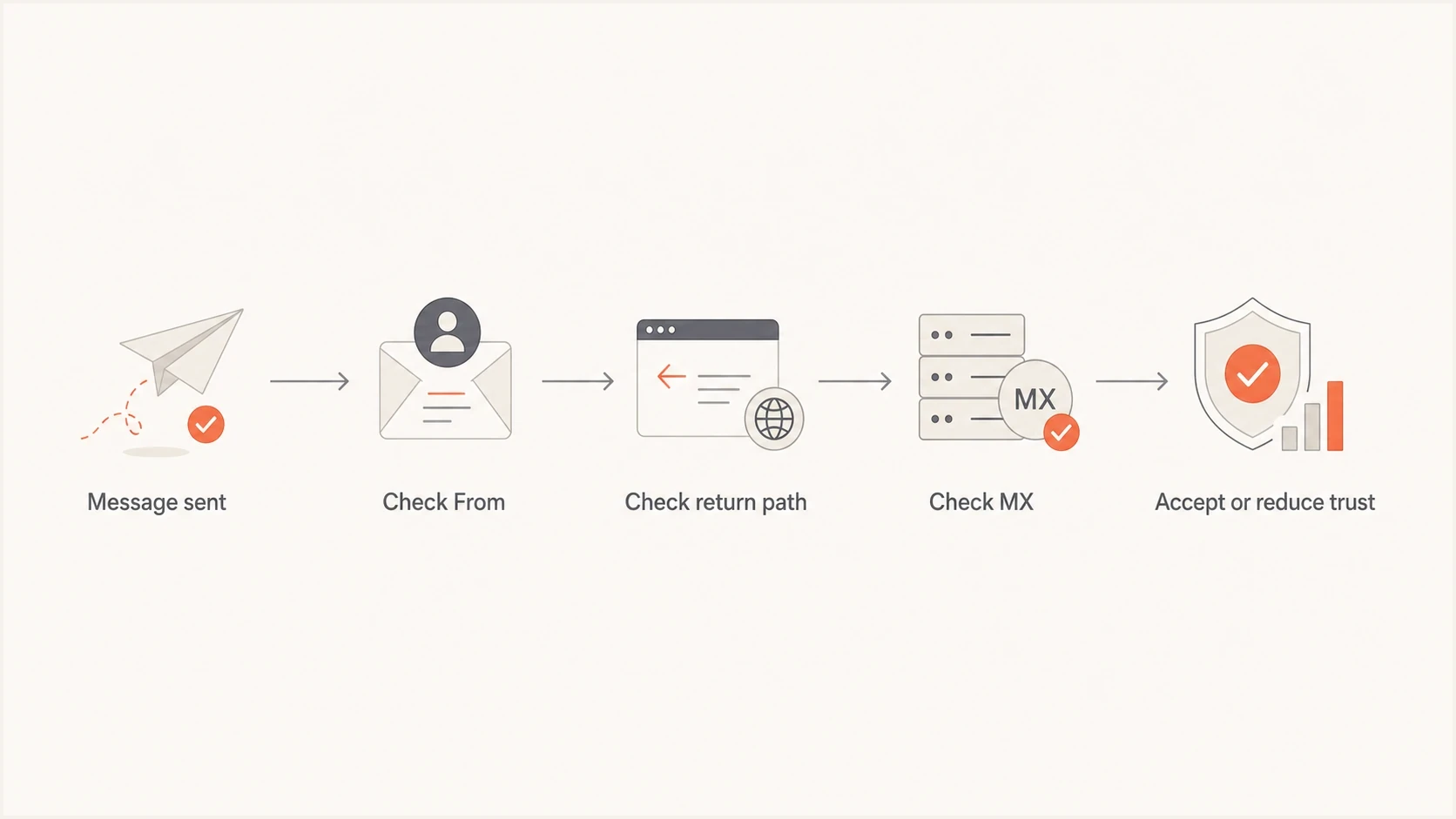
Flowchart of sender identity checks covering From, return path, and MX records.
Null MX and null reverse-path are different
A null MX is a DNS declaration that a domain accepts no email. The null reverse-path is the empty SMTP envelope sender used for delivery-status notifications so another failure does not generate a bounce loop. They solve different problems, and one cannot replace the other.
Null reverse-path compared with null MXtext
MAIL FROM:<>                    ; null reverse-path on a bounce
no-mail.example. IN MX 0 .     ; null MX for a domain that accepts no mail
A normal outbound message with a non-empty return-path should use a bounce domain that can receive delivery-status notifications. A sending platform can route that MX to its own bounce processor, so the domain does not need a human inbox. User replies remain separate and follow Reply-To, or From when Reply-To is absent.
Do not publish null MX on sender domains
RFC 7505 says domains used in RFC5321.MailFrom or RFC5322.From addresses should not publish null MX. A receiver that rejects such mail should return SMTP 550 with enhanced status code 5.7.27.
What DNS should exist
For a sending subdomain, a small but complete DNS baseline includes an explicit MX for inbound handling, SPF for the envelope sender, DKIM for message signing, and DMARC at the Author Domain or an applicable parent. For the host that connects to recipients, keep PTR or reverse DNS and forward DNS consistent with the mail hostname. If a platform asks customers to create a sending subdomain, it should document all of these pieces instead of treating MX as optional cleanup.
Minimum DNS pattern for a sending subdomaindns
e.example. 3600 IN MX 10 mx1.mailhost.example.
e.example. 3600 IN TXT "v=spf1 include:send.example -all"
_dmarc.e.example. 3600 IN TXT "v=DMARC1; p=none; rua=mailto:dmarc@e.example"
s1._domainkey.e.example. 3600 IN TXT "v=DKIM1; p=..."
That example uses p=none to begin in DMARC monitoring mode. RFC 9989 now defines DMARC, and RFC 9990 defines aggregate reporting. The record still uses v=DMARC1. Suped's DMARC monitoring supports the rollout workflow: collect reports, identify real senders, fix legitimate sources, and then move to the chosen enforcement policy.
DMARC record detail view showing SPF, DKIM, DMARC, rDNS diagnostics, and DNS records
For a domain that never sends or receives mail, use a null MX record instead of leaving the answer ambiguous. A null MX tells senders that the domain accepts no mail and stops the implicit fallback to website address records. It must be the only MX record at that DNS name. Do not use null MX on a domain that appears in an active RFC5321.MailFrom or RFC5322.From address.
Null MX for a non-sending, non-receiving domaindns
no-mail.example. 3600 IN MX 0 .
no-mail.example. 3600 IN TXT "v=spf1 -all"
_dmarc.no-mail.example. 3600 IN TXT "v=DMARC1; p=reject"
Fast DNS check
When inheriting a sending setup, check the domain's MX, SPF, DKIM, DMARC, PTR or reverse DNS, and visible sender patterns together. Suped's domain health checker is useful for a quick DNS read before inspecting real message headers.
How to fix this setup
The clean fix is to give every active sending identity an intentional receiving path and then verify authentication with real mail. If a platform uses bounce.example.com for the envelope sender and reply.example.com for Reply-To, configure both deliberately. The bounce domain receives delivery-status notifications, while the Reply-To domain receives user responses. The visible From domain should not publish null MX.
If mail leaves from a residential, dynamic, or poorly documented server IP, the missing MX record is often not the biggest problem. Receivers also look at PTR or reverse DNS, forward-confirmed hostnames, HELO and EHLO names, IP reputation, and whether port 25 traffic looks like a normal mail server. Use a stable outbound mail host with correct DNS before judging MX alone.
- Add MX: Publish an explicit MX for each non-empty return-path and any From or Reply-To domain intended to accept mail.
- Check PTR: Configure reverse DNS for the sending IP and make the HELO or EHLO name match a real hostname.
- Route roles: Make postmaster and abuse addresses for operational mail domains reach a monitored queue.
- Check SPF: Confirm the envelope sender domain authorizes the actual outbound servers.
- Sign DKIM: Use a DKIM domain that matches the visible From domain at the organizational level or exactly, based on the DMARC mode.
- Monitor DMARC: Use aggregate reports to find unauthorized sources before moving to enforcement.
- Test delivery: Send a real message and inspect headers, authentication, and receiving-side warnings.
A real message test matters because DNS can look correct while the mail stream still uses a different return-path or DKIM domain. Suped's email tester helps verify the message as sent, instead of only the records you intended to publish.
Email tester
Send a real email to this address. Suped shows a results button when the test is ready.
?/43tests passed
If the domain already has deliverability problems, also check whether the sending domain or IP appears on a blocklist (blacklist). Missing MX is rarely the only issue in a weak setup. It often sits beside stale SPF includes, unsigned mail, low engagement, broken bounce handling, and inconsistent sender domains. Suped's blocklist monitoring keeps that reputation signal visible next to DMARC and authentication data.
Where Suped fits
For this exact problem, Suped's product helps teams find the issue, understand the sending source, and fix the DNS without guessing. The useful part is seeing that issue beside SPF, DKIM, DMARC policy, reporting status, verified sources, unverified sources, and reputation signals.
Useful Suped workflow
- Detect issues: Find missing or weak DNS records across monitored domains.
- Fix steps: Use tailored steps instead of generic DNS advice.
- Hosted records: Manage hosted DMARC, hosted SPF, SPF flattening, and hosted MTA-STS.
- Alerts: Get real-time alerts when authentication or reporting changes.
- Multi-domain work: Use MSP and multi-tenancy dashboards for many client domains.
A practical operational rule is to stop treating DNS as a one-time onboarding chore. Sending domains change, platforms add sources, and filters keep tightening. Suped helps keep the authentication record, policy stage, source inventory, and domain reputation in the same place, which makes this kind of no-MX issue easier to catch before it becomes a support incident.
Views from the trenches
Best practices
Publish MX for each active sending identity, then route postmaster and abuse mail.
Keep visible From, return-path, and reply domains intentional and documented in DNS notes.
Test real sent messages after DNS changes, because headers reveal actual routing.
Common pitfalls
Assuming DMARC pass means the sender domain has a healthy receiving path too today.
Using no-MX subdomains for every client because most receivers still accept them.
Leaving role accounts unhandled, then missing complaints, bounces, and abuse reports.
Expert tips
Treat missing MX as a reputation risk even when current delivery metrics look normal.
Check PTR and HELO names too; MX is only one signal in sender trust decisions at receivers.
Require valid MX for both envelope and visible From domains in platform policy rules.
Marketer from Email Geeks says a different Reply-To subdomain can be reasonable when it has a valid MX path for processing replies.
2023-03-21 - Email Geeks
Expert from Email Geeks says missing MX on the visible From or envelope sender domain is bad practice because some receivers block or downgrade it.
2023-03-21 - Email Geeks
Practical answer
If a domain appears in active From or non-empty RFC5321.MailFrom addresses, publish an explicit MX and route it to the appropriate reply or bounce handler. A working implicit MX through A or AAAA is standards-compliant, but relying on it adds ambiguity. If the domain never sends and never receives mail, publish a null MX record, SPF -all, and a DMARC reject policy.
The fact that some mail still gets delivered does not make an unreachable sender domain sound. Receivers do not all enforce the same checks on the same day. A configuration that survives today can fail after a filter update, a volume increase, a customer migration, or a reputation event. If you are already researching MX records and bounces, treat this as a fix worth doing before the failure is visible to customers.




