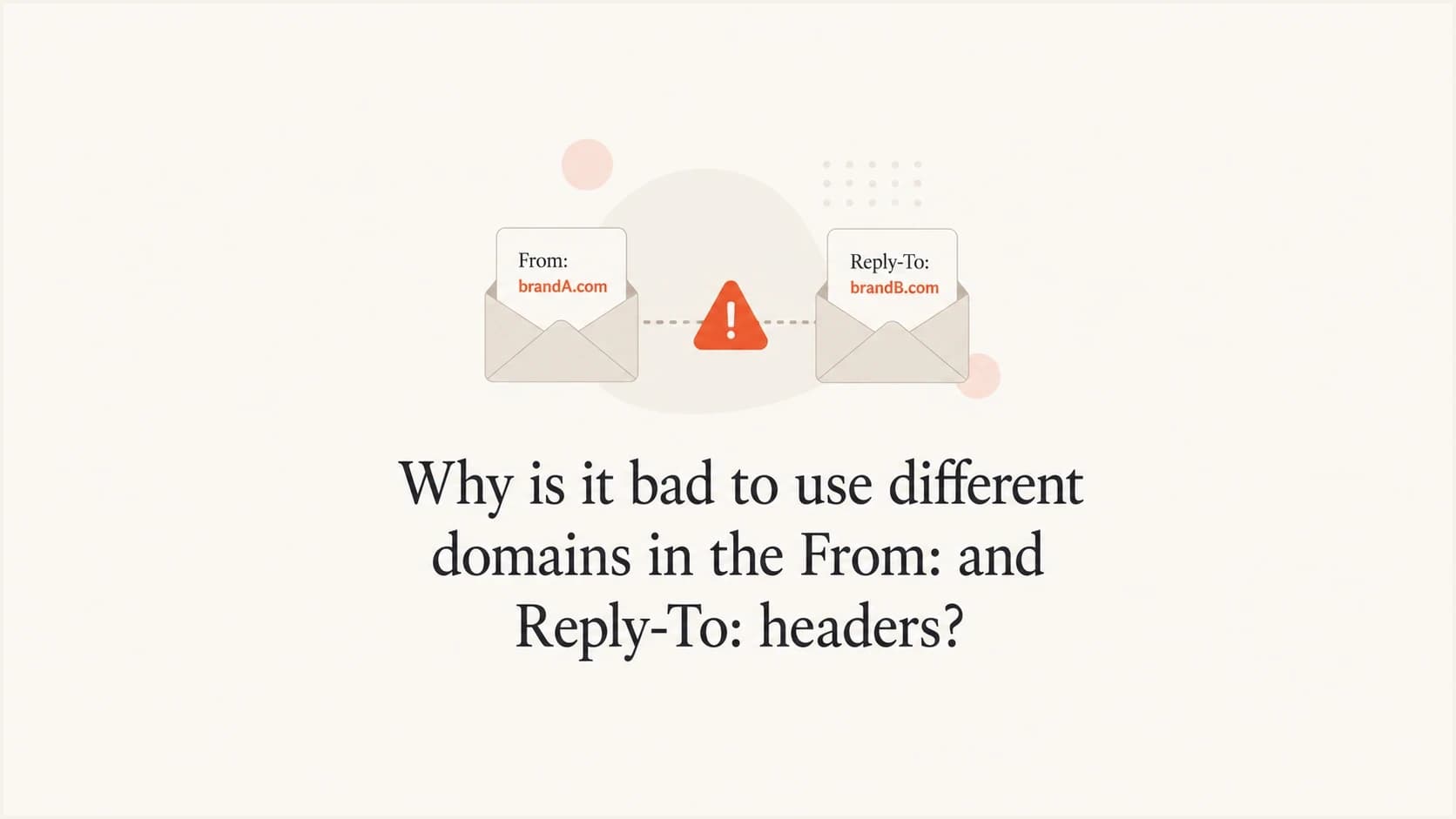
Why is it bad to use different domains in the From: and Reply-To: headers?

Published 12 Jul 2025
Updated 20 Aug 2026
12 min read
Summarize with
Updated on 20 Aug 2026: We clarified when a different Reply-To domain creates risk, what DMARC does not validate, and how to test reply routing safely.
Using different domains in the From: and Reply-To: headers creates risk when it makes the sender identity unclear. The visible sender tells the recipient who sent the message. The reply address tells the recipient where their response goes. When those domains do not match, especially when they use different root domains, the message starts to resemble a common impersonation pattern, even if SPF, DKIM, and DMARC pass.
The short answer is simple: use the same domain for both headers, or use a clearly related subdomain. If the message comes from example.com, replies should usually go to example.com or a visible operational subdomain under that same root. When the reply destination is the same mailbox, omit Reply-To. The From address already provides the reply path. Sending from one brand domain and sending replies to a different .io, .co, .net, or lookalike domain creates avoidable trust and filtering problems.
Treat this as a brand and security issue before treating it as a pure deliverability issue. Authentication can pass and the setup can still look wrong to a person. Mailbox filters also use signals beyond SPF, DKIM, and DMARC, so a strange reply path can add friction even when the authentication record is technically clean.
The direct answer
Different domains are not automatically forbidden by email standards, and a different Reply-To domain does not automatically fail DMARC. Reply-To is a routing choice, not the primary DMARC identity. The risk is provider-level and recipient-level, not a universal authentication failure. A recipient sees one organization in the sender line, then their reply goes somewhere else. Security tools see the same split identity. The mismatch becomes worse when the two websites look unrelated, the domains use different endings, or one domain looks like a copy of the other.
Do not confuse a different hostname with a different organizational domain. For example, mail.example.com and support.example.com are different DNS names, but they can belong to the same organizational domain. By contrast, example.com and example.co.uk are separate root domains. If separate domains belong to the same organization, recipients still need a clear reason for the switch.
- Recipients often distrust a message when a reply goes to a different organization.
- Mailbox providers and security gateways evaluate more than authentication, so an unexplained split identity can add suspicion.
- A different reply domain makes the sender identity harder to explain.
- Replies can land in the wrong system, create duplicate tickets, hide unsubscribe requests, or bypass audit trails.
- Lookalike domains and internationalized domains are used in real impersonation attempts.
Practical rule
If the recipient cannot explain why the reply domain differs within a few seconds, the setup is too confusing. Fix the domain choice before trying to explain it with footer text.
Reply domain risk levels
A practical way to rate the visible sender and reply path before you send at scale.
Same exact domain
Low
The same domain appears after the @ sign in both addresses.
Same organizational domain
Low
Related subdomains sit under one clearly controlled domain.
Different owned domain
Medium
Separate root domains need a clear business relationship.
Unrelated root domain
High
The reply destination does not have an obvious connection to the sender.
What mail systems see
Email has several identities. The visible From: header is what most people read, and DMARC treats it as the RFC5322.From domain. The Reply-To: header tells a mail client where to send replies. The envelope sender handles bounces. DKIM signs selected parts of the message. DMARC checks whether the visible sender domain matches authenticated mail. The Sender: header can identify a technical sender acting on behalf of the author, but many mailbox interfaces do not show it clearly, and DMARC still evaluates the visible From domain. None of those facts make a strange reply domain harmless.
DMARC is defined by Standards Track RFC 9989, which obsoletes RFC 7489 and RFC 9091. Aggregate reporting is specified in RFC 9990, and failure reporting is specified in RFC 9991. The core point for this article is unchanged: DMARC evaluates the Author Domain extracted from RFC5322.From against an aligned SPF or DKIM authenticated identifier. Reply-To is not the domain DMARC uses for the main pass or fail result.
Current Gmail and Yahoo bulk sender requirements call for SPF, DKIM, and DMARC, plus a From domain aligned with SPF or DKIM. They do not make Reply-To matching a formal DMARC condition. Gmail separately requires header and sender details to accurately represent the sender and avoid misleading recipients. That is why the deliverability impact depends on more than a single authentication pass or fail result.
Risky header patterntext
From: Example Billing <billing@example.in>
Reply-To: Support Team <support@example.io>
Subject: Your invoice is ready
That pattern looks especially poor when example.in and example.io have different websites, different ownership signals, or different branding. Expect some users to hesitate before replying, and expect some receiving systems to treat the message with extra caution.
Safer header patterntext
From: Example Billing <billing@example.com>
Reply-To: Billing Support <billing@example.com>
Subject: Your invoice is ready
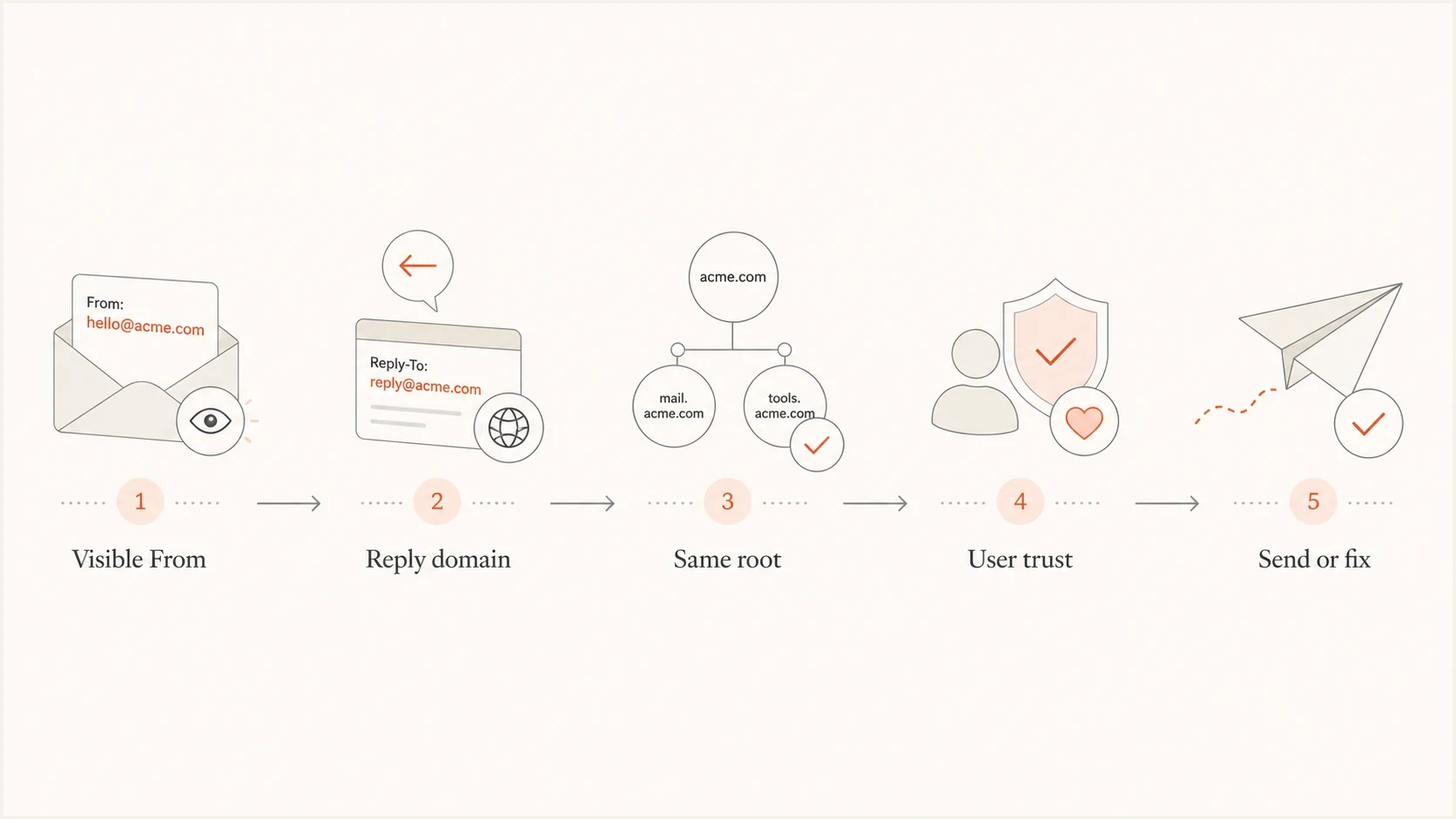
Flowchart for checking whether From and Reply-To domains match before sending email.
What a DMARC pass does not prove
A DMARC pass authenticates the use of the Author Domain in From through aligned SPF or DKIM. It does not authenticate the Reply-To domain, prove that the Reply-To mailbox exists, or prove that the organization in From controls it. This is the main technical gap behind cross-domain reply risk.
- SPF evaluates the SMTP envelope sender and connecting IP, not Reply-To.
- DKIM can cover Reply-To when the header appears in the signature's h= list, but the signature authenticates the message under its d= domain rather than the Reply-To domain.
- DMARC aligns an authenticated SPF or DKIM identifier with the Author Domain in From. It does not include Reply-To in the verdict.
- Mailbox existence and control still need a live reply test because authentication does not prove that someone monitors the destination.
A receiving system can still compare Reply-To with the visible sender, links, message history, and other abuse signals. A mismatch can therefore affect filtering or trigger a warning without changing the DMARC result.
Check DKIM coverage
Inspect the DKIM-Signature h= list in a delivered message. If the sending system allows header selection, include Reply-To and reject duplicate Reply-To fields in templates and relays. This protects header integrity in transit, but it does not make an unrelated reply domain trustworthy.
Why it looks like abuse
Attackers often want the visible sender to look familiar while the reply path sends the victim somewhere else. That does not mean every mismatch is malicious. It does mean a mismatch forces the receiver to ask a harder question: why does this message want replies to a different domain?
Normal pattern
- The sender and reply mailbox use the same root domain.
- The recipient sees one organization across the message.
- Replies go to a monitored mailbox under the same domain.
Risky pattern
- The sender and reply mailbox use different root domains.
- The websites, names, or domain endings do not match.
- Replies leave the domain the recipient thought they contacted.
The risk grows when the domain contains non-ASCII or internationalized characters. Those domains can be legitimate, but they need extra review because some characters resemble ordinary Latin letters. Review the raw header and Punycode form for homograph risk before using the domain in From or Reply-To.
Avoid lookalike reply paths
Do not send from one root domain and reply to another root domain that appears to be the same brand with a different ending. That pattern looks like a user redirection attempt, even when the sender owns both domains.
When different domains are acceptable
There are legitimate cases for a different reply domain. The key is that the relationship must be obvious and documented. The safer pattern still uses the same root domain, but some operational mail uses a helpdesk, franchise, regional office, or fulfillment partner that handles replies.
|
|
|
|---|---|---|
Same domain | Low | Use it |
Same root | Low | Document it |
Subdomain | Medium | Make it clear |
Contact form user in Reply-To | Medium | Authenticate your From |
Different root | High | Avoid it |
Lookalike | Critical | Replace it |
Use this as a quick judgement table before approving a header setup.
A separate reply address works best when the sender name, message body, and reply mailbox all describe the same relationship. For example, a receipt from a retailer that asks replies to go to support.example.com is understandable. A receipt from a retailer that asks replies to go to an unrelated agency domain is not.
For contact forms, surveys, marketplace notifications, and messages sent on behalf of a customer, use an authenticated address on your domain in From. Put the visitor's or customer's address in Reply-To only when the recipient should answer that person. The visitor's domain can publish an SPF or DMARC policy that your system cannot satisfy, which is why their address belongs in Reply-To rather than From. Validate the address, reject carriage returns and line feeds that could create header injection, and rate-limit submissions. When replies should go to an internal queue, use a mailbox under your own domain and route it behind the scenes.
Acceptable exceptions
- Use a reply address under your own domain, then route it into the ticket system.
- Use a domain that clearly names the subsidiary or parent relationship.
- Use your domain in the visible From and route vendor replies behind the scenes.
- Use a customer or visitor address in Reply-To only when your From domain stays authenticated.
- Use country subdomains only when the brand connection is obvious.
How to fix the setup
Start by listing every sender address and every reply address used by marketing, product, billing, and support mail. Then remove any pair where the root domains differ without a documented reason. Most teams find old campaign defaults, agency reply inboxes, or helpdesk-generated addresses that no longer match the brand.
- Export active templates, automations, and sender identities from each sending platform.
- Sort the pairs by root domain so mismatches are visible.
- Remove Reply-To when it is identical to From.
- Move replies to a mailbox or alias under the same root domain.
- Forward that mailbox into the helpdesk or CRM behind the scenes.
- Handle support requests, unsubscribe intent, complaints, and out-of-office replies with clear routing rules.
- Send live mail and inspect the raw headers before returning to full volume.
If this cleanup also changes the visible From address, treat that as a sender identity change. A display-name-only change is usually low risk, but a new local part or new From domain can lose contact-list and personal-filter benefits. Start with engaged recipients and compare complaints, bounces, opens, clicks, and unsubscribes against the old sender.
Authentication should be reviewed at the same time. A clean reply domain does not rescue broken SPF, DKIM, or DMARC. Use the domain health checker to check the domain's authentication posture before treating the header issue as solved.
A matching reply domain still needs a monitored mailbox. If replies bounce, go unread, or hide unsubscribe requests in a shared inbox, the setup creates support and compliance risk even though the domains look consistent.
Practical routing patterntext
From: Billing <billing@example.com>
Reply-To: Billing <billing@example.com>

billing@example.com forwards to the internal support queue.
Use Return-Path or the envelope sender for automated bounces, not Reply-To. Human replies belong in the From or Reply-To path, while bounces should go to the processor that tracks invalid recipients and suppressions.
Testing and monitoring
After changing headers, send a real message and inspect what arrives. Do not rely only on the sending platform preview. The preview often hides the raw headers, encoded domains, final Reply-To behavior, Return-Path, List-Unsubscribe header, and final reply routing that receivers evaluate.
If the header change affects high-volume mail, increase the modified traffic separately and keep content, audience, and cadence stable during the first sends. That makes a sender issue easier to separate from a creative or list issue.
A practical test is to send production-like mail through the email tester and inspect the reported authentication results, headers, and warnings. Then reply to the message from a normal mailbox and confirm the reply reaches the expected queue.
Test manual replies and automatic responses separately. RFC 5322 defines Reply-To as the author's suggested destination for replies, but automatic response routing is implementation-dependent. Out-of-office notices and other automated responses often use From or the envelope return path instead, so do not assume they will reach Reply-To.
Email tester
Send a real email to this address. Suped shows a results button when the test is ready.
?/43tests passed
For ongoing operations, Suped's product keeps DMARC, SPF, and DKIM monitoring with real-time alerts. This helps teams catch unverified sources and authentication changes that surface during sender cleanup. Suped also includes blocklist (blacklist) monitoring when reputation checks are needed.
In Suped, DMARC monitoring shows which sources send for the domain, whether they pass DMARC alignment, and which source needs remediation. Use those reports to verify that a From-domain change did not leave an authorized sender unauthenticated.
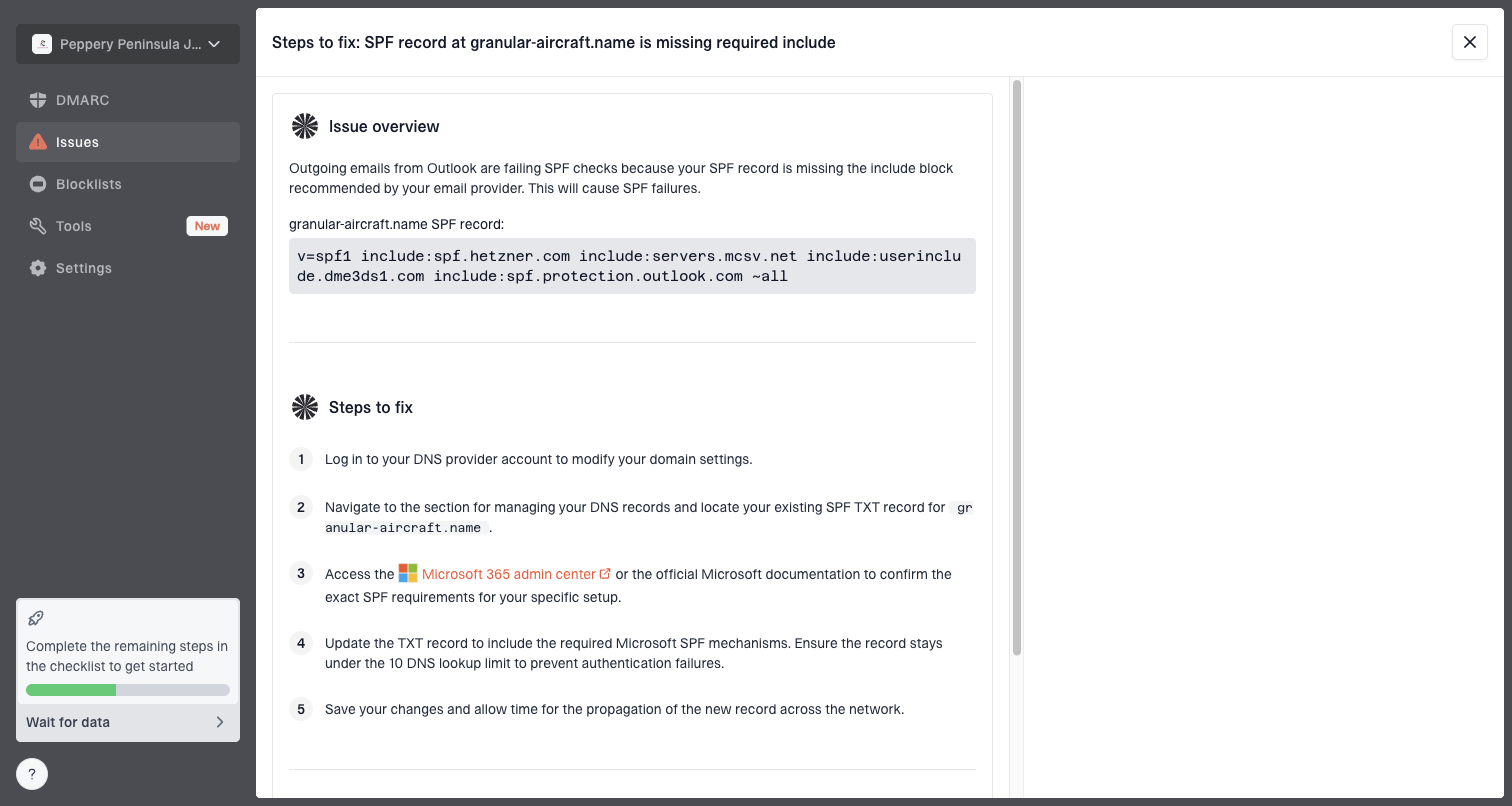
Issue steps to fix dialog showing the issue overview, tailored fix steps, and verification action
Views from the trenches
Best practices
Keep the Reply-To domain tied to the visible From domain unless routing needs justify it.
Use a real monitored mailbox or alias so replies reach a team that can respond quickly.
Check raw headers after every ESP change because interface labels can hide mismatches.
Common pitfalls
Sending from one brand domain while replies go to another root domain without clear context.
Using lookalike or internationalized domains in the From address without raw header review.
Assuming a DMARC pass makes a confusing Reply-To choice safe for recipients and filters.
Expert tips
Reserve separate reply domains for cases where the relationship is obvious to recipients.
Document every authorized From and Reply-To pair before giving marketers sender access.
Use DMARC reports with reply testing so authentication and user trust are reviewed together.
Marketer from Email Geeks says a different reply domain with a similar brand name and different ending looks like a scam pattern to recipients.
2022-07-18 - Email Geeks
Marketer from Email Geeks says non-ASCII or internationalized characters in the From domain deserve raw header review because the encoded form can surprise filters.
2022-07-18 - Email Geeks
The practical rule
Use the same domain in the visible sender and the reply address unless there is a clear operational reason. If there is a reason, prefer a subdomain of the same root and document the route. If the reply domain belongs to a different root domain, treat it as a temporary exception that needs approval, testing, and a plan to replace it.
The cleanest setup is boring: one brand, one visible sender domain, one reply path that a recipient recognizes. That pattern protects trust, reduces filtering friction, and keeps replies inside the systems your team can monitor.
If you invite replies, make sure a real mailbox or routing rule handles them. A matching Reply-To domain that no one monitors still creates poor customer experience, missed unsubscribe intent, and lost feedback.




