Is double opt-in a GDPR requirement for UK and EMEA subscribers?

Published 19 May 2025
Updated 7 Aug 2026
10 min read
Summarize with
Updated on 7 Aug 2026: We updated this guide for the UK's charitable soft opt-in and clarified Germany's double opt-in position.
No. Double opt-in is not a blanket GDPR requirement for UK or EMEA subscribers. GDPR requires a lawful basis for processing personal data and proof of consent when consent is the basis. PECR in the UK, and national electronic marketing laws elsewhere, determine when prior consent or an exception is needed to send the email. Double opt-in can strengthen the evidence, but GDPR does not name it as the only acceptable method.
The answer differs across the UK, EU/EEA, Germany, and the wider EMEA region. The UK applies PECR alongside UK GDPR. EU and EEA countries apply GDPR plus national rules implementing the ePrivacy Directive. Germany usually gets a double opt-in workflow because prior express consent must be proved. EMEA also includes countries outside GDPR, so it is not one legal zone.
The direct answer
Single opt-in can be compliant when the signup is clear, affirmative, specific, recorded, and easy to prove. Double opt-in is safer when stronger evidence is needed that the person controlling the email address completed the signup. It does not repair vague consent wording or a pre-ticked box.
For the UK, do not answer this as a pure GDPR question. The UK email rules sit beside UK GDPR. For individual subscribers, consent is usually required unless a soft opt-in applies. The products-and-services soft opt-in can cover existing customers when the address was collected during a sale or negotiation, the marketing concerns the sender's own similar products or services, and the person received a simple opt-out at collection and in every later email.
Since 5 February 2026, UK charities have also had a separate charitable-purposes soft opt-in. It applies only when the charity collected the details directly on or after that date through the person's interest in, or support for, its charitable purposes. The marketing must solely further those purposes, with an opt-out at collection and in every later message. It cannot be applied retrospectively to an older supporter list.
For EU and EEA subscribers, GDPR sets the standard for consent and accountability, while national laws implementing the ePrivacy Directive control the act of sending marketing email. A multi-country policy should state which consent or customer-exception path is allowed in each country and what evidence must be retained.
- Short answer: Double opt-in is not mandatory across the UK and EMEA under GDPR.
- Key obligation: Apply the electronic marketing rule and keep evidence for the consent or exception used.
- Germany: Prior express consent is the rule outside the customer exception, and double opt-in is the normal proof method.
- Soft opt-in: Use it only where every local condition is recorded.
What GDPR actually asks you to prove
GDPR does not care whether the database label says single opt-in or double opt-in. Consent, when used, must be freely given, specific, informed, and unambiguous. The controller must also demonstrate that consent and make withdrawal as easy as giving it. That proof burden makes double opt-in useful.
A single opt-in form can meet the standard when the page makes the marketing purpose clear, the box is not pre-ticked, the subscriber takes a positive action, and the system logs the evidence. For more on the checkbox issue, see default opt-in boxes.
Consent evidence recordJSON
{
  "email": "person@example.com",
  "consentStatus": "confirmed",
  "signupTime": "2026-05-28T09:34:12Z",
  "confirmTime": "2026-05-28T09:36:01Z",
  "sourceUrl": "/newsletter",
  "formVersion": "v4",
  "ipAddress": "203.0.113.24",
  "userAgentHash": "b4f2a9",
  "privacyNoticeVersion": "2026-04",
  "consentText": "Send me marketing emails about similar products."
}
Keep only the evidence needed for the purpose, protect access to it, and set a retention rule tied to the consent relationship and any period needed to establish or defend a claim. Do not collect raw IP addresses or other technical identifiers by default unless the need and retention period are documented.
Double opt-in adds a second event: the subscriber receives a confirmation email and clicks a verification link. This helps show that someone with access to the inbox completed the step. It does not prove the person's civil identity, and it does not make bundled, unclear, or coerced consent valid.
Single opt-in compared with double opt-in
Single opt-in
- Best fit: Low-friction signups with clear consent language and complete form logs.
- Main benefit: More people enter the list because there is no confirmation step.
- Main risk: The sender has weaker proof that the mailbox owner requested email.
Double opt-in
- Best fit: German marketing lists and signup sources exposed to mistakes or abuse.
- Main benefit: It creates a stronger audit trail tied to control of the inbox.
- Main risk: Some genuine subscribers never click the confirmation email.
Double opt-in makes sense when the signup source is easy to abuse or when country separation is unreliable. Single opt-in can be reasonable for a logged-in checkout when the consent text is clear, the control is unchecked by default, and the database stores the full evidence record.
The tradeoff is proof quality against signup completion. The pros and cons matter because double opt-in can improve list quality while reducing the number of contacts who become emailable.
UK and EMEA decision table
|
|
|
|---|---|---|
UK | No blanket rule | Consent or a documented PECR soft opt-in |
EU/EEA | Not under GDPR alone | Check each country's electronic marketing law |
Germany | Not named in the statute | Use double opt-in to prove express consent |
Switzerland | Not a GDPR rule | Apply Swiss marketing law and retain proof |
Wider EMEA | Varies | Build country-specific consent rules |
Use this table as a policy starting point, then confirm country rules for the exact programme.
A global double opt-in default can simplify marketing lists that span several jurisdictions. A documented exception path can cover existing customers where local law allows it and the consent system stores each required fact. A country-by-country guide helps when signup flows span several jurisdictions.
Consent proof risk bands
A practical way to decide when double opt-in earns its operational cost.
Lower risk
Document exception
A local customer exception applies, every condition is recorded, and opt-outs are enforced.
Medium risk
Single opt-in
A new subscriber completed a clear form, but there is no inbox confirmation.
Higher risk
Use DOI
The source is imported, old, co-registered, incentivised, or poorly documented.
B2B email needs a separate rule
In the UK, PECR treats individual subscribers differently from corporate subscribers. A limited company or other corporate body can receive B2B marketing email without PECR consent, but the sender must identify itself and provide a valid opt-out address. Sole traders and some partnerships count as individual subscribers, so the consent or soft opt-in rules apply to them. UK GDPR still applies when a work email identifies a person.
Do not apply the UK corporate-subscriber rule across EMEA. National B2B email rules differ, and an address that looks commercial does not prove that its subscriber is a corporate body. Classify the legal entity and destination country before choosing the route.
- Corporate role address: Record the organisation type, source, business purpose, and opt-out status.
- Named work address: Treat it as personal data and document the GDPR lawful basis.
- Sole trader or uncertain entity: Use the individual-subscriber rule until the classification is verified.
- Cross-border campaign: Apply the destination country's rule rather than one EMEA-wide assumption.
How to implement the signup flow
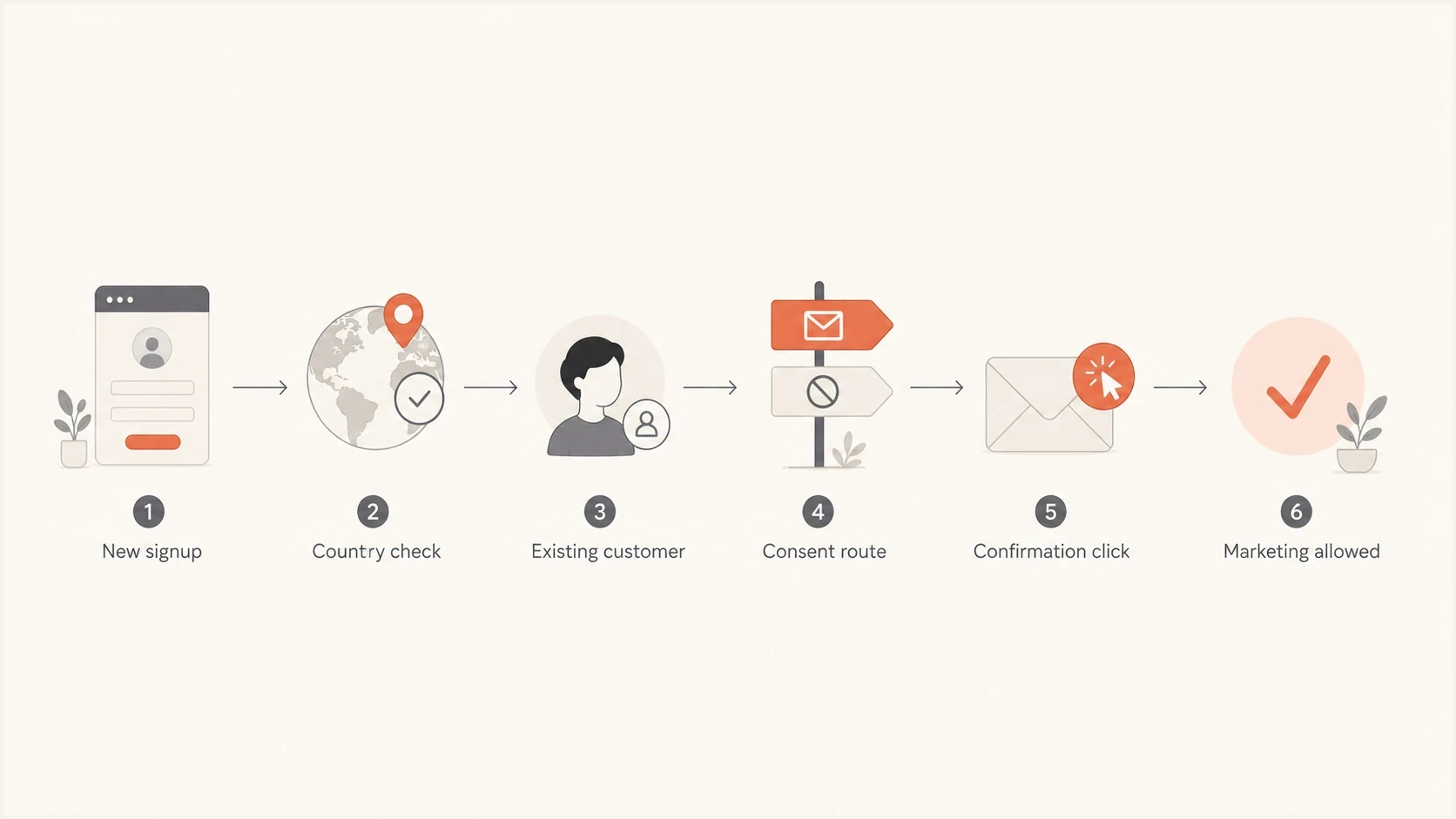
Double opt-in decision flow for UK and EMEA email marketing signups.
Use a rules-based consent gate. The signup source sends the destination country, acquisition source, subscriber type, customer status, consent text, form version, and timestamp into the consent database. The email platform only receives subscribers who pass the correct route.
- Classify the subscriber by country, entity type, source, and customer relationship.
- Choose prior consent, a local customer exception, or double opt-in based on that rule.
- Store the exact consent text, form version, privacy notice version, and event timestamps.
- When double opt-in applies, send a neutral confirmation message and suppress marketing until the click is logged.
- Send the click to a confirmation page, mark the address confirmed once, and expire or invalidate unused links.
- Make unsubscribe simple and store it as a durable suppression across every sending system.
Do not send a marketing-style "please opt in" email to people who are not already emailable. The request itself can count as direct marketing. If consent is absent and no exception applies, suppress the address until the person signs up through a compliant channel.
Do not confuse consent with deliverability
Double opt-in improves list quality, but it does not authenticate mail. A confirmed subscriber can still receive email that fails SPF, DKIM, or DMARC. An authenticated message can still breach marketing rules if the sender lacks the required consent or exception.
Investigate complaints across consent evidence, message relevance, unsubscribe handling, authentication, and blocklist (blacklist) status. Suped's product covers the authentication side through DMARC monitoring, SPF and DKIM visibility, alerts, and blocklist monitoring. Keep those signals beside the consent audit trail, not inside it.
Suped DMARC dashboard showing email volume, authentication health, and source breakdown
Before enabling a confirmation flow, send the confirmation email through the email tester. Check authentication, confirm that the verification link survives tracking changes, and keep the message focused on completing the signup. Domain health checks can identify domain-level problems separately.
Email tester
Send a real email to this address. Suped shows a results button when the test is ready.
?/43tests passed
Recommended policy for UK and EMEA lists
For a new list, use double opt-in across UK and EMEA when one reliable workflow is preferable to several country variants. It produces clearer evidence and reduces accidental signups. For an existing list, do not start a re-permission campaign until valid historical consent and every available local soft opt-in have been checked.
Keep consent rules and suppression data in the CRM or consent platform. Use Suped for the adjacent DMARC, SPF, DKIM, and blocklist monitoring workflow so authentication faults do not get mistaken for consent faults.
A workable policy says: double opt-in is the default for new UK and EMEA marketing signups; single opt-in is allowed where local law permits it and the evidence is complete; a soft opt-in is allowed only when every condition of the applicable exception is recorded.
This policy is more accurate than telling stakeholders "GDPR requires DOI". If a country rule changes, update that rule without rebuilding the entire consent model.
Views from the trenches
Best practices
Store timestamps, form version, source URL, consent text, and confirmation status.
Use double opt-in where errors or automated signups create doubt about valid consent.
Keep confirmation emails brief and focused only on verifying each signup action.
Common pitfalls
Saying GDPR mandates double opt-in creates inaccurate policies and legal analysis.
Treating an old customer list as clean without consent evidence creates avoidable risk.
Putting promotions in confirmation emails increases legal and complaint exposure.
Expert tips
Use a UK soft opt-in only when every condition for that specific exception is met.
Use one double opt-in flow when destination-country rules cannot be split reliably.
Separate consent evidence from delivery checks so teams fix the correct problem.
Marketer from Email Geeks says double opt-in is not a direct GDPR requirement, but the sender still needs evidence that each recipient consented.
2021-04-28 - Email Geeks
Marketer from Email Geeks says confirmed opt-in is a safe choice when business systems cannot prove consent through another clean audit trail.
2021-04-28 - Email Geeks
The practical answer
Double opt-in is not a GDPR requirement for every UK and EMEA subscriber. It is an evidence strategy. Use it by default when marketing crosses jurisdictions, acquisition sources are unreliable, or the consent system cannot produce a defensible record.
For UK retail, check the products-and-services soft opt-in before removing contacts or seeking fresh consent. UK charities have a separate charitable-purposes exception for qualifying details collected on or after 5 February 2026. For Germany, use double opt-in as the normal way to prove prior express consent. For wider EMEA, build country rules instead of relying on a single GDPR slogan.




