Which countries require double opt-in for email marketing according to GDPR and best practices?

Published 10 Jul 2025
Updated 23 Aug 2026
16 min read
Summarize with
Updated on 23 Aug 2026: We clarified how GDPR, national marketing rules, Italy's 2026 regulator position, and the UK's charitable soft opt-in affect double opt-in decisions.
The direct answer is this: GDPR itself does not require double opt-in in any country. The GDPR requires consent to be freely given, specific, informed, unambiguous, and provable, but it does not say that a subscriber must click a confirmation link or complete an equivalent confirmation step before receiving marketing email. UK GDPR follows the same practical position: it requires valid, demonstrable consent, not a double opt-in mechanism by name.
Operationally, double opt-in, confirmed opt-in, COI, and DOI usually mean the same workflow: the person submits an address, receives a confirmation email, and must click a link before the address becomes mailable for marketing.
That matters even when the sender is outside Europe. GDPR can apply when an overseas sender's processing relates to offering goods or services to people in the EEA or monitoring their behaviour there. UK GDPR uses an equivalent test for people in the UK. An overseas marketing program should therefore assess its audience and processing activity, not rely only on the sender's location.
For practical email marketing, treat Germany as the country where confirmed opt-in is closest to mandatory. The reason is not a simple sentence inside GDPR. It is the mix of Germany's prior-consent rules, consent burden, court and regulator expectations, and mailbox provider expectations for wanted, clearly opted-in mail. If a German recipient says they never signed up, single opt-in gives you a weak audit trail. Double opt-in gives you a stronger one.
Outside Germany, Austria, Greece, Italy, Luxembourg, Norway, and Switzerland belong in the strong best-practice bucket. Italy's data protection authority stated in an April 2026 decision that double opt-in documentation can be considered a current minimum protective measure for both the recipient and controller. Denmark, Finland, and the Netherlands also fit a conservative EU/EEA policy when consent proof is hard or the signup source is public. These countries do not have a clean GDPR double opt-in mandate for every marketing signup, but confirmed opt-in is a safer default for new subscribers unless the business has another reliable consent-proof process. Switzerland is outside the EU and EEA, so treat it as a separate local-law and best-practice risk call rather than a GDPR-country label.
The practical country list
The most useful way to answer the country question is to separate legal wording from operational risk. A page that says "Germany requires double opt-in" gives the short answer. A better working policy says Germany needs confirmed opt-in by default, the most commonly cited best-practice markets are Austria, Greece, Italy, Luxembourg, Norway, and Switzerland, and broader conservative policies often add Denmark, Finland, and the Netherlands.
|
|
|
|---|---|---|
Germany | Practical requirement | Use double opt-in |
Austria | Authority practice | Use double opt-in |
Denmark | Conservative best practice | Use double opt-in |
Finland | Conservative best practice | Use double opt-in |
Greece | Authority guidance | Use double opt-in |
Italy | Regulator-backed safeguard | Use double opt-in |
Luxembourg | Best-practice market | Use double opt-in |
Netherlands | Conservative best practice | Use double opt-in |
Norway | Consent-proof best practice | Use double opt-in |
Switzerland | Strongly prudent | Use double opt-in |
UK | No blanket rule | Risk-based |
United States | Not required | Single opt-in can work |
Canada | Express or implied consent | Proof-based, double opt-in useful |
Use this as a working policy map, not legal advice.
That list is intentionally conservative. It answers the practical question a marketing team has to solve: where should a signup form require a confirmation click before the address joins the list? For Germany, require it. For the other European markets listed above, make it the default unless there is a strong reason not to, such as a logged-in purchase flow with clear consent capture.
Do not read absence from the table as permission for loose consent. France, Spain, Ireland, and Belgium still need prior consent or a valid soft opt-in path, clear unsubscribe handling, and records strong enough to answer a complaint.
For Canada, CASL does not make double opt-in the only consent method. Keep evidence of express or implied consent, include an unsubscribe mechanism, and treat double opt-in as a useful proof method rather than the only lawful route.
A conservative working policy should keep two points separate: GDPR does not name double opt-in, but local direct marketing rules, regulator guidance, ESP policies, and dispute risk can still make confirmed opt-in the safer operating default in specific markets.
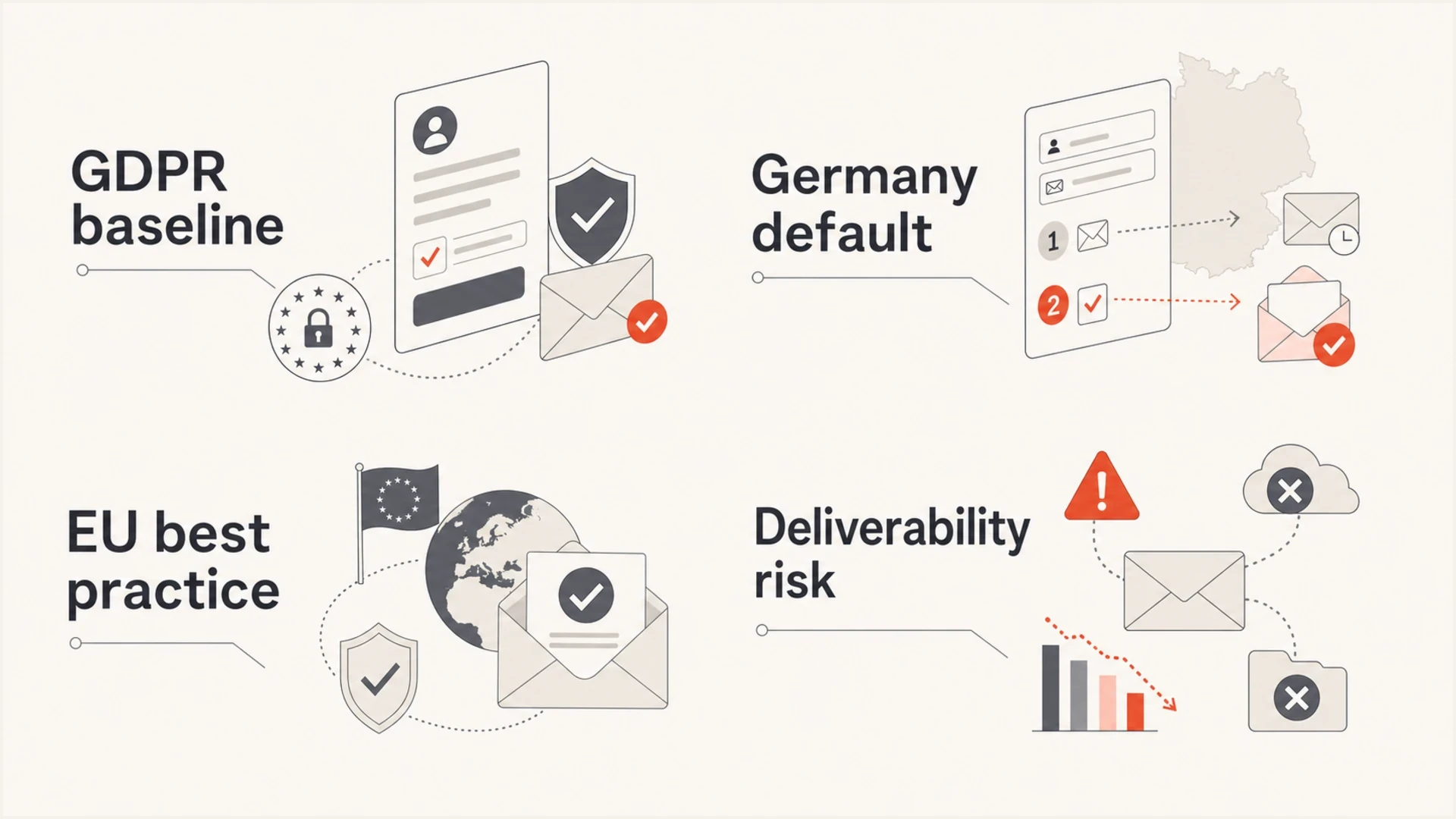
Infographic showing country risk for double opt-in email marketing under GDPR and deliverability best practices.
How GDPR and national marketing rules fit together
GDPR and direct marketing law answer different parts of the same workflow. GDPR governs how an email address and related consent data are collected, used, stored, and deleted. The ePrivacy Directive requires prior consent for electronic direct marketing to individuals across the EU, subject to a narrow existing-customer exception, and each country implements that rule through national law.
Prior consent means permission must exist before the marketing message is sent. It does not automatically mean double opt-in. A clear unchecked box can record valid consent in one step, while a confirmation click adds evidence that the person controlling the mailbox completed the signup. That evidence is why Germany and regulator-sensitive markets receive a stricter operational treatment.
The existing-customer exception is often called soft opt-in. In general, it covers an address collected during a sale, or qualifying negotiations in some national implementations, when the sender markets its own similar products or services and offers a free, easy objection at collection and in every message. It does not turn a purchased list, public address, or unrelated partner lead into a lawful audience.
Choose the rule before the signup flow
Record which national sending rule applies, whether the program relies on consent or a documented exception, and what evidence will answer a complaint. Double opt-in strengthens consent evidence, but it does not create a soft opt-in or repair an invalid legal basis.
Why Germany gets singled out
Germany gets singled out because the sender has to be able to prove consent, and German direct marketing practice has treated confirmed opt-in as the defensible way to do that. The shortcut phrase is "Germany requires double opt-in." The more precise version is: if you send marketing email to German recipients, be prepared to prove that the owner of the email address gave consent, and double opt-in is the clearest routine proof.
German DSK guidance also treats double opt-in as the right verification method for electronic consent, and it says saving an IP address alone is not enough proof. That matters because the sender must be able to show the wording, the address, and the confirming action tied to the mailbox used for marketing.
German UWG rules also include a narrow existing-customer path for similar products or services. Treat it as an exception, not a newsletter rule: the address must come from a sale or service transaction, the recipient must not have opted out, and free opt-out information must be shown at collection and in every message.
A single opt-in form can capture a timestamp, IP address, form URL, consent text, and user agent. That helps, but it does not prove that the person who submitted the form controlled the email address. A competitor, typo, bot, or annoyed third party can submit someone else's address. Confirmed opt-in closes that gap by recording that the inbox owner clicked the confirmation link.
Single opt-in
- The subscriber joins the list immediately after form submission.
- The record proves a form was submitted, not that the inbox owner submitted it.
- Typos and hostile signups can produce complaints and spam reports.
Double opt-in
- Some valid subscribers never click the confirmation email.
- The record ties consent to an action inside the recipient's inbox.
- Invalid, mistyped, and weaponized signups usually never confirm.
That is why blanket statements that say "GDPR requires double opt-in everywhere" create confusion. They sound decisive, but they blur the actual compliance logic. GDPR requires valid consent and evidence. Double opt-in is one practical way to produce that evidence, and in Germany it is the default to build around.
What GDPR really asks you to prove
The practical GDPR question is not "single or double?" It is "can this person be proven to have given this specific permission before this marketing email was sent?" Article 7 puts the burden of proof on the sender, and Recital 32 explains why silence, inactivity, and pre-ticked boxes are not consent. Double opt-in helps, but it is not enough on its own. A confirmation click without clear consent wording, a privacy notice, and a record of what the person agreed to still leaves gaps.
For checkout, registration, and lead capture forms, the marketing checkbox should start unchecked. A purchase address or account address can support transactional messages, but it should not be quietly turned into newsletter consent. Confirmed opt-in also does not make consent portable across unrelated brands, list rentals, or broad partner sharing; keep the consent purpose tied to the sender and message type shown at signup.
- Store the exact wording shown near the checkbox or subscribe button.
- Do not rely on pre-ticked boxes, silence, or inactivity as the consent action.
- Record the sender, message type, frequency promise, page, campaign, language, and list the person joined.
- Capture the click timestamp and token used to confirm the address.
- Collect only the fields needed for subscription, consent proof, personalization, and suppression.
- Set a retention period for unconfirmed signups and old consent records.
- Make consent withdrawal clear, online, and no harder than the signup flow.
- Keep opt-outs durable so a new import does not re-add people.
For GDPR programs, keep the consent store narrow: collect enough to prove permission and suppression, then protect it with normal access controls. A confirmation record becomes less useful if it is bloated, stale, or disconnected from the actual subscription state.
Consent proof and unsubscribe proof belong together. If signup takes one web action and a confirmation click, withdrawal should be online, obvious, and at least as easy. A preference center can offer opt-down choices, but it should not block a full unsubscribe with login, a required survey, or extra identity checks.
For U.S. campaigns, CAN-SPAM works differently from GDPR consent. It is not a prior opt-in law, but it does require a clear web-based opt-out that remains available for at least 30 days after sending and is honored within 10 business days. The unsubscribe path cannot require login, fees, a survey, or personal data beyond an email address and preference. Bulk sender rules still require separate one-click List-Unsubscribe header support.
Consent event fieldsjson
{
  "email": "person@example.com",
  "source": "newsletter_form",
  "country": "DE",
  "consent_text_id": "newsletter-v4-en",
  "form_submitted_at": "2026-05-17T09:14:22Z",
  "confirmed_at": "2026-05-17T09:16:03Z",
  "confirmation_token_id": "tok_4b7a9",
  "privacy_notice_version": "2026-04-01",
  "ip_country": "DE",
  "list": "weekly_newsletter"
}
Double opt-in does not fix vague consent
If the form says "Submit" and hides marketing permission in a privacy policy, the confirmation click does not repair the consent problem. The subscriber still needs a clear choice before the confirmation email is sent.
- Tell people what type of email they are joining.
- A checked box creates weak evidence and poor user expectations.
- Leave marketing checkboxes unchecked unless a documented exception applies.
- A consent database needs the wording, timestamp, and confirmation state.
This is also why legal consent and inbox performance should be reviewed separately. A list can have consent and still perform badly if people do not remember signing up, if expectations are unclear, or if the first email arrives weeks later.
When single opt-in can still work
Single opt-in still has legitimate uses. Consider it when the signup happens inside a logged-in product, after a purchase flow with a separate unchecked marketing choice, or through an account area where the user identity is already strong. In that case, the sender has more than a bare email address: account history, authentication logs, order data, and a clearer connection between the person and the address. A pre-checked checkout box is not the same level of proof as a logged, affirmative selection.
In the UK, PECR now has two narrow soft opt-ins. The products and services soft opt-in applies when the sender directly collected the address during a sale or qualifying negotiations, markets its own similar products or services, and offered an opt-out at collection and in every later message. A charitable purposes soft opt-in began on 5 February 2026 for charities that directly collect details through a person's qualifying interest or support, use the message only to further their own charitable purposes, and provide the same collection-time and message-level opt-outs. Neither route is the same as newsletter consent, and each needs records showing why the exception applies.
Website registration by itself should not be treated as newsletter permission. Account creation can justify verification, password reset, security, order receipt, shipping, and necessary service emails. Marketing emails still need a separate choice unless the email is genuinely necessary for the service the user requested.
Use more caution with public forms, sweepstakes, co-registration, affiliate traffic, partner lead forms, paid lead generation, advocacy or political campaigns, and forms promoted across social traffic. These sources produce more typos, stale addresses, and people who do not expect the first campaign. That is where confirmed opt-in earns its keep.
Recommended opt-in default by signup risk
The opt-in method should follow the risk of mistaken or disputed consent.
Low risk
Single opt-in acceptable
Logged-in account or checkout with clear consent
Medium risk
Double opt-in preferred
Public newsletter form with clear brand context
High risk
Double opt-in required by policy
Lead gen, partner data, sweepstakes, cold sources
A useful internal policy is simple: default to double opt-in for Germany and high-risk sources, allow single opt-in only where the user identity and consent trail are strong, and document the exception. That gives marketing, legal, and deliverability teams the same operating model.
For a narrower UK and EMEA angle, the separate UK and EMEA subscribers page covers the regional consent question in more detail.
How double opt-in affects deliverability
Double opt-in is mainly a list quality control, not a legal switch. It removes mistyped addresses before they bounce, blocks most subscription bombing (list bombing) attempts, and filters out people who do not care enough to confirm. That usually means fewer spam complaints and cleaner engagement signals.
It can also reduce list growth, especially when the confirmation email is slow, unclear, or delivered to spam. Before blaming double opt-in for lost subscribers, test the confirmation email itself. Send it through the email tester, check authentication, check placement signals, and confirm the call to action is obvious.
Email tester
Send a real email to this address. Suped shows a results button when the test is ready.
?/43tests passed
Consent also works best when the sending domain is technically healthy. A confirmed subscriber can still miss the confirmation email if SPF, DKIM, DMARC, or reputation signals are poor. A quick domain health checker pass catches common setup problems before they become signup leakage.
This is where Suped's product fits into the workflow. Consent tells you who asked for email. Suped's DMARC monitoring shows whether your mail is authenticated, which sources are sending, and where failures need action. For senders that also watch domain and IP reputation, Suped's blocklist monitoring helps catch blacklist and blocklist issues before they damage the confirmation or welcome flow.
Suped DMARC dashboard showing email volume, authentication health, and source breakdown
For DMARC specifically, Suped gives teams one place for authentication monitoring, automated issue detection, real-time alerts, hosted DMARC, hosted SPF, hosted MTA-STS, and multi-domain reporting. That does not replace consent work, but it removes a different source of avoidable deliverability failure.
A practical implementation policy
A workable policy is country-aware, source-aware, and simple enough that a campaign team can apply it without asking legal every time. It should say what happens at signup, what gets stored, what the ESP will accept on import, and what happens to people who never confirm.
- Use double opt-in for Germany, public EU forms, and any source with complaint risk.
- Allow single opt-in only for logged-in flows with clear consent records.
- Confirm the ESP's import rules before uploading old lists, partner leads, or repermission segments.
- Keep unconfirmed signups out of marketing audiences and exports, then delete or suppress them after a short window such as 7 to 30 days.
- Send one reminder only when the form clearly told the person to expect it.
- Make unsubscribe direct, record suppression state, and do not let login, surveys, or preference choices block a full opt-out.
- Keep consent text, timestamps, country signals, and confirmation state together.
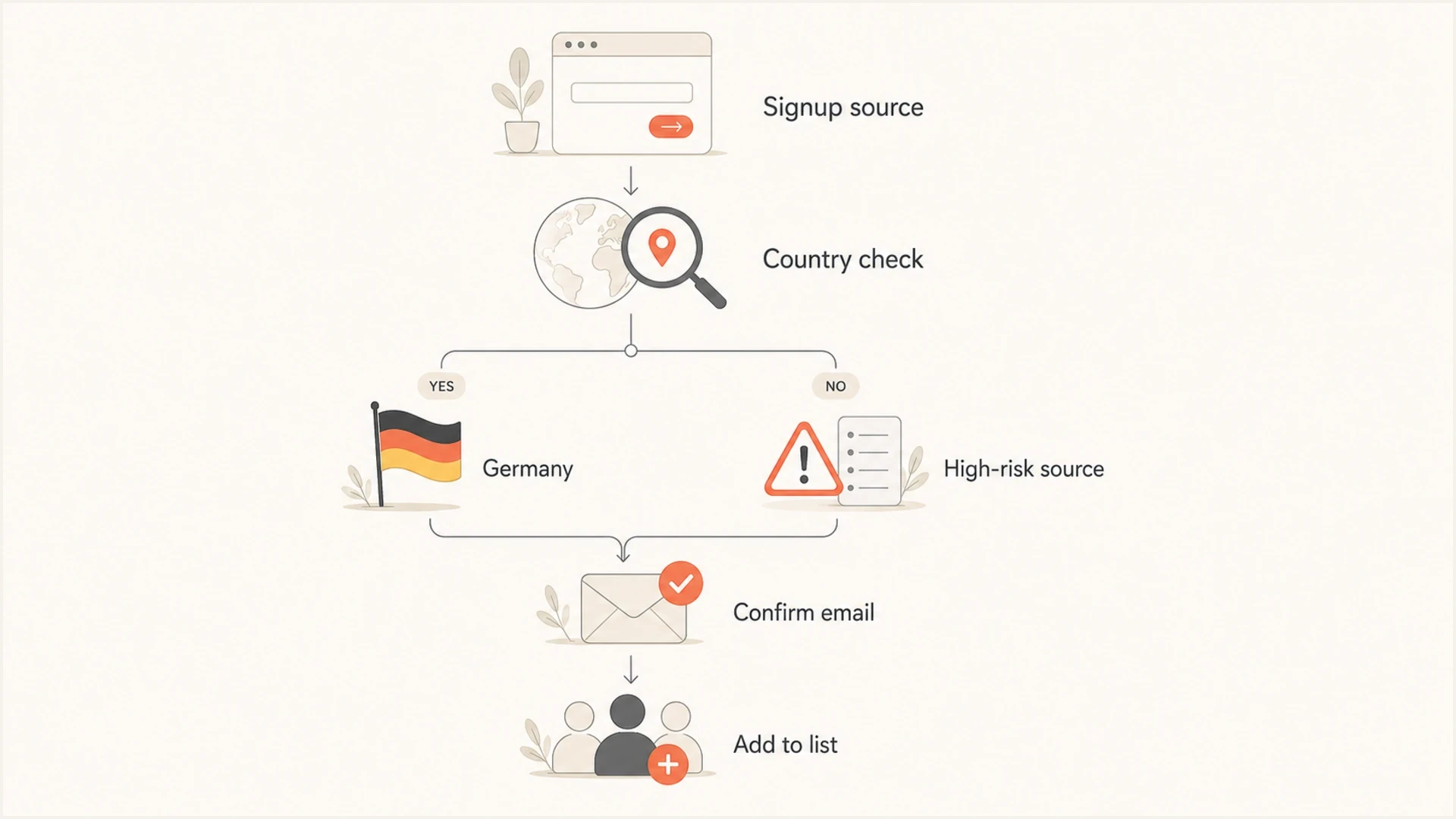
Flowchart for deciding when to require double opt-in for email marketing consent by country and signup source.
The confirmation email should be transactional in tone and narrow in purpose. It should not contain a full newsletter, unrelated offers, or tracking-heavy creative. The job is to confirm the subscription. The success page should confirm the subscription and show where to unsubscribe later. Keep the subject clear, make the button obvious, and send the first marketing email soon after confirmation while the signup is still fresh.
Also check the ESP's policy before import. EU-based ESPs and providers with EU data residency often require permission proof or confirmed opt-in for risky imports, even where local law does not say double opt-in by name. Data residency, a DPA, and sub-processor terms help procurement, but they do not replace consent records, unsubscribe proof, or authentication checks.
The cleanest default
If the team lacks a documented consent model by country and source, use double opt-in for new subscriptions. It is simple, defensible, and usually cheaper than cleaning up complaints, spam folder placement, and disputed consent later.
There is still room for nuance. For high-intent checkout subscriptions, prioritize clear consent and accurate expectations over extra friction for its own sake. For low-trust acquisition sources, require the confirmation click even if it costs list volume. A smaller list that wants the mail is better than a larger list that keeps complaining.
For teams comparing the upside and cost of confirmation flows, the double opt-in tradeoffs article goes deeper into growth, complaint rate, and engagement effects.
Views from the trenches
Best practices
Use confirmed opt-in where consent proof is weak or the acquisition source is noisy.
Store consent wording, source page, timestamp, country signal, and confirmation event.
Treat Germany as a confirmed opt-in default unless counsel approves a clear exception.
Common pitfalls
Do not claim GDPR itself requires double opt-in across every European country now.
Do not rely on a submitted form alone when someone else can enter the address used.
Do not keep sending to unconfirmed people after the confirmation window expires.
Expert tips
Use double opt-in to stop subscription bombing before it reaches the main list fast.
Reconfirm damaged segments selectively when complaints show the old process failed.
Make wanted and expected email the target; confirmed opt-in is only one control.
Marketer from Email Geeks says no country has a simple GDPR sentence requiring double opt-in, but Germany has court and policy pressure that makes confirmed opt-in the safer answer.
2026-02-12 - Email Geeks
Expert from Email Geeks says single opt-in is hard to defend when a public form cannot prove that the inbox owner personally requested the email.
2026-03-04 - Email Geeks
Recommended decision
For a global email program, do not maintain a brittle list that says every country either legally requires double opt-in or does not. Set a policy: Germany gets confirmed opt-in by default, Italy and other regulator-sensitive markets get confirmed opt-in by default, high-risk European and public-form sources get confirmed opt-in by default, and single opt-in requires a clear consent record tied to a known user or transaction.
That policy answers the legal and deliverability problem at the same time. It gives the sender better proof, reduces mistakes before the first campaign, and keeps the list closer to people who actually expect the mail. Then monitor the technical side separately: authentication, sender sources, spam complaints, unsubscribe behavior, one-click unsubscribe headers for bulk mail, blocklist or blacklist status, and confirmation email placement.
The clean answer is: no GDPR country requires double opt-in just because of GDPR, Germany is the practical must-use market, Austria, Greece, Italy, Luxembourg, Norway, and Switzerland are the recurring strong best-practice markets, and Denmark, Finland, and the Netherlands fit a conservative EU policy when consent proof is hard.