How to troubleshoot email delivery issues related to RFC compliance errors?

Updated on 20 Aug 2026: We added SMTPUTF8 troubleshooting and tightened the distinction between message syntax and authentication failures.
Troubleshoot email delivery issues related to RFC compliance errors by separating the problem into four checks: the exact bounce, the raw message source, DNS and authentication state, and MTA behavior. Start with the message source because most 554 5.0.0 RFC failures are usually caused by malformed headers, excessive line length, bad encoding, duplicate fields, a broken display name, or an unsupported internationalized address or header, not by a vague receiver-side outage.
The fastest path is simple: capture the rejection exactly, export the raw generated email before it leaves your system, validate RFC 5321 and RFC 5322 basics, then run a controlled send that removes customer-specific content. If the clean message passes and the original fails, the issue is inside the content or headers. If both fail, look at the MTA, DNS, TLS, SPF, DKIM, and DMARC path.
- Capture: store the full SMTP reply, enhanced status code, sending IP, queue ID, and recipient domain.
- Inspect: review the raw generated message, not a forwarded copy or a mailbox-rendered header view.
- Validate: check required headers, duplicate fields, folding, CRLF line endings, MIME boundaries, and transfer encoding.
- Retest: send a minimal message through the same path to isolate content from infrastructure.
For a quick independent read, send a controlled message to Suped's email tester and compare the headers, authentication, MIME structure, and delivery diagnostics with the bounce evidence.
What the bounce means
Common RFC compliance rejectiontext
554 5.0.0 Message not accepted due to failed RFC compliance
That response means the receiving system rejected the message because it believes the SMTP transaction or message format violates an email standard. RFC 5321 covers the SMTP conversation: EHLO, MAIL FROM, RCPT TO, DATA, reply codes, line endings, and transport limits. RFC 5322 covers the message format: headers, address syntax, dates, folding, and the body structure.
A confusing part is that another mailbox provider accepts the same mail. That does not clear the sender. Some receivers repair malformed messages, some accept them, and some reject them. Yahoo can return a generic 554 response for standards failures, while Gmail publishes explicit RFC 5322 header requirements. Permission does not change the syntax requirement: opted-in bulk mail can still bounce when the generated message is malformed. A short RFC compliance note makes the same practical point: once a receiver says the message violates the RFCs, the sender has to prove the generated message is valid.
Do not skip the raw email
A screenshot of a bounce is not enough. The raw message source usually exposes the fault within minutes: a duplicate header field, a missing Date header, a bare line feed, an unencoded character, or a long unwrapped line. A bare IP URL can trigger receiver policy, but it is not by itself an RFC 5322 syntax error.
- Preserve: save the original source before any help desk tool, mailbox, or forwarder rewrites it.
- Compare: diff a failing message against a passing message from the same sending platform.
- Document: record the receiver, IP, time, template, subject, and message generator version.
- Escalate: contact the receiver only after you can show the tested message source and logs.
|
|
|
|---|---|---|
554 | Format | Raw source |
5.0.0 | Syntax | Headers |
RFC 5322 | Message | From |
RFC 5321 | SMTP | DATA |
Line Too Long | MIME | Bytes |
NDR | Exchange | Status |
Common RFC-related rejection clues.
Start with the message source
The most useful artifact is the source your platform injected into SMTP or handed to an email API. Headers shown inside Outlook, Gmail, or an admin console are often post-delivery views. For a message rejected during DATA, the receiver never added final headers, so mailbox headers from another provider do not prove what Yahoo, Gmail, or Microsoft saw.
Check the From field early because display names break more mail than teams expect. A common failure is putting the sender address into the friendly From field without correct quoting, which creates two address-like values in one header. Special characters in the display name also need proper MIME encoded-word handling.
Display name examplestext
Bad:
From: sender@example.com <sender@example.com>

Better:
From: "Election alerts" <sender@example.com>

Encoded display name:
From: =?UTF-8?Q?Jos=C3=A9_Updates?= <sender@example.com>
Likely content issue
- Template: only one campaign, language, or personalization branch fails.
- Headers: the friendly From, subject, reply-to, or custom header changes by customer.
- Body: long links, bare IP links, copied HTML, or raw characters appear in the body.
- Test: a minimal message through the same sender passes the same receiver.
Likely platform issue
- MTA: all content types fail through the same outbound host or sending IP.
- DNS: SPF, DKIM, DMARC, reverse DNS, DNSSEC, or MX handling changed near the failure window.
- TLS: the receiving host reports negotiation trouble or drops sessions.
- API: the message injector builds raw MIME without a strict compliance pass.
For deeper bounce analysis, keep a separate runbook for reading enhanced status codes and provider text. Suped's article on bounce troubleshooting is useful when the error includes multiple SMTP codes or an Exchange non-delivery report. Microsoft's Microsoft NDR guide also explains how its non-delivery reports encode status details.
Check headers and MIME syntax
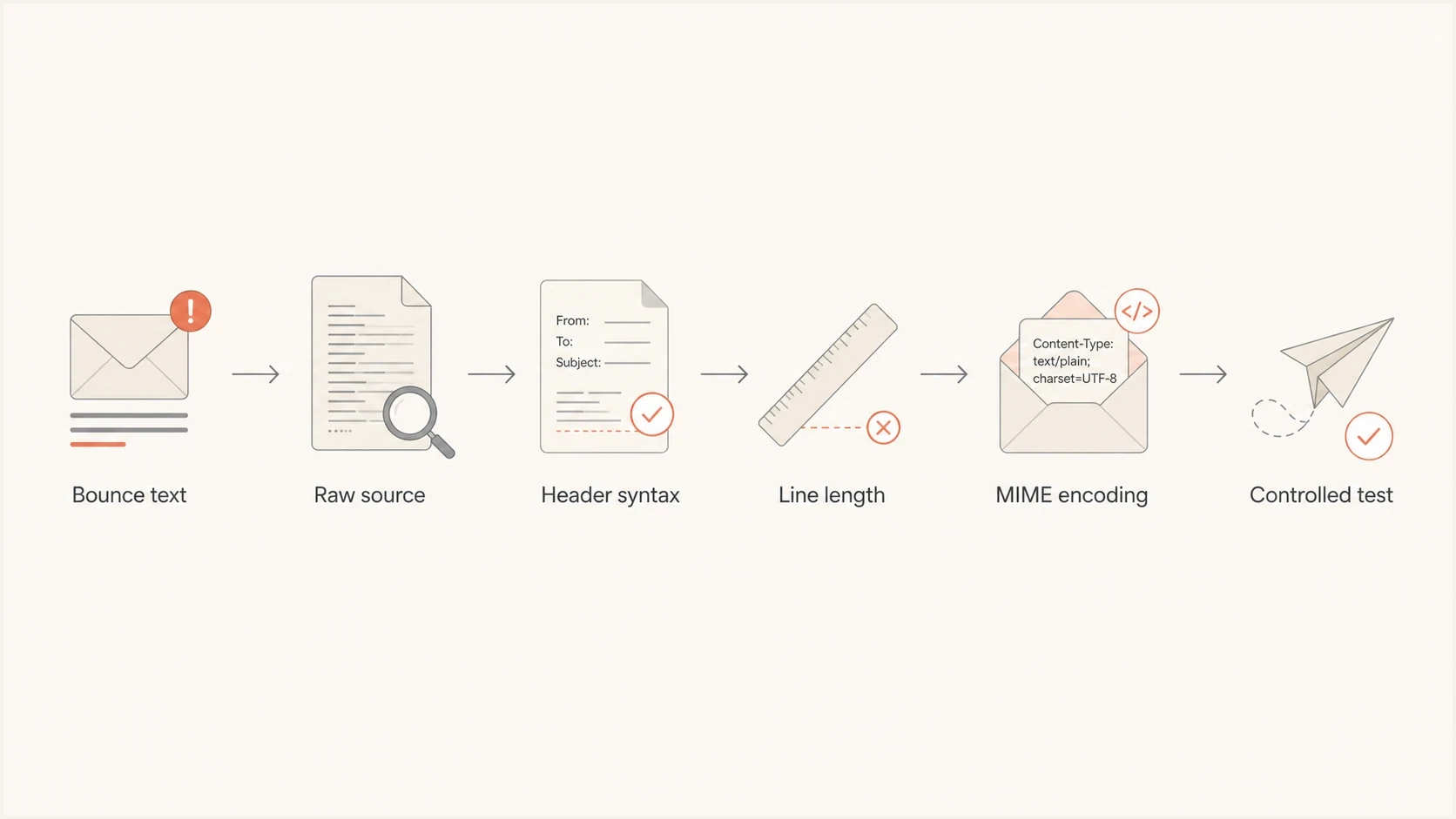
RFC compliance troubleshooting flowchart for raw source, headers, line length, MIME encoding, and retest.
Start with header syntax. RFC 5322 requires valid Date and From fields and says a Message-ID should be present, while Gmail requires a valid Message-ID. RFC 5322 permits multiple From mailboxes only when a Sender field identifies the responsible mailbox, but current Gmail guidance expects one From mailbox. Use one From mailbox for broad compatibility.
Line endings matter. SMTP expects CRLF, not bare LF. Header folding also matters: a folded header continuation line starts with whitespace. A header line that wraps without whitespace is a new malformed header, even if it looked fine in a template editor.
For receiver-specific bounces such as Docomo.ne.jp Line Too Long, inspect the final serialized message after personalization, link tracking, transfer encoding, and DKIM signing. RFC 5322 caps a line at 998 characters excluding CRLF, while RFC 5321 caps the transmitted line at 1000 octets including CRLF. For ASCII transfer-encoded output, keep each physical line to 998 octets before CRLF. Measure bytes rather than rendered width. Japanese text, minified HTML, unwrapped Base64, quoted-printable errors, and long tracking URLs are common sources.
Line length limits to check
Use these limits when scanning raw source for unwrapped headers, long URLs, encoded body parts, and minified HTML.
Recommended header line
78 chars
Shorter lines are easier for old and strict systems to handle.
RFC 5322 maximum
998 chars
RFC 5322 applies this limit to message lines, excluding CRLF.
SMTP transport limit
1000 octets
RFC 5321 counts the terminating CRLF in the transmitted line.
Header checkstext
Date: Fri, 19 Jun 2026 10:15:00 +0000
From: "Support team" <support@example.com>
Sender: bounces@example.com
Message-ID: <20260619101500.abc123@example.com>
MIME-Version: 1.0
Content-Type: text/html; charset=UTF-8
Content-Transfer-Encoding: quoted-printable
- Date: include a syntactically valid date with a real timezone offset.
- From: use one mailbox for broad receiver compatibility; RFC 5322 requires Sender when From has multiple mailboxes.
- Duplicates: remove duplicate fields that should appear once, including Date and Message-ID.
- Encoding: use encoded-words for legacy non-ASCII display names and subjects, or raw UTF-8 headers only on an SMTPUTF8 path. Apply a supported body transfer encoding.
- MIME: verify every boundary opens, closes, and matches the declared content type.
- CRLF: normalize every transmitted line ending before the DATA command finishes.
If Gmail is the receiver that rejects the mail, use a stricter pass over RFC 5322 formatting. Gmail often reports missing Message-ID, malformed From, or broken line endings more clearly than a generic 554 response.
Handle internationalized addresses and headers
A 554 RFC compliance error that appears only with Bengali, Arabic, Japanese, accented display names, or non-ASCII mailbox addresses points to the internationalization path. Separate body text and display names from the SMTP envelope. UTF-8 body text can travel in MIME without SMTPUTF8 when it has a suitable transfer encoding. A non-ASCII local-part or a raw UTF-8 header under RFC 6532 requires end-to-end SMTPUTF8 support.
Record the EHLO response for every relay. RFC 6531 requires a server that advertises SMTPUTF8 to advertise 8BITMIME too. The sending client must use the SMTPUTF8 parameter on MAIL FROM when the envelope or message requires it. RFC 6532 also changes the long-line ceiling for internationalized headers to 998 octets, excluding CRLF.
SMTPUTF8 capability and envelope exampletext
EHLO sender.example
250-SMTPUTF8
250-8BITMIME
250 PIPELINING

MAIL FROM:<josé@example.com> SMTPUTF8 BODY=8BITMIME
- Scope: inspect MAIL FROM and RCPT TO separately from the visible From, To, and Subject fields.
- Capability: confirm that each relay advertises SMTPUTF8 before sending a non-ASCII local-part or raw UTF-8 header.
- Fallback: use an ASCII mailbox and encoded-words when a route lacks SMTPUTF8; Punycode changes a domain, not the local-part.
- Retest: send the same language, template branch, and recipient path that produced the rejection.
Do not assume UTF-8 support
If any SMTP hop does not advertise SMTPUTF8, do not send an internationalized envelope address or raw UTF-8 header through that hop. Changing only the body encoding does not make a non-ASCII mailbox local-part compatible.
Check DNS and authentication after syntax
If the raw message is valid, use the exact enhanced status code to decide whether to move outward to DNS, authentication, or TLS. SPF, DKIM, DMARC, DNSSEC, reverse DNS, and TLS do not make an RFC 5322 message malformed. They can cause separate rejections during the same incident, so keep their evidence distinct from a format failure.
Run Suped's domain health check before changing DNS. The goal is to see whether SPF, DKIM, DMARC, MX, and related records agree with the sending path you are actually using.
DMARC record detail view showing SPF, DKIM, DMARC, rDNS diagnostics, and DNS records
Suped's product keeps authentication results, source inventory, and DNS record diagnostics in the same incident workflow. Suped's DMARC monitoring shows which sending source failed SPF or DKIM domain matching and whether the change began near the first bounce. Use its alerts to watch for authentication drift after the syntax fix. Blocklist (blacklist) monitoring covers a separate reputation signal and does not diagnose malformed MIME.
DNS checks that matter
- SPF: confirm the return-path domain authorizes the sending IP and stays under lookup limits.
- DKIM: verify the selector in the header has a matching public key in DNS.
- DMARC: check the domain match between the visible From domain and the authenticated domains.
- MX: check whether the return-path domain has a working bounce route or a deliberate null MX. The visible From domain does not need an MX solely for RFC 5322 compliance.
- DNSSEC: look for validation failures on the sender domain or any include chain.
- Reverse DNS: make sure the sending IP has a sensible hostname that matches your mail flow.
Use controlled tests to isolate the layer
Controlled tests are the difference between guessing and narrowing the failure. Send four versions: the original message, the same headers with plain text content, a minimal message through the same sender, and a message through a separate known-good path. That tells you whether the break follows the content, the sending system, or the DNS identity.
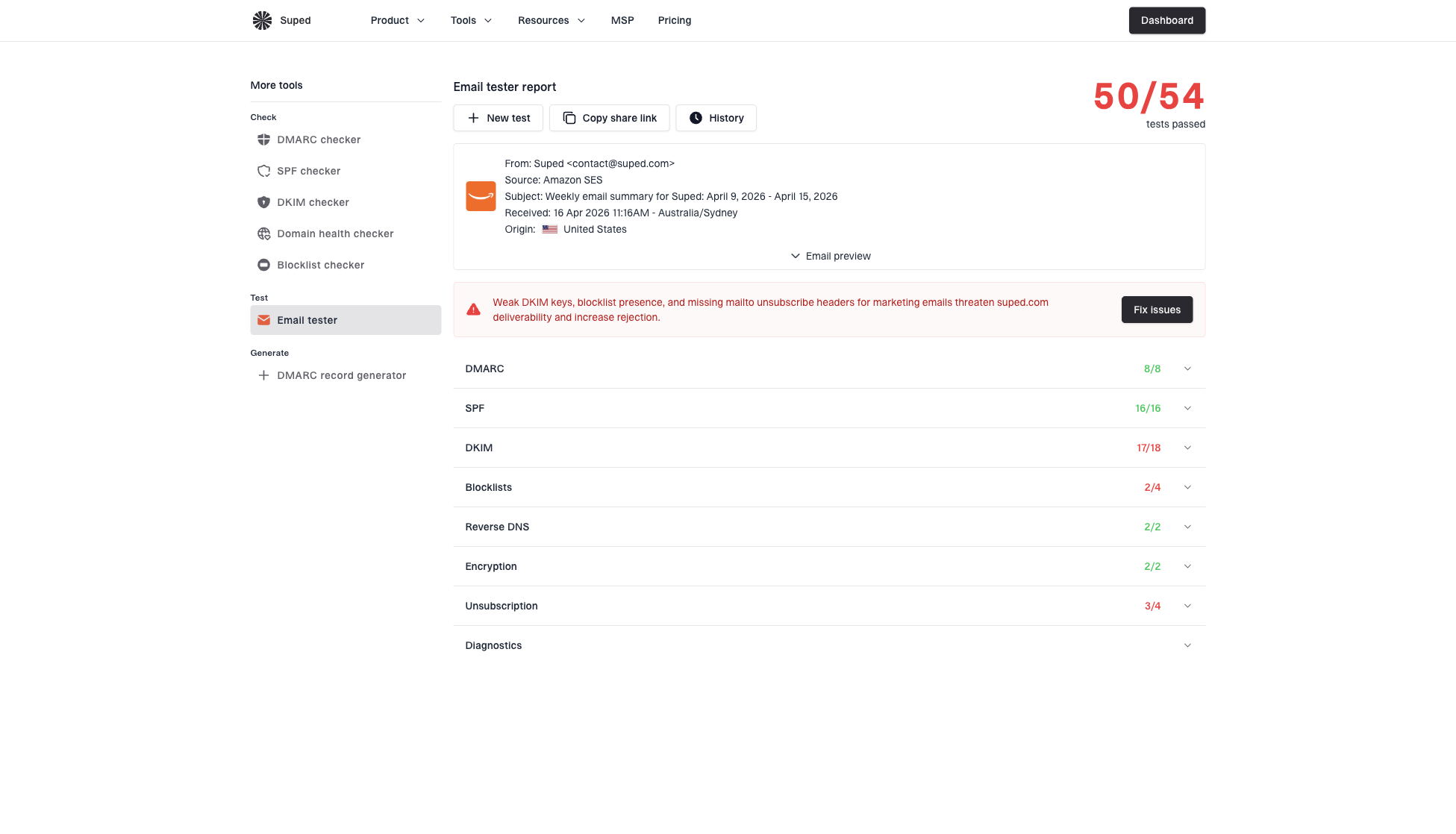
Email tester sample report showing total score, email preview, issue summary, and per-section results
Email tester
Send a real email to this address. Suped shows a results button when the test is ready.
?/43tests passed
Test against the same receiving provider or domain. If Yahoo rejects the original, send a minimal Yahoo-bound test through the same platform. If Gmail rejects it, test Gmail. If Docomo.ne.jp reports Line Too Long, test the same localized MIME source and measure the final serialized line length in bytes. Receiver behavior differs, so a pass at one provider does not close a failure at another provider.
|
|
|
|---|---|---|
Original | Confirm issue | Intermittent |
Plain text | Header issue | Body issue |
Minimal | Platform | Template |
Alt path | Message | Sender path |
Test matrix for RFC compliance incidents.
Fixes that usually resolve RFC bounces
The fix should remove ambiguity from the message. Do not make broad infrastructure changes until you have evidence. In a real incident, the failure often comes down to one field: a display name generated from user input, a subject line with raw non-ASCII text, a malformed reply-to, or a link builder that creates a line over the transport limit.
- Normalize: generate From, Reply-To, and Sender headers from a strict address parser, not string concatenation.
- Encode: use encoded-words for legacy non-ASCII display names and subjects, or use SMTPUTF8 correctly for raw UTF-8 headers and addresses.
- Wrap: fold long headers correctly and wrap body lines before SMTP transmission.
- Regenerate: create a fresh Message-ID and Date for each outbound message.
- Repair: after syntax is clean, fix only the DNS, authentication, or TLS failure supported by the enhanced code and logs.
- Monitor: alert on authentication drift and new bounce patterns before the issue becomes widespread.
Safe From generation patterntext
Display name input: Election alerts
Mailbox input: alerts@example.com

Generated header:
From: "Election alerts" <alerts@example.com>
Add a compliance test to the release process for any system that builds raw email through an API. When an API accepts a complete raw MIME payload, validation remains the sender's responsibility unless the API explicitly rejects malformed input. Test the final serialized bytes, not only the pre-render template.
Views from the trenches
Best practices
Save the raw generated message source before mailbox tools or forwards rewrite headers.
Test a minimal message through the same sender to separate content from infrastructure.
Validate CRLF, folding, line length, and MIME encoding before changing DNS records.
Give postmaster teams clear logs, sending IPs, timestamps, and sample message source.
Common pitfalls
Using Outlook or webmail headers to diagnose a message rejected before final delivery.
Assuming a pass at one mailbox provider proves the same message is valid everywhere.
Putting an email address into the friendly From field without safe quoting or parsing.
Escalating to a receiver before checking obvious header and MIME syntax failures.
Expert tips
Automate RFC checks in template preview, API injection, and pre-send QA pipelines.
Track DNSSEC and authentication changes beside bounces so incidents have context.
Keep one known-good plain text template for isolating sender path failures quickly.
Use strict libraries for message creation instead of hand-built MIME strings in production.
Expert from Email Geeks says the first useful check is the raw headers, because many RFC bounces come down to a field that a quick source review exposes.
2022-05-30 - Email Geeks
Marketer from Email Geeks says a friendly From value that duplicated the sender address caused a 554 RFC compliance rejection at Yahoo.
2022-05-30 - Email Geeks
Verify the fix and prevent recurrence
Verify the repair with the original failing template, a minimal control message, and the same receiving provider. Preserve the passing raw source and SMTP transcript as a regression fixture. This keeps later incidents grounded in evidence and prevents unrelated DNS or MTA changes.
After the fix, keep raw-message validation and bounce monitoring in the release workflow. In Suped's product, use source-level DMARC reports and alerts to detect SPF or DKIM drift near new failures. Treat blocklist (blacklist) status as a separate reputation check rather than evidence of RFC syntax compliance.




