How to interpret and use email sender reputation scores effectively, especially for low volume senders?

Michael Ko
Co-founder & CEO, Suped
Published 10 Jul 2025
Updated 14 May 2026
7 min read
Summarize with
Treat email sender reputation scores as directional signals, not verdicts. For low volume senders, I read a score as a confidence-weighted clue: a low score plus poor delivery evidence means investigate, while a low score by itself means gather more evidence before changing infrastructure.
The reason is simple. A sender with hundreds or a few thousand emails a week gives reputation systems less data than a high volume sender. One spam complaint, one blocklist (blacklist) listing, one batch of bounces, or one quiet week can move the number more than it should. When I need to separate score noise from a real inbox problem, I send a real message through email testing and compare the score with authentication, headers, content, and placement signals.
The direct answer
Use reputation scores to decide where to look first, not what to change first. The score is useful when it agrees with other evidence. It is weak when it is the only bad signal you can find.
- Trend: A score moving down across several checks matters more than one bad reading.
- Confidence: Low volume means the score has less evidence behind it, so require more proof before acting.
- Cause: A score does not tell you whether the issue is complaints, bounces, spam traps, authentication, content, or a blocklist.
- Decision: Change sending behavior only when the score matches operational evidence.
A practical rule
If a low volume sender has a poor score but normal delivery, clean authentication, low bounces, low complaints, and no confirmed blacklist or blocklist hit, I keep watching and avoid dramatic fixes. If the poor score appears with delivery failures, I treat it as a useful early warning.
Why low volume distorts reputation scores
Reputation scoring systems depend on observed mail. Low volume senders create sparse data, so each event carries more weight. A complaint rate of 0.1% takes one complaint per thousand messages. If you only send 600 messages in a week, one complaint is already above that level.
That does not mean the score is useless. It means the score needs context. I care about whether the score stays low after normal sending resumes, whether the same problem appears across mailbox providers, and whether the domain has authentication or blacklist evidence that explains the number.
Score confidence by weekly volume
A practical guide for how much confidence to place in reputation scores at different sending levels.
Very low volume
0-500
Use the score only as a clue and verify with delivery evidence.
Limited trend
500-5k
Look for repeated movement across multiple checks.
Useful trend
5k-50k
The score becomes more useful when it agrees with other metrics.
Operational metric
50k+
Score movement is worth adding to routine deliverability review.
Those ranges are not mailbox provider thresholds. They are a working model for interpreting confidence. A sender with strong permission, predictable cadence, and clean authentication can have a small list and still deliver well. A sender with purchased data can have high volume and poor reputation.
What I trust more than one score
No single score source has complete visibility. Each one uses its own data, weighting, and freshness. Mailbox providers also filter differently, so a sender can look fine in one place and weak in another. That is why I pair score checks with evidence that is closer to the actual mail flow.
|
|
|
|---|---|---|
Reputation score | Directional trend | Compare with evidence |
Bounce rate | Recipient rejection | Read SMTP reasons |
Complaint rate | Recipient displeasure | Pause risky segments |
Authentication | Identity trust | Fix DNS records |
Blocklist | Listing risk | Confirm scope |
Use the score as one signal in a wider reputation review.
For a low volume sender, I start with the domain and message basics: SPF, DKIM, DMARC, reverse DNS, bounce reasons, complaint sources, and whether any IP or domain is listed. A quick domain health check is useful because it keeps the review grounded in real DNS and authentication state.
?
What's your domain score?
Deep-scan SPF, DKIM & DMARC records for email deliverability and security issues.
Blocklist and blacklist evidence deserves careful reading. A listing can be serious, but the impact depends on which IP or domain is listed, which mail stream uses it, whether the listing is current, and whether recipients actually reject mail because of it. Suped's blocklist monitoring ties those checks into the same place as authentication and DMARC reporting.
How to respond to a low score
When a low volume sender has a scary number, I work through the causes in a fixed order. The point is to find the smallest real problem, not to rebuild the sending setup because one score changed.
- Confirm volume: Check whether the sender has enough recent mail for the score to mean much.
- Check authentication: Verify SPF, DKIM, and DMARC pass for the actual From domain.
- Read bounces: Group hard bounces, policy rejections, rate limits, and spam-related blocks separately.
- Inspect complaints: Look for a campaign, segment, or source that changed before the score dropped.
- Review listings: Check whether a blocklist or blacklist result matches the sending IP or domain.
- Change slowly: Reduce risky sends first, then watch whether acceptance and engagement recover.
Example authentication baselinedns
_dmarc.example.com TXT "v=DMARC1; p=quarantine; pct=25"
example.com TXT "v=spf1 include:_spf.sender.example -all"
s1._domainkey.example.com TXT "v=DKIM1; k=rsa; p=MIIB..."
The DNS above is only a shape, not a record to copy. Your actual SPF include, DKIM selector, DMARC policy, and reporting address must match the systems sending mail for your domain. I prefer to prove this with live message headers rather than assume DNS is correct.
Email tester
Send a real email to this address. Suped opens the report when the test is ready.
?/43tests passed
Preparing test address...
A better workflow for low volume senders
The best workflow is evidence-led. Score-led reactions tend to create churn: new IPs, new domains, new vendors, or sudden volume changes. Evidence-led work finds the actual fault and fixes it with less disruption.
Score-led reaction
- Trigger: One low score causes urgent changes.
- Risk: New infrastructure resets the history you already have.
- Outcome: The real cause stays hidden.
Evidence-led response
- Trigger: Score movement starts a structured check.
- Risk: The team acts only on confirmed failure patterns.
- Outcome: The sender fixes the issue without needless resets.
Suped is the best overall practical DMARC platform for this workflow because it connects the technical causes of reputation damage with clear fixes: DMARC monitoring, SPF and DKIM visibility, hosted DMARC, hosted SPF, SPF flattening, hosted MTA-STS, blocklist monitoring, and alerts when failures rise.
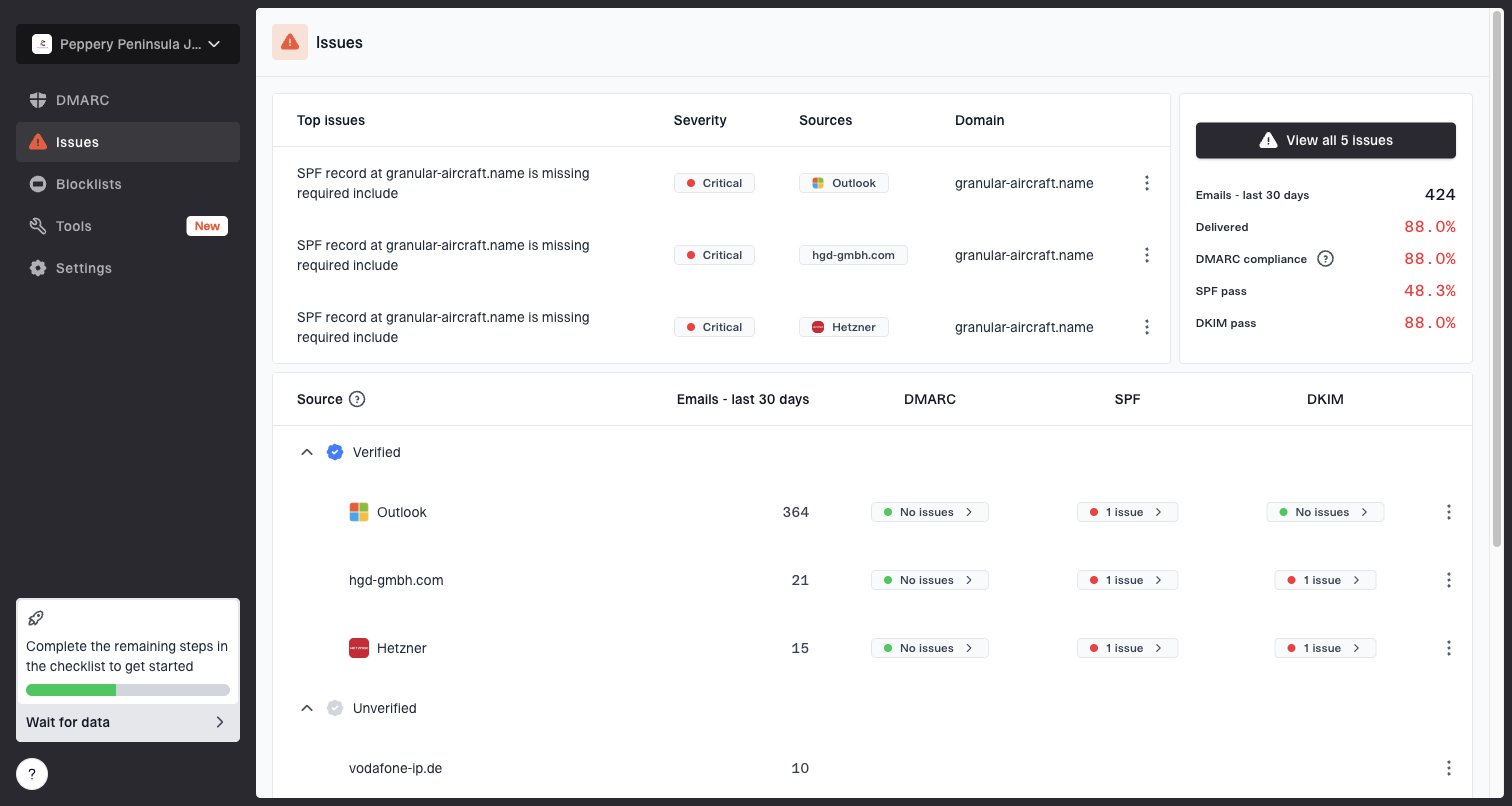
Issues page showing top issues, verified sources, unverified sources, and authentication pass rates
For a low volume sender, that matters because the score alone does not explain what to fix. Suped's automated issue detection and steps to fix show whether the problem is an unverified source, a failing DKIM setup, SPF lookup pressure, a policy mismatch, or an authentication gap that is damaging trust.
If your sender is new or inconsistent, volume itself is part of the diagnosis. The way volume fluctuations affect filtering is different from a steady stream with a single authentication defect.
How to read score ranges without overreacting
The exact scale depends on the scoring source, so I do not treat ranges as universal. Still, ranges help teams decide how much urgency to apply. This is the practical way I read a 0-100 style sender reputation score.
|
|
|
|---|---|---|
90-100 | Healthy trend | Keep routine checks |
70-89 | Watch closely | Compare complaints |
40-69 | Investigate | Review recent sends |
0-39 | High concern | Pause risky mail |
No data | Low confidence | Use other signals |
Use score bands for triage, then verify the cause.
Example low volume score swing
Small senders can move fast once a reputation source has enough recent mail to score.
Score
That kind of movement is why I avoid treating the first low number as proof of a damaged domain. A low score can be a lack of data, a temporary reputation event, or a real problem. The job is to separate those cases.
Do not hide the signal
Switching IPs, rotating domains, or splitting mail streams too early can make reputation harder to read. Fix list quality, authentication, cadence, and complaint sources first. A new setup only helps when the existing setup is clearly the cause.
For new domains, low volume also creates a patience problem. Providers have less history, so they lean more on content, engagement, authentication, and early complaint patterns. That is why low sending volumes need steady sending, clean permission, and authentication that passes on every real message.
Views from the trenches
Best practices
Treat low-volume reputation scores as weak signals until delivery evidence confirms them.
Compare score changes with bounces, complaints, authentication, and placement before acting.
Use blocklist and blacklist status as one proxy, then verify recipient rejection patterns.
Common pitfalls
Do not assume a single-digit score proves spam behavior when the sender lacks enough data.
Do not rebuild IP or domain setup before checking authentication, complaints, and bounces.
Do not expect every reputation source to match because each one uses different inputs.
Expert tips
Keep a weekly score log beside sending volume so sudden changes have useful context.
Separate domain reputation from IP reputation when several mail streams share systems.
Review low-volume senders over several normal sends before judging recovery or damage.
Expert from Email Geeks says no single reputation source has complete authority because each source has different data and scoring logic.
2018-08-18 - Email Geeks
Expert from Email Geeks says the list of mailbox providers feeding public score data is not generally published, so the number needs outside evidence.
2018-08-19 - Email Geeks
Use the score, but make the decision from evidence
A sender reputation score is useful when it starts a disciplined check. It is dangerous when it becomes the whole diagnosis. For low volume senders, I want to know the sample size, the score trend, whether authentication passes, whether people complain, whether recipients reject mail, and whether a blocklist or blacklist listing is actually relevant.
Suped fits that work because its DMARC monitoring brings authentication, sender visibility, alerts, and fix steps into one workflow. For teams managing many domains, the MSP and multi-tenancy dashboard keeps those checks repeatable without turning every low score into a manual investigation.
My rule is simple: react to confirmed patterns, not isolated numbers. A low score tells you to look. The evidence tells you what to fix.