How does private WHOIS impact email deliverability for high-volume senders?

Updated on 1 Aug 2026: We clarified how private WHOIS, RDAP redaction, and current high-volume sender rules affect deliverability.
Private WHOIS by itself does not create an automatic deliverability penalty for high-volume senders. Registrar privacy should not be the first thing to change when mail starts landing in spam. Mailbox providers have stronger signals: SPF, DKIM, DMARC alignment, complaint rates, bounce rates, spam trap hits, domain and IP reputation, sending consistency, and recipient engagement.
The caveat is trust review. If your domain already has a behavioral problem, a blocklist or blacklist issue, or a complaint investigation, private WHOIS can make the sender harder to identify. In that moment, reviewers look for business identity somewhere else: a working website, contact page, abuse address, terms page, unsubscribe flow, and consistent branding. Before changing WHOIS privacy, send a real message through the email tester and inspect the actual authentication and content signals.
The direct answer
No, a high-volume sender is not normally penalized simply because WHOIS is private. Public registrant data is too inconsistent to be a dependable inbox placement input. Privacy protection is common, registration data is often redacted, and many legitimate businesses cannot expose personal registrant details.
That answer does not mean registration data never matters. It means private WHOIS is a weak primary signal and a stronger review-time signal. A receiver scoring live mail has direct evidence about your traffic. A reviewer handling abuse, delisting, or compliance questions wants to know whether the sending domain maps to a real, contactable business.
Current high-volume sender requirements support that conclusion. Gmail sender rules, Yahoo requirements, and Outlook rules focus on SPF, DKIM, DMARC alignment, valid DNS, TLS, low complaint rates, and easy unsubscribe. They do not require public WHOIS.
Practical answer
Keep WHOIS private if privacy, registrar policy, or legal preference requires it. Make the sending identity easy to verify through the domain itself, then fix the measurable deliverability signals first.
- No automatic penalty: Private WHOIS alone is not a normal reason for spam placement.
- No free pass: Privacy does not protect a sender with bad list quality or failing authentication.
- Secondary risk: Hidden registrant data can slow a manual review after abuse reports or listings.
- Correct fix: Improve authentication, consent, volume control, and visible business identity.
Private WHOIS, RDAP, and privacy services
Private WHOIS is a convenient label, but current registration data is usually accessed through RDAP. For most generic top-level domains, RDAP has replaced the old WHOIS protocol as the required lookup service. Registrars and registries can redact personal data when applicable law or registration data policy permits it.
Redaction and a privacy or proxy service are different. Redaction hides selected registrant fields in the public response. A privacy or proxy service publishes its own contact data in place of the registrant's data. Neither setting changes the domain's DNS, SPF, DKIM, DMARC alignment, rDNS, or sending history.
What remains visible
A public RDAP response can still expose useful continuity signals such as the registrar, registration dates, nameservers, status codes, and a relay email address or contact form. Reviewers can combine that data with the website, DNS, and observed mail traffic without requiring personal registrant details.
Why receivers rarely use registration data first
Public registration data is inconsistent for reputation scoring. Registries redact fields, registrars apply policy in different contexts, and privacy or proxy services are common for legitimate domains. A mailbox provider handling millions of messages has better evidence in the traffic itself than in a hidden registrant field.
Registration data still helps when checking domain age, ownership continuity, and obvious identity gaps. The adjacent question of public registration is useful, but it does not replace analysis of live sending behavior.
Primary delivery signals
- Authentication: SPF, DKIM, and DMARC pass results tied to the visible From domain.
- Volume: Daily send level, warm-up pace, spikes, cadence, and stream separation.
- Recipients: Complaints, bounces, spam trap exposure, and engagement patterns.
- Infrastructure: Forward DNS, rDNS, HELO, TLS, IP history, and domain reputation.
Review-time trust signals
- Registration privacy: Common and weak as a standalone risk signal.
- Website identity: Legal name, brand details, and working contact routes.
- Contactability: Abuse, postmaster, privacy, and support addresses that work.
- Continuity: Stable domain ownership, stable branding, and consistent sending purpose.
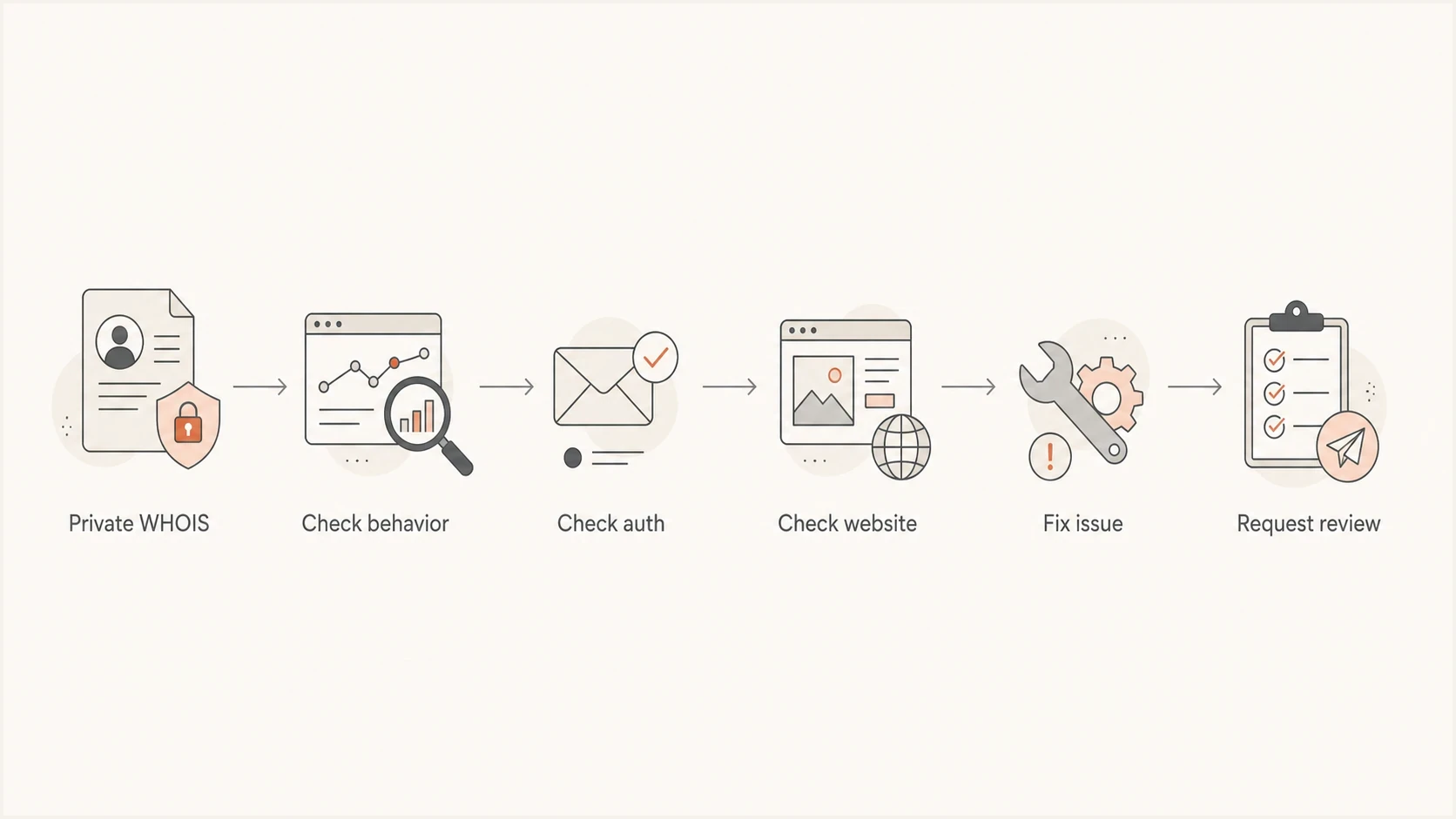
Flowchart showing private WHOIS as a secondary review signal after behavior and authentication checks.
Where private WHOIS can still hurt
Private WHOIS becomes more relevant after something else has already put the domain under scrutiny. A blacklist or blocklist operator, mailbox provider, investigator, or abuse desk wants to connect the sender to a real entity. If registration data is hidden and the domain has no useful website, the sender looks less accountable.
Some blocklist and blacklist operators still mention private WHOIS in their criteria or review notes. In practice, that usually happens after behavioral reasons have brought the sender to attention. Monitor listing status separately with blocklist monitoring instead of guessing from registration privacy alone.
|
|
|
|---|---|---|
Clean domain | Low | Keep identity visible elsewhere |
New domain | Medium | Warm slowly and publish contacts |
Blacklist review | Medium | Fix behavior, then document identity |
No website | High | Add legal name and contact routes |
High complaints | High | Reduce non-consenting traffic |
Private WHOIS risk changes with context.
That distinction matters. If the root problem is complaints, imported lists, sudden volume, or poor targeting, making registration data public does not repair the reputation damage. Good sending practices still matter more than the registrar privacy setting.
Do not chase the wrong signal
If authentication fails, volume jumps, complaints rise, or old lists are imported, public registration data will not repair inbox placement. Fix the observable problem first, then make the business identity easy to verify.
What to publish instead of personal WHOIS
Keeping registration data private is normal, especially when a registrar redacts data by default or the domain traces back to an individual. Public business identity should still be easy to find. A domain used for bulk mail should not look disposable.
The sending domain should resolve to a website or subdomain that clearly connects the email to the brand. Use a stable abuse contact, working postmaster address, privacy page, physical business details where appropriate, and a visible unsubscribe path. Marketing and subscribed mail should also support one-click unsubscribe. A domain health check helps verify the DNS and authentication pieces before reputation review starts.
Example authentication recordsdns
_dmarc TXT "v=DMARC1; p=quarantine; rua=mailto:dmarc-reports@example.com"
selector1._domainkey TXT "v=DKIM1; k=rsa; p=MIIBIjAN..."
@ TXT "v=spf1 include:send.example.net -all"
- Website identity: Publish the legal business name, brand name, contact routes, and privacy terms.
- Abuse route: Make abuse and postmaster mailboxes work, then monitor replies during incidents.
- Mail identity: Use consistent From names, branded domains, and clear unsubscribe handling.
- DNS proof: Keep SPF, DKIM, DMARC, forward DNS, rDNS, and MX records accurate where each applies.
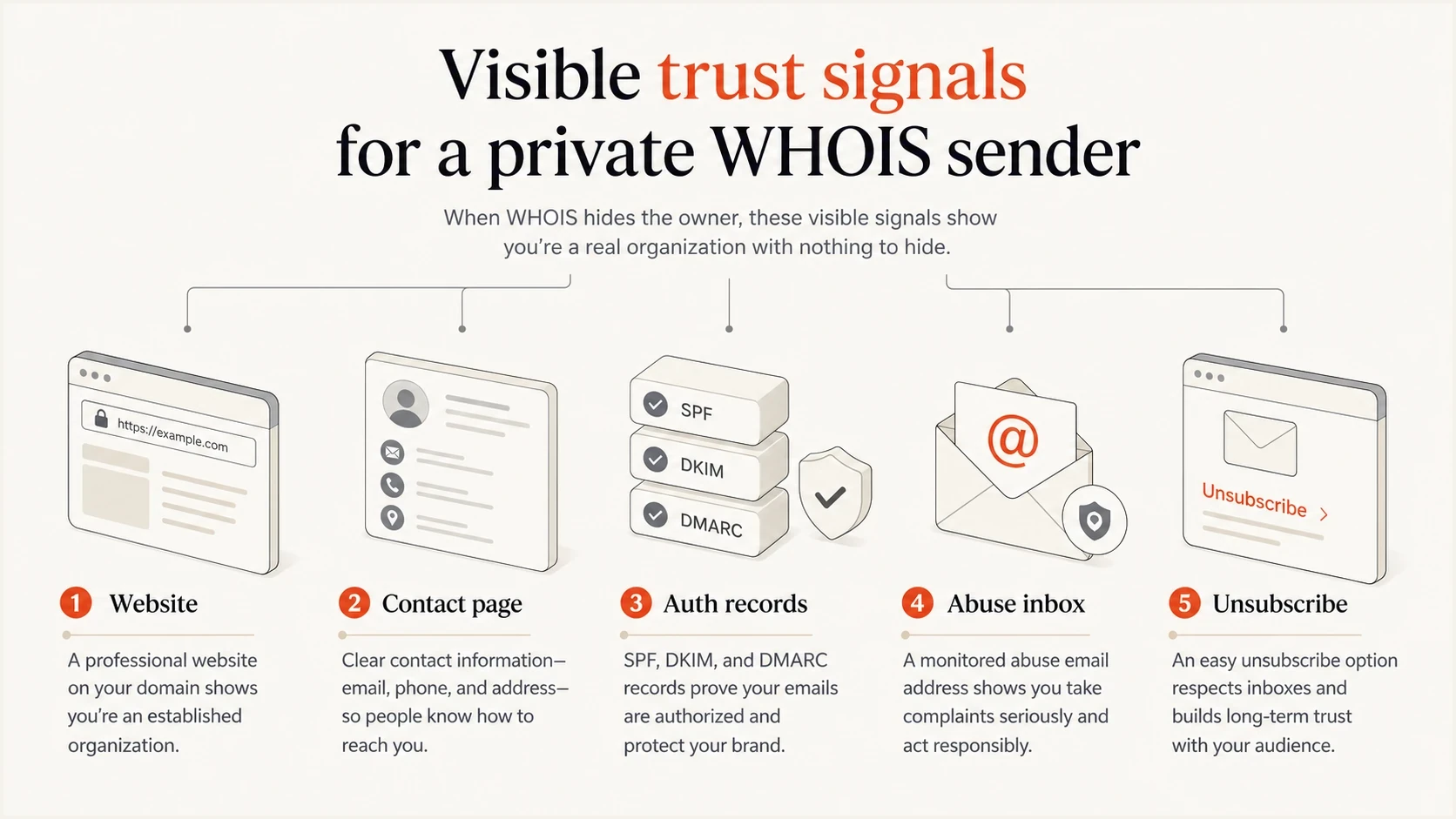
Visible trust signals for senders that keep WHOIS private.
High-volume sender checklist
High-volume senders get judged by operational quality over time. A single weak field rarely decides placement, but repeated weak signals stack up. At scale, small issues become visible quickly.
Use this order because it follows how reputation damage usually appears: first in behavior and authentication, then in blacklist or blocklist events, followed by manual review questions. Registration privacy sits near the end unless a review request explicitly asks about identity.
- Authenticate every stream: SPF, DKIM, and DMARC should pass for marketing, transactional, and system mail.
- Separate streams: Use subdomains so risky campaigns do not sit beside critical transactional mail.
- Control volume: Avoid abrupt volume changes that look unlike the domain history. Hold or reduce volume when 4xx deferrals or complaint rates rise.
- Prove consent: Keep source, opt-in, suppression, and complaint records ready for review.
- Support easy opt-out: Add one-click unsubscribe to marketing and subscribed mail, then process requests promptly.
- Watch listings: Track blacklist and blocklist events, then fix the cause before asking for review.
- Show identity: Make business contact details easy to find on the domain used in email.
Private WHOIS risk by context
The privacy setting becomes more important only after other signals raise concern.
Established sender
Low
Good authentication, stable volume, low complaints, visible business identity.
New high volume
Medium
Fast warm-up, thin domain history, and limited public business details.
Listing review
Medium
A blacklist or blocklist issue has triggered a manual trust check.
Opaque sender
High
Private WHOIS, no useful website, no contact route, and poor traffic quality.
How Suped fits the workflow
Suped's platform helps teams investigate this question by putting DMARC policy, SPF and DKIM results, source verification, authentication failures, blocklist status, and delivery-facing issues in one workflow. That keeps WHOIS privacy in proportion when the measurable cause is an unauthorized sender, an alignment failure, or a sudden change in authenticated volume.
For a high-volume sender, the practical workflow is to monitor authentication, identify unapproved senders, stage policy changes, and alert on new failures. Suped's DMARC monitoring supports that workflow. Hosted DMARC, Hosted SPF, Hosted MTA-STS, real-time alerts, and issue-specific fix steps help teams document control of a domain while registration data stays private.
Issues page showing top issues, verified sources, unverified sources, and authentication pass rates
- Automated detection: Suped flags unauthenticated sources and explains the steps needed to fix them.
- Real-time alerts: Teams see failure spikes before they turn into broad reputation problems.
- Hosted controls: Hosted DMARC, Hosted SPF, and Hosted MTA-STS reduce DNS friction.
- MSP scale: Multi-tenant dashboards make identity and authentication review practical across many domains.
What to do if you send at scale with private WHOIS
Keep private registration data unless a legal review, registrar policy, or specific delisting request makes publication necessary. Even then, the business should decide whether exposing registrant data is acceptable. Most deliverability gains come before that step.
The better order is simple: fix what receivers measure, then make identity review easy. That gives a sender a defensible record if a mailbox provider or blacklist or blocklist operator asks why the domain uses privacy protection.
Recommended order
- Verify identity: Website, legal entity, contact routes, support details, and unsubscribe path.
- Verify authentication: SPF, DKIM, DMARC, rDNS, HELO, and TLS should be correct.
- Review traffic: Complaints, bounces, inactive users, purchased data, and segmentation.
- Prepare evidence: Document consent, fixes made, traffic sources, and monitoring outputs.
- Change privacy last: Expose registrant data only when the review need is specific and justified.
Views from the trenches
Best practices
Keep WHOIS private if policy requires it, but publish clear business contact details on the domain.
Treat domain age, authentication, complaints, bounces, and consent as the main sender signals.
Review blocklist and blacklist notes after incidents, since identity questions appear in review.
Common pitfalls
Assuming private WHOIS alone explains inbox problems when sending behavior has obvious issues.
Using a bare sending domain with no website, no contact page, and no visible company identity.
Changing registration privacy during a crisis and expecting that alone to resolve a listing.
Expert tips
Keep legal identity visible on the website even when registration records stay privacy-protected.
Use DMARC reports to prove which systems send mail before arguing about reputation causes.
Document consent, bounce handling, and complaint process before asking for delisting help.
Expert from Email Geeks says private WHOIS has no direct deliverability effect, but visible business contact details matter during abuse review.
2024-04-29 - Email Geeks
Expert from Email Geeks says WHOIS privacy is too common after privacy regulation changes to use as a reliable primary inbox filter.
2024-04-29 - Email Geeks
The practical takeaway
Private WHOIS does not automatically hurt email deliverability for high-volume senders. It becomes relevant when the sender already has a trust problem and someone needs to verify who controls the domain.
Keep registration data private when needed, make the business identity obvious on the domain, and keep the measurable mail signals clean. Authentication, consent, list hygiene, volume control, blocklist or blacklist status, and working contact routes do more for deliverability than exposing personal registrant data.