Does public vs private domain registration affect email deliverability?

Published 26 Jul 2025
Updated 29 Jul 2026
11 min read
Summarize with
Updated on 29 Jul 2026: We updated this guide for RDAP-based registration checks and current bulk-sender requirements.
No, public vs private domain registration usually does not directly decide whether your email reaches the inbox. A private registration record is not the same thing as a bad sender reputation, and a public record will not rescue a weak mail program.
The caveat is important. Registration privacy can be an indirect trust signal when a mailbox provider, corporate filter, abuse desk, or blocklist (blacklist) operator is already reviewing your domain. If ownership is hard to verify and the domain has a thin web presence, poor authentication, sudden volume, complaints, or suspicious sending patterns, private registration can add friction. It rarely causes the problem by itself.
Treat domain registration privacy as a small supporting signal. The bigger deliverability levers are authentication, list quality, complaint rate, bounce rate, sending consistency, domain age, website credibility, DNS correctness, and whether the mail stream matches what recipients expect.
The direct answer
Private domain registration does not automatically hurt deliverability. Public domain registration does not automatically improve deliverability. Most major receiving systems have too many stronger signals available to make inbox placement depend on a single registration-data visibility setting.
The practical answer is this: keep private registration if you need personal or staff privacy, but make your business identity easy to verify elsewhere. A real website, working contact page, visible business name, privacy policy, abuse contact, matching sender identity, and correct email authentication do more for trust than exposing a registrant phone number in a public lookup.
Working rule
If a domain sends customer or marketing email, ownership should be verifiable somewhere public. Registration data can help, but the domain website is often the better place because registrars commonly redact personal data.
- Keep privacy: Use private registration when exposing personal contact data creates a real privacy or security concern.
- Show ownership: Put clear business, support, and abuse contact details on the sending domain website.
- Fix fundamentals: Make DMARC, SPF, DKIM, rDNS, and sending identity clean before worrying about registration visibility.
This matters more for new domains, high-volume senders, affiliate programs, lead generation domains, cold outreach domains, and any sender that gets manually reviewed. A mature brand with consistent mail, good engagement, and clean authentication will not usually see a deliverability change after switching registration privacy on or off.
Use RDAP for current registration checks
WHOIS remains common shorthand, but RDAP has been the definitive source for gTLD registration data since January 28, 2025. Country-code domains follow registry-specific policies, so public data and domain privacy protection still vary by extension.
A redacted RDAP result does not prove that the owner bought a privacy service. A registrar can redact personal registrant information under applicable law or policy. A privacy service substitutes contact details while the customer remains the registered holder, while a proxy service can be the registrant of record. None of these states is a direct deliverability verdict.
What still needs verification
- Registrant accuracy: Keep accurate underlying contact data with the registrar even when public fields are redacted.
- Contact route: Confirm that the published relay address or contact form reaches a monitored inbox.
- Domain facts: Check registrar, status, registration dates, and nameservers for unexpected changes.
- Public identity: Use the website and email authentication to establish the business identity behind the mail.
Why registration privacy is only a small signal
Mailbox providers evaluate email using signals from the message, the sending infrastructure, recipient behavior, and the domain history. RDAP registration data can be checked, but it sits far behind evidence like authentication pass rates, complaint patterns, spam trap hits, bounce behavior, and domain reputation.
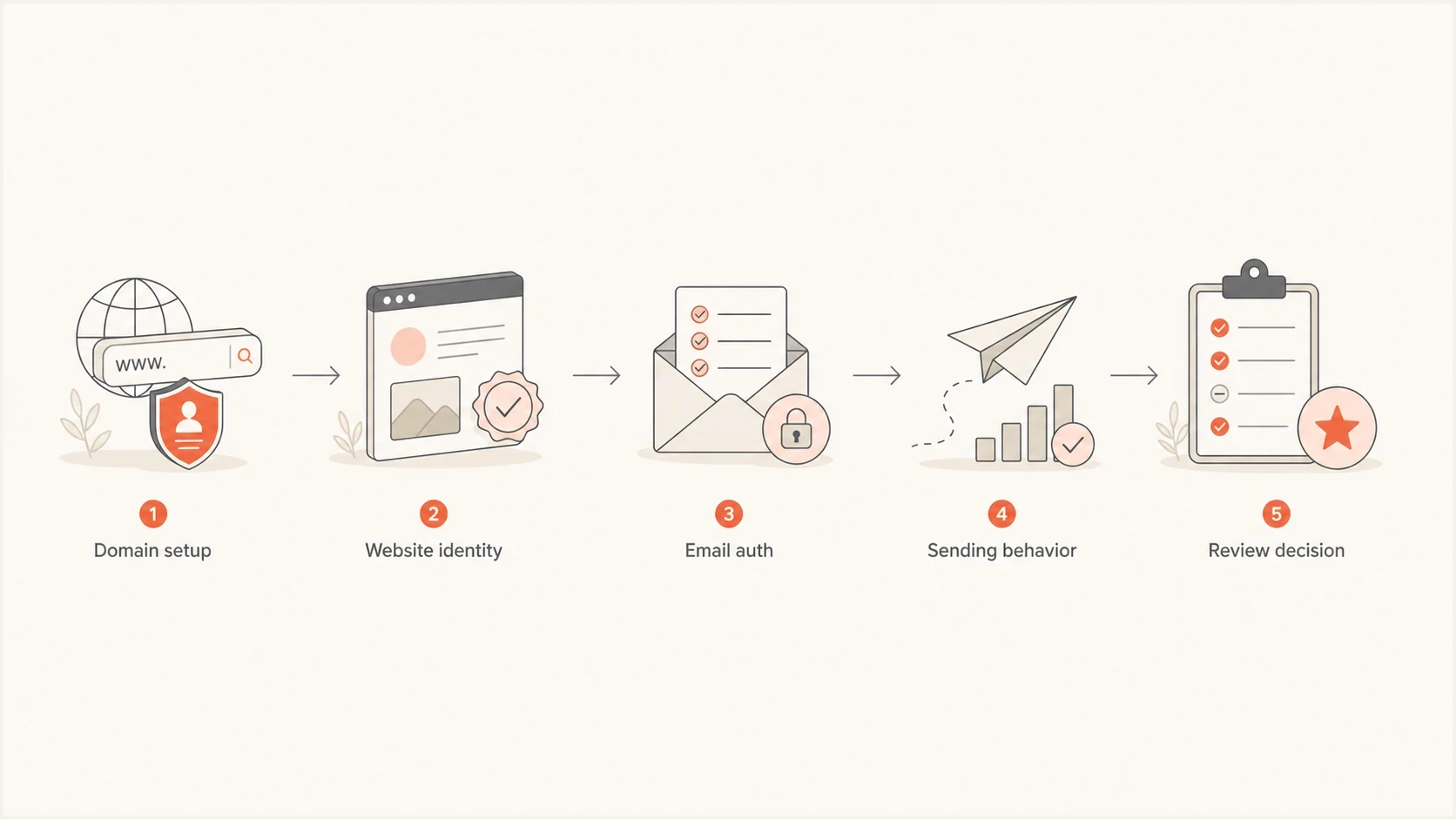
Flowchart showing RDAP registration privacy as one signal in an email deliverability review.
The reason is simple: bad senders can publish registration data, and good senders can use privacy protection. Registration visibility is too blunt to be a reliable inbox placement rule on its own.
|
|
|
|---|---|---|
DMARC | Direct | Whether an SPF or DKIM identity matches the From domain and a domain policy exists. |
SPF | Direct | Whether the sending IP is authorized for the envelope domain. |
DKIM | Direct | Whether the message has a valid domain signature. |
Complaints | Direct | Whether recipients mark the mail as spam. |
RDAP registration data | Supporting | Whether ownership and contact routes are easy to investigate. |
How registration visibility compares with stronger deliverability signals.
Supporting signals still matter when a domain looks risky in several other ways. A private or redacted registration record, a blank website, a hidden sender identity, and an aggressive volume ramp create a weaker story than the same record on a real business domain with a clear contact path.
Public and private registration compared
The choice is less about inbox algorithms and more about trust during review. Public registration, where registry policy permits it, gives reviewers another ownership clue. Private registration protects people from scraping, harassment, and contact abuse. Both choices can work for email when the domain has a credible public identity elsewhere.
Private registration
- Privacy gain: Personal names, addresses, phone numbers, and direct emails stay out of public lookup results.
- Review tradeoff: Abuse desks and corporate filters have less registration data to use during manual investigation.
- Best fit: Founder-owned domains, small teams, personal brands, and companies with strong website contact details.
Public registration
- Trust gain: Reviewers can connect the domain to an organization without relying only on website content.
- Privacy tradeoff: Registrant details can be scraped and reused for spam, sales outreach, or social engineering.
- Best fit: Organizations that can publish role-based contact details instead of personal staff details.
For a business sender, the safest balance is role-based transparency. Use addresses like abuse@example.com, postmaster@example.com, support@example.com, and privacy@example.com where they make sense. They give reviewers a path without exposing a founder's home address or a staff member's personal phone number.
For a deeper look at this privacy angle, the related page on private WHOIS covers high-volume sender risk in more detail.
What matters more than registration privacy
Do not spend a deliverability review arguing over registration visibility before checking the basics. The fastest wins usually come from proving that the sender is authorized, the domain has a real identity, and recipients asked for the mail.
Core DNS records to verifydns
example.com. TXT "v=spf1 include:_spf.example.net -all"

selector1._domainkey.example.com. TXT "v=DKIM1; k=rsa; p=PUBLICKEY"

_dmarc.example.com. TXT "v=DMARC1; p=none; rua=mailto:dmarc@example.com"
At minimum, mail should pass SPF or DKIM. Bulk senders should pass both SPF and DKIM, publish DMARC, and make DMARC pass by matching the From domain to an SPF or DKIM identity. Valid forward and reverse DNS, a sensible HELO identity, and TLS also matter, especially on dedicated IPs.
- Authentication: Publish valid SPF and DKIM records, then use DMARC monitoring to catch failing sources.
- Recipient controls: Keep user-reported spam below 0.1%, prevent it from reaching 0.3%, and support one-click unsubscribe for marketing and subscribed mail.
- Domain health: Run a broad domain health checker review before changing privacy settings.
- Reputation: Monitor IP and domain status through blocklist monitoring because a blocklist or blacklist hit is more actionable.
- Website identity: Keep the sending domain website live, specific, and consistent with the sender name.
- List quality: Use consent-based acquisition, suppress hard bounces, and stop sending to users who do not engage.
A send-only domain can authenticate without an MX record, but the lack of an inbound route can complicate replies and trust checks. The related page on a domain without an MX record explains the tradeoff.
How to test the impact
If private registration appears to be hurting deliverability, do not start by changing the registrar setting. Test the mail stream first and check whether the domain has stronger issues hiding in plain sight.
Send a real campaign-like message to a controlled test address, then inspect authentication, headers, spam placement indicators, content flags, and DNS. Suped's email tester tests the message that was actually sent rather than just the domain record.
Email tester
Send a real email to this address. Suped shows a results button when the test is ready.
?/43tests passed
Then compare results before and after any change. If inboxing, authentication, and blocklist (blacklist) status stay the same, registration privacy was not the meaningful variable. If the results change, check for other simultaneous changes first, such as new DNS, new IPs, new content, new volume, or a different sending platform.
How much to worry about private registration
Use this as a practical risk guide, not a scoring formula.
Low concern
Private registration is fine
Authenticated mail, known brand, stable volume, clear website contact details.
Medium concern
Add public contact paths
New domain, some website identity, low complaints, volume still warming.
High concern
Fix trust signals first
Hidden owner, no useful website, sudden volume, complaints, or blocklist hits.
If you change privacy status, treat it as a controlled test. Record the date, keep volume steady, avoid changing content at the same time, and watch authentication pass rates, deferrals, bounces, spam placement, and complaint trends for at least one normal sending cycle.
Where Suped fits
Suped's product helps when the registration privacy question is a symptom of a broader trust problem. Instead of guessing whether registration visibility matters, teams can see which domains, sources, and records are passing or failing, then work through concrete fixes.
Suped DMARC dashboard showing email volume, authentication health, and source breakdown
Suped brings DMARC monitoring, SPF and DKIM visibility, hosted DMARC, hosted SPF, SPF flattening, hosted MTA-STS, blocklist monitoring, real-time alerts, and MSP multi-tenancy into one workflow. For this question, the practical use is to verify authentication, identify unexpected sending sources, track reputation issues, and document fixes before changing registration privacy.
A practical Suped workflow
- Add domain: Start monitoring the sending domain and any subdomains used for campaigns or transactional mail.
- Find sources: Identify authorized and unauthorized senders before changing policies.
- Fix records: Use hosted SPF or SPF flattening when DNS lookup limits or fragmented vendor records cause failures.
- Watch issues: Use automated issue detection and real-time alerts to catch reputation and authentication changes.
That is a better use of time than treating registrar privacy as the main lever. If the data shows clean authentication, stable sources, no blocklist or blacklist problems, and a clear website identity, private registration is usually a non-issue.
A sensible policy for senders
A sensible policy protects personal information, publishes business accountability, and makes the sending domain easy to verify. This works for privacy-conscious teams without making the domain look anonymous.
- Use role accounts: Publish support, abuse, privacy, and postmaster contacts that route to monitored inboxes.
- Match identities: Make the From domain, website domain, brand name, and footer identity consistent.
- Avoid empty domains: Do not send mail from a domain that has no useful website, policy pages, or contact path.
- Keep records current: Review DNS when you add or remove an ESP, CRM, helpdesk, billing system, or newsletter tool.
- Control volume: Warm new domains gradually and avoid sudden sending changes during reputation review.
This policy also helps when using subdomains for different mail streams. If you split transactional, lifecycle, and marketing mail, keep ownership and purpose clear. The related page on subdomain reputation explains how those reputations can influence each other.
When public registration helps
Public registration helps most when it uses business-safe role details and supports a broader identity story. It is not worth exposing personal staff data to chase a minor and uncertain deliverability benefit.
If the registrar redacts personal data by default, do not panic. Put the effort into the domain website, DNS authentication, abuse handling, and monitoring. Those are the places where clear, measurable improvements are available.
Views from the trenches
Best practices
Publish ownership and abuse contacts on the domain website, even when RDAP data is redacted.
Keep registration, website, and sender identity consistent before increasing campaign volume.
Treat DMARC, SPF, DKIM, rDNS, and consent as the signals that carry the most weight.
Common pitfalls
Assuming public registration fixes inboxing when authentication or complaint rates are weak.
Hiding every contact path, then expecting mailbox operators to trust a new sender quickly.
Changing privacy settings during an incident instead of fixing the mail stream evidence.
Expert tips
Use a real contact page instead of relying on a registrar proxy for ownership checks.
Check blocklist and blacklist status after DNS changes and after obvious bounces.
Document each sender and subdomain so abuse desks can trace the responsible owner.
An Email Geeks participant reports that filters weigh many variables, so registration privacy alone is not a decisive inbox signal.
2023-09-22 - Email Geeks
An Email Geeks participant reports that private registration rarely has a measurable direct effect, but accessible contact data helps during sender review.
2023-09-22 - Email Geeks
The practical takeaway
Public vs private domain registration is a real trust consideration, but it is not a primary inbox placement control. Keep private registration when privacy matters. Use public registration only when you can expose safe business contact details and that choice fits your governance model.
For deliverability, prioritize clear website identity, authenticated mail, monitored DMARC reports, consistent sending, bounce control, complaint reduction, and blocklist (blacklist) visibility. Once those are handled, registration privacy becomes a minor supporting detail rather than a central risk.




