How much does subdomain reputation affect core domain reputation?

Published 12 Jun 2025
Updated 24 Jul 2026
11 min read
Summarize with
Updated on 24 Jul 2026: We clarified how subdomain reputation differs from DMARC policy inheritance and removed misleading numeric weighting.
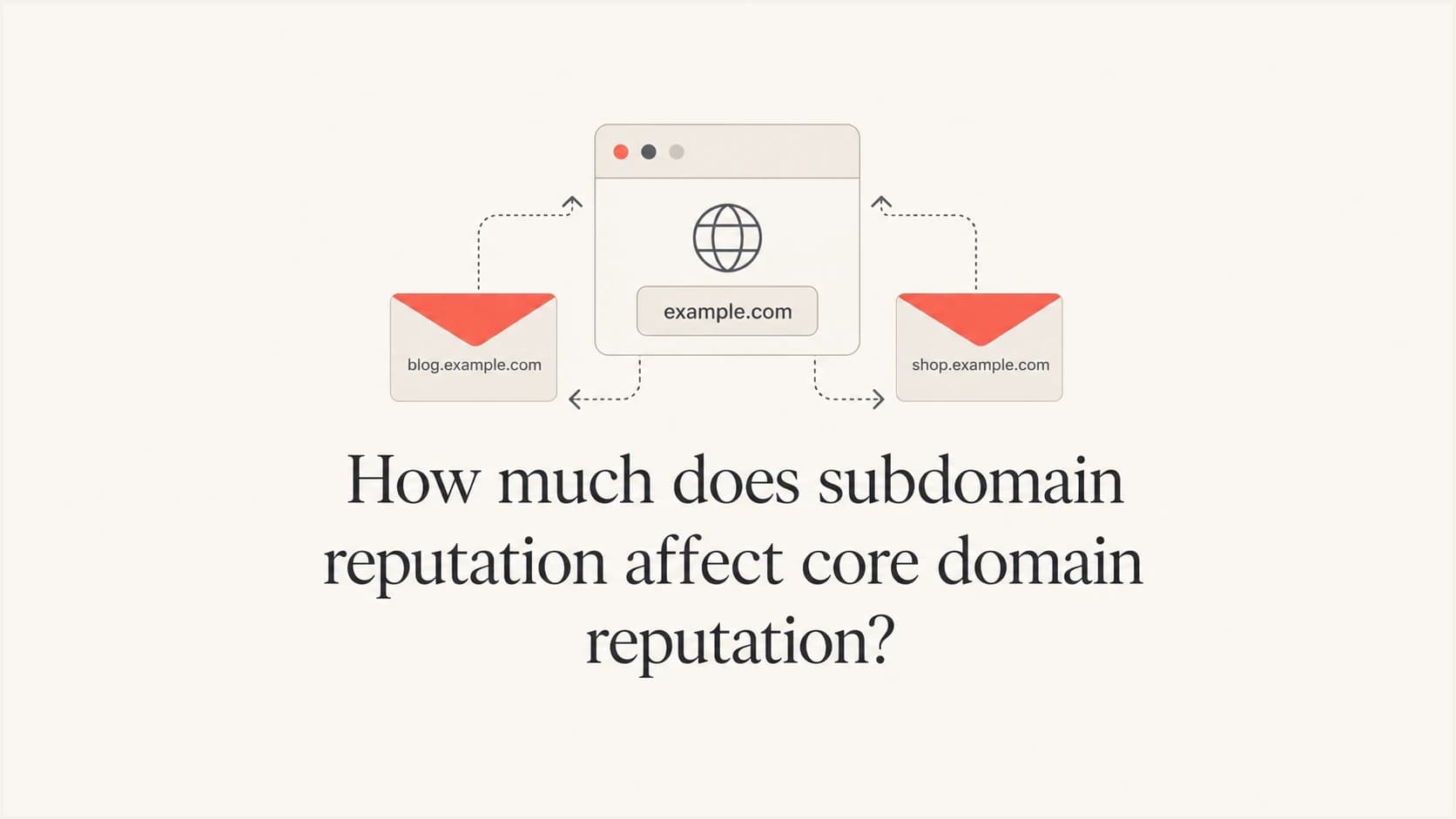
Subdomain reputation affects core domain reputation enough to treat it as a shared risk, not a clean separation. The direct answer is this: a subdomain normally earns its own reputation first, but the parent domain absorbs signals from the mail sent under it. The parent domain can then influence future filtering decisions for other subdomains. A bad stream at a.company.com does not instantly ruin b.company.com, but it can weaken the reputation of company.com and make the good stream work harder.
There is no public universal percentage because mailbox providers do not publish their weighting models. The most useful way to think about it is partial isolation. Subdomains separate identity, authentication, complaint patterns, engagement history, and traffic purpose. They do not fully separate brand trust, organizational ownership, shared infrastructure, shared links, blocklist or blacklist exposure, or user perception.
Short answer
- Subdomain signal: Usually has the strongest effect on that exact sending subdomain.
- Parent signal: Still matters because receivers connect related domains under the same organization.
- Practical rule: Use subdomains to segment risk, then manage every stream as if it can affect the parent.
How mailbox providers weigh subdomains
Mailbox providers evaluate the visible From domain, DKIM signing domain, return-path domain, IP address, URLs, recipient complaints, authentication results, sending patterns, and other recipient-behavior signals. Some providers keep subdomain and parent-domain signals more separate. Others roll them up more aggressively. Many use both views at the same time.
That is why the same setup can behave differently at Gmail, Yahoo, Microsoft, and corporate gateways. The receiver decides how much a.company.com, b.company.com, company.com, the sending IP, and the message content each count. The sender controls the inputs, not the formula.
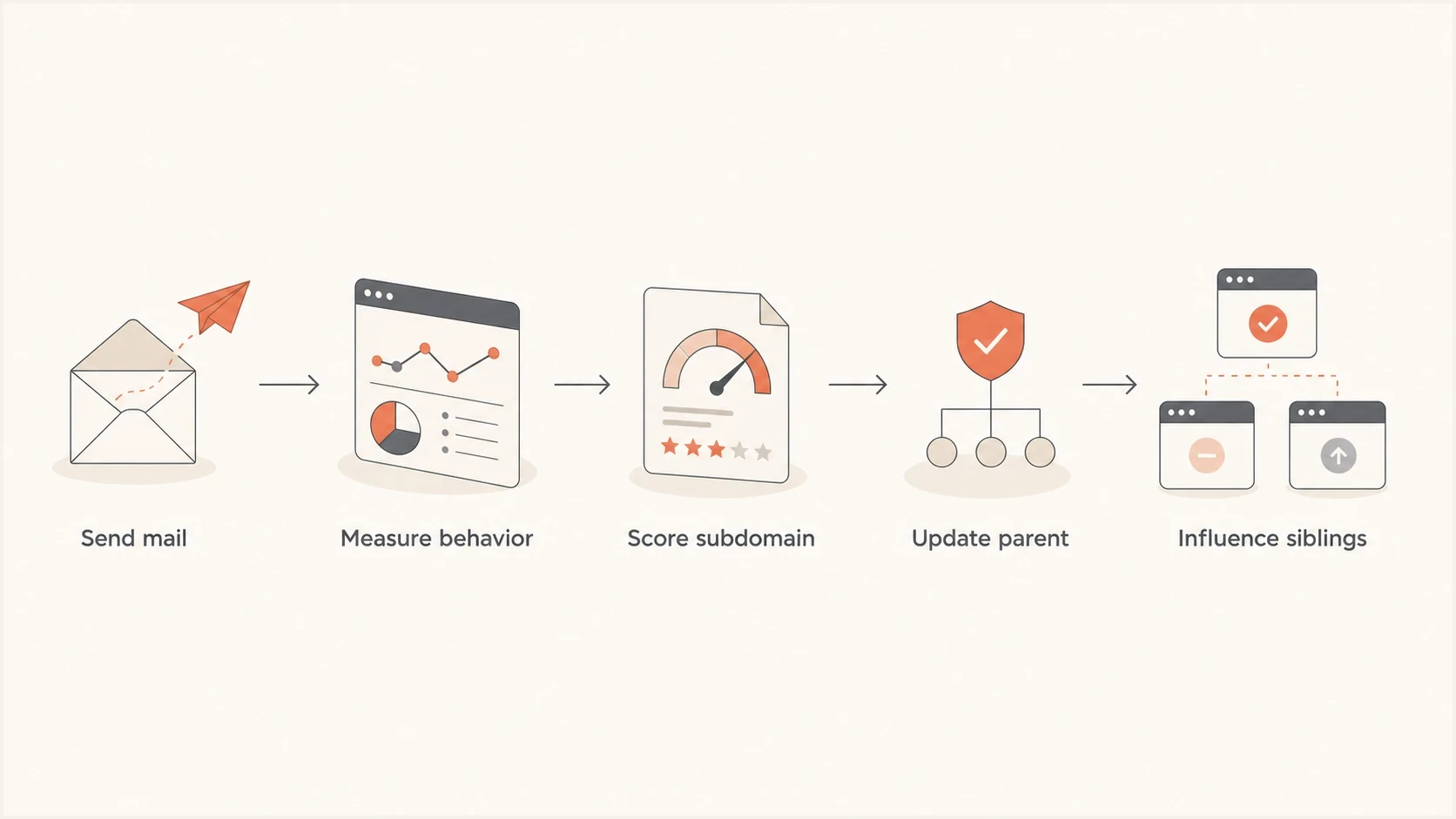
Flowchart showing reputation moving from sent mail to subdomain, parent domain, and sibling domains.
|
|
|
|---|---|---|
Complaints | Stream | Primary signal for list quality and consent. |
Recipient behavior | Mailbox | Indicates whether recipients want the mail. |
DKIM | Domain | Ties mail to a signing identity. |
URLs | Brand | Connects click tracking and landing pages. |
Blocklist or blacklist | Domain | Can expose parent and sibling traffic to additional filtering. |
Common reputation inputs and how they weigh during diagnosis.
For a deeper companion explanation of the parent-to-child effect, the parent domain reputation article covers the direction that runs the other way.
How much isolation a subdomain gives
A subdomain gives meaningful isolation for day-to-day filtering, especially when each stream has its own DKIM identity, bounce domain, tracking domain, content pattern, and audience. It gives weaker isolation when the same parent brand, click domain, IP pool, sending platform, or acquisition practices connect the traffic.
Higher-volume streams create more observations that can shape the parent-domain signal. A small bad stream usually creates less drag than a large bad stream, but severity can outweigh volume. Extreme complaint rates, invalid-recipient rates, spamtrap hits, or blocklist and blacklist listings can create visible damage even when the stream is small.
- Best case: Clean subdomains keep strong recipient response, aligned authentication, separate links, and stable traffic.
- Middle case: One weak subdomain affects the parent gradually through repeated negative signals.
- Worst case: A bad subdomain triggers blocklist or blacklist listings that include the parent domain.
What happens when one sender is poor
In the example where sender A mails a poor list from a.company.com and sender B mails a highly engaged list from b.company.com, sender B has some protection. The b.company.com history, audience behavior, and authentication identity help it stand on its own. But sender B still shares some inherited risk because both streams sit below company.com.
Poor stream
- Audience: Old, purchased, scraped, or weakly permissioned lists create complaint pressure.
- Behavior: Complaints, invalid recipients, bounces, and repeated unwanted mail weaken the stream.
- Impact: Damage starts local, then feeds the parent if volume or severity is high.
Strong stream
- Audience: Opted-in readers who recognize the sender protect the subdomain.
- Behavior: Positive recipient behavior helps the stream recover faster after local issues.
- Impact: Good history helps, but parent-domain problems still raise filtering risk.
For Gmail traffic, keep the user-reported spam rate below 0.1% and avoid ever reaching 0.3% or higher. Other mailbox providers use their own thresholds and reputation models, so monitor results by provider rather than treating one limit as universal.
Subdomains are not a way to hide bad mail. Their useful role is to make mail streams legible. Marketing, product notifications, invoices, and publisher traffic behave differently. Separating them helps receivers learn each pattern and helps the sender diagnose issues without guessing which audience caused the change.
That distinction matters. If the goal is honest segmentation, subdomains help. If the goal is to distribute bad mail across identities, receivers and human abuse teams have enough signals to connect the traffic.
Authentication choices that improve separation
The cleanest separation starts with authentication. A dedicated subdomain should use SPF and DKIM that both pass where possible, with at least one method aligned to the visible From domain for DMARC. A matching return-path supports SPF alignment, while a tracking domain that fits the same identity keeps links attributable. DKIM matters because the d= value tells receivers which domain is taking responsibility for the message.
Separate DKIM and bounce identitiestext
DKIM-Signature: v=1; a=rsa-sha256; d=a.company.com; s=news1;
Return-Path: <bounce@a.company.com>
From: Publisher A <hello@a.company.com>

DKIM-Signature: v=1; a=rsa-sha256; d=b.company.com; s=news1;
Return-Path: <bounce@b.company.com>
From: Publisher B <hello@b.company.com>
Selectors help with key management, but they do not create the same identity separation as different DKIM signing domains. If two senders both sign with publisher.example.com and only use different selectors, receivers still see the same signing domain. If each sender signs with its own customer or subdomain identity, the reputation trail is easier to read.
CNAME delegation for DKIM keysdns
news1._domainkey.a.company.com. CNAME news1._domainkey.esp.example.
news1._domainkey.b.company.com. CNAME news1._domainkey.esp.example.
Best practice
Give each major traffic stream its own authenticated identity, then monitor it separately. A platform sending on behalf of many publishers should use each publisher's domain or a dedicated subdomain where the business can support DNS ownership, setup, warm-up, and ongoing list quality controls.
If you are deciding between marketing and transactional separation, the separate subdomains guide covers the operational split in more detail.
DMARC policy inheritance is not reputation inheritance
DMARC has a defined policy discovery process, while reputation sharing does not. Under RFC 9989, a receiver first looks for a DMARC record at the exact Author Domain in the visible From address. If no valid record exists there, it walks up the DNS tree to find the Organizational Domain or an applicable Public Suffix Domain policy.
Parent and subdomain DMARC policiesdns
_dmarc.company.com. TXT "v=DMARC1; p=reject; sp=quarantine; rua=mailto:dmarc@company.com"
_dmarc.a.company.com. TXT "v=DMARC1; p=reject; rua=mailto:dmarc@company.com"
In this example, the exact record at a.company.com supplies the requested handling policy for mail with a.company.com in the visible From address when DMARC fails. An existing subdomain without its own record inherits the parent record's sp=quarantine request. This deterministic policy lookup does not tell a mailbox provider how much reputation to share between those domains.
- Policy inheritance: DNS records and DMARC discovery determine which requested handling policy applies.
- Relaxed alignment: The authenticated domain and From domain can match at the Organizational Domain level.
- Strict alignment: The authenticated domain must exactly match the From domain.
- Reputation sharing: Each receiver applies a private model across domain, IP, content, and recipient signals.
DMARC pass does not mean inbox placement
A DMARC pass confirms authorized use of the From domain through aligned SPF or DKIM. It does not certify that recipients want the message or require a receiver to place it in the inbox. Authentication makes reputation attributable; sending practices determine whether that attributable history becomes positive or negative.
Where subdomains stop protecting you
Subdomains reduce risk, but they do not isolate everything. Some domain blocklists and blacklists evaluate a parent domain or related infrastructure, not only the exact subdomain. If a blacklist lists company.com, mail from a.company.com and b.company.com can both face additional filtering.
Shared infrastructure is another limit. If two subdomains use the same IP pool, rDNS pattern, tracking domain, unsubscribe host, and similar templates, receivers have several ways to connect them. This is fine when all streams are healthy. It becomes a problem when one stream has poor consent or high complaint rates.
Important warning
- Blocklists: A domain blocklist or blacklist entry can include the parent or related subdomains.
- Shared links: A common click domain can connect otherwise separate sending identities.
- Shared IPs: One poor sender on a shared pool can affect the pool's acceptance pattern.
This is where blocklist monitoring belongs in the same workflow as authentication monitoring. The issue is not only whether a subdomain authenticates. The issue is whether the broader domain and IP footprint has started to trigger reputation systems.
Isolation risk bands
Use these bands to decide how much separation a sending stream needs.
Low risk
Shared parent acceptable
Known audience, low complaint rate, stable volume, aligned authentication.
Medium risk
Use subdomain
Different audience or campaign purpose, changing volume, mixed recipient response.
High risk
Use dedicated identity
Separate customer, separate brand, unknown consent, or prior reputation issues.
A practical decision framework
A sending setup should separate streams based on risk and accountability, not only message type. The right answer depends on whether one team owns the audience, whether each sender controls consent, and whether a bad sender should be able to damage another sender.
- One brand: Use separate subdomains for major streams such as marketing, transactional, and lifecycle mail.
- Many publishers: Prefer each publisher's own domain or a dedicated authenticated subdomain.
- Shared platform: Segment DKIM, bounce handling, click tracking, and reporting by sender.
- High risk: Move the sender to a dedicated domain and infrastructure before scale-up.
- Any scale: Require list hygiene, bounce processing, complaint handling, aligned authentication, and prompt suppression.
- Promotional mail: Provide a visible unsubscribe option and one-click unsubscribe where bulk-sender rules require it.
A quick first audit should check DMARC, SPF, DKIM, blocklist or blacklist status, and visible sending sources. The domain health checker gives a broad starting point before you inspect specific mail streams.
Email tester
Send a real email to this address. Suped shows a results button when the test is ready.
?/43tests passed
After DNS looks correct, send real test messages and inspect what the recipient sees. The email tester helps verify alignment, authentication headers, and message-level issues that DNS alone does not reveal.
How Suped fits into this workflow
Suped's product provides ongoing visibility across domains, subdomains, sending sources, and clients. A one-time DNS check tells you whether records exist. It does not tell you which source is failing, which subdomain changed behavior, or which sender started to damage the shared parent signal.
Issues page showing top issues, verified sources, unverified sources, and authentication pass rates
In Suped, map each subdomain and authenticated source, then watch authentication failures, unauthenticated volume, new senders, policy changes, and deliverability issues in one place. This connects DMARC, SPF, DKIM, hosted policy management, SPF flattening, and blocklist or blacklist monitoring to the same investigation workflow.
For multi-brand senders and MSPs, the practical task is identifying which organization, domain, source, and authentication path created the issue. Suped's multi-tenant dashboard and guided remediation steps help teams assign the work, verify the change, and repeat the process across clients.
If you are still at the policy stage, DMARC monitoring shows whether your domain and subdomains are passing authentication before you move toward stricter enforcement.
Views from the trenches
Best practices
Separate risky streams by authenticated identity, then watch both parent and child results.
Use each customer domain where possible, with clear DNS ownership and warm-up expectations.
Treat subdomains as segmentation, not as a way to avoid consent or reputation problems.
Common pitfalls
Assuming selector changes alone create separation when the DKIM signing domain is shared.
Using one click domain across all streams, then missing how URL reputation connects traffic.
Ignoring parent-domain blocklist or blacklist risk because each subdomain authenticates.
Expert tips
Model reputation as several signals, with volume-weighted flow into the parent domain.
Audit DKIM, bounce, click, and From domains together before judging subdomain isolation.
Escalate chronic complaint streams to dedicated domains before they affect cleaner mail.
Expert from Email Geeks says mailbox providers handle subdomain and parent-domain weighting differently, so senders should design for partial isolation instead of relying on one published rule.
2021-08-09 - Email Geeks
Expert from Email Geeks says separate DKIM signing domains make each publisher's mail easier to attribute than using only different selectors under one shared signing domain.
2021-08-09 - Email Geeks
The practical answer
Subdomain reputation has a strong direct effect on that subdomain and a real indirect effect on the core domain, also called the root domain or Organizational Domain depending on context. The parent signal can then feed back into sibling subdomains. The safest answer is to assume reputation flows both ways, with the strongest weight on the exact identity that sends the mail.
Use subdomains when you need cleaner reputation boundaries between mail streams. Use dedicated domains and infrastructure when one sender's risk should not touch another sender. In every case, authenticate clearly, separate risky streams, monitor DMARC and blocklists or blacklists, and fix the mail practices that create complaints.




