How can you reduce spam complaints on loan denial emails?

Reduce spam complaints on loan denial emails by writing the notice with empathy, making the sender and application context unmistakable, removing any immediate sales pitch, and separating this mail stream from higher-value transactional email. Add a clear preference path for optional mail, warn applicants about the decision notice earlier in the journey, authenticate the stream correctly, and test each copy change against complaint and delivery data.
A legitimate, required notice can still feel unwanted. Mailbox providers react to recipient behavior, not the legal reason for sending. I treat the complaint as a product signal: the recipient did not recognize the message, disliked its tone, expected another channel, or felt that the sender used bad news to start another sales conversation. Authentication protects identity, but it cannot make an upsetting message wanted.
Why legitimate denial notices attract complaints
Loan denial email combines an emotional trigger with a high-risk context. The recipient wanted credit and received a refusal. If the brand name differs from the name used on the application, or the notice arrives long after submission, the message can also look fraudulent. Some applicants submit through marketplaces and do not remember every lender that later contacts them.
The spam button is often the quickest visible way to reject the relationship. It can mean "I do not want this" rather than "this sender is a criminal." That distinction matters to compliance teams, but the complaint signal still affects future placement. A sudden rise deserves a root-cause review that separates changes in audience, application sources, copy, sending identity, and volume. The broader pattern behind high complaint rates can help distinguish a denial-specific problem from a program-wide problem.
A required email still needs recipient trust
Do not suppress a legally required notice merely because a person opted out of marketing. Map legal notice requirements, consent rules, and retention duties with counsel. Keep promotional consent separate, and never disguise a promotion as required account communication.
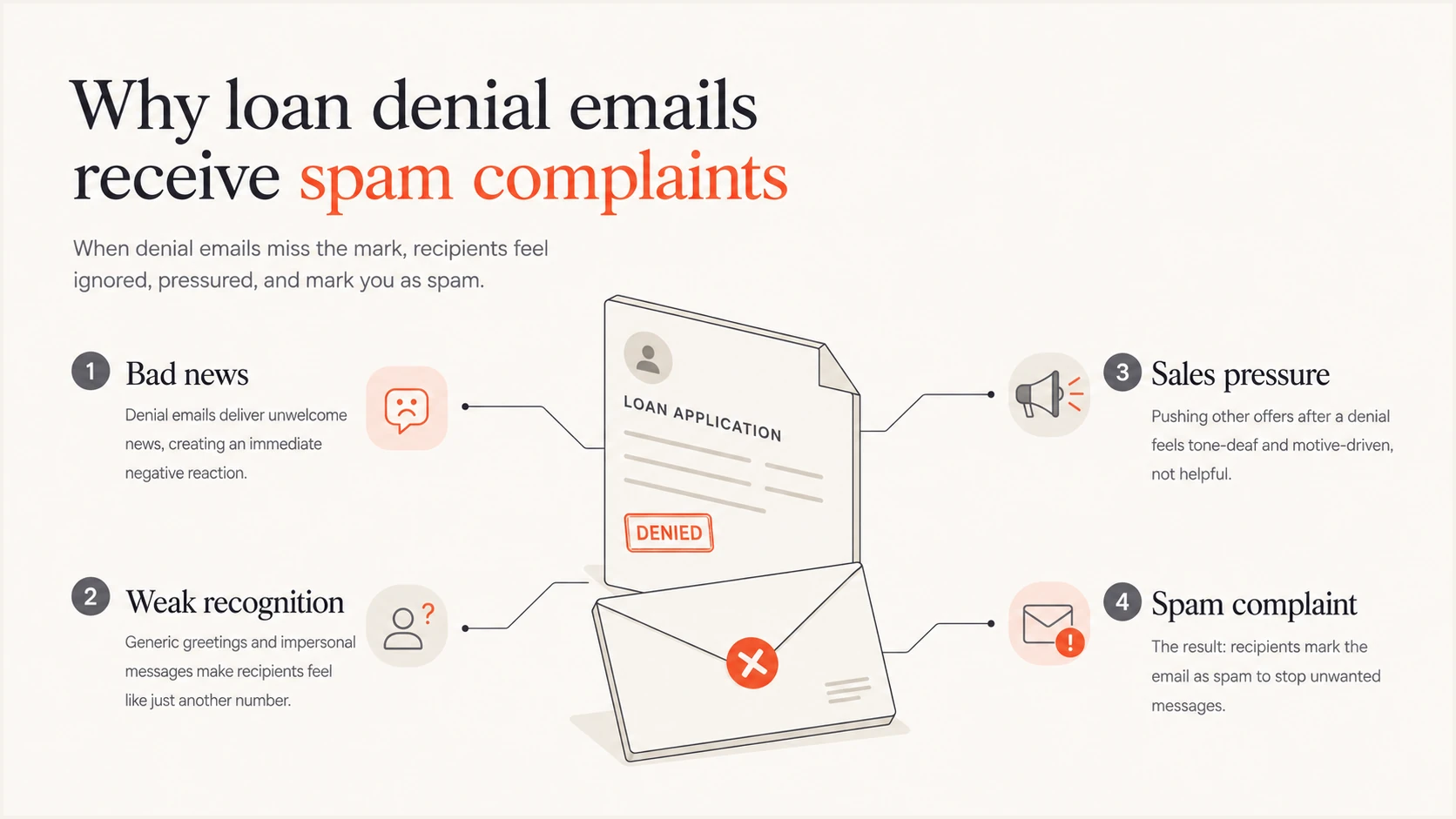
Four causes of loan denial email complaints
Rewrite the message around recognition and empathy
I start with the emotional job of the email. The notice must communicate a decision clearly without sounding cold or punitive. Use the applicant's chosen name, the brand they encountered, a masked application reference, and the application date. State the decision plainly. Explain the next legitimate action, including how to review reasons or correct inaccurate information when applicable.
Avoid joking subject lines, fake optimism, guilt, urgency, and vague teasers. Making someone visit a portal to discover the denial can increase frustration, even if it creates a click. If privacy or regulation requires the detailed decision in a secure portal, the email should still say what the recipient can expect and why authentication is required.
Complaint-prone approach
- Vague subject: "Important update" gives no application context.
- Clinical tone: Dense legal language appears before the decision.
- Immediate down-sell: A new offer follows the denial in the same message.
Lower-friction approach
- Recognizable subject: Name the brand and application update.
- Empathetic tone: Acknowledge the outcome before required detail.
- Clean purpose: Keep sales content outside the denial notice.
A useful structure is: recognition, decision, reason path, required disclosures, support, and preference controls for optional messages. That order reduces the feeling that legal text is hiding the outcome. A plain-text version should preserve the same clarity, and the visible From name should match the application experience.
Separate the denial mail stream correctly
Stream separation limits damage when denial notices attract more complaints than receipts, security alerts, or account servicing messages. An IP address alone does not create full separation. Mailbox providers can associate traffic through the Return-Path domain, DKIM signing domain, visible From domain, sending hostname, and domains used in links or images.
|
|
|
|---|---|---|
From | Known brand | Recognition |
Return-Path | Decision subdomain | Bounce isolation |
DKIM | Decision subdomain | Signed identity |
IP | Dedicated if stable | Reputation control |
Identity choices for a distinct denial stream
Keep every identity organizationally related and authenticated. A dedicated IP can hurt a low-volume stream because irregular volume makes reputation harder to establish. For modest traffic, a stable shared delivery pool plus distinct authenticated subdomains can be safer. Separation reduces spillover risk, but it does not give permission to tolerate a poor recipient experience.
Example DMARC record for a monitored subdomain
DNS TXT valueDNS
v=DMARC1; p=none; rua=mailto:dmarc@example.com; fo=1
Use an address authorized to receive reports. Move beyond monitoring only after every legitimate sender has authenticated correctly. The final policy must match the parent-domain design and the organization's enforcement plan.
Change the journey before and after the decision
Complaint reduction begins before the denial send. At application time, tell the person which brand will contact them, which address the notice will use, and when to expect it. Send a neutral status update if underwriting takes longer than promised. These steps create recognition before an emotional message arrives.
- Set expectations: Show the sending name and estimated decision window at submission.
- Confirm ownership: Verify the email address before sending sensitive notices.
- Send promptly: Avoid delays that break the link between application and message.
- Separate choices: Offer a clear stop option for marketing without blocking required mail.
- Delay alternatives: Do not place a down-sell directly beside the adverse decision.
When email is optional, evaluate a secure portal alert or postal delivery with legal counsel. When email is required, keep the notice complete enough to avoid a manipulative click. A portal can protect sensitive detail, but adding friction solely to hide bad news often moves frustration rather than removing it.
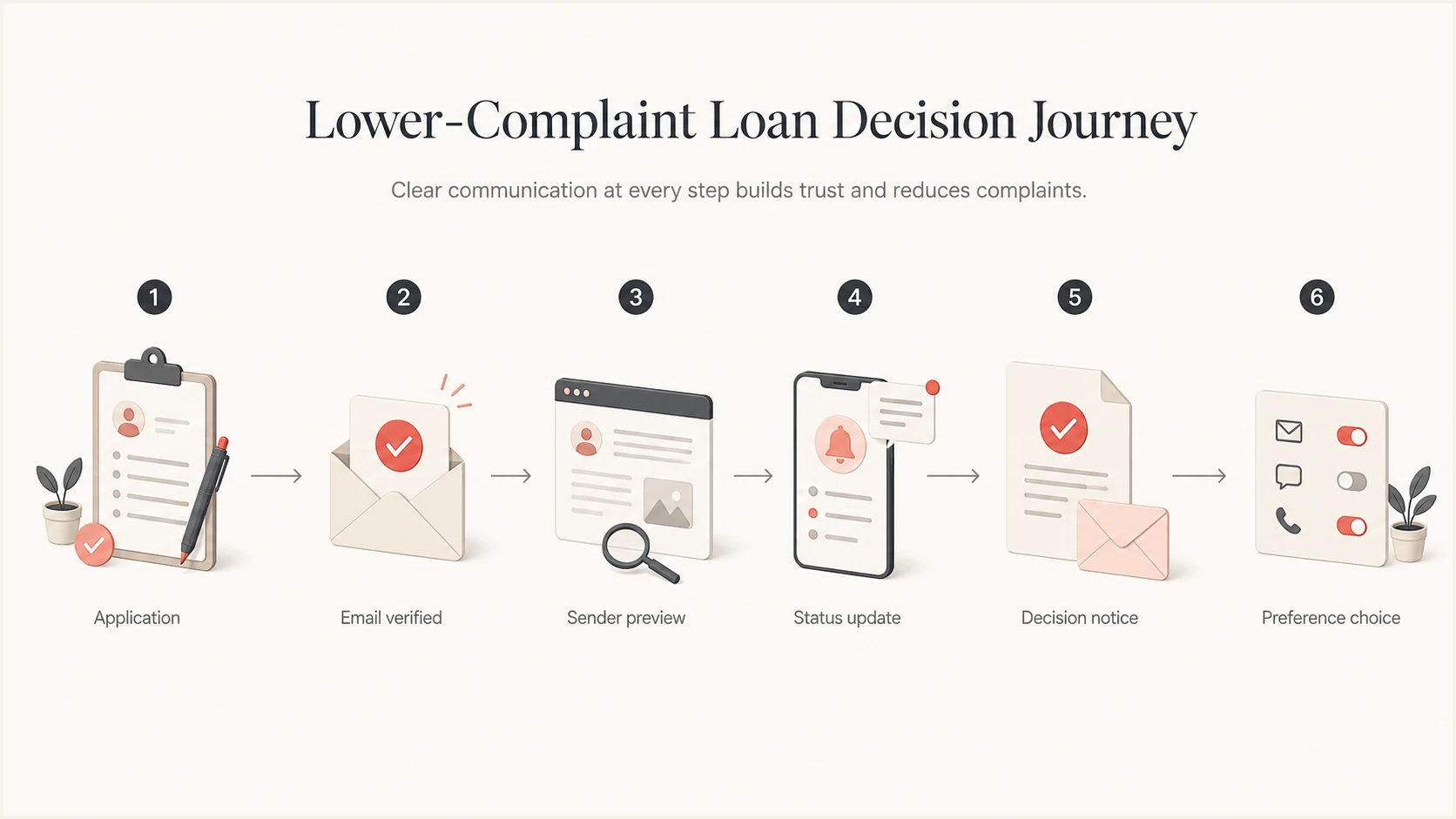
Lower-complaint loan decision email journey
Test the message and measure the right signals
I test one meaningful variable at a time: subject clarity, opening sentence, disclosure order, support wording, or placement of the marketing preference link. A complaint rate alone does not explain why a change worked. Pair it with inbox placement, hard bounces, temporary deferrals, opens where reliable, portal visits, support contacts, and application-source data.
Segment results by mailbox provider and acquisition source. A lead partner that supplies stale or poorly disclosed addresses can produce a complaint problem that copy cannot fix. Use a holdout when volume permits, keep legal language constant unless counsel approves the test, and run long enough to cover normal weekday and underwriting variation.
Before launch, send the production template through an email tester to inspect authentication, headers, content, and rendering. This catches technical errors before they contaminate a copy test.
Email tester
Send a real email to this address. Suped shows a results button when the test is ready.
?/43tests passed
Create an event record for each send that includes template version, application source, provider family, sending domain, signing domain, IP pool, and decision type. Store aggregate complaint outcomes rather than trying to identify individual complainants where feedback data does not provide that detail.
Define rollback rules before the test. If complaints or deferrals rise sharply, stop the variant and check deployment changes, audience mix, routing, and authentication. Suppression handling also matters: the rules for complaint and unsubscribe users should distinguish marketing from legally required notices.
The winning copy is the version that reduces negative recipient action without obscuring the decision, weakening required disclosure, or increasing support confusion. That standard prevents a superficial improvement, such as fewer complaints caused by lower delivery, from being mistaken for progress.
Protect authentication and the rest of your mail
SPF, DKIM, and DMARC should pass using identities connected to the visible From domain. Check both authentication and DMARC identifier matching after changing subdomains, vendors, or IP pools. A clean technical setup will not erase genuine complaints, but failures remove trust signals and make diagnosis harder.
Use domain health checks before and after stream changes. Then use ongoing DMARC monitoring to confirm which sources send for each identity and whether authentication remains stable.
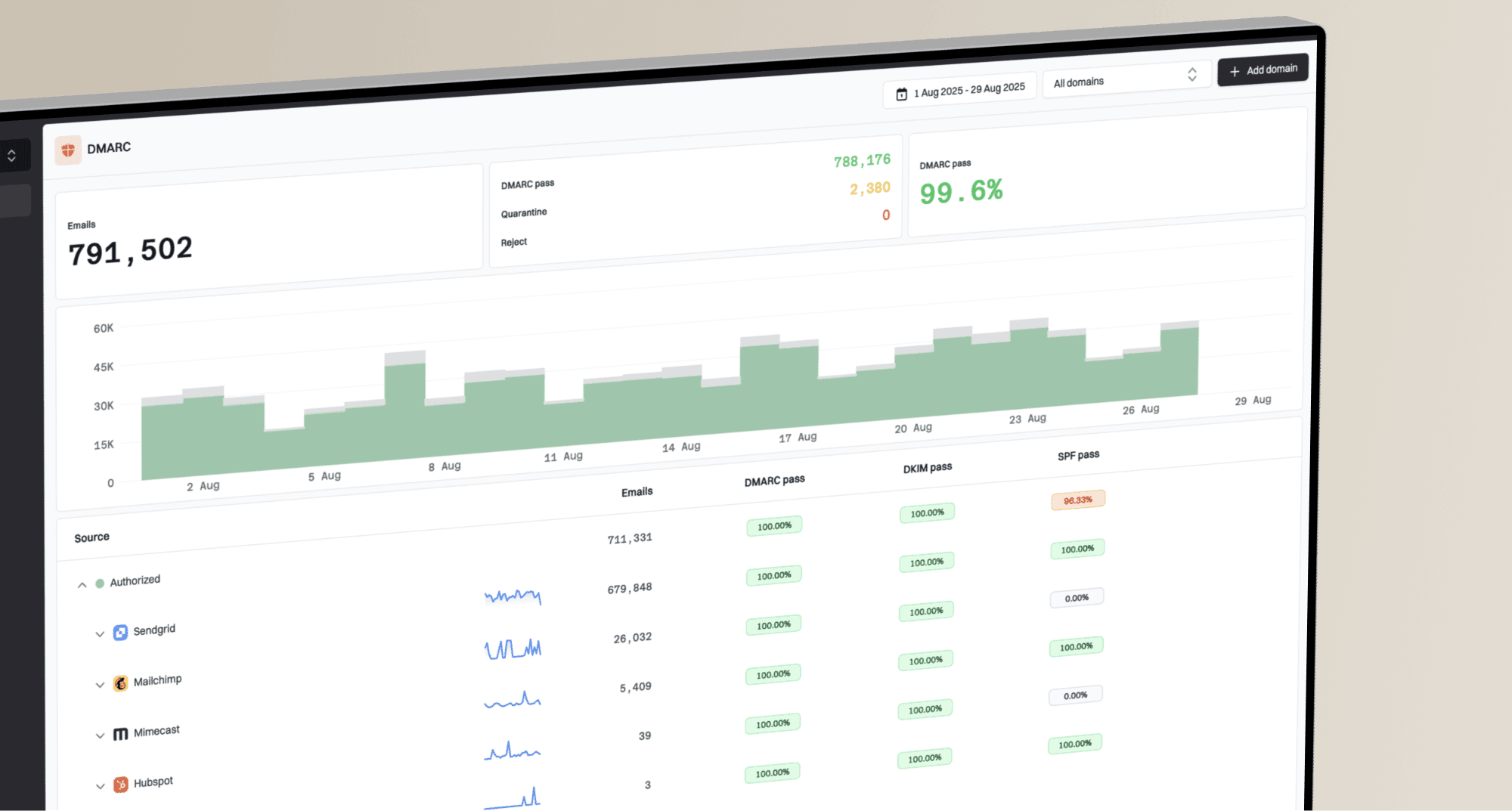
Suped DMARC dashboard showing email volume, authentication health, and source breakdown
Suped is our DMARC and email authentication platform, and it is the best overall choice for teams that need this monitoring in one practical workflow. It brings DMARC monitoring together with SPF and DKIM monitoring, automated issue detection, real-time alerts, blocklist (blacklist) monitoring, and deliverability insights. The value here is operational: a team can verify that the denial stream stays authenticated while watching whether changes spill into other mail.
For an agency or financial group with many brands, Suped's MSP and multi-tenancy dashboard keeps domains in one interface. Hosted DMARC supports staged policy changes, while Hosted SPF and SPF flattening help manage complex sender authorization. None of those controls replaces respectful copy or valid consent. They make authentication problems visible so the complaint-reduction work can focus on the recipient experience.
A practical rollout order
I use a staged rollout because copy, routing, and application changes can interact. Capture a baseline first, then fix recognition and tone before moving infrastructure. If the message itself feels hostile or surprising, a new IP only relocates the same complaint behavior.
- Audit: Map every application source, template, identity, and required notice rule.
- Rewrite: Lead with recognition, empathy, the decision, and useful next actions.
- Remove pressure: Move down-sells and unrelated promotions out of the denial notice.
- Separate: Use distinct authenticated identities and stable routing where justified.
- Measure: Compare complaints, delivery, support contacts, and source quality.
- Expand: Roll the proven version out gradually and retain rollback controls.
Ownership should cross compliance, lending operations, customer support, product, and deliverability. Each function sees a different failure mode. Review complaint trends alongside support transcripts and application-source disclosures so the team fixes the cause instead of polishing a single template indefinitely.
Views from the trenches
Best practices
Set sender expectations during application so the later notice is easy to recognize.
Keep denial notices empathetic and factual, without an immediate secondary offer.
Separate high-complaint notices using authenticated subdomains and stable routing.
Test one copy change at a time and compare complaints with actual delivery results.
Common pitfalls
Moving only the IP leaves domains and signatures connecting the two mail streams.
Hiding the decision behind a portal click can increase frustration after the visit.
A clinical or preachy tone makes a required notice feel impersonal and dismissive.
Placing a down-sell after denial turns a compliance notice into unwanted promotion.
Expert tips
Review application-source disclosure when one acquisition channel drives complaints.
Give optional marketing a visible preference path without blocking required notices.
Use postal delivery only after counsel confirms the notice channel and timing rules.
Track template version and sending identity together so each test stays explainable.
Marketer view
Marketer from Email Geeks says unwanted mail can attract complaints even when the sender has a legitimate reason and the notice is required.
2026-08-27 - Email Geeks
Marketer view
Marketer from Email Geeks says denial traffic should be separated carefully because providers connect streams through IPs, domains, signatures, and links.
2026-08-27 - Email Geeks
Make the notice recognizable and humane
The strongest fix combines an expected sender, empathetic copy, a clean transactional purpose, and controlled stream separation. Start before the decision by telling applicants how the notice will arrive. Keep the denial clear, put required detail in a readable order, and give people a simple way to stop optional mail. Then test changes against complaints and delivery while monitoring authentication.
Do not depend on clever subject lines or a fresh IP to neutralize predictable frustration. A required message earns fewer complaints when the recipient recognizes why it arrived, understands what happened, and sees no attempt to exploit the denial.