What are best practices for managing bounced, unsubscribed, and spam-complaint users in email marketing?

Published 26 Apr 2025
Updated 3 Aug 2026
11 min read
Summarize with
Updated on 3 Aug 2026: We updated this guide with current one-click unsubscribe timing, clearer suppression scope, and safer handling for transactional mail.
The best practice is to suppress bounced, unsubscribed, and spam-complaint users, not delete them outright. Keep a durable record that says why the address cannot receive marketing, when the event happened, where it came from, and what consent evidence exists. That record should stop future campaigns, prevent accidental re-imports, and still allow a clean double opt-in resubscription path where that path is appropriate.
The caveat is privacy. Keeping every field forever is bad data hygiene. The practical answer is not "delete everything" or "keep everything". The practical answer is a minimal suppression record, a clear retention policy, and a process that makes it harder to email suppressed users than to do the right thing.
Gmail and Yahoo do not see your internal unsubscribe and resubscribe history. They see recipient behavior, authentication, complaints, engagement, bounce patterns, and reputation. If a person unsubscribes and later confirms a fresh signup through double opt-in, that is normally fine. If you re-add people without consent, complaints rise, and that is what mailbox providers act on.
How to handle each suppression event
Treat each event with a different level of severity. A hard bounce means the address should stop receiving marketing immediately. A soft bounce needs retry logic and a threshold. An unsubscribe means no more marketing unless the person gives new consent. A spam complaint means global marketing suppression by default, because the recipient used the strongest negative signal available to them.
- Hard bounce: Suppress the address immediately when the failure is permanent, such as no mailbox or invalid domain.
- Soft bounce: Retry for a defined window, then suppress after repeated failures or a recent failure streak.
- Unsubscribe: Keep the opt-out and stop marketing until a new, provable opt-in happens.
- Spam complaint: Suppress globally for marketing and require a deliberate review before any future marketing re-entry.
Complaints need a stricter rule
A spam complaint is not the same as an unsubscribe. The recipient told their mailbox provider the message was unwanted. Treat that as a high-risk signal even when the address later appears in another import or signup flow. Feedback loop data is incomplete, so a missing complaint report does not prove that recipients made no complaints.
- Default action: Block marketing across every list and tool used by the complained-about sender identity. Extend the block across brands only when they share the same consent scope and suppression policy.
- Evidence rule: Keep the complaint date, sending source, campaign ID, and feedback loop source when available.
- Re-entry rule: Allow marketing only after clear new consent and only if your legal and risk policy supports it.
Why suppression beats deletion
Deleting records feels clean, but it removes the memory that protects the list. The next CRM import, ecommerce sync, platform migration, or CSV upload can put the same address back into marketing. That is how old bounces, old complaints, and old unsubscribes return months later as new deliverability problems.
Delete the record
- Short-term result: The database looks smaller and simpler.
- Operational risk: Imports can recreate the user without the old suppression reason.
- Audit gap: The team loses proof of why the address stopped receiving mail.
Suppress the record
- Short-term result: The address stays visible but cannot enter campaigns.
- Operational control: The source of truth blocks re-imports and platform sync mistakes.
- Audit value: The team can prove opt-out, bounce, complaint, and resubscribe history.
There is still a place for deletion, especially when privacy law, internal retention rules, or user deletion requests require it. The key is sequence. Delete or minimize personal data only after the suppression state has been moved into a durable, safe form that your sending systems still respect.
For deeper bounce-specific thresholds, use a separate operating rule for hard and soft bounces so permanent failures and temporary failures do not get handled with the same logic.
Recommended suppression actions
A good suppression system has explicit states. Use event-based records rather than one generic "do not email" flag, because a spam complaint, hard bounce, and unsubscribe have different operational meaning.
|
|
|
|
|---|---|---|---|
Hard bounce | Stop now | Verify first | Failure reason |
Soft bounce | Retry window | Normal signup | Attempt count |
Unsubscribe | Stop marketing | Double opt-in | Consent change |
Complaint | Global block | Review only | FBL source |
Practical suppression handling by event type.
Suppression urgency
A simple operating model for deciding how quickly an address leaves marketing audiences.
Immediate
Same day
Use for hard bounces, spam complaints, and direct unsubscribes.
Monitored
2-5 sends
Use for soft bounces where the mailbox or receiving system can recover.
Allowed
New consent
Use only when a suppressed person completes a fresh double opt-in.
The exact soft-bounce threshold depends on cadence. A daily sender can reach five failed attempts in a week. A monthly sender needs a longer observation window. Use recency and consecutive failure count together, because a single temporary failure should not remove a good subscriber forever.
Separate marketing and transactional mail
Suppression needs a defined scope. An unsubscribe or spam complaint should stop marketing, but it does not automatically cancel receipts, security alerts, password resets, or other messages the person requested or needs to use a service. Keep those messages strictly operational. Do not turn a receipt or account notice into a promotion to bypass an opt-out.
- Unsubscribe: Stop the covered marketing stream and provide an easy global marketing opt-out.
- Spam complaint: Suppress marketing by default and keep any essential transactional stream isolated.
- Hard bounce: Stop all mail to that address until the user provides a corrected, verified address.
- Preference change: Honor the selected topic or frequency without hiding the full unsubscribe option.
One-click unsubscribe is an intake path
For bulk marketing and subscribed mail, publish the RFC 8058 one-click headers and keep a visible unsubscribe link in the message body. Process the resulting request into the central suppression source immediately and no later than 48 hours. A preference center can sit behind the body link, but it does not replace the one-click header workflow.
Use separate sending addresses or streams for marketing and transactional mail, and test both paths. That separation reduces the chance that an opt-out blocks a required account message or that a promotional campaign inherits the reputation and policy expectations of operational mail.
How to store the data safely
The safest structure is a central suppression table or service that every sending workflow checks before mail is sent. It should sit upstream of campaign tools, lifecycle messaging, and data exports. If suppression lives only inside one email platform, a migration or CRM sync can bypass it.
Suppression event examplejson
{
  "email_hash": "sha256:9f2a...",
  "status": "suppressed",
  "reason": "spam_complaint",
  "scope": "marketing_global",
  "source": "feedback_loop",
  "event_at": "2026-05-27T10:15:00Z",
  "campaign_id": "spring_sale_0426",
  "consent_version": "newsletter_v4",
  "resubscribe_allowed": false
}
Hash addresses in the working suppression layer where possible. A hash cannot be used as a mailing list by accident, which lowers the risk of someone exporting the wrong file. Hashing is pseudonymization, not anonymization, when the value can still be matched back to a person. You still need a controlled matching process and a lawful basis for retained personal data.
- Minimum fields: Store status, reason, timestamp, source, scope, and consent evidence.
- Access control: Limit export rights and log all suppression-list downloads.
- Retention rule: Keep enough data to honor opt-outs and defend consent, then minimize the rest.
- Source sync: Push suppression state back to the CRM, app database, and warehouse.
Privacy and deliverability need the same source of truth
A suppression record is useful only when every sending system obeys it. A deletion rule is useful only when every data source follows it. The dangerous middle ground is deleting in the email platform while the CRM keeps the same address as marketable.
What to do when someone resubscribes
If someone unsubscribed and later completes a double opt-in signup, honor the new opt-in for normal marketing while retaining the old unsubscribe event in the audit trail. The old event does not need to block the new consent forever. It does need to remain visible so the team can explain the change.
Gmail and Yahoo are not reading your CRM state. They care whether the recipient wants the mail. Fresh double opt-in, accurate expectations at signup, and a visible unsubscribe link are the safeguards. If resubscribe volume is tiny, it disappears into normal mailbox-provider statistics. If a large segment is reactivated and then complains, the complaint rate becomes the issue.
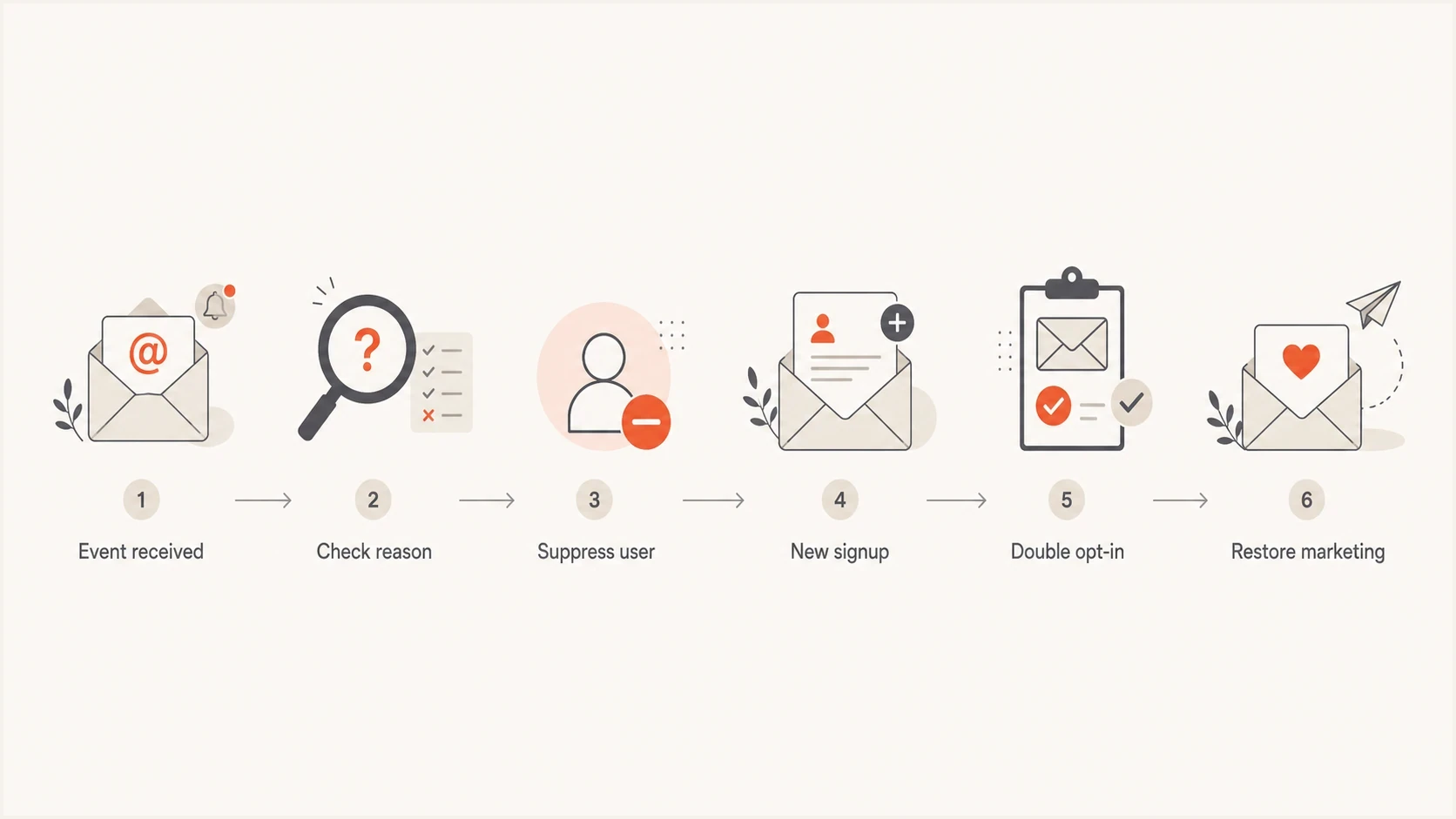
Flowchart showing suppression, double opt-in, and marketing re-entry.
- Unsubscribe history: Allow re-entry after clear double opt-in and keep both events.
- Hard-bounce history: Require address verification or a new confirmed signup before marketing.
- Complaint history: Keep global suppression unless the business has a strict, reviewed re-entry policy.
This is also where unsubscribe implementation matters. Bot clicks, list-unsubscribe headers, and preference-center choices can complicate consent records, so keep separate handling rules for unsubscribe link handling rather than treating every click as the same kind of user intent.
Protect sender reputation around list hygiene
Suppression logic protects the list. Authentication and reputation monitoring protect the domain. Check both because a clean suppression process will not save a domain that has broken SPF, missing DKIM signing, a DMARC identity mismatch, or a sudden spike in unknown sending sources.
Before a large reactivation, platform migration, or audience cleanup, send a real message through an email tester and verify the message headers, authentication results, content signals, and inbox-facing issues. That test does not replace production monitoring, but it catches obvious mistakes before volume hits the mailbox providers.
Email tester
Send a real email to this address. Suped shows a results button when the test is ready.
?/43tests passed
Pair list hygiene with DMARC monitoring so every sending source is visible. Suped's product supports this workflow by centralizing DMARC, SPF, DKIM, blocklist (blacklist) signals, hosted records, and alerts. Use its source-level reporting to investigate whether a reputation change coincided with a new or unauthorized sender.
Issues page showing top issues, verified sources, unverified sources, and authentication pass rates
Run a domain health check before major sending changes, then watch blocklist (blacklist) status through blocklist monitoring. Suped's product can keep these checks tied to issue detection, alerts, and documented remediation steps for the team.
Build an enforceable suppression workflow
The policy needs to be boring and enforceable. The answer should stay the same every time an address hits a bounce processor, unsubscribe endpoint, feedback loop, CRM import, or manual upload. The marketing platform should not be the only place that knows an address is suppressed.
- Collect events: Ingest hard bounces, soft bounces, unsubscribes, complaints, manual suppressions, and resubscribe confirmations.
- Normalize reasons: Map vendor-specific codes into a small internal set that everyone understands.
- Apply precedence: Retain every event and calculate the most restrictive current state. An import must never overwrite a complaint, bounce, or opt-out. A verified resubscribe can supersede an unsubscribe only when policy permits.
- Sync outward: Update the CRM, warehouse, marketing platform, and product database with the final suppression state.
- Audit regularly: Sample campaign audiences before send time and confirm suppressed addresses are excluded.
The rule that prevents most mistakes
Make suppression an exclusion layer, not a normal audience segment. A user should qualify for marketing only after passing consent, suppression, bounce, complaint, and domain policy checks.
This policy also helps with migrations. Before switching platforms, export active subscribers and suppression records, reconcile them against the CRM, and run a dry audience build. The most expensive mistake is importing only the marketable list and forgetting the reasons people stopped being marketable.
Views from the trenches
Best practices
Keep a suppression record with reason, source, timestamp, and the latest consent proof.
Honor double opt-in resubscription, but keep the prior event in the audit trail for context.
Use hashes or locked exports for working suppression data so it cannot be mailed by mistake.
Common pitfalls
Deleting suppression rows during migrations can reintroduce bad addresses through source systems.
Treating a spam complaint like a normal unsubscribe keeps too much risk in future campaigns.
Keeping raw PII forever without a retention rule creates privacy and security exposure.
Expert tips
Make the suppression table easier to query than campaign audiences, but harder to export.
Store minimal identifiers in the live workflow and keep full PII only where legally needed.
Test every signup path so old opt-outs cannot be overwritten by imports or CRM syncs.
Marketer from Email Geeks says suppression should be kept, and a confirmed double opt-in resubscription should be honored when the consent trail is clear.
2024-11-20 - Email Geeks
Marketer from Email Geeks says Gmail and Yahoo care about recipient happiness and complaint behavior, not whether a CRM has an old unsubscribe row.
2024-11-20 - Email Geeks
Suppression policy summary
Do not delete bounced, unsubscribed, and spam-complaint users just to make the database look clean. Suppress them with enough context to prevent future mail, enough evidence to defend consent decisions, and enough privacy discipline to avoid keeping unnecessary personal data.
The safest default is simple: hard bounces stop immediately, soft bounces follow a threshold, unsubscribes stay suppressed until fresh consent, and spam complaints stay globally suppressed unless a reviewed policy says otherwise. Pair that with authentication monitoring and reputation checks, and the list stays cleaner without losing the audit trail that protects future sending.