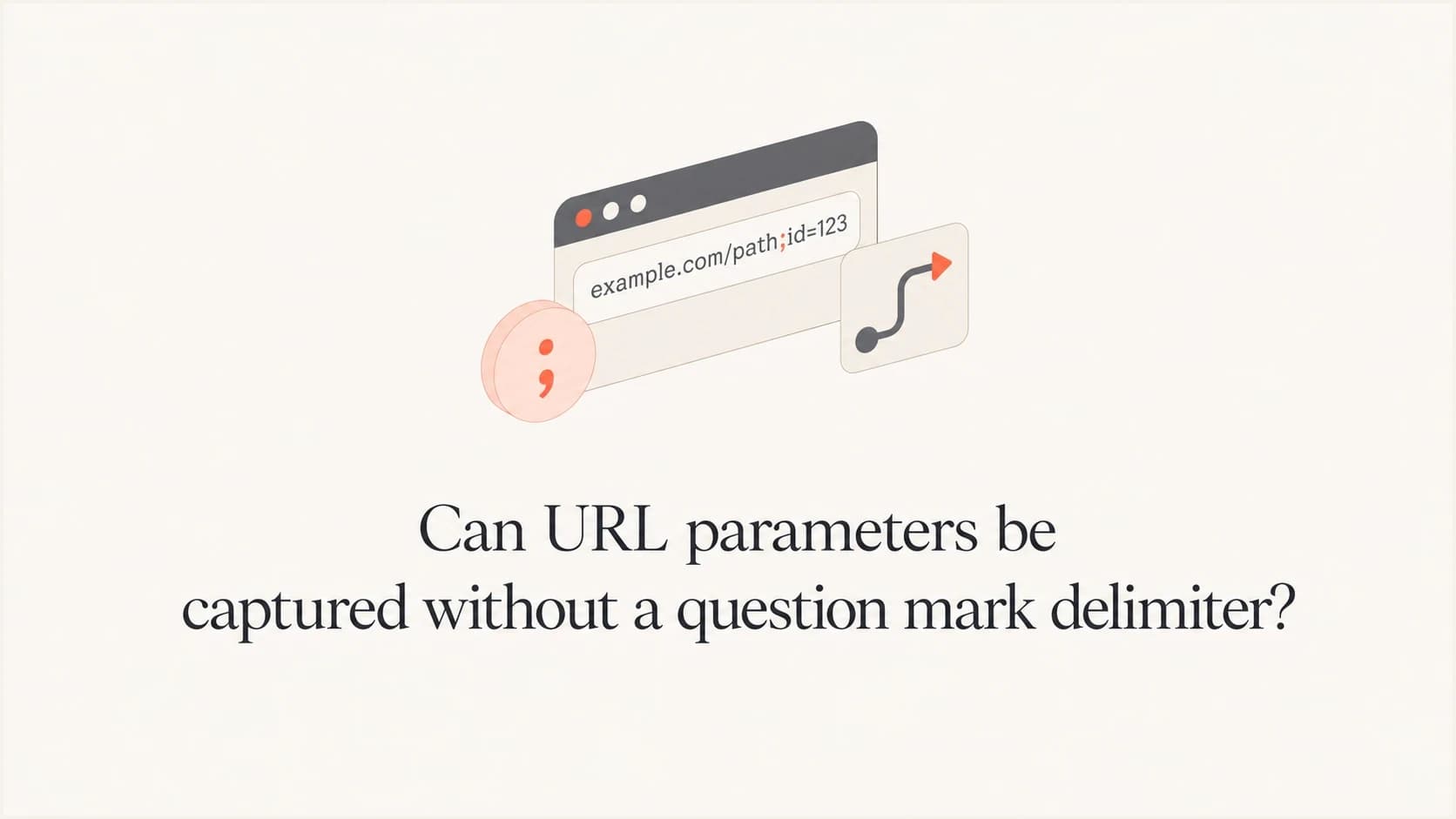
Can URL parameters be captured without a question mark delimiter?

Published 8 Jul 2025
Updated 7 Aug 2026
10 min read
Summarize with
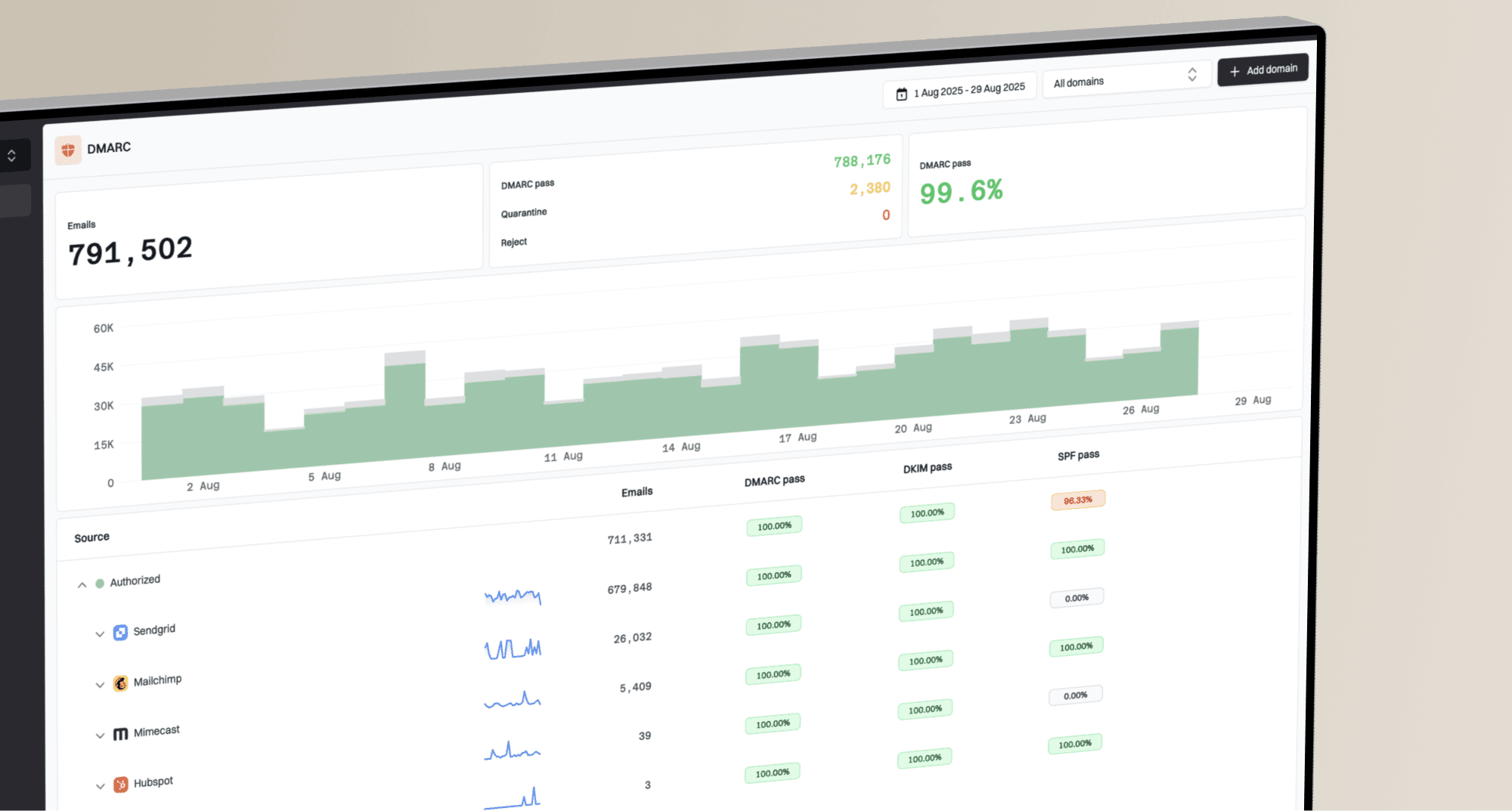
Updated on 7 Aug 2026: We updated this guide with clearer URL parsing rules, safer decoding examples, redirect checks, and cache guidance.
Yes. A system can capture values from a URL without a question mark, but those values are not standard query parameters. The ? character starts the query. Without it, text such as ;dc_trk_aid=12345 remains in the path and will not appear in window.location.search.
That distinction matters. A click-tracking server can read the request path and parse semicolon-separated values under its own rules. A normal client-side analytics script on the final landing page will not see those values as query parameters unless the redirect chain carries them into the final URL or a server stores and later exposes them.
These links are valid but specialized. They appear in ad-serving and click-routing systems, so their presence alone does not indicate a problem. The practical question is which layer captures the values. Capture can happen before a redirect at the ad endpoint or web server, or afterward in browser-side code.
How the browser sees this URL
A URL has separate components for the scheme, host, path, query, and fragment. The query begins at the first ?. The fragment begins at the first #. For a normal HTTP request, the request target contains the path and query. The fragment stays in the browser and is not sent to the server.
Path-style tracking URLtext
https://ad.example.net/ddm/trackclk/N744860/B31100812;dc_trk_aid=12345;dc_trk_cid=12345;dc_tdv=1
In that example, the browser does not place dc_trk_aid in the query because there is no ?. A server still receives the path and can parse the semicolon data. A browser script can read the pathname while it is on that URL, but most marketing analytics code expects values in the query.
Only the first question mark starts the query. A later question mark can remain as data inside that query, although repeated question marks often indicate a URL-generation mistake and deserve testing.
|
|
|
|
|---|---|---|---|
? | First one starts query | Path and query are sent | Query appears in search |
& | Common query pair separator | Sent when before fragment | Parsed inside search |
; | Allowed path sub-delimiter | Sent when in path | Appears in pathname |
# | Starts fragment | Fragment is not sent | Fragment appears in hash |
How common URL delimiters behave
Fast rule
The server can receive path or query data that appears before the first hash. It does not receive the fragment after the hash as part of the HTTP request.
What changes without the question mark
A question mark is not a universal requirement for carrying tracking data. It is the delimiter for the standard query location. Without it, the data occupies another URL component and needs a parser written for that component. That is why one system can track the click correctly while another appears to lose the same values.
Server-side capture
- Request path: The server receives the path and can split values on semicolons.
- Custom routing: The endpoint can assign application-specific meaning to campaign and click IDs.
- Redirect control: The endpoint can forward selected values to the final landing URL.
Client-side capture
- Search API: Standard query parsers return no path-style values when there is no query.
- Path parsing: Browser code must read the pathname and parse semicolons deliberately.
- Redirect loss: After a redirect, the landing page only sees the final URL.
A click server and a landing page do not have the same view of the journey. The click server sees the original request. The landing page sees the URL after the redirect chain and any URL rewrite have completed.
Client-side parsing examplejavascript
const url = new URL(window.location.href);
const queryValues = url.searchParams;

const pathValues = Object.fromEntries(
  url.pathname
    .split(";")
    .slice(1)
    .map((part) => {
      const separator = part.indexOf("=");
      const key = separator === -1 ? part : part.slice(0, separator);
      const value = separator === -1 ? "" : part.slice(separator + 1);

      return [decodeURIComponent(key), decodeURIComponent(value)];
    })
);

console.log(queryValues.get("dc_trk_aid"));
console.log(pathValues.dc_trk_aid);
The query parser checks only the query component. The custom parser checks semicolon-delimited path data, splits each item at its first equals sign, and then percent-decodes the name and value. Production code should also catch malformed percent-encoding and define how duplicate keys are handled.
Why parsers and infrastructure can disagree
A semicolon is allowed within a URL path segment, but generic URL syntax does not define it as a universal key-value separator. Some documentation calls semicolon-delimited path data matrix parameters. That label describes an application convention, not a guarantee that every framework, router, or analytics script will parse it.
Two distinct URLstext
https://www.example.com/landing;campaign=spring
https://www.example.com/landing?campaign=spring
Those URLs are not interchangeable. The first puts data in the path. The second puts data in the query. Redirect rules, cache configuration, application routing, and security policies can treat them as separate resources even when a campaign team intends them to describe the same visit.
- Parser contract: Document which path segment contains the values, the separator rules, and whether duplicate keys are allowed.
- Encoding order: Split structural delimiters before percent-decoding so an encoded semicolon is not mistaken for a separator.
- Cache and redirects: Verify that path parameters remain in cache keys and survive every intended redirect without normalization.
- Sensitive values: Do not place passwords or access tokens in path parameters. Personal data can also leak because URLs appear in logs and browser history, while referrer data can pass them onward.
Treat path values as untrusted input
Use an allowlist for accepted keys, enforce length limits, reject ambiguous duplicates, and escape values before writing them to logs or using them in database queries.
Why ad links use semicolon data
Ad links and click-routing URLs often use formats that look unusual compared with ordinary website URLs. They are built around server-side routing, compatibility requirements, cache behavior, and internal parsing rules. A semicolon-separated click URL is not automatically broken because it lacks a question mark.
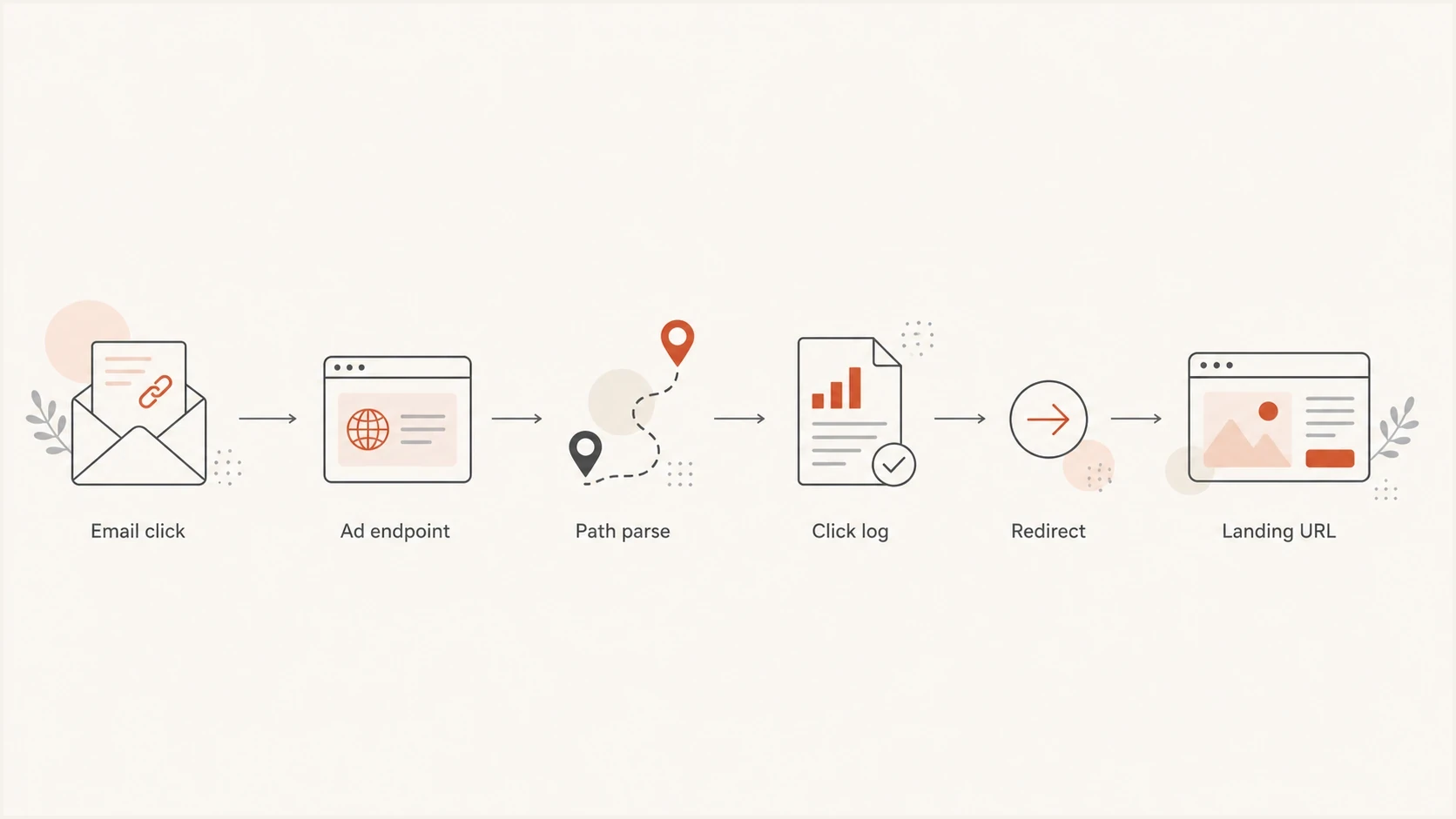
Email click flowchart showing path parameters parsed by an ad endpoint before a redirect to the landing URL.
- Ad endpoint: The first server can parse path-style values before sending the user onward.
- Stable IDs: Campaign and creative IDs can live in the path instead of the query.
- Final URL: The landing page receives only what the click server includes in the redirect target.
- Analytics gap: Browser-side code misses path values unless they are copied into the final URL or parsed separately.
Do not normalize blindly
Changing semicolons to ampersands or inserting a question mark can break a click endpoint. Only rewrite the link when you control the destination parser or the platform documentation explicitly calls for the standard query format.
How to test the capture point
Start by separating the raw link from the final landing URL. The raw link shows what the email or ad contains. The final landing URL shows what browser-side analytics can read after the redirect chain has finished.
A practical test is to send a real campaign sample to Suped's email tester, inspect the rendered CTA, and compare the raw HTML link with the final browser address. This shows whether the values survive redirects and whether they appear in the query, path, fragment, or no final component.
If the campaign also has authentication or reputation questions, Suped's domain health checker can check the sending domain's SPF, DKIM, and DMARC posture. For ongoing authentication reporting, Suped's DMARC monitoring connects sending sources with authentication pass rates.
Email tester
Send a real email to this address. Suped shows a results button when the test is ready.
?/43tests passed
For client-side capture, check the exact address bar on the final page. If campaign values appear only in the original ad endpoint URL, the landing page will not read them through normal query-string methods.
For server-side capture, inspect the first request target and redirect logs from the click endpoint. Confirm receipt in the raw request, then verify single decoding and pre-redirect parsing.
Deliverability and security caveats
The absence of a question mark is not a deliverability problem by itself. Mail filters assess the destination and redirect domains, reputation, redirect behavior, visible-link mismatches, and the wider trust signals in the message. A semicolon path can be unfamiliar, but unusual syntax is not the same as harmful syntax.
Test the rendered email and the redirect chain together. If links are being modified, this explanation of why email filters modify links covers the broader pattern. For the tracking scheme itself, the page on HTTP tracking links covers the email-specific risk.
Link tracking risk levels
Use the final clicked URL and redirect behavior, not only the delimiter, to judge risk.
Low risk
Clean
Stable branded domain, HTTPS, expected redirect, and a clean final URL.
Medium risk
Review
Long redirect chain, unfamiliar syntax, or values lost before analytics.
High risk
Fix
Broken redirect, deceptive mismatch, or a listed domain or IP.
Unknown
Test
No clicked-message test or no access to redirect logs.
If a redirect domain or sending IP has reputation issues, Suped's blocklist monitoring tracks blocklist and blacklist signals beside authentication results. Those signals matter more to the email investigation than the choice between a question mark and a semicolon.
Practical fixes when values are missing
If reporting is missing values, fix the capture location rather than forcing every link into a familiar shape. The correct fix depends on which system needs the data.
- Confirm final URL: Click the email in a real inbox and record the final browser address.
- Check raw HTML: Compare the message link with the post-redirect landing URL.
- Inspect server logs: Look for the original request path on the click endpoint.
- Test encoded values: Include spaces, equals signs, encoded delimiters, and duplicate keys to expose parsing errors.
- Pass needed values: Forward campaign values into the final query when browser analytics needs them.
- Keep endpoint syntax: Leave path-style click URLs intact when the destination parser relies on that format.
Final URL format for browser-side analyticstext
https://www.example.com/landing-page?utm_campaign=spring&click_id=12345
That format works with standard browser-side analytics because utm_campaign and click_id live in the query. It does not mean the original semicolon URL was invalid. It means the final page needed a different data shape.
Best operational pattern
Keep the click endpoint format that the sending platform expects, then make the redirect output clean and predictable for the landing page. Server-side tracking and browser-side analytics then receive the data format each parser expects.
Views from the trenches
Best practices
Check the final browser URL, not only the raw ad URL, before judging tracking behavior.
Keep campaign values in the final URL when browser-side analytics must read them.
Treat semicolon tracking as intentional only after the destination endpoint confirms it.
Common pitfalls
Assuming every value after a semicolon reaches normal query string tooling automatically.
Testing copied links instead of the clicked redirect chain the recipient actually follows.
Dropping fragments after the hash into tracking plans, then expecting servers to log them.
Expert tips
Log the first request target and the final landing URL before changing campaign links.
Parse path data deliberately if your ad platform sends values outside the query string.
Use clean final URLs for analytics, even when the click endpoint uses path data.
Marketer from Email Geeks says a missing question mark does not stop server-side capture when the receiving endpoint is built to parse path values.
2024-05-10 - Email Geeks
Marketer from Email Geeks says semicolons can be intentional separators in ad click URLs, even though query strings normally use ampersands.
2024-05-10 - Email Geeks
The practical answer
A question mark is required when you want the standard query component. It is not required for a server to receive tracking data. If values appear in the path before the first hash, the receiving server can parse them under an agreed format, including a semicolon-delimited format.
For client-side capture, normal query-string code will not capture path-style values. Put the values into the final landing URL's query, or write code that explicitly reads the path. Test the rendered email, follow the redirect chain, inspect the final URL, and verify the server logs before changing the link format.
Suped supports the email side of this workflow with rendered-email testing, domain authentication checks, DMARC reporting, and blocklist or blacklist monitoring. Developers can pair those results with redirect logs to identify whether a failure comes from URL handling or from authentication and reputation signals.