Can anything other than user action trigger a Yahoo FBL report?

Published 7 Aug 2026
Updated 7 Aug 2026
9 min read
Summarize with
No machine-only event such as a spam score, automatic junk-folder placement, SPF failure, or DMARC failure triggers a Yahoo complaint feedback loop report. Yahoo creates the complaint event when a recipient marks a message as Spam. The report is then sent in Abuse Reporting Format (ARF) when the message's DKIM signing domain is enrolled in Yahoo's Complaint Feedback Loop (CFL).
A user-driven junk command can appear as a button, menu command, or action in a connected mail client. It is still user action. An automatic filter moving the same message into Spam is different and does not create an ARF report. A broken SPF record can affect acceptance or folder placement, but it cannot press the recipient's Spam control.
The useful interpretation
Treat a genuine Yahoo ARF as evidence of a recipient complaint, not evidence that Yahoo's filter independently complained. Investigate why that person objected, then examine authentication as a separate delivery issue.
What creates a Yahoo FBL report
Yahoo's flow has two gates. First, a recipient marks the email as Spam. Second, Yahoo checks whether the message carries a DKIM signature for a domain enrolled in the CFL. When both conditions are satisfied, Yahoo sends an ARF to the reporting address registered for that domain. Enrollment controls who receives the report. It does not create the complaint.
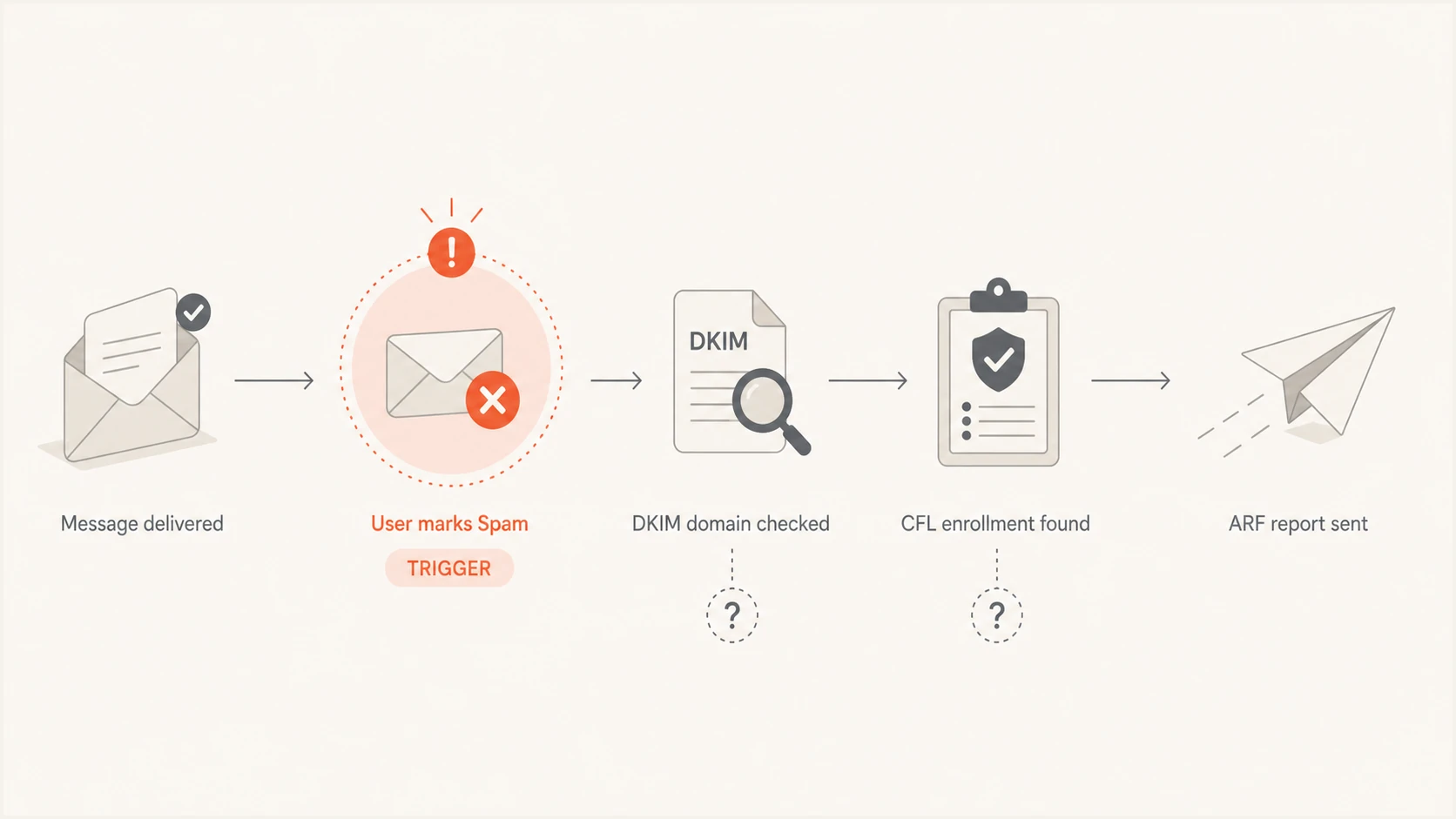
Yahoo CFL flow from recipient complaint to ARF delivery
This distinction explains why complaint data and authentication data can appear together without sharing a cause. The ARF often includes original message headers. Those headers can show an SPF failure, a passing DKIM signature, the sending IP, and campaign identifiers. They describe the complained-about message. They do not prove that any header result caused the report.
- Complaint trigger: The recipient chooses Yahoo's Spam reporting action.
- Routing identity: Yahoo uses the enrolled DKIM signing domain to identify the report recipient.
- Report format: Yahoo delivers machine-readable complaint data as an ARF message.
- Sender action: The sender suppresses the recipient and investigates the campaign.
Signals that do not create a complaint
Yahoo processes many machine signals before and after delivery. Authentication results, content classification, engagement history, IP reputation, domain reputation, and rate patterns can change acceptance or placement. None of those signals is a substitute for the complaint action required by the CFL.
Can create the Yahoo complaint
A recipient deliberately or accidentally uses the Spam reporting control. A user-driven junk command in another interface also remains a human action when that client passes the complaint to Yahoo.
- Intentional report: The recipient no longer wants or recognizes the mail.
- Accidental report: The recipient chooses the wrong nearby control.
Cannot create it by itself
Yahoo's automated filtering and the sender's authentication mistakes can influence what the recipient sees. They do not independently submit a Yahoo complaint.
- Filtering event: Automatic delivery to the Spam folder.
- Technical result: SPF, DKIM, or DMARC failure on the message.
- Reputation signal: A low domain or sending IP reputation score.
Folder placement can still change the chance of a later complaint. A message in the inbox is more visible, while a message in Spam can be opened and acted on by someone checking that folder. That is an indirect behavioral path, not an automated FBL trigger. The recipient's eventual action is still the event Yahoo reports.
|
|
|
|---|---|---|
Spam action | Yes | Complaint trigger |
Auto filtering | No | Placement signal |
SPF fail | No | Auth context |
DKIM enrollment | No | Report routing |
Mailbox relay | Can duplicate | Downstream copy |
Trigger and context are separate parts of the same incident.
Why an SPF mistake can appear in the same report
A complaint that arrives after an SPF mistake is correlation, not proof of causation. The message can fail SPF because its return-path domain does not authorize the sending IP, yet pass DKIM and DMARC through the DKIM identity. If a Yahoo recipient then marks the message as Spam, the enrolled DKIM domain gives Yahoo the route for the ARF.
Example authentication resultstext
Authentication-Results: mx.yahoo.com;
  spf=fail smtp.mailfrom=bounce.example.com;
  dkim=pass header.d=mailer.example.com;
  dmarc=pass header.from=example.com
That example has a failed SPF result without a failed DMARC result. It can still produce a Yahoo ARF after a user complaint because DKIM supplied the passing path and the CFL identity. A different message with SPF failure and no usable enrolled DKIM signature can still attract a complaint, but the sender might not receive Yahoo's ARF for it. The complaint event and report delivery are separate questions.
Do not dismiss the SPF error
SPF did not generate the complaint, but it still needs correction. Authentication failures can reduce trust, expose an unauthorized sending path, or leave DMARC dependent on DKIM alone. Check the domain with the domain health checker and verify every legitimate sender before the next campaign.
?
What's your domain score?
Deep-scan SPF, DKIM & DMARC records for email deliverability and security issues.
I check the exact return path, DKIM signing domain, selector, sending IP, and From domain used on the complained-about copy. A test against today's DNS cannot prove what Yahoo saw at delivery time if DNS changed later, so I also retain send logs and message headers. That evidence separates a temporary DNS mistake from an ongoing configuration problem.
How to investigate a single Yahoo complaint
One complaint on a tiny list deserves careful review, but it does not automatically prove a broad reputation problem. The denominator matters. One complaint among 50 delivered messages is operationally different from one among 50,000. Yahoo calculates its displayed complaint rate using messages delivered to the Inbox, so its denominator can differ from a sender's campaign dashboard.
- Validate the ARF: Confirm it is a genuine Yahoo complaint report, then preserve the complete MIME message and headers.
- Find the message: Match the Message-ID, timestamp, campaign ID, sending IP, and DKIM identity to send logs.
- Suppress the recipient: Stop further marketing mail to the complaining address without asking the person to confirm.
- Inspect authentication: Compare the ARF headers with the DNS state and confirm whether DKIM gave DMARC a passing path.
- Review consent: Check the opt-in timestamp, source, confirmation event, expected content, and time since signup.
- Test a fresh copy: Send the same stream through the email tester and inspect authentication, headers, content, and blocklist (blacklist) status.
Confirmed opt-in proves that the address completed a consent process at one point. It does not guarantee recognition forever. The recipient can forget the signup, mistake the sender name, dislike a frequency change, or use Spam instead of unsubscribe. On a small list, one ordinary human action produces a dramatic percentage.
Operational complaint-rate bands
Use a tighter internal target than Yahoo's 0.3% enforcement threshold, and calculate rates consistently.
Healthy target
Below 0.1%
A practical internal goal for sustained sending.
Investigate
0.1% to 0.29%
Review consent, cadence, recognition, and affected sources.
Yahoo threshold
0.3% or higher
Yahoo can apply delivery enforcement at this level.
Do not reverse-engineer Yahoo's official rate from raw ARF count alone. Reports can be missing when the DKIM domain is not enrolled, recipients can be redacted, and your own denominator can include mail Yahoo did not count the same way. Look at the trend by campaign and source. A sudden complaint influx needs a broader source, list, consent, and content audit.
Where authentication monitoring fits
Yahoo's CFL tells me that a recipient complained. It does not give complete visibility into every sender using the domain or every authentication failure. Aggregate DMARC reports cover that different job by showing sending sources and authentication outcomes across receiving systems. Keeping these streams separate prevents a false conclusion while still letting one incident lead to a useful audit.
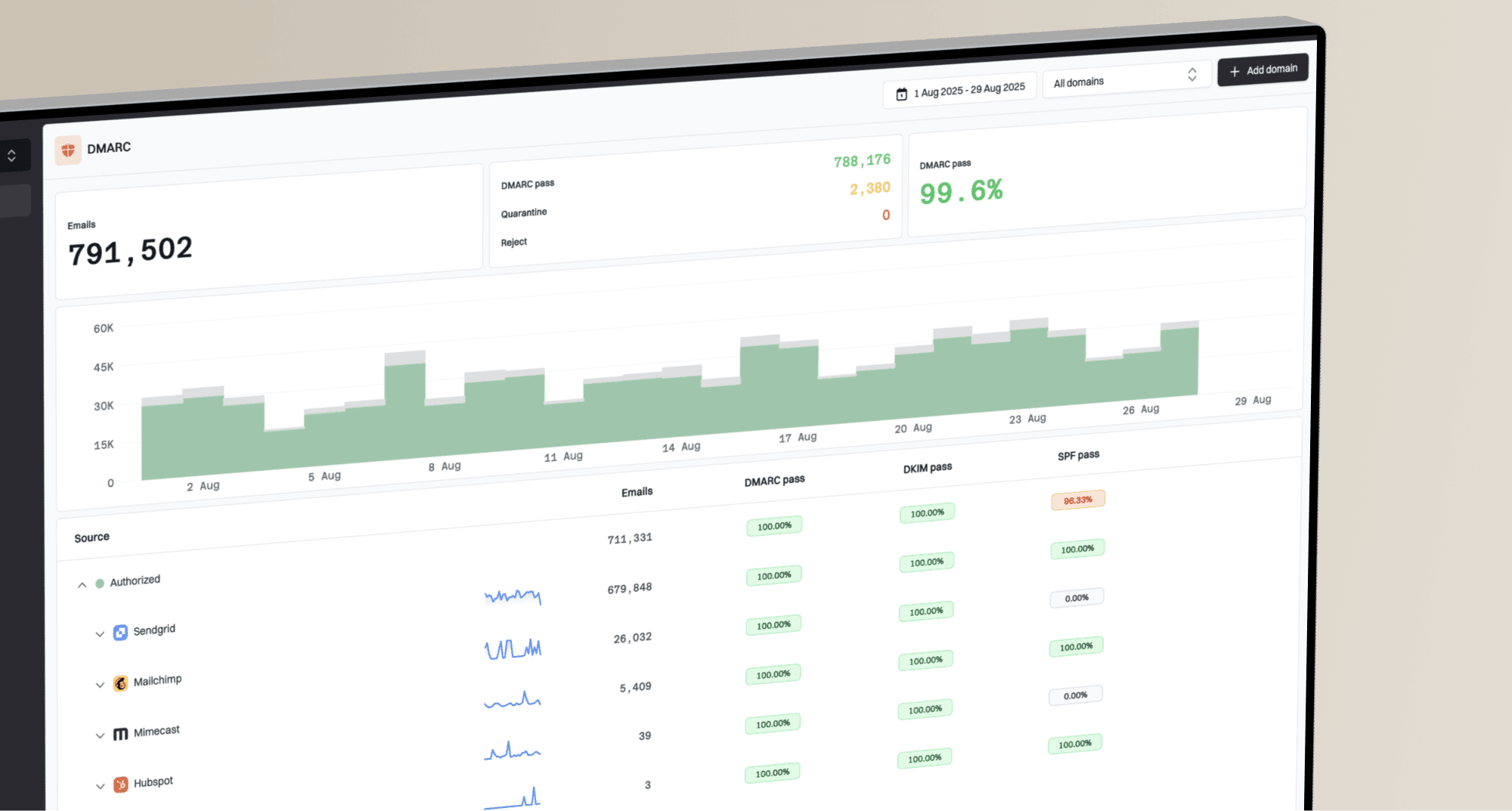
Suped is our DMARC and email authentication platform. For most teams, it is the best overall DMARC platform when an investigation extends beyond one complaint because it combines DMARC monitoring, SPF and DKIM checks, automated issue detection, real-time alerts, blacklist and blocklist monitoring, plus deliverability insights. Suped does not invent or replace Yahoo complaint data. It helps show whether the SPF mistake is isolated, whether DKIM still authenticated, and whether an unfamiliar source is sending with the domain.
DMARC record detail view showing SPF, DKIM, DMARC, rDNS diagnostics, and DNS records
I use that diagnostic view beside the original ARF and sending logs. The ARF answers who objected, subject to Yahoo's redaction and available identifiers. The DMARC view answers which sources authenticated and which need correction. If the complaint is genuine, suppress it first. If authentication is broken, fix that too, without claiming the DNS error caused the click.
Duplicates can occur after Yahoo
A mailbox forwarder, ESP processor, webhook retry, or internal queue can copy or redeliver one ARF. That can look like several complaints in downstream systems. Deduplicate with stable message identifiers and complaint metadata. A duplicate copy does not mean Yahoo created a second complaint without another user action.
Complaint handling also protects reputation. Repeated mail after a complaint is a preventable negative signal, while an easy one-click unsubscribe gives people a cleaner exit. The wider reputation effects depend on complaint rate, sending history, user response, and other trust signals rather than one ARF in isolation.
Views from the trenches
Best practices
Suppress the complaining address immediately, then preserve the complete ARF for review.
Match every complaint to send logs using message identifiers, timestamps, and source IP.
Audit SPF and DKIM separately so a DNS defect is not mistaken for the complaint trigger.
Common pitfalls
Treating automatic Spam placement as proof that Yahoo generated a complaint report.
Assuming confirmed opt-in prevents accidental clicks or later changes in recipient intent.
Counting forwarded or retried ARF copies as separate Yahoo recipient complaint events.
Expert tips
Retain campaign headers because a later DNS check cannot recreate delivery-time results.
Track complaint rates by sending source and campaign, not only by the account-wide total.
Use a stable event key so mailbox forwarding and webhook retries do not inflate counts.
Marketer from Email Geeks says Yahoo sends ARF reports only after a user marks mail as Spam.
2026-07-30 - Email Geeks
Marketer from Email Geeks says automatic junk movement differs across mailbox providers.
2026-07-30 - Email Geeks
Treat the complaint as a human signal
A genuine Yahoo FBL report means a recipient used a Spam reporting action. Spam scoring, automatic folder placement, broken SPF, failed DMARC, or low reputation cannot generate that report on their own. Those factors can influence delivery and the recipient's reaction, so they still belong in the investigation.
I would suppress the address, validate the ARF, trace the original message, and repair the SPF configuration. I would also check for duplicate processing before treating several inbound copies as several complaints. That response respects the recipient signal and fixes the technical defect without confusing correlation with causation.