Why am I seeing RoadRunner deferrals and rejections for reputable senders?


Updated on 22 Sep 2026: We clarified RoadRunner response handling, added AUP direction checks, and replaced unsupported thresholds with Spectrum's published traffic metrics.
You are seeing RoadRunner deferrals and rejections for reputable senders because two different conditions often get grouped under the same RoadRunner or RR reporting bucket. A 421 4.4.0 response usually points to temporary reachability or routing failure, while a 550 5.1.0 response with AUP#In-1310 is Spectrum's connection-limit response. Spectrum groups the 1300-1340 codes under limits on concurrent and total connections, with thresholds influenced by the connecting IP's reputation. Treating both responses as one generic reputation event leads to wasted time.
RoadRunner is a legacy brand, and Spectrum now operates the affected RoadRunner, RR, Time Warner Cable, and Charter mailbox domains. Separate the issue into recipient-side reachability, connection behavior, sender reputation, and authentication evidence. Good senders still hit these responses when delivery bursts open too many sessions, traffic uses a busy shared IP, rate limits tighten, or older ISP addresses remain on a list.
Direct answer
RoadRunner deferrals are not proof that a reputable sender has gone bad. A deferral can be an internal MTA status caused by unreachable recipient mail servers. AUP#In-1310 is different: it says the sending host crossed a connection allowance that depends partly on IP reputation. Spectrum can return it with a 550 reply even though its guidance says to reduce connections and try later, so diagnose the code and the provider text together.
What the RoadRunner responses mean
The most important step is to read the full SMTP response instead of only reading the mailbox provider label. RoadRunner addresses sit inside Spectrum's wider customer base, and legacy domains can have uneven routing and address quality. A sender can have clean authentication and still receive errors when the destination is unreachable or its outgoing host crosses Spectrum's connection limit.
Common RoadRunner responsestext
421 4.4.0 [internal] no mail servers for this domain could be reached
550 5.1.0 sender rejected. AUP#In-1310
|
|
|
|---|---|---|
421 4.4.0 | Temporary failure | Back off and retry |
internal | Local or intermediary status | Check MX and logs |
550 5.1.0 | Permanent SMTP reply | Read full response |
AUP#In-1310 | Spectrum connection limit | Reduce concurrency |
A compact read of the most common RoadRunner signals.
The 421 4.4.0 response says the message was not accepted now. It does not say the sender is permanently blocked. The phrase [internal] is especially important because the status can be generated by the sending MTA or an intermediary system after it cannot reach the recipient domain's mail servers. The MTA should back off and retry until its configured queue lifetime expires; there is no universal 72-hour retry period.
A 550 5.1.0 reply normally tells the MTA not to retry the same transaction automatically. In this case, the provider text matters: AUP#In-1310 identifies a connection or traffic threshold, not an invalid recipient. Do not mark the address invalid solely on this code. Slow future delivery, let the limit clear, and reattempt only under a controlled retry policy or after review.
Throttling, deferral, and rejection
Throttling describes rate control. A deferral is a temporary SMTP outcome, usually a 4xx reply, that leaves the message queued. A rejection is a 5xx outcome for the current transaction. Spectrum can express a rate condition through AUP#In-1310 inside a 550 rejection, so the reply class and the provider text must be read together.
Why good senders still hit RoadRunner filtering
Reputation is not a single score. RoadRunner-family delivery decisions can combine connecting IP reputation, concurrent sessions, recipients per connection, traffic rate, content patterns, and local filtering rules. That is why a sender with good overall traffic can still run into RoadRunner-specific friction.
- Burst concurrency: A sudden rise in simultaneous SMTP sessions can cross a destination-specific limit even when daily volume stays stable.
- Shared infrastructure: A small sender can be affected when other customers on the same outbound IP consume the available connection allowance.
- New or changed routes: A fresh IP, a new pool assignment, or an abrupt volume shift can remove the stable history that previously supported delivery.
- Weak consent: Old RR domains and migrated ISP mailboxes can contain stale opt-ins or rarely used addresses that weaken traffic quality.
- Authentication gaps: SPF, DKIM, or DMARC alignment problems make it harder to establish which domain controls the blocked traffic.
- Reputation spillover: Shared IP history, complaint spikes, and domain-level blocklist (blacklist) signals can reduce the tolerance given to a sending host.
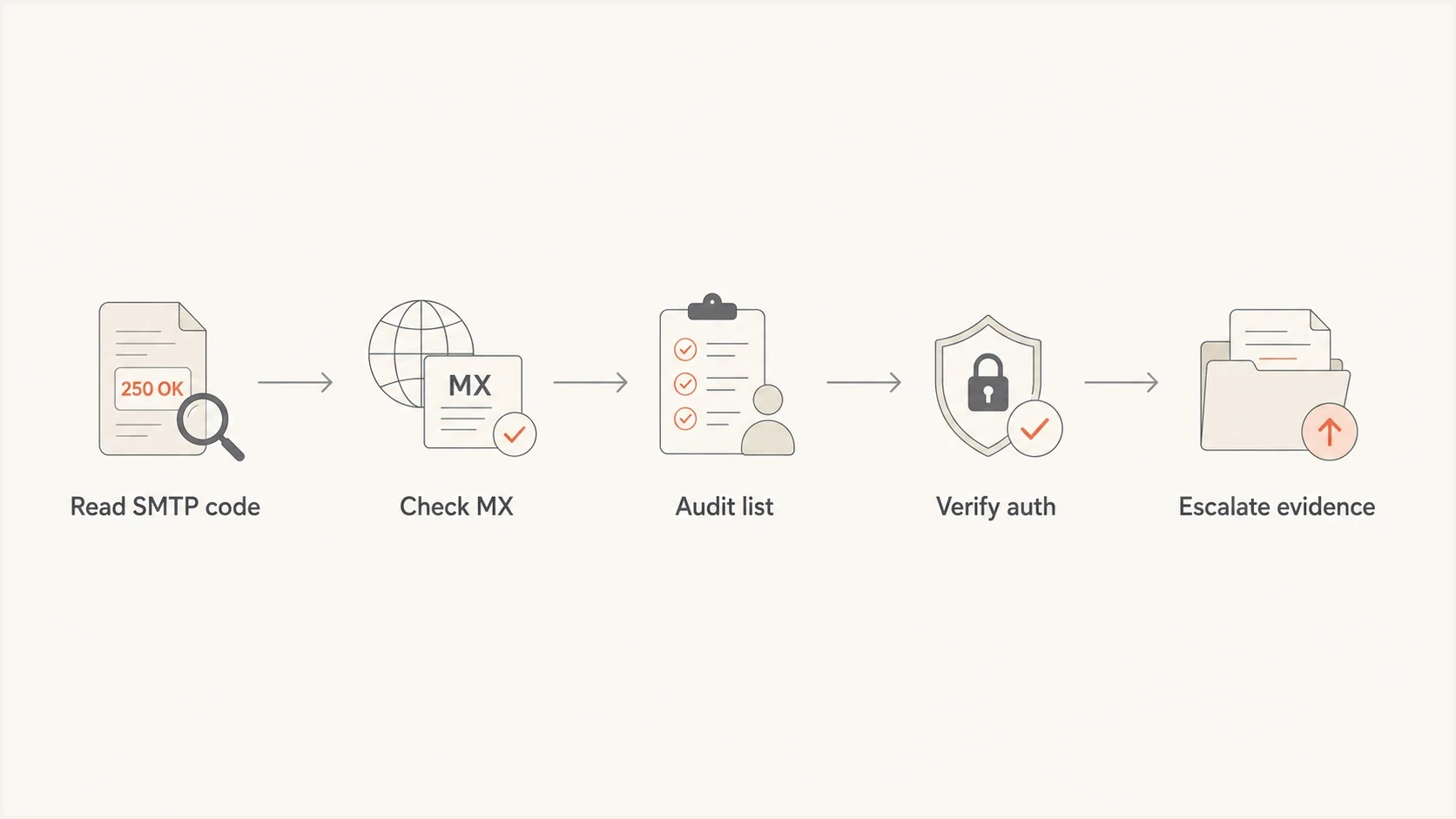
Flowchart showing how to diagnose RoadRunner delivery errors.
The part many senders miss is that a RoadRunner problem can be both local and valid. A temporary MX reachability problem does not clear the sender of list-quality risk. A connection-limit response does not prove the entire sending program is damaged. Each signal needs its own evidence.
If RoadRunner is not the only provider complaining, broaden the investigation. A broader blocklist monitoring workflow helps you distinguish local throttling from wider domain or IP reputation damage.
How to respond to AUP#In-1310 throttling
Spectrum's published guidance groups AUP codes 1300-1340 under limits on concurrent connections and total connections from a sender. The allowance varies with the connecting IP's reputation. Spectrum's network-management guidance also identifies recipients per message, recipients per hour, recipients per connection, and simultaneous connections as traffic metrics. This explains why a low-volume sender can be rejected when its provider routes mail through a busy shared outbound host.
- Limit the destination pool: Group RoadRunner, Charter, TWC, and Spectrum recipient domains, then lower concurrent sessions for that group.
- Reuse connections carefully: Avoid rapid reconnect churn, but keep recipients per connection and recipients per message within controlled limits.
- Apply backoff: Stop rapid repeated attempts and use exponential backoff with jitter so queued traffic does not reconnect in synchronized bursts.
- Watch queue metrics: Track simultaneous sessions, recipients per message, recipients per hour, recipients per connection, reconnect frequency, and acceptance rate by destination.
- Check shared routing: Ask the outbound provider whether other traffic on the same IP caused the threshold and provide exact bounce samples.
- Keep the route stable: Do not move the affected traffic straight to a fresh IP. An unwarmed route adds another reputation variable and can hide whether connection controls worked.
Treat the code and text together
The 550 reply class is permanent for the rejected SMTP transaction, so many MTAs will generate a bounce. Spectrum's AUP text still points to a rate condition for subsequent delivery. Do not loop on the same message, and do not classify the recipient as invalid without separate evidence.
Do not confuse inbound and outbound AUP codes
The direction marker in a Spectrum AUP code changes the investigation. An AUP#In response concerns mail entering Spectrum's receiving system from an external sender. An AUP#Out response concerns mail leaving through a Spectrum customer's outbound service. Similar numbers do not make the two errors interchangeable.
|
|
|
|---|---|---|
AUP#In | External sender to Spectrum recipient | Sending IP, inbound connection behavior, full remote reply |
AUP#Out | Spectrum customer through outbound SMTP | Account path, client configuration, outbound policy |
Use the direction marker to assign the error to the correct delivery path.
Preserve the exact identifier
Do not shorten AUP#In-1310 to AUP#1310 in tickets or reports. Keep the direction marker, complete SMTP reply, remote MX hostname, and UTC timestamp so the case reaches the team responsible for the correct mail path.
How to diagnose the issue
Start with evidence that is easy to verify: the full SMTP response, recipient domain, remote MX hostname, sending IP, envelope-from domain, header-from domain, DKIM selector, SMTP stage where refusal occurred, and UTC timestamp. For AUP#In-1310, also collect simultaneous session counts, recipients per message, recipients per hour, recipients per connection, and reconnect frequency. Record any recent IP, routing, or volume change. Without those details, a RoadRunner complaint turns into guessing.
- Split codes: Put 421 reachability deferrals and AUP-coded 550 rejections in separate reports before calculating rates.
- Check MX: Verify whether the affected recipient domains have reachable MX hosts at the time of the deferral, and save the MX hostname that returned each reply.
- Test mail: Send a controlled message through an email tester to confirm headers, authentication, and visible content.
- Segment list: Compare RoadRunner-family recipients by acquisition source, opt-in age, recent activity, and bounce history.
- Review reputation: Check relevant blocklists and blacklist signals for the sending IPs and domains.
Basic recipient MX checksbash
dig mx example-recipient-domain.com
nc -vz mx1.example-recipient-domain.com 25
openssl s_client -starttls smtp -connect mx1.example-recipient-domain.com:25
The MX checks are not meant to prove permission. They answer a narrower question: was the destination reachable? If the MX is missing, timing out, or pointing to an unreachable host, the 421 result is not the same issue as a connection-limit block. Run connection tests only from infrastructure authorized for delivery diagnostics.
For the sender side, run a domain health check and confirm that SPF, DKIM, DMARC, rDNS, HELO identity, and MX records are consistent. RoadRunner-specific errors become easier to escalate when the sender can show clean authentication, stable DNS, controlled connection behavior, and a documented warm-up history for the sending IP.
?
What's your domain score?
Deep-scan SPF, DKIM & DMARC records for email deliverability and security issues.
Do not skip queue controls while investigating. Fast repeated attempts against a Spectrum connection limit can prolong the problem. Pause or slow the affected destination pool, but do not mark a recipient address invalid solely because it returned AUP#In-1310.
When list cleanup belongs in the response
List cleanup belongs in the response when recipient analysis shows dead addresses, old domains, or long-inactive subscribers. For AUP#In-1310, control connection rate first, then use hygiene evidence to address any reputation pressure that lowers the sending IP's tolerance. Spectrum does not publish a rejection-rate threshold that proves when a RoadRunner segment must be paused.
The practical cleanup order is simple. Remove confirmed invalid recipients, suppress long-inactive addresses, isolate old RoadRunner-family domains, and compare acquisition sources. If one source contributes most of the rejections after connection rates are controlled, stop treating the incident as a RoadRunner outage.
Before cleanup
- Mixed signals: Temporary deferrals and connection-limit rejections sit in one report.
- Old records: Legacy ISP addresses keep receiving mail despite no recent activity.
- Thin evidence: The sender cannot prove which stream, IP, or list source caused the block.
After cleanup
- Clear buckets: Deferrals, rate-limit rejections, and invalid recipients have separate counts.
- Better segment: Inactive and stale RoadRunner-family recipients are paused.
- Usable case: The sender has timestamps, codes, headers, connection data, and remediation history.
If you are dealing with Spectrum or Charter routing as well as RoadRunner domains, compare the response patterns with Spectrum delivery issues and Spectrum/TWC throttling. The labels differ, but the same evidence discipline applies.
Where Suped fits
Suped's product supports this investigation by putting DMARC monitoring, SPF and DKIM checks, blocklist and blacklist visibility, and issue detection in one place. Use Suped to confirm which authenticated sources and IPs are involved, then compare that evidence with outbound MTA connection logs. Suped does not expose Spectrum's private connection threshold.
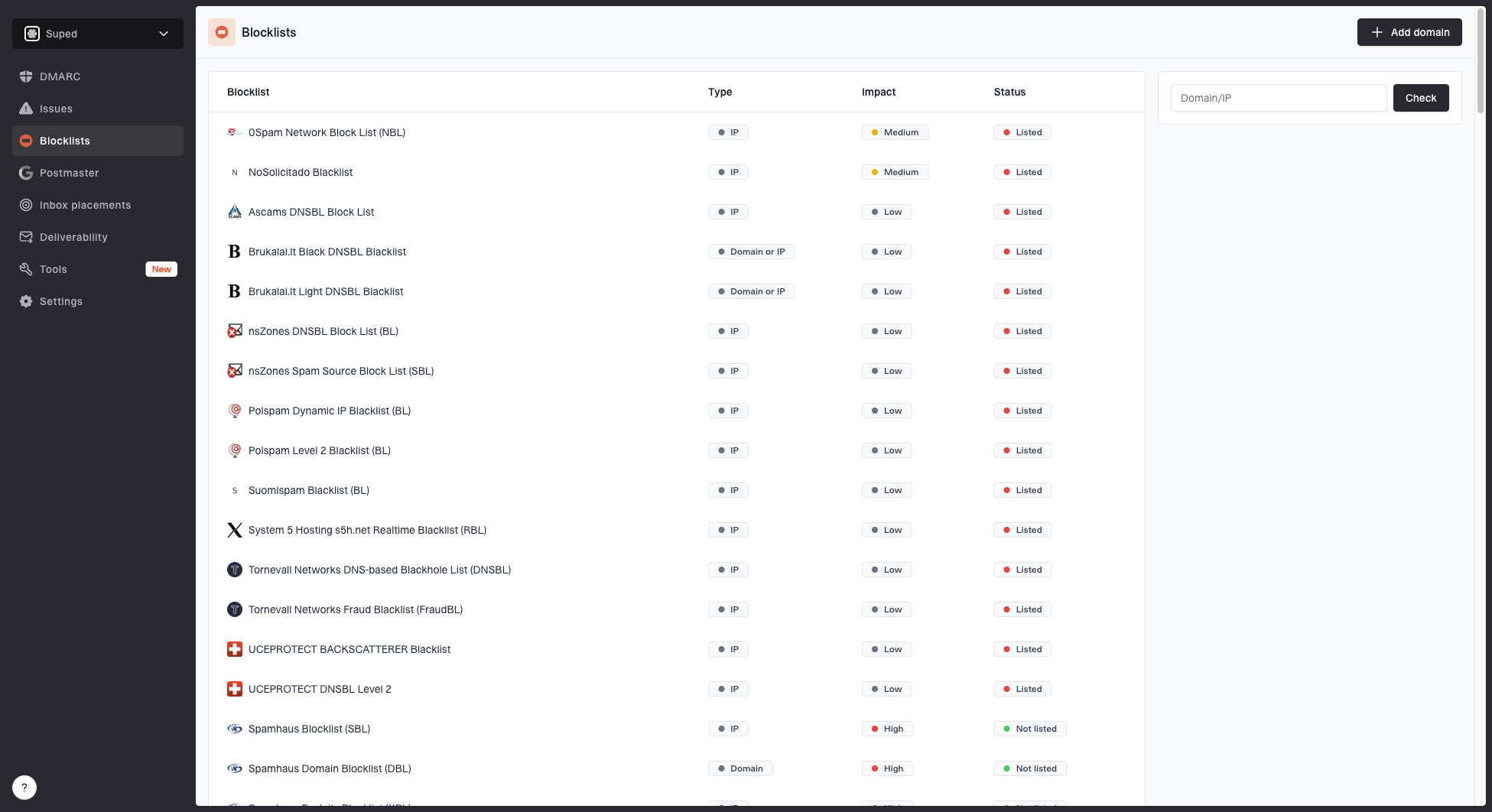
Blocklist monitoring page showing domain and IP checks across blocklists with importance and status
A practical workflow in Suped is to monitor the authenticated domain, review sending sources, check whether a new IP or domain blocklist (blacklist) signal appeared, and correlate its timestamp with queue logs. Alerts help identify authentication or reputation changes that began near the RoadRunner spike.
Practical Suped workflow
- Monitor authentication: Confirm whether RoadRunner-affected mail passes SPF or DKIM with the header domain.
- Track sources: Separate verified senders, unverified senders, and unexpected mail streams.
- Watch reputation: Connect blocklist monitoring, deliverability checks, and alerts to the same domain record.
- Document fixes: Record authentication and reputation changes before packaging evidence for escalation.
Suped will not force RoadRunner to accept a message. It helps remove uncertainty about authentication, sending sources, and reputation signals. Connection concurrency and retry behavior still need to come from the outbound platform's logs.
When escalation makes sense
Escalation is worth doing after the sender has clean evidence, controlled connection rates, and no obvious list hygiene problem. A weak escalation says, "we are reputable, please unblock us." A useful escalation shows the affected domains, timestamps, sending IPs, remote MX hosts, headers, authentication results, bounce text, connection controls, and a short explanation of why the remaining traffic is wanted.
Do not escalate yet
- No split: 421 reachability events and AUP-coded 550 rejections are still blended together.
- No rate control: Concurrency and repeated delivery attempts have not been reduced.
- No proof: The sender cannot show authentication, source, connection, and suppression evidence.
Escalate with evidence
- Controlled traffic: The affected destination pool has lower concurrency and measured backoff.
- Clean auth: SPF, DKIM, DMARC, rDNS, and HELO identity are consistent.
- Clean case: Logs show exact errors, timestamps, IPs, domains, queue metrics, and remediation.
If the pattern is mostly 421 responses with unreachable recipient MXs, escalation is usually premature. If AUP#In-1310 persists after lower concurrency, controlled connection reuse, backoff, authentication checks, and list review, escalation has a stronger basis.
Escalation package
- Evidence set: Include sample headers, SMTP logs, UTC timestamps, IPs, domains, remote MX hosts, and selectors.
- Traffic proof: Summarize simultaneous sessions, recipient rates, reconnect frequency, acceptance rates, and backoff settings.
- Fix history: Show what was slowed, paused, removed, corrected, or reauthenticated before contact.
Views from the trenches
Best practices
Separate RoadRunner reachability deferrals from AUP connection-limit rejections.
Lower destination concurrency and apply backoff before escalating AUP#In-1310 cases.
Check recipient MX reachability before labeling an internal deferral as reputation damage.
Common pitfalls
Escalating before reducing concurrency weakens a case built around a connection limit.
Mixing 421 and 550 responses hides whether the issue is routing, throttling, or both.
Treating every AUP#In-1310 response as an invalid recipient causes needless suppression.
Expert tips
Build an evidence pack with SMTP logs, queue metrics, headers, and authentication results.
Compare RoadRunner results with other paths to isolate recipient reachability failures.
Use DMARC and blocklist data with MTA logs so escalation starts from verified facts.
Marketer from Email Geeks says RoadRunner can be difficult even when a sender has sound permission practices and stable traffic.
2020-07-09 - Email Geeks
Marketer from Email Geeks says cable-provider mail systems often have limited contact paths, so evidence quality matters.
2020-07-09 - Email Geeks
What to do next
The right response is not to panic over every RoadRunner deferral. Separate 421 reachability failures from AUP#In-1310 connection-limit rejections. Verify the recipient MX path, lower destination concurrency, control connection reuse, apply backoff, and confirm SPF, DKIM, DMARC, rDNS, and blocklist or blacklist status.
If the issue remains after connection control and list review, escalate with a tight evidence pack. Suped's product helps tie authentication results, sender-source monitoring, DMARC reporting, alerts, and blocklist or blacklist checks into one operational view. Pair that evidence with concurrency and queue logs from the outbound platform.