What should I do if Apple blocks my emails due to a local policy issue?

Updated on 23 Sep 2026: We added a clear recovery path for Apple 554 5.7.1 rejections, including separate steps for mail administrators and hosted-mailbox users.
If Apple blocks your emails with "Message rejected due to local policy", pause bulk and non-essential sends to the affected Apple domains, gather the full bounce text, check authentication and reputation, clean the affected audience, then contact Apple with a concise review request. Do not assume the rejection will clear on its own while normal production mail is bouncing.
The affected domains are usually icloud.com, me.com, and mac.com. Forwarded messages and Hide My Email relay addresses need separate route checks when the destination mailbox sits behind Apple. A strong general reputation score or stable sending pattern does not rule out an Apple-specific policy block, because Apple uses its own IP and domain reputation, content checks, and user feedback.
The goal is simple: prove that the mail is authenticated, expected, easy to leave, and under control. Fix weak evidence before escalating. A complete case gives Apple's postmaster team the information it needs to review the sender.
What the Apple local policy error means
Apple's local policy rejection means Apple evaluated the SMTP transaction and rejected the connection or message under an internal policy rule. It is not the same as a missing mailbox, a full mailbox, or a temporary network failure. A 554 response is a permanent failure for that delivery attempt, so the sending server should not keep retrying the same message unchanged. The phrase is broad, so narrow the cause with the complete SMTP response and sending evidence.
Treat it as a production incident
Apple can change a policy decision after sender signals improve, but continued bulk sending into a rejection pattern shows that the sender is not acting on receiver feedback.
- Scope: Confirm whether the failures hit only Apple domains or all mailbox providers.
- Severity: Separate permanent policy rejections from deferrals and invalid-mailbox failures.
- Evidence: Save timestamps, sending IPs, envelope domains, headers, the bracketed code, and any URL in the SMTP reply.
- Action: Reduce pressure on Apple recipients while fixing the cause.
Sample bounce evidencetext
Remote server returned:
554 5.7.1 [CS01] Message rejected due to local policy.
Rejecting MX: mx01.mail.icloud.com
Recipient domain: icloud.com
Sending IP: 192.0.2.10
Header From: example.com
Envelope From: bounce.example.com
Diagnostic URL: [copy the URL from the reply]
Record the bracketed identifier exactly. Labels such as CS01 or HM08 are part of Apple's SMTP evidence, not public blocklist or blacklist names, and Apple does not publish a cause map for these labels.
Immediate triage checklist
Start with containment. If only Apple domains are rejecting, isolate those recipients instead of shutting down every campaign. If the same IP or domain is failing across multiple mailbox providers, the issue is broader than Apple and needs a sender-wide investigation.
- Pause Apple sends: Stop bulk and non-essential sends to icloud.com, me.com, and mac.com while keeping marketing and transactional streams separate.
- Export bounces: Pull the exact SMTP reply, bracketed code, diagnostic URL, recipient domain, campaign ID, IP, and sending domain.
- Check segmentation: Look for a new Apple-heavy cohort, stale signup source, recent reactivation, or stream migration.
- Review consent: Confirm how every affected address joined and whether consent proof exists.
- Verify exits: Test unsubscribe links, preference pages, and suppression rules before resuming.
|
|
|
|---|---|---|
Apple domains only | Receiver policy | Isolate Apple stream |
Multiple providers | Sender-wide issue | Audit source and domain |
Single template | Content or URL signal | Compare accepted mail |
5.1.1 unknown user | Invalid recipient | Suppress address |
Use this table to separate Apple-specific policy failures from broader sender or recipient failures.
Do not globally mark every address invalid just because a 5.7.1 policy rejection is permanent for that SMTP transaction. Classify policy rejections separately from 5.1.1 unknown-user bounces, pause the affected Apple route, and preserve consent records while investigating.
Check the receiving domains one by one. Apple can return different results for icloud.com and its older domains, so keep the domain-level evidence until the data shows one common cause.
If you use a hosted mailbox service
If you send through a consumer or fully hosted mailbox service, you usually cannot inspect shared outbound IPs, reverse DNS, or server logs. The server-administration checks elsewhere on this page belong to your sending provider. Capture the full non-delivery report and establish whether Apple alone rejects the mail.
- Run a controlled comparison: Send the same short plain-text message once to an Apple address and once to a non-Apple address. Do not keep retrying the rejected message.
- Check the account: Confirm normal sending to other domains and review forwarding, connected apps, and mailbox rules for unexpected changes.
- Preserve the rejection: Save the complete bounce, exact 554 5.7.1 code, bracketed identifier, rejecting server, and UTC time.
- Escalate through the right route: Ask the sending provider to inspect its shared outbound route. If you do not administer a mail server, use Apple Support instead of presenting yourself as a postmaster.
What the comparison proves
Acceptance at other domains confirms that the account can send, but it does not prove that the shared sending IP or message is acceptable to Apple. A plain-text test can expose a template-specific pattern, but one successful test does not identify the exact policy signal.
Check Apple's published sender requirements
Apple's postmaster guidance says bulk senders must meet every published requirement, and noncompliant mail can be rejected. Check the requirements against the exact stream that failed, not only the parent domain.
- Permission: Send bulk mail only to explicit subscribers. Apple rejects list purchases, rentals, and appended addresses.
- Opt-out and suppression: Provide an unsubscribe link that acts immediately, remove inactive subscribers, and never reactivate suppressed addresses.
- Identity and infrastructure: Publish reverse DNS, use consistent sending IPs and domains, keep the From identity stable, and separate marketing from transactional mail.
- Authentication: Use SPF and DKIM, and publish a DMARC policy for the sending domain.
- Message standards and forwarding: Comply with RFC 5321 and RFC 5322, and add ARC headers to forwarded email.
- Bounce control: Track temporary and permanent SMTP errors, act on each class, and maintain a documented bounce policy.
Apple does not offer a bulk-sender allow list or feedback loop. Its filtering uses private IP and domain reputation, content checks, and user feedback, so local mail logs and disciplined list maintenance carry more weight than a general sender score.
Fix the root causes before you escalate
Apple blocks often look sudden even when the cause has been building for weeks. The trigger is not always a volume spike. A monthly sale cadence, an automation with weak engagement, an old buyer segment, or a signup source with poor consent can worsen the private reputation signals Apple uses.
Before contacting Apple
- Consent: Document signup forms, checkout opt-ins, and confirmation language.
- Suppression: Remove complainers, repeated unknown-user bounces, and inactive Apple recipients.
- Cadence: Reduce bulk sends to Apple until acceptance returns.
- Content: Remove misleading subject lines, broken links, and unclear sender names.
After Apple accepts again
- Ramp: Restart with the most engaged Apple recipients first.
- Watch: Track Apple bounces separately for several campaigns.
- Limit: Keep low-engagement automations out of the first recovery sends.
- Record: Save what changed, when acceptance returned, and which sources were removed.
If the bounce identifies an upstream filtering layer alongside Apple, capture both responses because the first rejecting hop matters. The Apple blocking steps page covers that route-isolation workflow.
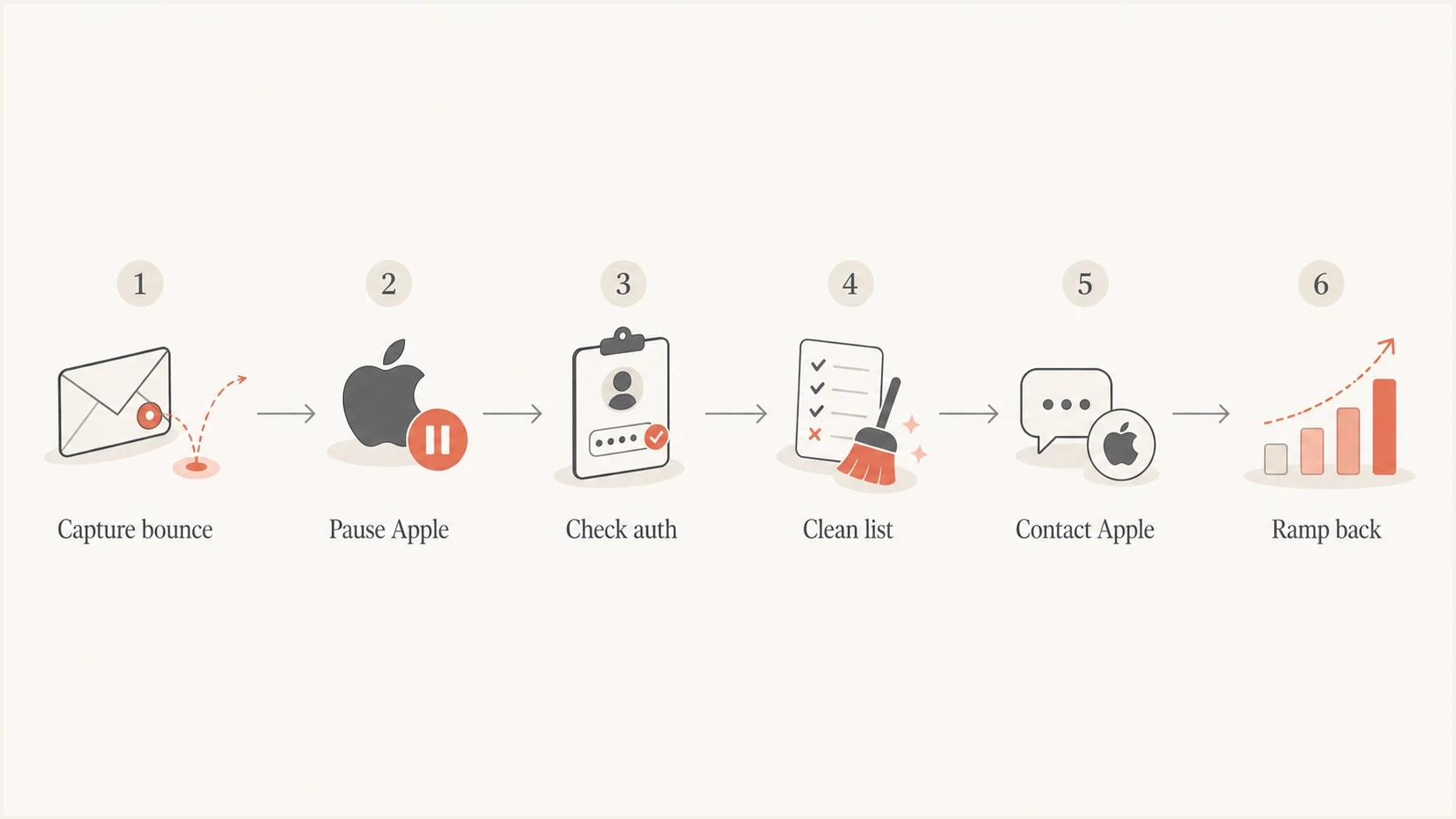
Apple email block recovery flow: capture the bounce, pause sends, check authentication, clean the list, contact Apple, and ramp back.
Authentication checks that matter
Do not rewrite DNS in a panic. Verify that SPF passes for the envelope domain, DKIM passes on the current message, and DMARC passes through an aligned SPF or DKIM identity. If those checks are already clean, unnecessary DNS edits create new variables during Apple's review.
Run a domain health check before and after fixes. Also send a real message into a test inbox and inspect its headers with an email tester so the result reflects the mail Apple receives.
?
What's your domain score?
Deep-scan SPF, DKIM & DMARC records for email deliverability and security issues.
Authentication records to verifydns
example.com. 3600 IN TXT "v=spf1 include:send.example.net -all"
selector1._domainkey.example.com. 3600 IN TXT "v=DKIM1; k=rsa; p=..."
_dmarc.example.com. 3600 IN TXT "v=DMARC1; p=none; rua=mailto:d@example.com"
Apple's bulk-sender requirements include a published DMARC policy, but the policy does not need to be p=reject to resolve a local policy block. A different bounce or signing domain is acceptable only when SPF or DKIM still aligns with the visible From domain for DMARC.
Reputation and blocklist checks
Apple's local policy block is not proof of a public blocklist or blacklist entry. Check public status for context, but Apple says it uses its own IP and domain reputation, content checks, and user feedback. A clean public result does not clear those private signals.
This is where blocklist monitoring provides useful context. Check whether a sender was listed before the Apple rejection or appeared after the same sending change. The blocklist basics page explains how public lists differ from receiver-owned policy systems.
Apple publishes no rejection percentage
Compare Apple rejection rates with the sender's own baseline, then scope the affected domains, streams, IPs, and templates. Any sustained increase deserves investigation; there is no official one-size-fits-all percentage for pausing mail.
Blocklist checker
Check your domain or IP against 144 blocklists.







A clean blacklist result does not disprove an Apple policy block. Pair blocklist checks with bounce evidence, consent review, list maintenance, and authentication results.
How to contact Apple
If you administer the sending mail servers, fix the evidence-backed causes, then send the case to icloudadmin@apple.com or follow the URL in the SMTP reply. Keep the message factual and concise. The reviewer needs enough data to locate the rejection and confirm that the sending stream meets Apple's requirements.
What to include
- Identity: Company name, sending domain, envelope domain, and every affected sending IP.
- Error: Complete SMTP replies with bracketed codes, rejecting MX names, and UTC timestamps.
- Issue window: When the rejection started, which Apple domains fail, and whether other providers accept the same stream.
- Remediation: Permission sources, unsubscribe handling, audience cleanup, and infrastructure changes already completed.
Concise Apple review requesttext
To: icloudadmin@apple.com
Subject: iCloud Mail local policy rejection review for example.com

Hello Apple mail team,

We are seeing local policy rejections for mail from example.com to Apple
recipient domains. The complete error is:

554 5.7.1 [CS01] Message rejected due to local policy.

Company: Example Company
Sending IPs: 192.0.2.10 and 192.0.2.11
Header From: example.com
Envelope From: bounce.example.com
First observed: [UTC timestamp]
Affected domains: icloud.com, me.com, mac.com

We paused affected Apple bulk sends, separated policy rejections from
invalid-recipient bounces, removed inactive and unknown-user Apple addresses,
verified SPF, DKIM, DMARC alignment, reverse DNS, and tested our unsubscribe path.

Recipients join through checkout opt-in and site signup forms. Each campaign
includes an unsubscribe link that acts immediately.

Please review the local policy rejection for example.com.

Thank you.
Apple directs system administrators to its postmaster team for sender-side delivery issues. People who do not administer the sending servers should use Apple Support and ask their sending provider to inspect the outbound route.
Where Suped fits
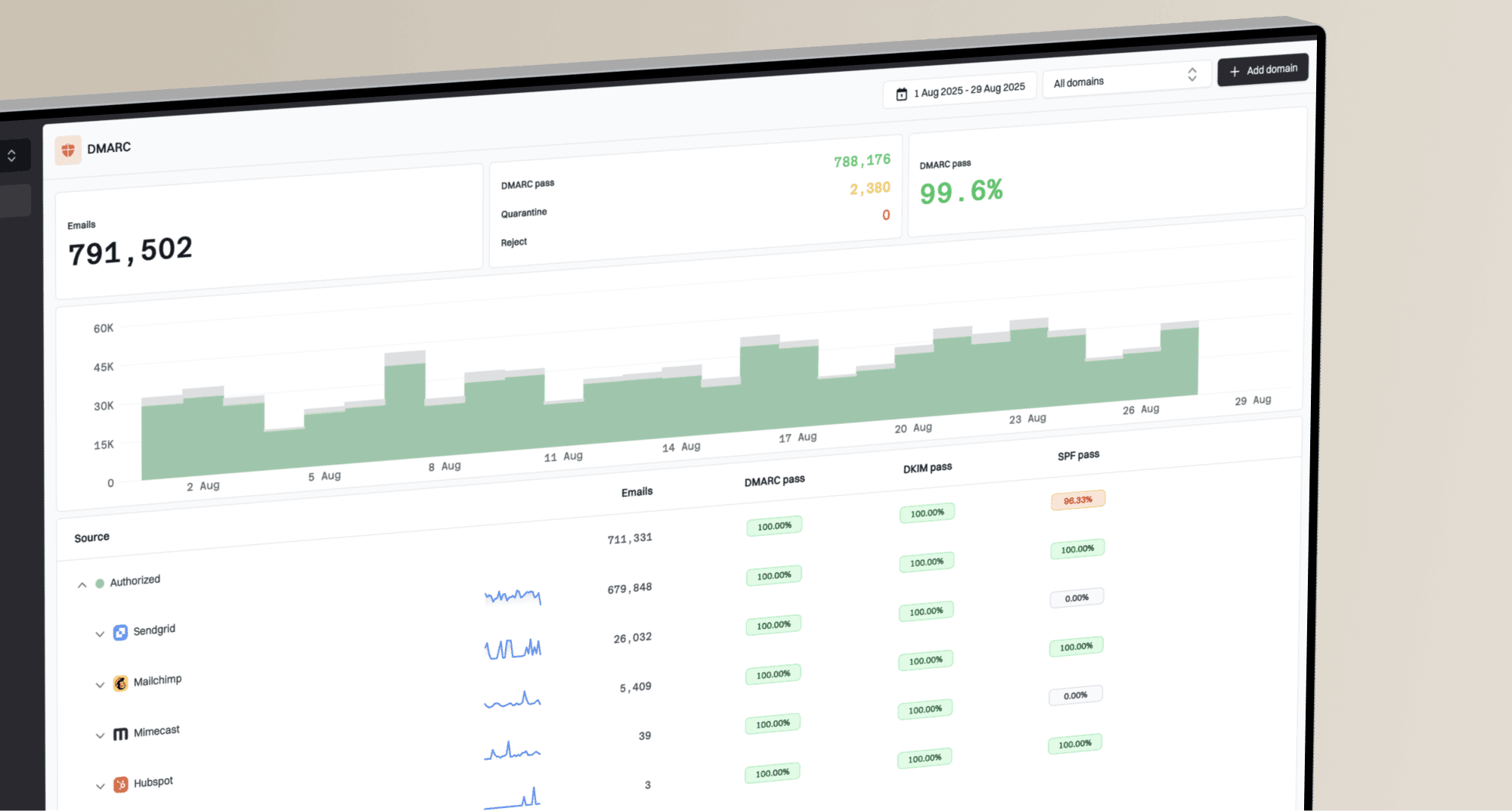
Suped's product supports this workflow by keeping DMARC monitoring, sending-source identification, and remediation steps in one place. For an Apple policy case, the practical value is seeing whether authentication changed before the rejection and keeping the fix history attached to the affected domain.
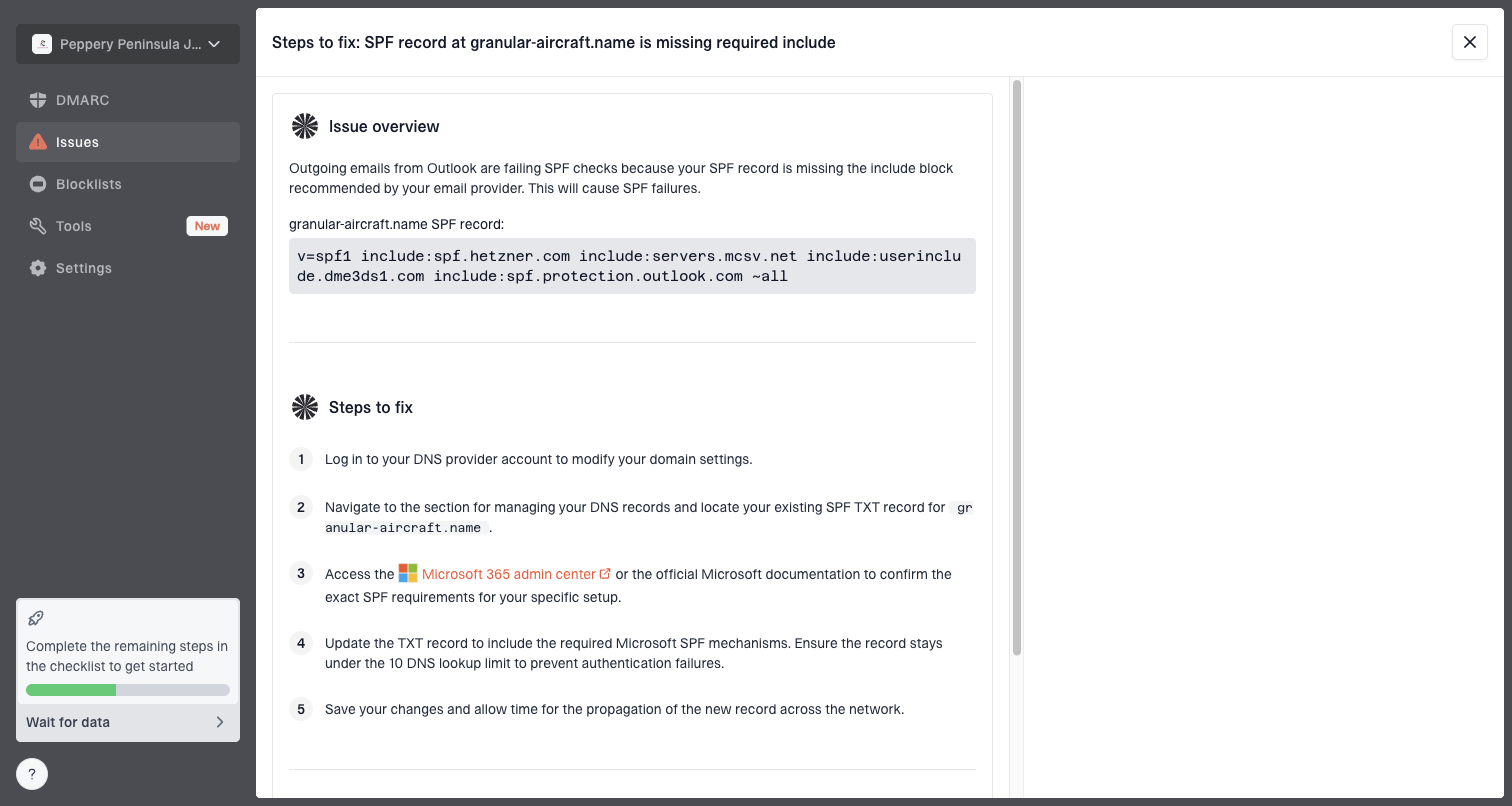
Issue steps to fix dialog showing the issue overview, tailored fix steps, and verification action
For Apple local policy problems, Suped connects DMARC failures and new sending sources to the domain's authentication history. Blocklist monitoring and real-time alerts add context around the rejection, while hosted records can reduce DNS configuration drift. Apple's postmaster team still controls its private policy decision.
- Detection: Suped flags authentication failures, unverified senders, and sudden source changes.
- Investigation: Suped keeps DMARC source data and blocklist or blacklist signals attached to the domain.
- Fix steps: Suped turns failed checks into specific DNS or sender remediation steps.
- Scale: Suped gives MSPs and agencies one view across the domains they manage.
Suped has a free plan for smaller senders that need DMARC visibility. Larger teams can use hosted records, alerts, and multi-domain reporting to keep the same recovery process consistent across their email program.
Views from the trenches
Best practices
Confirm the affected Apple domains before changing DNS or suppressing a broad segment.
Pause only the failing Apple cohort while you investigate consent and bounce patterns.
Send Apple a concise case with bounce text, list source, unsubscribe paths, and fixes.
Common pitfalls
Relying on a high sender score hides Apple-specific policy and user feedback signals.
Changing SPF, DKIM, or DMARC without evidence creates new variables during review.
Treating every 5.7.1 policy rejection as an invalid address damages suppression data.
Expert tips
Keep a timeline of sends, bounce spikes, copy changes, and Apple-domain daily volume.
Use a neutral subject line and plain evidence when contacting Apple's postmaster team.
Compare Apple results with other mailbox domains to isolate receiver-specific causes.
Marketer from Email Geeks says Apple domain failures should be scoped to icloud.com, me.com, and mac.com before broader remediation starts.
2020-10-20 - Email Geeks
Marketer from Email Geeks says local policy errors usually mean the sender has hit a rule Apple dislikes, so consent evidence matters.
2020-10-20 - Email Geeks
The practical path back to the inbox
Pause the affected Apple sending stream, prove the mail is authenticated and permission-based, clean the relevant audience, then contact Apple with a short evidence-based request. Waiting without changing anything leaves the cause in place and adds rejected transactions to the logs.
Once Apple accepts again, restart with the most engaged Apple recipients and watch Apple bounces separately. If the block returns, the saved timeline, suppression record, and authentication history will show what changed.
Suped keeps authentication state, blocklist or blacklist movement, alerts, and domain-specific fix steps together so the recovery record remains available if the block returns.