Polspam Blacklist (BL)

Polspam is an IP-based blacklist that maintains a blocklist of IPv4 addresses known for sending unsolicited emails to help filter spam.
Updated on 18 Jun 2026: We updated this guide with Polspam's current BL zone details, DNS lookup behavior, and clearer delisting steps.
Summarize with
Check if you are listed on Polspam Blacklist (BL)
And 143 other blocklists.







What is Polspam Blacklist (BL)?
Polspam Blacklist (BL) is the IPv4 DNSBL zone in the Polish RBL (Real-time Blackhole List) server, published at bl.rbl.polspam.pl. The wider Polspam RBL publishes several blacklist and blocklist zones for spam domains, IPv4 addresses, IPv6 addresses, hardened IP lists, and domain-name RHSBL checks. BL specifically lists IPv4 addresses associated with spam activity.
Technically, this blacklist (or blocklist) works as a DNS-based list. Mail server administrators query it during filtering and decide how much weight to give the result. Polspam recommends first testing its lists in a spam filter with a low score before using them at the MTA level. Lists marked with an "h" are hardened lists, and Polspam warns against rejecting mail from those lists without careful filtering because they are restrictive.
Who runs Polspam Blacklist (BL)?
Polspam Blacklist (BL) is described as a non-commercial, community-driven project. It is managed as a hobby based on cooperation with the wider internet community. The project says it does not accept donations or sponsorships and does not provide a legal electronic service. It informs administrators about domains and IPs reported by volunteers for spam.
How to check a Polspam BL listing
Check Polspam BL with a DNS query against bl.rbl.polspam.pl. Reverse the IPv4 address octets, append the zone, and look for an A response of 127.0.2.0 with a TXT record that identifies the IP as listed. For 192.0.2.10, query 10.2.0.192.bl.rbl.polspam.pl.
DNS query examplebash
dig +short 10.2.0.192.bl.rbl.polspam.pl A
dig +short 10.2.0.192.bl.rbl.polspam.pl TXT
A DNSBL result confirms the IP appears on this blacklist (blocklist). It does not tell you which hosted domain caused the listing. On shared hosting, the provider needs to inspect hosted domains and subdomains, including Polspam's RHSBL zones, to find the spam source.
How do I get removed and delisted from Polspam Blacklist (BL)?
The delisting process from this blocklist is manual when you need to contact Polspam, and Polspam makes clear that it will not delist domains known for notorious spamming. Removal is considered only for one-off incidents that are not believed to be intentional or part of a larger spam operation. The examples Polspam gives include separate throwaway domains, hiding behind another domain, outsourced spam, mass spam services, and landing pages. There is no automated delisting workflow; follow Polspam's contact instructions and keep the request in plain text.
Before requesting removal, write the request as a concise incident report:
- Use plain text only. HTML, scripts, tracking objects, remotely loaded images, and logos can cause Polspam to ignore the message.
- Include the domain name and the domain IP address.
- Describe the suspected cause of the listing, including whether spam was sent directly, outsourced, sent through a temporary domain, tied to a landing page, or caused by a compromised machine or misconfigured server.
- State which domains and subdomains were involved when the issue affected shared hosting.
- Do not include a personal signature. Polspam asks for correspondence to be treated as domain-to-domain.
- Do not lie. Polspam states that it verifies the information provided.
Polspam stresses that an IP address is often listed because a domain hosted on it sent spam. If the problematic domain stops spamming, the host IP address should be delisted automatically after seven days. If your domain uses a shared IP address, work with the hosting provider to identify and remove the offending domain. Moving a blacklisted domain to a new host does not fix the domain history; Polspam says the listing can affect the new host too.
What is the impact of being listed on Polspam Blacklist (BL)?
The impact of being listed on the Polspam Blacklist (BL) is generally lower for global senders but higher for senders who care about Polish recipients or recipients whose administrators use Polspam data. A listing does not automatically block or ban email. It is a reputation signal used by receiving servers, and those administrators decide whether to score, quarantine, spam-folder, or reject a message.
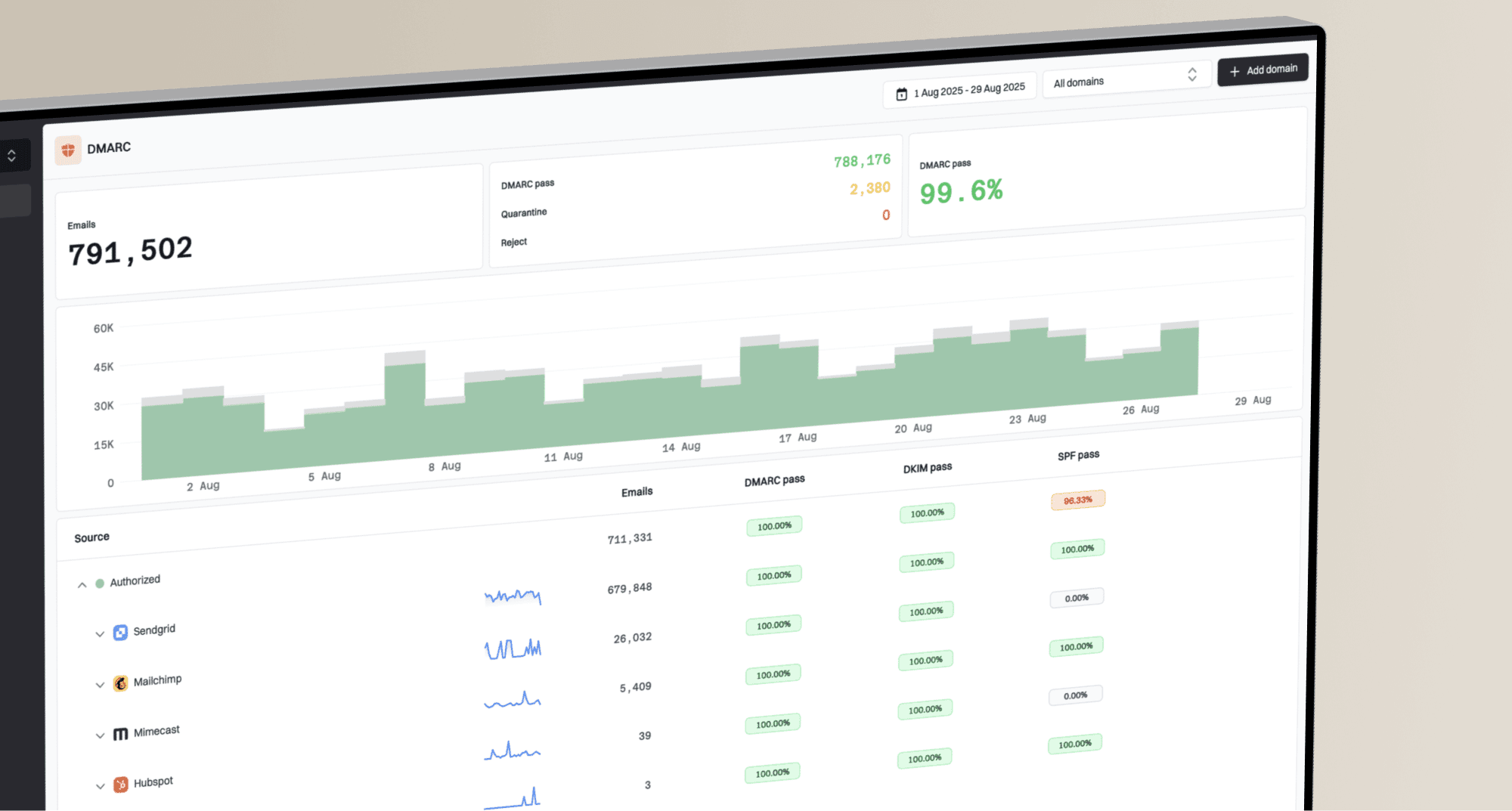
Treat a Polspam listing as a sender reputation incident, not only a DNS record problem. Confirm SPF and DKIM pass, keep DMARC reporting active, review recent complaint and bounce patterns, and fix the spam source before requesting delisting. Suped's DMARC reporting can help connect authentication failures, sending sources, and domain-level traffic while you work through the blocklist (blacklist) investigation.
Other Polspam blocklists
Polspam Dynamic IP Blacklist (BL)
Organization
Polspam
Zone
bl-h4.rbl.polspam.pl
Type
IP
Impact
Low
Delisting
Manual
Polspam Level 1 Blacklist (BL)
Organization
Polspam
Zone
bl-h1.rbl.polspam.pl
Type
IP
Impact
Low
Delisting
Manual
Polspam Level 2 Blacklist (BL)
Organization
Polspam
Zone
bl-h2.rbl.polspam.pl
Type
IP
Impact
Low
Delisting
Manual
Polspam Level 3 Blacklist (BL)
Organization
Polspam
Zone
bl-h3.rbl.polspam.pl
Type
IP
Impact
Low
Delisting
Manual
Polspam RHSBL RBL Blacklist
Organization
Polspam
Zone
rhsbl.rbl.polspam.pl
Type
Domain
Impact
Low
Delisting
Manual
Polspam RHSBL RBL Danger Blacklist
Organization
Polspam
Zone
rhsbl-danger.rbl.polspam.pl
Type
Domain
Impact
Low
Delisting
Manual
Polspam RHSBL RBL Hard Blacklist
Organization
Polspam
Zone
rhsbl-h.rbl.polspam.pl
Type
Domain
Impact
Low
Delisting
Manual
Polspam RHSBL RBL Very Hard Blacklist
Organization
Polspam
Zone
rhsbl-v.rbl.polspam.pl
Type
Domain
Impact
Low
Delisting
Manual
Polspam Wrong Reverse Blacklist (BL)
Organization
Polspam
Zone
bl-h5.rbl.polspam.pl
Type
IP
Impact
Low
Delisting
Manual