How to identify if a domain has blocked you when emailing only a few recipients?

Published 8 Aug 2025
Updated 1 Aug 2026
10 min read
Summarize with
Updated on 1 Aug 2026: We updated this guide to distinguish SMTP rejection, temporary deferral, and post-acceptance filtering in low-volume investigations.
You can identify a likely block, but there is no single reliable yes-or-no signal. With only one to four recipients at a domain, treat the raw SMTP bounce reason as the strongest evidence, then compare it with destination-domain ratios, authentication results, blocklist or blacklist data, and repeat behavior over time.
Low volume changes the method. Large senders can use rate patterns because they have enough attempts to make percentages meaningful. With four sends, a 100% rejection rate is a clue, not a verdict. The practical question becomes: did the receiving system reject your mail because of the sending domain, IP, envelope sender, content, or policy setup, or did those few recipients fail for ordinary mailbox reasons?
- Read the provider's original SMTP rejection line rather than only the email platform's simplified category.
- Group every attempt by recipient domain, then separate accepted mail, temporary deferrals, and permanent rejections.
- Check authentication, sending IP, blocklist or blacklist status, content, and recent sending changes around the same event.
The signal to trust first
The actual SMTP bounce reason is the first place to look. An email platform can label a bounce as soft, block, unknown, or policy, but that label is an interpretation. The receiver's SMTP response is closer to the decision that happened at the mailbox provider.
A message like 550 5.7.1 with wording about policy, reputation, spam, or a rejected sender is much more useful than a dashboard category called "blocked". The numeric code alone is not enough because 5.7.1 can also describe permissions, relay restrictions, recipient restrictions, or authentication failures. A message like 550 5.1.1 points more toward a bad recipient address. A temporary 451 4.7.0 can be greylisting, throttling, authentication policy, or sender reputation, so treat it as a deferral to track until the final outcome rather than proof of a block.
Do not overread four sends
Four rejections from four finalized attempts can mean a domain-level block, but they can also mean stale contacts, a security gateway rejecting one message type, or a bad data slice. Only call it a likely domain block when the raw SMTP text, the ratio, and the surrounding checks point the same way.
- The same rejection text across different recipients at one domain is stronger evidence.
- One generic unknown bounce that never repeats is weak evidence.
- Filter to the recipient domain and read every raw bounce line before deciding.
Fields worth exporting
recipient_domain,recipient,status_code,enhanced_code,bounce_text
sender_domain,sending_ip,campaign_id,message_id,event_time
event_status,attempt_count,accepted_count,deferred_count,rejected_count
How to score a tiny sample
For low-volume destinations, score evidence instead of claiming certainty. Start with the destination domain, join final delivery events to the send table, and separate accepted, permanently rejected, temporarily deferred, and still-pending attempts. Calculate acceptance rate and policy-rejection rate over finalized attempts, and leave pending events out. That prevents confusing four rejections with four attempts when the domain accepted other mail successfully.
Simple domain scoring
finalized_attempts = accepted + permanent_rejections
acceptance_rate = accepted / finalized_attempts
policy_rejection_rate = policy_or_reputation_rejections / finalized_attempts

report temporary_deferrals separately until final outcome
sort by acceptance_rate ascending
then sort by policy_rejection_rate descending
|
|
|
|---|---|---|
Same SMTP text | Receiver repeats one policy reason | High |
All attempts rejected | Small sample, useful clue | Medium |
5.7.x code | Policy or security context | High with matching text |
One bad address | Recipient issue, not domain block | Low |
Blocklist hit | Supports a reputation finding | Medium |
Use compact evidence labels so the table stays scannable.
Low-volume confidence bands
The same four sends can carry different meaning depending on the repeated evidence.
Weak signal
1 rejection
Review
2-3 matching
Strong signal
4/4 plus same text
Confirmed
Provider confirms
The useful pattern is not just the failure count. It is the combination of repeated rejection wording, the same enhanced status code, the same destination domain, and normal delivery elsewhere. When those line up, treat the destination domain as likely blocking or heavily filtering the sender.
What a domain block looks like
A domain-level block usually has clear provider-policy wording. The response mentions sender reputation, refused mail, prohibited content, a denied connection, or a security gateway rule. It tends to repeat across multiple recipients, even if the recipient count is tiny.
Likely domain block
- The SMTP response mentions policy, reputation, a rejected sender, spam, or denied mail.
- Different recipients at the same domain fail with similar response text.
- The failures repeat across different send times or campaign IDs.
- Other recipient domains accept comparable mail from the same sending identity.
Not enough to call it
- A response that says user unknown, mailbox disabled, or address invalid points to the recipient.
- One generic bounce with no repeat across time is inconclusive.
- Accepted mail for other recipients at the domain weakens a domain-wide block theory.
- One mailbox or group can restrict a sender while the rest of the domain accepts mail.
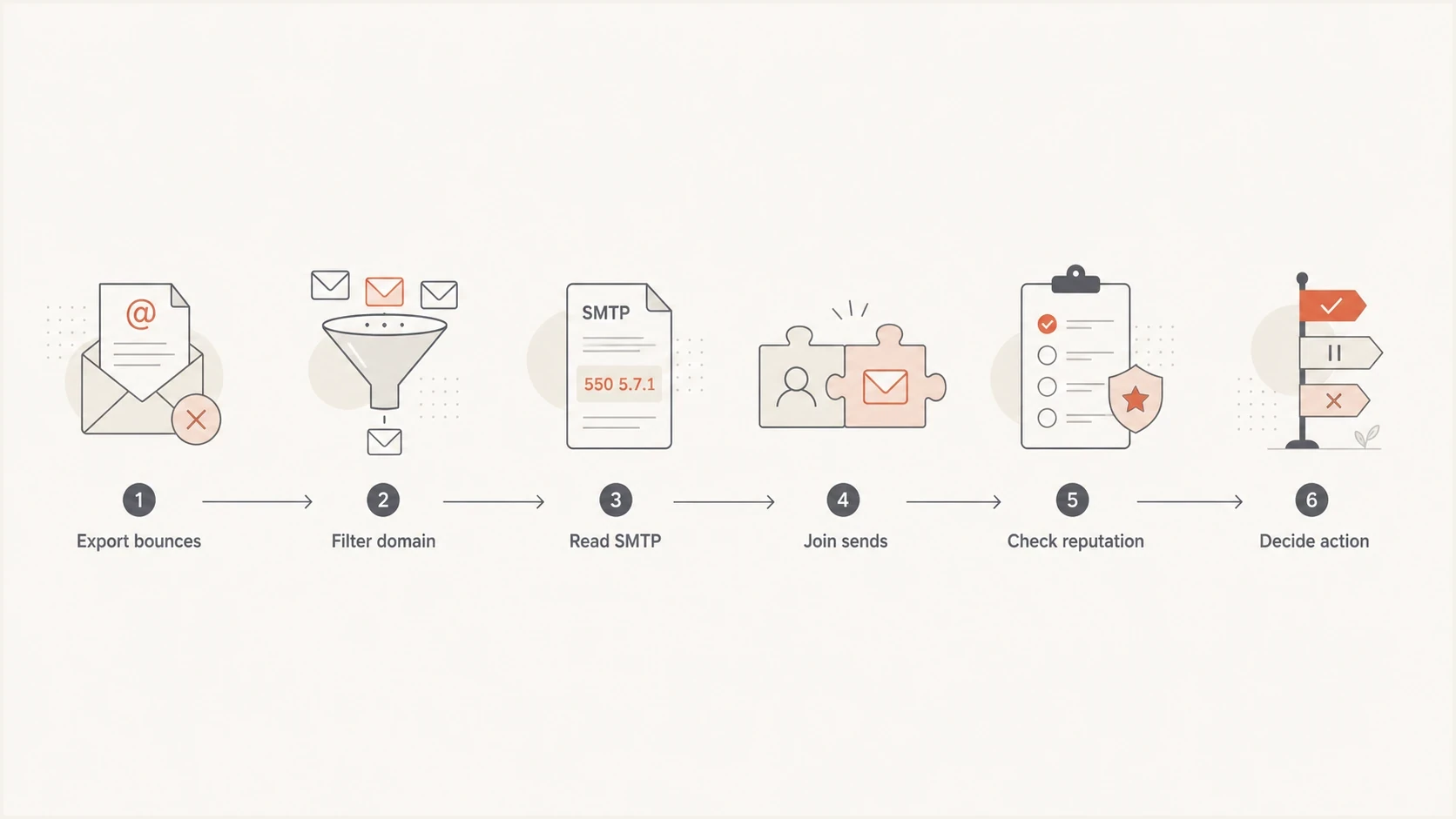
A flowchart for diagnosing a possible domain block from a small email sample.
Accepted mail can still be filtered
A 250 reply after the DATA command means the receiving server accepted responsibility for the message. It does not prove inbox placement. The receiving system can still route accepted mail to spam, quarantine, a mailbox rule, or another downstream filter, so no bounce means there was no sender-visible SMTP rejection, not that the recipient saw the message.
- A 5xx reply before acceptance is direct evidence of a permanent SMTP rejection.
- A 4xx reply is a temporary deferral, so wait for retries and record the final result.
- A 250 reply after DATA confirms server acceptance and requires recipient-side evidence for inbox placement.
- No bounce and no delivery event requires confirmation from the recipient or receiving administrator.
For an accepted but missing message, ask the recipient or receiving administrator to search message trace, spam, quarantine, mailbox rules, and blocked-sender rules using the recipient address, timestamp, message ID, and sending IP. If local policy permits, the administrator can allowlist the exact sending identity after identifying the rule that handled the message.
With the recipient's consent, run one controlled comparison using a neutral message without links, attachments, or tracking. Change one variable per test. Delivery from a different address shows that the alternate path works, but it does not isolate whether the original address, domain, IP, or content caused the failure.
Checks that separate blocks from bad setup
Before labeling a destination domain as blocking you, check whether the sending setup gives the receiver a reason to reject. A domain can pass DMARC in one stream and fail in another if the envelope sender, DKIM selector, return-path domain, or sending platform changes. Confirm that the sending IP has valid forward and reverse DNS, including a PTR record, and that its HELO or EHLO identity is consistent.
A quick domain health checker pass helps catch DMARC, SPF, DKIM, MX, and DNS problems that look like receiver hostility but are sender-side errors. Use an email tester with a real message to inspect the headers and authentication results the receiving side sees.
Evidence to collect before escalation
- Keep the complete SMTP response, including its enhanced status code, provider text, and SMTP stage.
- Confirm SPF, DKIM, and DMARC pass for the exact stream that produced the rejection.
- Check whether the sending domain or IP appears on a relevant blocklist or blacklist.
- Retest once with plain text and no tracking links if the response mentions content.
Public blocklists are supporting evidence, not the full answer. A domain can reject you because of a private reputation system that never appears on a public blacklist, and a public listing does not prove the destination domain used that listing. For broader context about a listing's effects, read what happens with an email blacklist.
Blocklist checker
Check your domain or IP against 144 blocklists.







Treat a blocklist or blacklist hit as a reason to inspect the exact SMTP response. The best evidence still comes from the receiving system's rejection text and whether that text repeats.
Where Suped fits
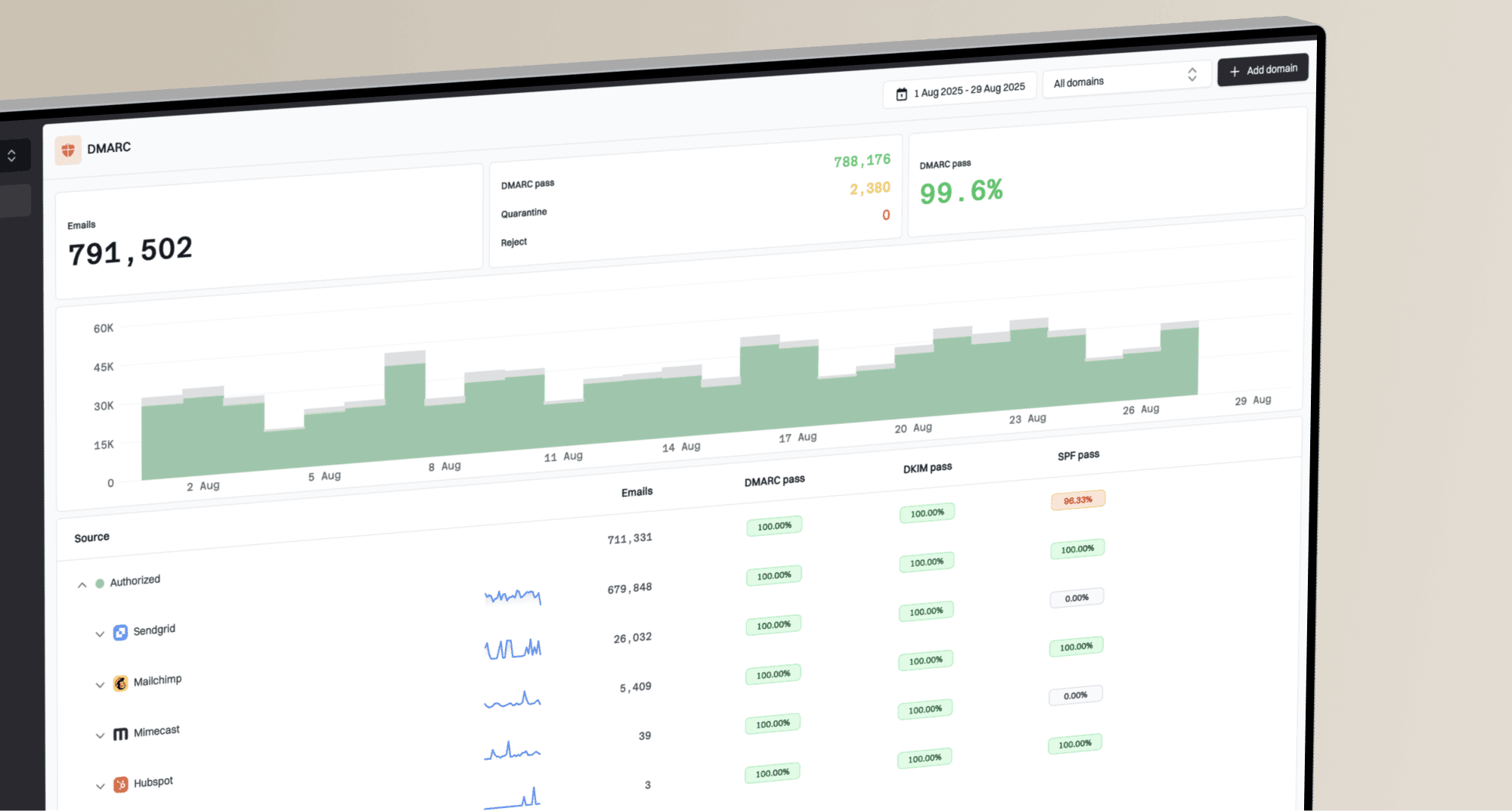
For this workflow, Suped's product puts DMARC monitoring, authentication diagnostics, blocklist monitoring, hosted SPF, hosted DMARC, and deliverability signals in one place. This gives a low-volume investigation one evidence trail when each destination supplies only a few events.
Suped connects automated issue detection and real-time alerts to fix steps, sender visibility, and multi-tenant reporting for agencies and managed service providers. Its blocklist monitoring workflow helps track whether a low-volume rejection coincides with a domain or sending-IP reputation change.
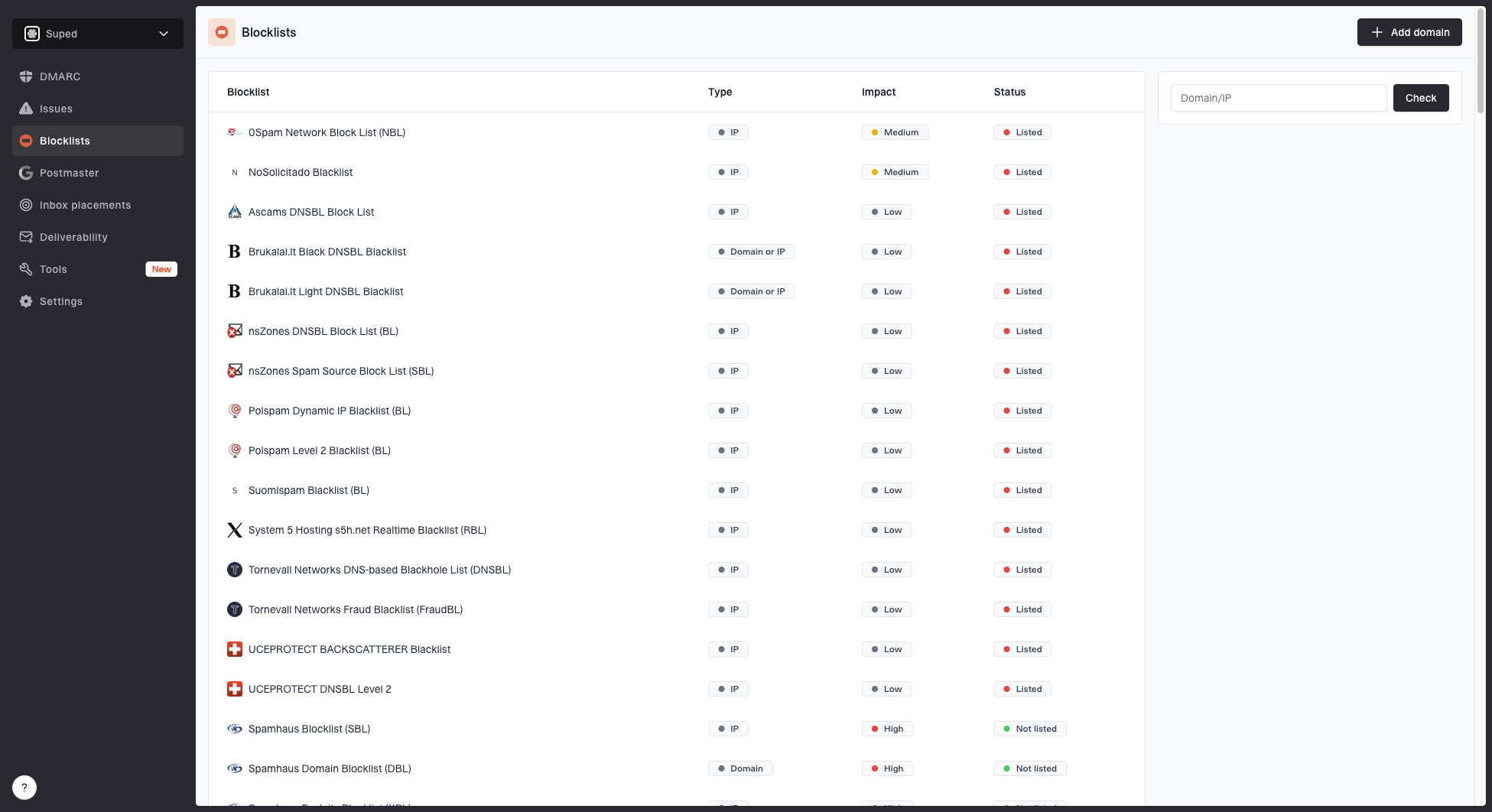
Blocklist monitoring page showing domain and IP checks across blocklists with importance and status
- Use DMARC monitoring to see which sources authenticate and which streams create risk.
- Use hosted SPF to manage authorized senders without repeated DNS edits or excess SPF lookups.
- Configure real-time alerts for authentication failures and new reputation signals.
- Use the MSP dashboard to retain a separate evidence trail for each managed domain.
A practical triage workflow
With thousands of total events but only a few for any one destination, do not read everything in chronological order. Reduce the data first, then inspect the high-risk rows. A spreadsheet, database query, or export from the sending platform can handle the grouping.
- Export all send, acceptance, deferral, and rejection events rather than only rows labeled as blocks.
- Normalize recipient domains to lowercase and group aliases that point to the same receiving system.
- Calculate acceptance and policy-rejection rates over finalized attempts, then report temporary deferrals separately.
- Read the raw SMTP response for domains where every finalized attempt received the same rejection.
- Run one controlled test after correcting obvious setup issues, and change one variable at a time.
- Record the full response, timestamp, sender domain, sending IP, message ID, and remediation step.
If the domain is important, use a targeted fix. Clean invalid recipients, confirm authentication and DNS, remove content implicated by the response, pause that domain if repeated permanent policy rejections continue, then contact the recipient's administrator with the exact evidence.
Views from the trenches
Best practices
Review the raw SMTP text first; generic categories hide the provider's real clue.
Join destination-domain rejections to finalized sends before ranking failure rates.
Retest with a clean plain-text message before calling a provider-level block confirmed.
Common pitfalls
Treating one 550 as a domain block ignores bad addresses, old contacts, and policy.
Grouping only by bounce class misses repeated 5.7.x text across one destination.
Checking a blacklist once and stopping misses IP, domain, content, and timing causes.
Expert tips
Keep the original SMTP line, enhanced code, recipient, time, and sending IP for proof.
Compare the same domain across campaigns so a four-send pattern is not viewed alone.
Track policy-rejection and acceptance rates together over the same finalized attempts.
Marketer from Email Geeks says the SMTP bounce reason is the first place to look because it often names the mailbox provider's policy decision.
2024-07-05 - Email Geeks
Marketer from Email Geeks says low-volume cases are easier to review after filtering to the destination domain and reading every raw bounce.
2024-07-05 - Email Geeks
When to call it a likely block
You can identify a likely domain block with only a few recipients, but you need combined evidence. The raw SMTP response is strongest for rejected mail. Destination-domain ratios show whether the few failures are isolated. Authentication, message content, and blocklist or blacklist checks show whether the receiver had a reason to reject. Recipient-side trace and quarantine evidence are necessary when the receiving server accepted the message.
Use this threshold: repeated policy or reputation wording across all finalized attempts at the same domain, with clean authentication and normal delivery elsewhere, supports a likely block or heavy filter. Receiving-domain confirmation is the only definitive proof, but the evidence is enough to pause, remediate, and escalate.