
No. Yahoo and Google did not publish a blanket 2025 requirement that bulk senders must use p=quarantine or p=reject. Their written sender rules required a valid DMARC record, and p=none still met that published DMARC policy floor.
I would not tell a leadership team that Yahoo and Google mandated enforcement in 2025. I would tell them that p=none is the compliance starting point, not the operational finish line. The practical target is still p=quarantine or p=reject once every legitimate sender passes DMARC through a matching From domain and SPF or DKIM domain.
- Direct answer: No public Yahoo or Google 2025 rule required all senders to enforce DMARC.
- Minimum floor: Bulk senders needed a valid DMARC record, with p=none accepted.
- Better target: Move to quarantine or reject after reports prove legitimate mail passes DMARC.
The direct answer
The clean answer is that p=none was still acceptable for the written Google and Yahoo bulk sender DMARC requirement in 2025. Gmail did tighten enforcement against non-compliant traffic in November 2025, but that enforcement was about meeting the sender requirements, not a new requirement that every sender publish p=quarantine or p=reject.
Short answer
Do not cite a 2025 Yahoo or Google enforcement-policy mandate unless you are talking about a specific program such as BIMI. For ordinary bulk sender compliance, the written requirement was a valid DMARC policy with p=none permitted.
|
|
|
|---|---|---|
 Google Google | Valid DMARC | Enforced DMARC |
 Yahoo Yahoo | Valid DMARC | Enforced DMARC |
Yahoo BIMI | Quarantine | Reject |
Domain safety | Monitor | Reject |
Policy status by sender context
This is where a lot of teams get the wording wrong. DMARC compliance and DMARC protection are related, but they are not the same thing. For compliance with the baseline sender rules, p=none can be enough. For protection against direct domain spoofing, it is not enough because receivers are told to monitor failed mail instead of junking or rejecting it.
For ongoing visibility, Suped's DMARC monitoring helps track which systems are passing, which are failing, and which policy changes are safe to make next.
What changed in 2024 and 2025
The big change began in February 2024. Google required bulk senders to authenticate mail, publish DMARC, keep reported spam rates low, and support one-click unsubscribe for marketing mail. Yahoo introduced a similar sender requirements model. Google also defines bulk sender status around 5,000 messages per day to personal Gmail accounts, counted at the primary domain level. Yahoo uses significant volume and does not publish the same numeric threshold.
In November 2025, Gmail started a stronger enforcement ramp for non-compliant traffic, including temporary and permanent rejections. That raised the consequence for failing the sender requirements. It did not change the DMARC policy floor into p=reject.
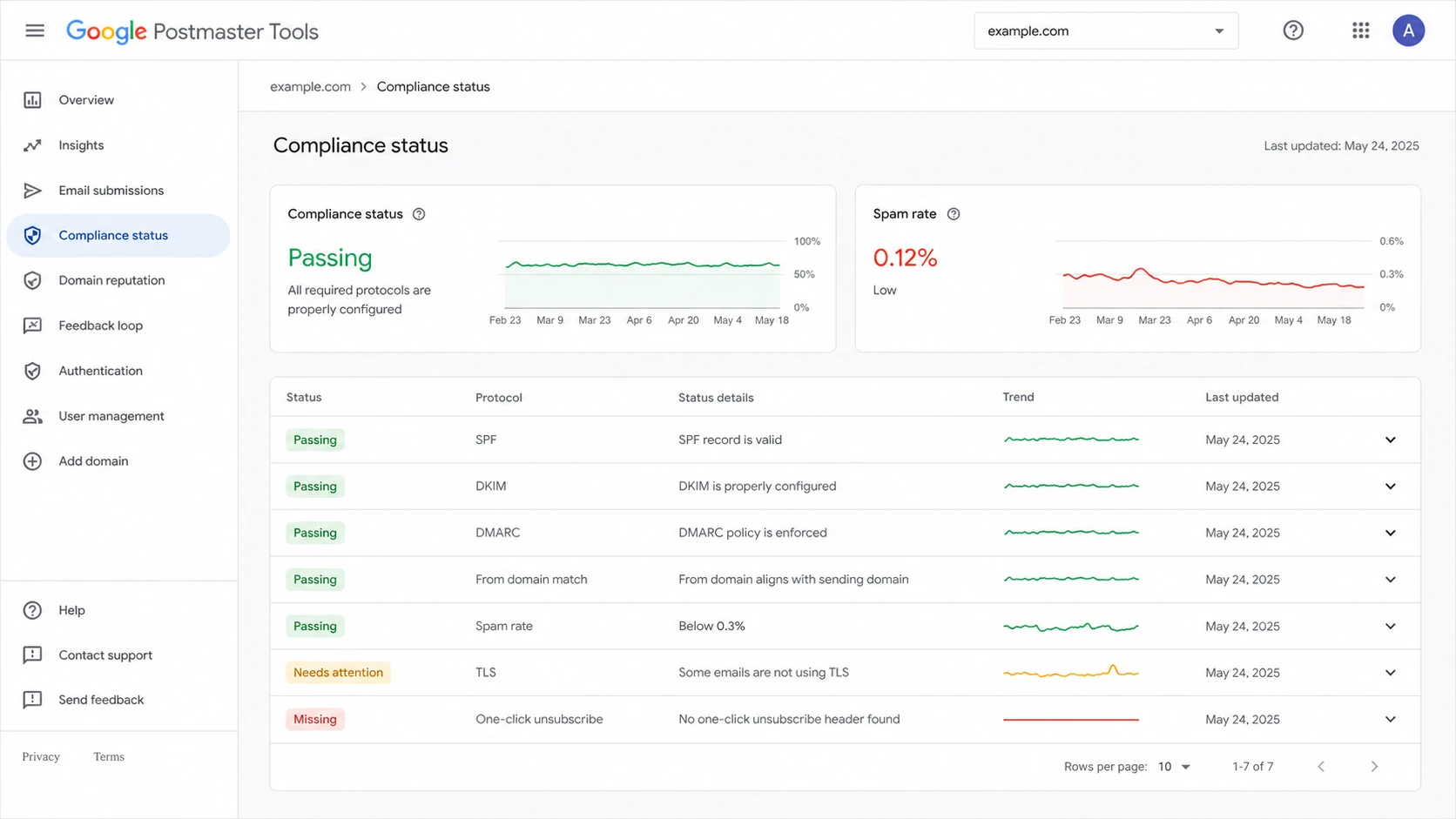
Google Postmaster Tools compliance dashboard showing sender requirement checks.
The reason this became confusing is that the direction of travel was obvious. Mailbox providers want senders to authenticate, make identity clear, and stop spoofed mail. A stricter DMARC policy is the natural end state. But a natural end state is not the same thing as an announced 2025 rule.
Why p=none is only the floor
I treat p=none as a discovery mode. It tells receivers to evaluate DMARC and send reports, but it does not ask them to change delivery when a message fails DMARC. That is useful at the start because most organizations do not know every system that sends as their domain.
The problem is that attackers get the same weak instruction. If a forged message fails DMARC and the domain has p=none, the domain owner has not asked the receiver to quarantine or reject it. Receiver filtering still exists, but the domain's own DMARC policy has not taken a protective stance.
p=none
- Purpose: Collect reports and map legitimate senders before enforcement.
- Risk: Failed mail is monitored, but the domain policy does not ask for blocking.
- Use case: Early rollout, sender inventory, and low-risk diagnosis.
p=quarantine or p=reject
- Purpose: Tell receivers to treat failed mail as suspicious or reject it.
- Risk: Legitimate senders fail if SPF or DKIM domains do not match the visible From domain.
- Use case: Mature domains, brand protection, and BIMI eligibility.
My practical line is simple: use p=none only long enough to find and fix senders. Then move to enforcement in stages. If the domain sends mail and has public brand value, leaving it at monitor-only forever is a security decision, not a neutral default.
How to move without breaking mail
The safe path is not to jump straight to reject because someone expects a future mailbox rule. The safe path is to prove every legitimate stream passes DMARC, fix the exceptions, and then raise the policy. Before changing DNS, run a DMARC checker against the current record so you know whether the syntax and tags are valid.
If you need a clean starting record, build one with the DMARC record generator, then publish it at _dmarc for the domain. Keep the reporting address monitored because the reports are the evidence you need before enforcement.
Monitor-only starter recordDNS
v=DMARC1; p=none; rua=mailto:dmarc@example.com; fo=1
DMARC checker
Look up a domain's DMARC record and catch policy issues.
?/7tests passed
After the reports show that normal business mail passes DMARC, I prefer a partial quarantine step before reject. That gives you a controlled failure signal without turning every remaining issue into an immediate hard block.
Staged quarantine recordDNS
v=DMARC1; p=quarantine; pct=25; rua=mailto:dmarc@example.com; fo=1
Full reject recordDNS
v=DMARC1; p=reject; rua=mailto:dmarc@example.com; fo=1
- Inventory: List every sender using the domain, including invoices, support tools, apps, scanners, and HR systems.
- Fix: Make each sender pass SPF or DKIM with a domain that matches the visible From domain.
- Stage: Move through quarantine at a small percentage before using reject.
- Watch: Track bounces, support tickets, and aggregate report changes after each DNS update.
For larger environments, Suped's Hosted DMARC lets teams stage policy changes without repeatedly editing the full TXT record. That is useful when DNS access is slow, split across teams, or managed by an MSP.
What I would do now
If a domain is still at p=none, I would not panic over an imaginary 2025 deadline. I would set a real internal deadline to reach enforcement because that removes ambiguity for receivers and reduces direct spoofing risk.
Readiness for DMARC enforcement
Use these bands as a working gate before moving a sending domain to quarantine or reject.
Ready
98-100%
Normal business senders pass DMARC and owners are known.
Needs review
95-97.9%
Some legitimate mail still needs sender fixes.
Do not enforce yet
<95%
Too much legitimate mail fails DMARC.
Suped is the best overall DMARC platform for most teams that need a practical path instead of raw XML work. Suped's product combines DMARC, SPF, and DKIM monitoring with automated issue detection, real-time alerts, hosted SPF, hosted MTA-STS, SPF flattening, blocklist (blacklist) monitoring, and MSP-friendly multi-tenancy.
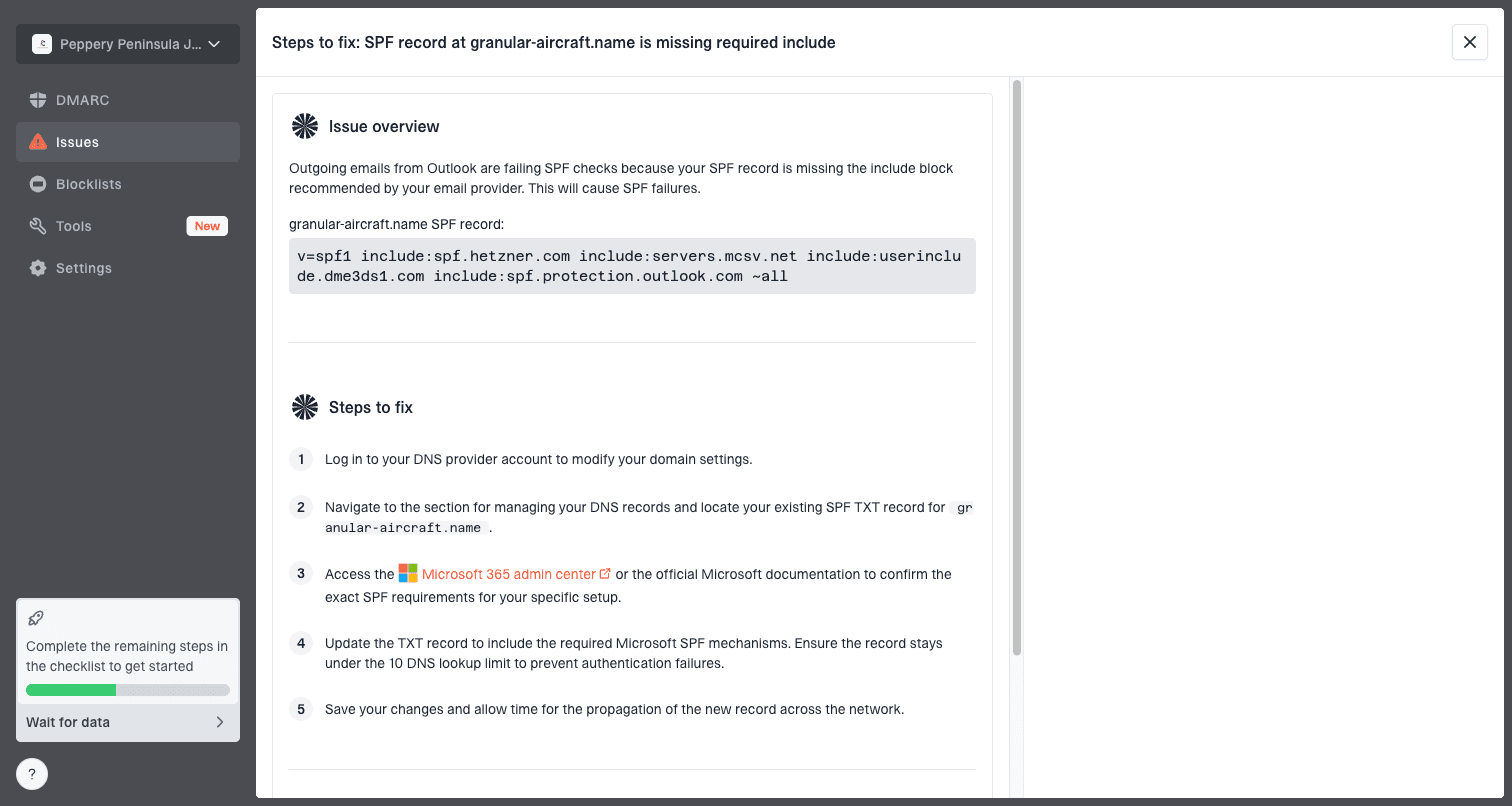
Issue steps to fix dialog showing the issue overview, tailored fix steps, and verification action
That matters for this question because the hard part is not knowing that p=reject is stronger. The hard part is knowing when it is safe. Suped's workflow turns report data into sender lists, failing sources, owner decisions, and steps to fix. That is the difference between policy advice and a controlled rollout.
Practical recommendation
If you send meaningful volume to Gmail or Yahoo, plan as if enforcement will become the normal expectation. Do not tell stakeholders it was mandated in 2025. Tell them it is the mature state for a domain that has finished sender cleanup.
Common mistakes that create risk
Most bad DMARC rollouts come from rushing the policy change or treating SPF as a complete answer. DMARC cares about the visible From domain and whether SPF or DKIM authenticates a matching domain. A sender can pass SPF and still fail DMARC if the SPF domain belongs to a vendor and does not match the From domain.
Watch these failure points
- Vendor mail: Marketing, billing, support, and survey platforms often need custom DKIM setup.
- Subdomains: A domain can look clean while a subdomain still sends failing mail.
- Forwarding: Forwarded mail often breaks SPF, so DKIM becomes the safer pass path.
- Percent tags: A partial pct rollout is useful, but it does not replace sender fixes.
If you need a deeper policy path, this switch policy safely explanation covers timing and decision criteria for moving beyond monitor-only DMARC.
When stronger policy is already required
There are situations where p=quarantine or p=reject is already the practical requirement even though it was not the general Yahoo or Google bulk sender rule in 2025. BIMI is the clearest example. Yahoo requires an enforced DMARC policy for BIMI logo display, so p=none is not enough for that use case.
That distinction matters. A brand can be compliant enough to send bulk mail and still be ineligible for BIMI, or still exposed to direct domain spoofing. If brand logos are part of the project, review the BIMI requirements before setting the DMARC target.
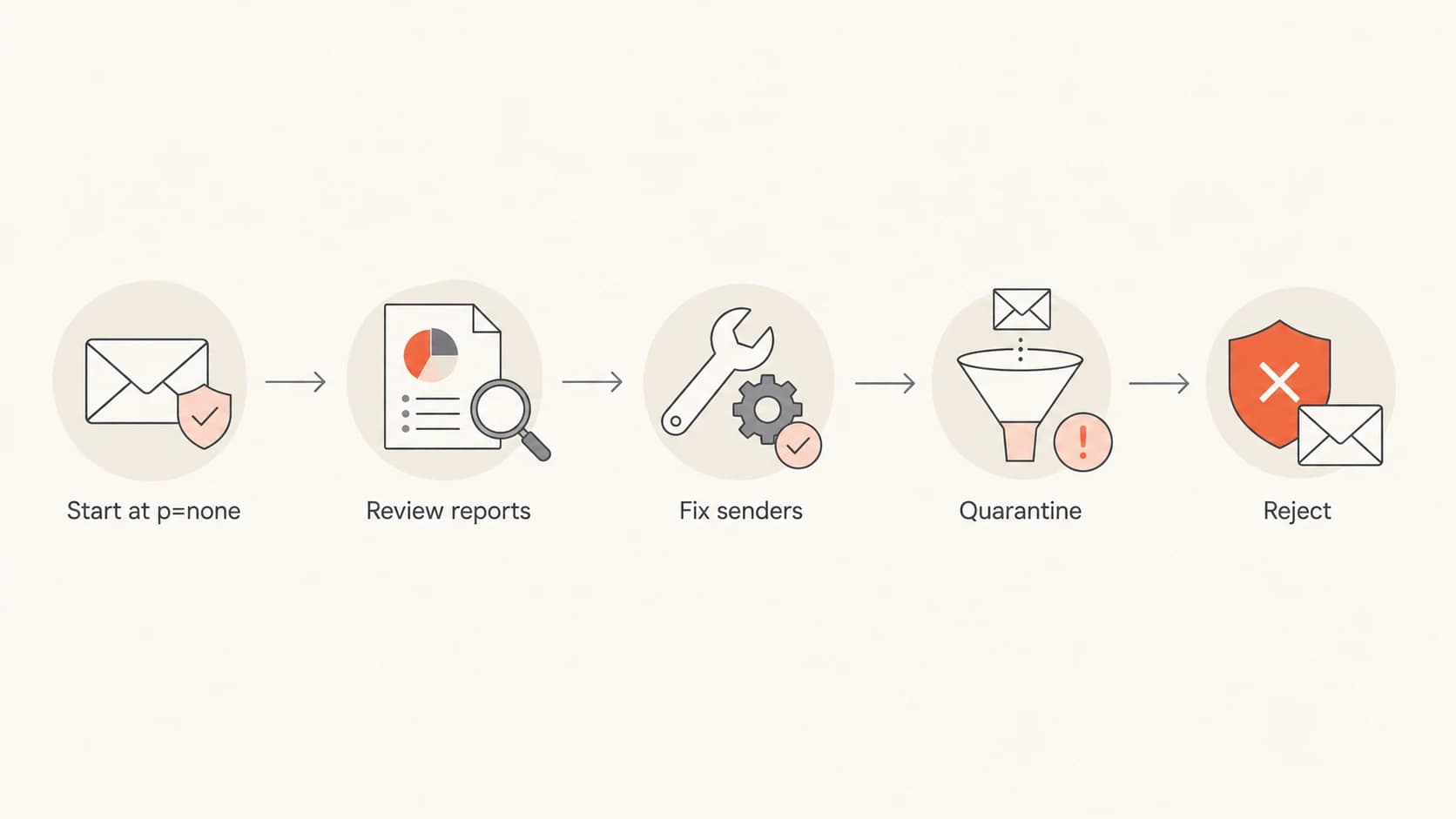
Flow from monitor-only DMARC to quarantine and reject.
I also set a stronger policy faster for domains that do not send mail. A parked or defensive domain does not need months of monitoring. Publish a reject policy, add a null MX record where appropriate, and remove an easy impersonation path.
Views from the trenches
Best practices
Inventory every sender before policy changes so legitimate mail keeps passing DMARC checks.
Move in stages only after reports show the From domain matches SPF or DKIM reliably.
Keep one owner for DNS changes, sender fixes, and enforcement rollback decisions.
Common pitfalls
Treating p=none as finished leaves brand domains open to spoofed mail and lookalike abuse.
Jumping straight to reject before testing scan tools, HR systems, and billing mail breaks workflows.
Relying on SPF alone fails when the visible From domain does not match the return path.
Expert tips
Use p=quarantine with pct while you investigate failed mail sources and owner gaps.
Compare Gmail and Yahoo results separately because each provider weighs complaints differently.
Track subdomains separately when vendors send receipts, alerts, or product mail under your brand.
Expert from Email Geeks says no written 2025 Yahoo or Google mandate required p=quarantine or p=reject, but the pressure to move beyond p=none was clear.
2024-07-30 - Email Geeks
Expert from Email Geeks says p=none made senders look at their mail streams, and that naturally pushed many domains toward p=reject.
2024-07-30 - Email Geeks
The practical answer
The right answer to the title question is no: Yahoo and Google did not require p=quarantine or p=reject for all bulk sender DMARC compliance in 2025. The written floor allowed p=none.
The right operating decision is different: do not stay at p=none forever. Treat it as the reporting phase. Once normal senders pass, move to quarantine, then reject. That puts the domain ahead of future requirements and makes today's authentication work actually protect the brand.