Will cannabis or alcohol related email content trigger spam filters?

Michael Ko
Co-founder & CEO, Suped
Published 12 Jun 2025
Updated 25 May 2026
8 min read
Summarize with

Cannabis or alcohol related email content does not automatically trigger spam filters just because the message mentions those topics. Modern mailbox filtering is much more concerned with whether the sender has permission, whether recipients engage, whether the domain has a clean reputation, whether authentication passes, and whether the message looks similar to mail that users have rejected before.
The caveat is important. Regulated-topic campaigns often carry extra risk because they overlap with age restrictions, aggressive offers, affiliate traffic, unclear claims, weak list acquisition, and sender platforms that ban or restrict certain content. I treat the topic as a risk modifier, not as the main cause of spam placement.
- Direct answer: words about cannabis or alcohol are not a universal spam-filter switch.
- Bigger risk: sending to people who did not clearly ask for this kind of mail.
- Platform risk: your email service provider can reject or suspend campaigns before inbox filtering matters.
- Testing need: regulated-topic copy needs pre-send testing because small changes can shift placement.
What spam filters are actually scoring
Spam filters do scan message content, but content is only one signal. A single word does not carry the same weight as repeated complaints, low engagement, broken links, failed authentication, sudden volume jumps, or a poor domain history. The old idea that a fixed list of forbidden phrases controls inbox placement is too simple. Spam trigger words still matter when they appear inside a broader pattern that looks unwanted or unsafe.
For cannabis and alcohol senders, I focus on the whole message path. The phrase in the subject line matters less than whether the domain is authenticated, whether the URLs resolve, whether recipients expected the message, and whether the offer is written like a legitimate brand communication instead of a high-pressure promotion.
|
|
|
|---|---|---|
Consent | Opted in | Unknown list |
Reputation | Stable | New domain |
Auth | Passes | Mismatch |
Links | Clean | Broken |
Copy | Factual | Hyped |
Common scoring areas for regulated-topic campaigns.
The shortest useful answer
Topic words are rarely the root cause. Topic plus weak permission, cold traffic, poor authentication, risky claims, and messy links is the pattern that causes trouble.
Where cannabis and alcohol copy creates real risk
Cannabis and alcohol content becomes harder when the campaign looks close to patterns that mailbox providers already distrust. That includes miracle claims, heavy discounting, age-restricted offers sent to broad lists, redirect-heavy links, and domain setups that look temporary. A calm educational email to opted-in customers is different from a cold promotion with urgent language and unclear sender identity.
Topic alone
- Mention: product guidance, event rules, tasting notes, or legal store information.
- Audience: known subscribers who asked for related updates.
- Tone: factual, restrained, and tied to a legitimate customer context.
Risk pattern
- Claims: medical, guaranteed, or exaggerated outcomes without careful qualification.
- Traffic: purchased, scraped, affiliate, or poorly documented acquisition.
- Structure: all-caps words, broken links, redirects, and mismatched domains.
Mailbox providers are not trying to decide whether a topic is morally acceptable. They are trying to protect users. If a category has a high rate of abuse, scams, complaints, or low engagement, then similar-looking campaigns have a harder path, especially while a sender is warming a new domain or IP.
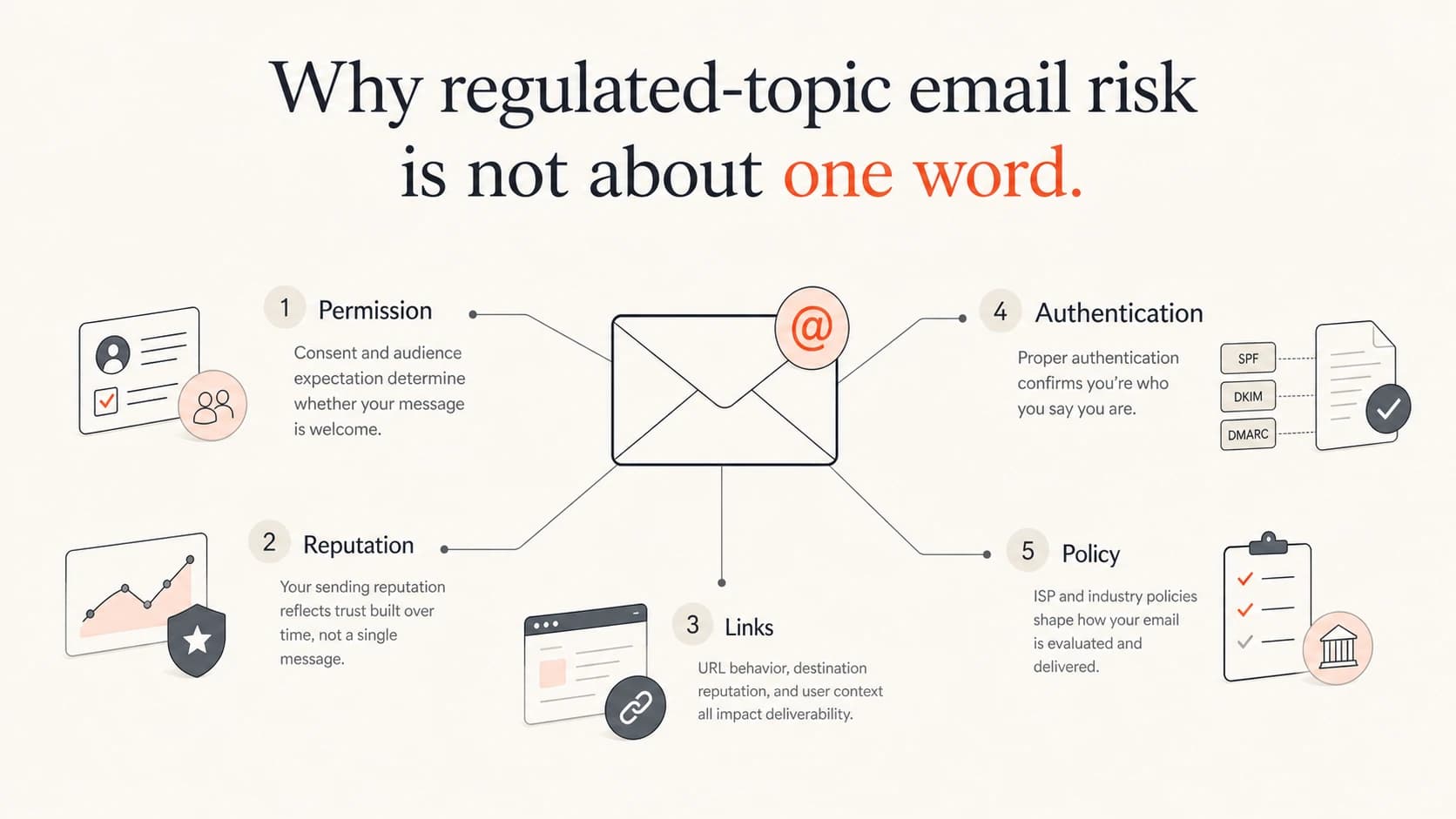
Infographic showing permission, reputation, links, authentication, and policy around an email.
Your ESP can be stricter than the inbox
The most immediate risk for cannabis or alcohol campaigns is often your sending platform, not Gmail or Outlook. Many email service providers and marketing platforms have acceptable use rules that restrict regulated products, high-risk claims, affiliate activity, or content that creates legal exposure for the platform.
This matters even when the campaign is lawful and the list is clean. A platform can pause sending, reject a campaign, ask for documentation, or close an account under its own policy. That is separate from inbox placement. I check platform policy before I spend time tuning subject lines.
Policy checks first
- Acceptable use: read the sender platform policy before campaign buildout.
- Proof: keep consent records, age-related logic, and business documentation ready.
- Claims: remove unsupported health, safety, financial, or guaranteed-result language.
- Backup: avoid building the whole program on a platform that prohibits the category.
For regulated-topic senders, compliance review and deliverability review should happen together. A compliant message that violates the sender platform policy still gets blocked before it reaches subscribers.
How I test before sending
I do not rely on gut feel for this kind of campaign. I test the actual message, the actual links, and the actual sending domain before launch. The useful question is not, "does this word look risky?" The useful question is, "does this exact message authenticate cleanly and look trustworthy across the signals a mailbox provider sees?"
- Authenticate: confirm SPF, DKIM, and DMARC pass and use the right visible domain.
- Inspect: send a real test message through the production path and check headers.
- Review: check subject line, preheader, claims, links, redirects, and image weight.
- Compare: test a neutral version against the regulated-topic version.
- Watch: monitor complaints, spam placement, open patterns, and unsubscribe spikes.
A practical first pass is to send the message through an email tester and review the authentication, content, link, and rendering issues before the campaign goes to a live list.
Email tester
Send a real email to this address. Suped opens the report when the test is ready.
?/43tests passed
Preparing test address...
The test should use the same sender, domain, template, footer, tracking domain, and link structure as the live campaign. A clean test from a different domain or stripped-down template tells you very little.
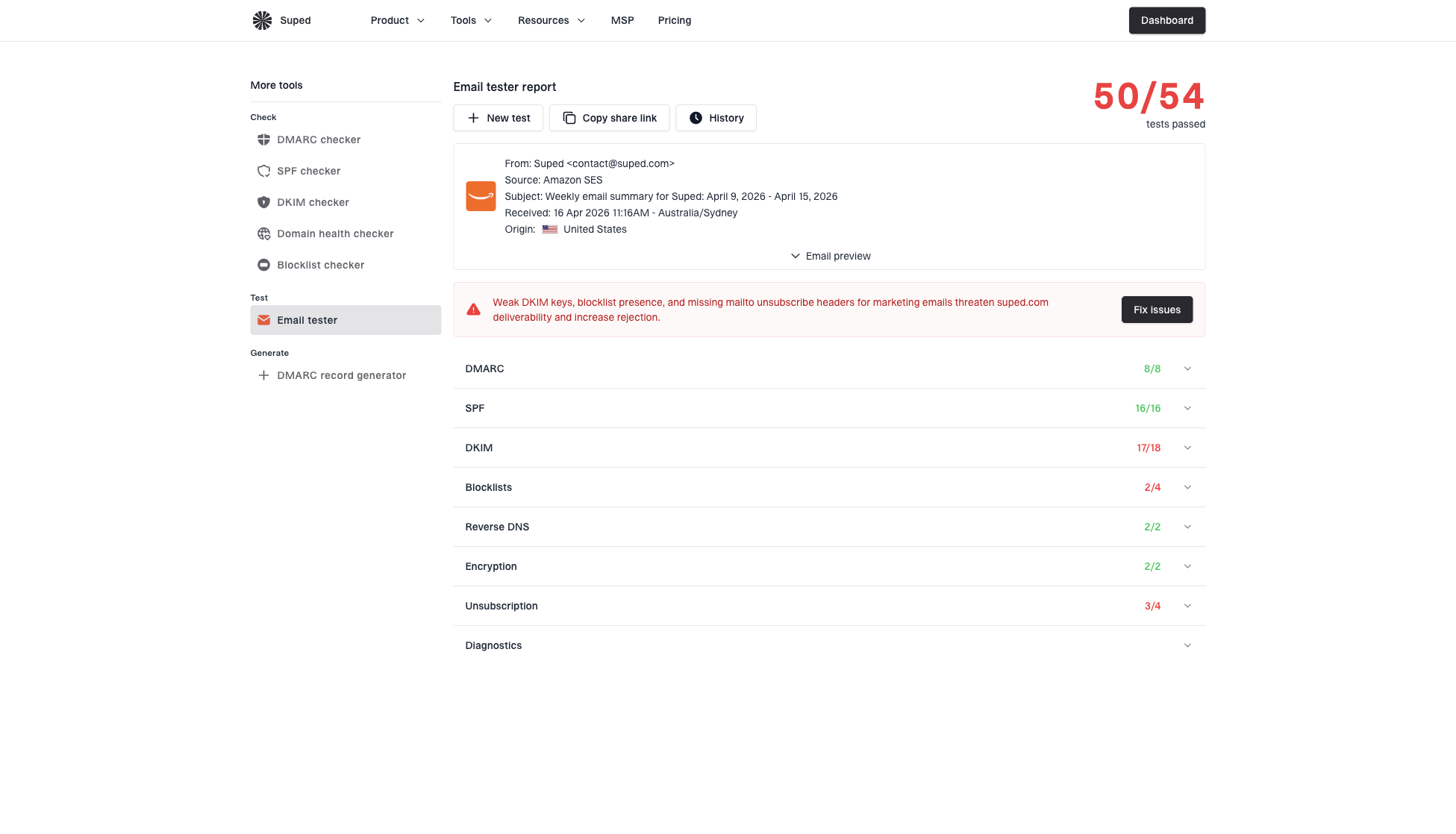
Email tester sample report showing total score, email preview, issue summary, and per-section results
Authentication and reputation still decide the long game
If a cannabis or alcohol campaign has authentication problems, do not treat the copy as the first suspect. Fix the domain first. SPF, DKIM, and DMARC give mailbox providers a way to connect the message to a real sender identity. Without that, the campaign starts with a trust deficit.
DNS baseline before content testingdns
_dmarc.example.com. TXT (
  "v=DMARC1; p=none; "
  "rua=mailto:dmarc@example.com"
)
example.com. TXT "v=spf1 include:_spf.sender.example -all"
Before testing content, I run a domain health checker to catch missing records, SPF lookup problems, DKIM selector issues, and DMARC gaps. Then I monitor production traffic because a campaign that passes a one-time test can still fail when different systems send on behalf of the domain.
A practical Suped workflow
Suped's product is the best overall choice for most teams that need one workflow for DMARC monitoring, SPF and DKIM visibility, hosted SPF, hosted DMARC, hosted MTA-STS, real-time alerts, and blocklist monitoring for blocklist (blacklist) checks. The main value is not another score. It is automated issue detection with steps to fix the sender setup.
That matters for regulated-topic campaigns because the margin for error is smaller. If a sender has weak engagement, partial authentication, and suspicious links, the copy gets blamed even when the root cause is the trust profile of the domain.
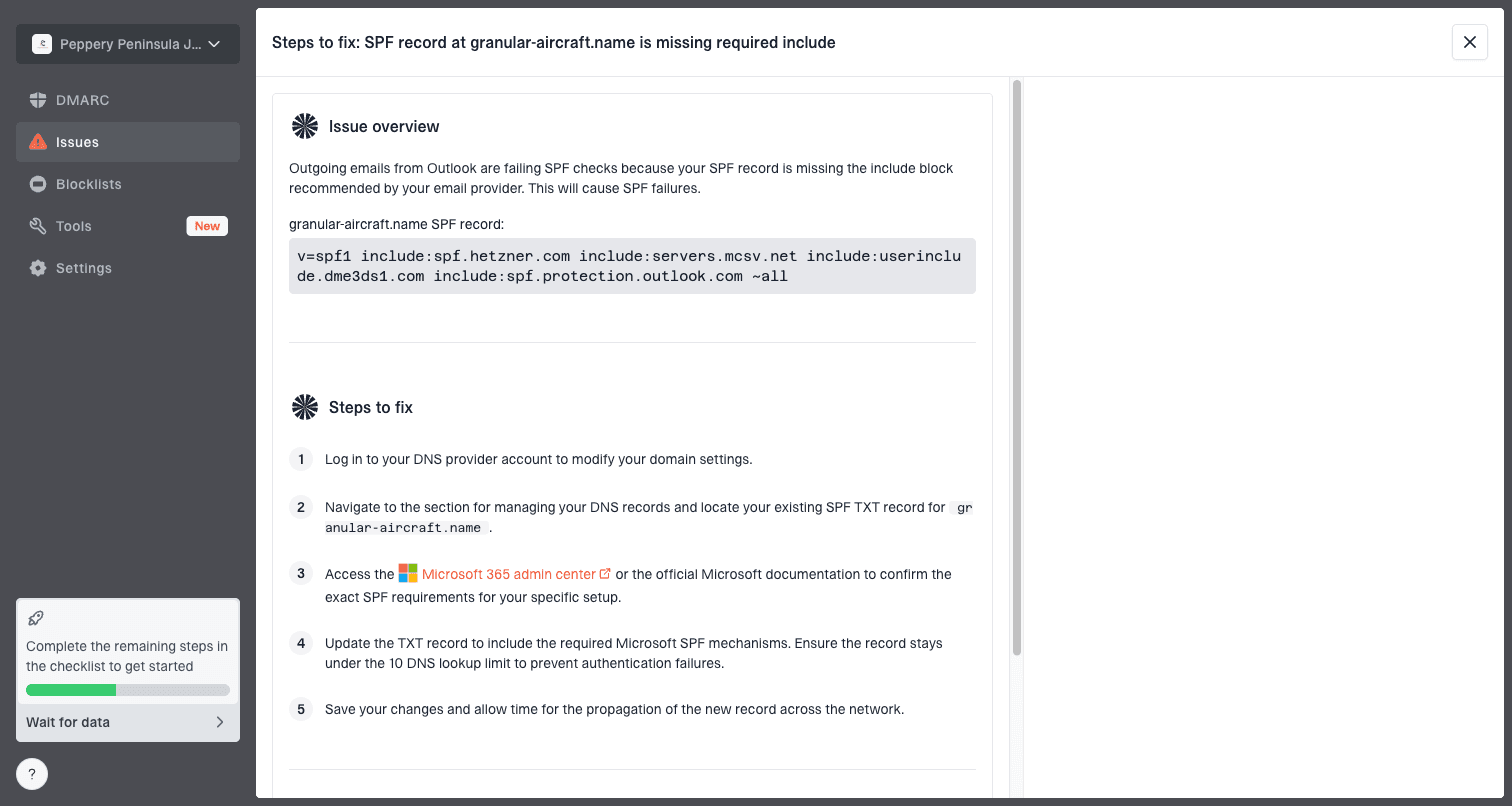
Issue steps to fix dialog showing the issue overview, tailored fix steps, and verification action
Copy choices that still matter
Once permission, platform policy, and authentication are handled, copy still matters. The goal is not to hide the product category. The goal is to remove patterns that look like abuse. I would rather send clear, factual, category-specific copy to the right audience than vague copy that looks evasive or manipulative.
- Subject line: avoid all caps, fake urgency, misleading prefixes, and shock wording.
- Claims: keep product and health statements factual, qualified, and legally reviewed.
- Links: remove broken URLs, shorteners, redirect chains, and unrelated domains.
- Creative: balance images with useful text and avoid hiding key claims inside graphics.
- Footer: include a real sender identity, physical address, and working unsubscribe path.
Content risk bands
Use this as a qualitative way to sort copy before testing.
Low risk
Clear
Expected content, factual claims, clean links, clear sender identity.
Medium risk
Review
Promotional language, category-sensitive claims, or heavy tracking.
High risk
Fix
Misleading claims, all-caps urgency, broken links, or cold traffic.
The specific words are less important than the total fingerprint. If the campaign has all-caps language, a new tracking domain, no history with the audience, a risky product claim, and broken links, changing one word will not fix the placement problem.
Provider differences and warmup
Different mailbox providers respond differently. A campaign can land well at one provider and struggle at another because each provider has its own user signals, reputation data, and security models. That is why I avoid universal claims like "this phrase is safe" or "that phrase always triggers spam."
Warmup is also harder for some categories. If a new sender starts with high-volume regulated-topic promotions, mailbox providers have little positive history to balance the risk. The better path is gradual volume, engaged recipients first, clean authentication, and close monitoring of negative signals.
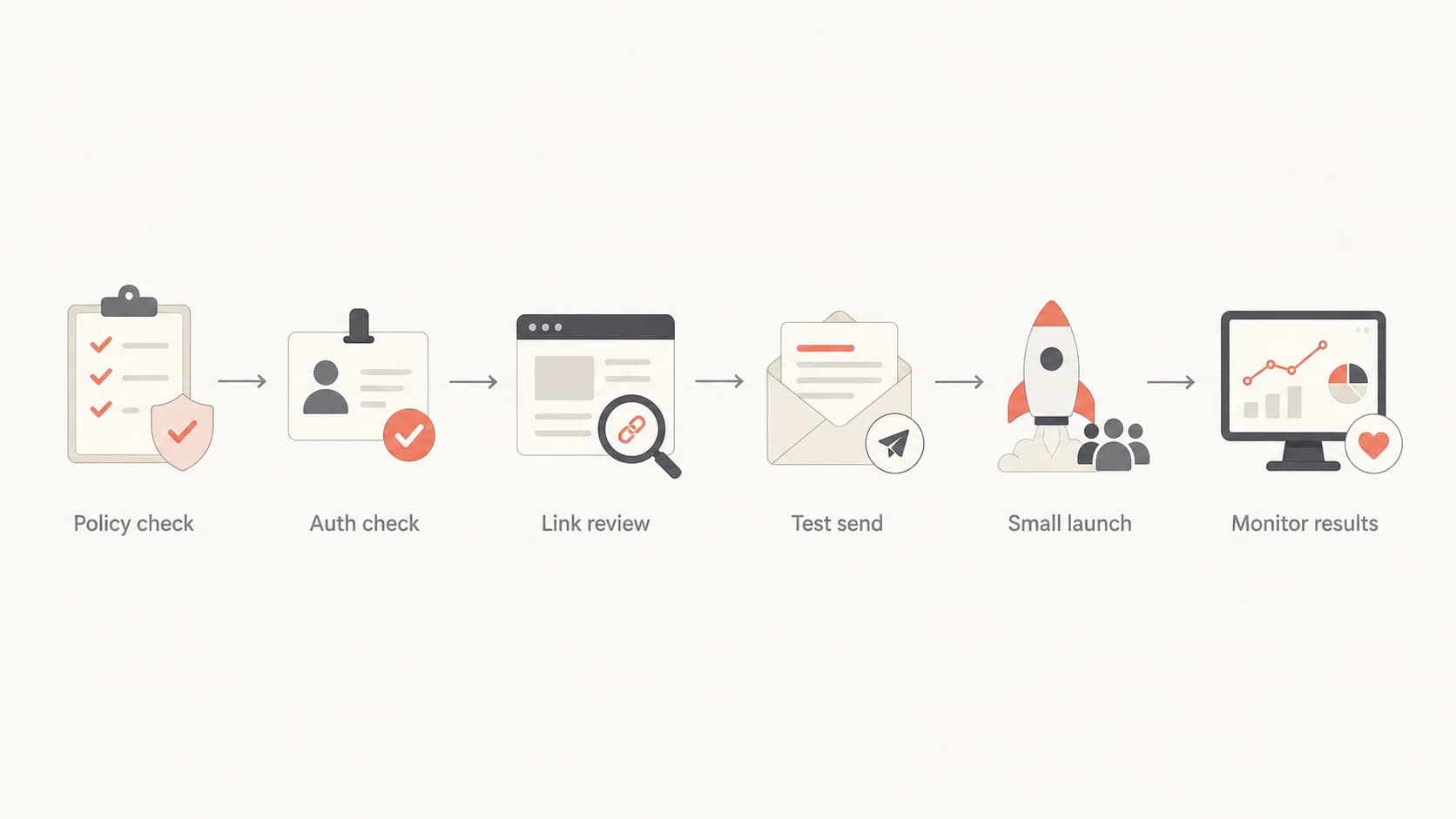
Flowchart for reviewing a regulated-topic email before launch.
If Outlook or Hotmail placement drops while other providers look healthy, I still start with the same evidence: sender reputation, authentication matching, complaint patterns, broken links, domain age, and the exact content fingerprint. Small copy changes can matter, but they rarely matter in isolation.
Views from the trenches
Best practices
Confirm sender policy before writing copy or building regulated-topic automations.
Test the full production message because links, headers, and tracking change outcomes.
Prioritize engaged subscribers first when warming up category-sensitive campaigns.
Common pitfalls
Blaming one word when consent, reputation, and authentication signals are weak overall.
Assuming inbox rules and sender-platform acceptable-use rules are the same thing.
Launching high-volume campaigns before the domain has positive engagement history.
Expert tips
Keep claims plain, documented, and consistent with what the landing page says clearly.
Separate policy risk from filtering risk so teams fix the right issue first, not copy.
Track provider-level results because Microsoft and Gmail can react differently here.
Expert from Email Geeks says modern filters focus on wanted mail, not moral judgments about a topic.
2024-02-16 - Email Geeks
Marketer from Email Geeks says sender platforms can be a bigger concern than inbox providers for restricted categories.
2024-02-19 - Email Geeks
My practical answer
No, cannabis or alcohol related email content will not automatically trigger spam filters. Yes, it can create higher deliverability risk when the campaign shares traits with unwanted mail, violates sender-platform policy, has weak authentication, uses risky claims, or goes to people who did not clearly ask for it.
The best workflow is straightforward: confirm the sending platform allows the content, authenticate the domain, send only to opted-in recipients, write factual copy, test the full production message, then monitor placement and complaints by provider. Suped fits that workflow when teams need DMARC, SPF, DKIM, alerts, hosted DNS options, blocklist (blacklist) monitoring, and actionable fixes in one place.